As always, I also keep myself acquainted with the affairs of the world. So, here are a few notable news & links that I came across this week (in no particular order):
Between Friends: Saturday, April 2, 2016
Rhyme with Orange: Monday, April 4, 2016
Ben: Saturday, April 16, 2016
Dilbert: Sunday, April 17, 2016
[ Traduire ]
WARNING: May contains trace of spoilers! People allergic to the discussion of any plot’s elements before seeing a movie are strongly advised to take the necessary precautions for their safety and should avoid reading further.
This movie is very Japanese: it is beautiful and slow paced. It’s a rather complex story and the festival’s program did a very good job at summarizing it, so I won’t say more about it. It’s set around a rural ritual where one danse to please the gods in order to get a good harvest, but it’s a story about grief, about caring for elderly parents, and a little about domestic violence. It poses a very fundamental question about modern life in Japan: is it better to preserve the tradition as it always was or should we adapt it to modern life and therefore preserve the tradition spirit rather than its strict form?
Exceptionally, this movie was subtitled in french (which is rather rare at the MWFF as it is done mostly for the movies in competition) but, unfortunately, this time the subtitling was full of mistakes. Bad translation and spelling mistakes can be quite distracting from the movie itself. The translation was probably done hastily to present the movie at the festival.
All in all, it remains a beautiful movie (Japan’s countryside is always pleasant to look at) about the trials of life.
Film screened at the Montreal World Film Festival on August 29th, 2015 (Cinema Quartier Latin 9, 15h00 – the theatre was a little less than a quarter full) as part of the “First Film World Competition” segment. The production team organizer was present to introduce the movie.
For more information you can visit the following websites:
WARNING: May contains trace of spoilers! People allergic to the discussion of any plot’s elements before seeing a movie are strongly advised to take the necessary precautions for their safety and should avoid reading further.
This screening was plagued from the start by numerous technical problems: the show started ten minutes late, there was microphone problems for the presentation, not long after the beginning the movie lost its sound, then there was sound but no picture, repeatedly. After forty-five minutes of agony, the screening was definitely stopped. I had to finish watching this movie in the press screening room later. In the end, this movie was a great disappointment.
Kei is a female ninja sent to the Koga clan as double agent. She comes back with a list of traitors inside the Iga clan. After bringing the list she go to see Tao, her friend. A battle ensue and Tao is hit on the head, loosing his memory. Now, Kei is dead, and he is not sure who the enemy is anymore. Maybe he is one of the traitor? Or is he one of the heroes? He will have to slowly figure out what happened.
This is clearly a low budget movie (they use lots of natural set like cave, temple, forest) that makes a terrible ninja movie with lots of bad fighting stunt. The costumes of not historically accurate (lots of leather and the female ninja wears high heel boots!) and the blood looks horribly fake. And there’s this very annoying special effects that marks the beginning and end of all flashbacks. The end credits are nice, though.
The idea is interesting but the execution is rather clumsy. The movie repeats the same battle scene again and again, each time with a different point of view, in order to show Tao’s conflicting memories, his current understanding of the situation or the reversal of his hypothesis. Did I mention the annoying flashbacks? The final battle is quite ridiculous. It’s an entertaining movie, but nothing more.
It is a kind of movie that would have had more appeal with the Fantasia audience, which is younger and specifically seek this kind of not-so-serious action movie. I guess that adding this title to the programming was an attempt from the MWFF to reach out to this kind of audience—without much success.
Film screened at the Montreal World Film Festival on August 28th, 2015 (Cinema Quartier Latin 12, 16h00 – the theatre was a little more than a quarter full) as part of the “Focus on World Cinema” segment. The screening was interrupted due to technical problems.
« Stupeur et tremblements pourrait donner l’impression qu’au Japon, à l’âge adulte, j’ai seulement été la plus désastreuse des employés. Ni d’Ève ni d’Adam révélera qu’à la même époque et dans le même lieu, j’ai aussi été la fiancée d’un Tokyoïte très singulier. »
-Amélie Nothomb.
Ni d’Eve ni d’Adam, par Amélie Nothomb. Paris, Albin Michel, 2007. 252 p. 13.0 x 20.0 cm, 18.20 € / $11.95 Cnd. ISBN 9782226179647.
Tokyo Fiancée nous offre une intéressante réflexion sur la diversité culturelle, l’étrangeté de l’autre, et particulièrement sur la difficulté des couples mixtes à concilier cette différence qui les sépare.
Si le film en lui-même est assez bon, il est aussi une excellente adaptation du roman de Amélie Nothomb. Il y a bien sûr de nombreuses différences entre les deux (quelques scènes manquantes dans le film, la motivation des personnages expliquée plus en profondeur dans le roman) mais dans l’ensemble tout l’esprit du livre est présent dans le film. C’est non seulement agréable et divertissant à regarder mais aussi très intéressant.
Pour plus d’information vous pouvez consulter les sites suivants:
Cette histoire de couple, que ce soit dans le film ou le livre, est particulèrement intéressante lorsqu’on la remet dans le contexte de l’oeuvre (et de la vie) de l’auteur. Elle fait non seulement partie des titres de Nothomb qui sont en partie autobiographiques (mais ne le sont-ils pas tous un peu?) mais est également l’un des éléments de sa “trilogie japonaise”. Stupeur et tremblement raconte le retour de l’auteur au japon, où elle avait passé son enfance, mais traite surtout de ses mésaventures au sein d’une corporation japonaise et comment l’esprit collectif japonais du jeune travailleur y est façonné par des règles strictes et par l’humiliation afin de le conformer au modèle uniforme et docile auquel s’attend la société japonaise — ce qui est toujours pire dans le cas d’une femme. Dans Nostalgie Heureuse, l’auteur raconte son second retour au Japon dans le cadre d’un reportage tourné pour la télévision française. Ni d’Eve ni d’Adam lève le voile sur la partie de l’histoire à laquelle elle avait mainte fois fait allusion sans jamais donner de détails: la relation amoureuse qu’elle a entretenu au cours de son premier retour avec un jeune japonais.
Ayant grandit au Japon, elle s’était toujours considérée comme japonaise mais son expérience durant ce premier retour lui fera réaliser que la nature nippone est beaucoup plus complexe et profonde qu’elle ne se l’imaginait…
Le livre, quant à lui, offre une narration très fluide, parsemé de l’humour sarcastique et un peu déjanté si particulier à Nothomb. C’est une très bonne lecture (comme la plupart des Nothomb).
Pour plus d’information vous pouvez consulter les sites suivants:
[ Translate ]
Avec une telle innovation qui vise à encourager la relève cinématographique, le festival espère se repositionner comme un centre important du cinéma mondial.
As usual, we will concentrate our interest on the Japanese program that includes 4 anime (in total you can also find 33 other animated features — 29 shorts and 8 movies — from various countries). Besides Momotaro, Sacred Sailors, which is probably one of the first anime ever produced in Japan, there’s nothing out of the ordinary among those titles — although we’ve noticed that there’s lots of manga adaptations. Here’s a list of all the Japanese titles (with links to full description):
Bakuman : 2015 / 120 mins / Dir.: Hitoshi Ohne. Adaptation of the manga written by Tsugumi Ohba and illustrated by Takeshi Obata (Death Note) [AsianWiki, Eigapedia, IMdB]
Chihayafuru / Chihayafuru Kami no KuPart 1 & Part 2 : 2015-16 / 111 mins &112 mins / Dir.: Nori Koizumi. Adaptation of Yuki Suetsugu’s acclaimed manga series. [AsianWiki, Trailers Part 1 & Part 2, Wikipedia]
A Jirô Taniguchi’s one shot published in issue #8 & #9 of Big Comic (april 2016). Titled Izuko ni ka, document.write(“”); it is set in Tokyo during the Meiji era [Animeland, in french]
Crackle has announced that it has acquired streaming rights to Harmony Gold’s Robotech 85-episode television series and the Robotech: The Shadow Chronicles feature film. It will be available from May 15. Crackle has launched an anime channel that play like linear television, but content is also available on demand. Sony, Crackle parent company, also announced last year that it was planning a live-action Robotech film. [ANN]
TMS announced a new television anime production titled Trickster: Edogawa Rampo ‘Sh?nen Tantei-dan’ Yori (Trickster: From Rampo Edogawa’s “The Boy Detectives Club”). It will air in October on Tokyo MX and Yomiuri TV. It is based on Sh?nen Tantei-dan (The Boy Detectives Club), a 1937 series of novels by renowned Japanese mystery novelist Edogawa Rampo. A manga adaptation will also begin in the July issue of Kodansha’s Magazine Special [ANN]
The trend continues: after the announcement of live-action adaptation from anime like Ghost in the Shell, Battle Angel Alita, Yowamushi Pedal and Fullmetal Alchemist, now they are talking about adaptations for Gintama, Peach Girl, and even an americanized version of Death Note ! [Animeland, ICv2]
“Dans une petite boutique népalaise, Fukamachi tombe sur un appareil photo qui pourrait bien être celui de George Mallory, le célèbre alpiniste qui fut le premier à essayer de vaincre l’Everest. Mallory disparût avec Andrew Irvine, lors de cette ascension en 1924, sans que l’on puisse savoir s’ils sont parvenus au sommet. Et si c’était seulement lors du chemin du retour qu’ils avaient eu cet accident fatal? Cela changerait l’histoire de l’alpinisme! C’est sur cette passionnante question que s’ouvre le chemin initiatique de Fukamachi qui sera amené à faire la rencontre de figures hautes en couleurs.” [résumé sur Manga-News]
Toujours selon Animeland, un court manga inspiré du film et dessiné par Tetsuya Saruwatari devrait paraitre dans le numéro de mars 2016 (parution le 24 février) de Grand Jump Premium. Décidément, le roman de Baku Yumemakura est très populaire.
En effet, en janvier dernier Manga-News nous apprenait que la superbe adaptation manga de ce même roman par Jir? Taniguchi serait elle-même adaptée en un long métrage d’animation 3D! Le film serait produit par le studio Julianne Films (France) en association avec Walking The Dog (Belgique) et Mélusine Productions (Luxembourg) et est réalisé par Jean-Christophe Roger et Eric Valli. Il n’y a pas encore de date de sortie d’annoncée. [MAJ: quelques détails de plus sur Cineuropa]
Contrairement à mon habitude je n’y suis pas allé vendredi (n’ayant pas reçu la passe pour la journée des professionnels) mais plutôt samedi. Je me suis dit que tant qu’à payer autant y aller une journée pour voir un maximum de monde. Maximum de monde il y avait. Un peu trop à mon goût (My kingdom for a two-handed sword!)
J’ai donc pu rencontrer Claude R. Blouin, document.write(“”); un spécialiste du cinéma nippon que je croise annuellement au Festival des Films du Monde. Je l’ai manqué à sa séance de signature aux Presses de l’Université Laval (où il a publié un fort intéressant essai sur le cinéma japonais) mais j’ai tout de même réussi à l’attraper au kiosque des Éditions Mots en toile où il signait Les cueilleuses de bleuets, un recueil de nouvelles publié l’an dernier et inspiré de toiles de maîtres ou d’images.
J’ai aussi pu passé par le kiosque des Éditions Alire, pour le cinq à sept des revues, et saluer et faire la jasette à plusieurs de mes connaissances qui y sont publiés.
Il y a vraiment beaucoup de choses à voir au salon du livre. Trop. Nos sens sont saturés de toute part et c’en est vraiment accablant. Ça ne s’améliore pas d’année en année.
Contrairement à mon habitude de ne JAMAIS acheter au salon du livre, j’ai succombé à la tentation une fois, puis, étant sur la pente glissante du désir livresque, une autre et un autre. Ça ma coûté cher mais là j’ai de la lecture intéressante pour un bout. Il reste à trouver le temps de les lire et de les commenter. Voici donc mes heureux achats (après le saut de page):
Le cinéma japonais et la condition humaine
“Que garder du bushido dans la société nouvelle ? Comment honorer les doctrines équilibristes du shintoïsme à l’ère du capitalisme accéléré ? Que faire des conceptions étendues de la famille à l’heure où celle-ci doit se recentrer en noyau nucléaire ? La question de la transmission traverse tout le cinéma japonais.”
“Nous aider à saisir le rythme poétique japonais, les enjeux politiques et révolutionnaires sous-jacents à ce cinéma surcodé, dont les clés sont moins l’affaire d’une élite bourgeoise que celle d’une culture radicalement transformée, c’est ce à quoi Claude Blouin s’est consacré.”
Cet essai m’apparait passionnant et j’ai bien hâte de le lire. En attendant, vous pouvez consulter un extrait des vingt premières pages sur le site de l’éditeur.
“Meet Kitaro. He’s just like any other boy, except for a few small differences: he only has one eye, his hair is an antenna that senses paranormal activity, his geta sandals are jet-powered, and he can blend into his surroundings like a chameleon. Oh, and he’s a three-hundred-and-fifty-year-old yokai (spirit monster). With all the offbeat humour of an Addams Family story, Kitaro is a lighthearted romp in which the bad guys always get what’s coming to them.”
“Kitaro is bestselling manga-ka Shigeru Mizuki’s most famous creation. The Kitaro series was inspired by a kamishibai, or storycard theater, entitled Kitaro of the Graveyard. Mizuki began work on his interpretation of Kitaro in 1959. Originally the series was intended for boys, but once it was picked up by the influential Shonen magazine it quickly became a cultural landmark for young and old alike. Kitaro inspired half a dozen TV shows, plus numerous video games and films, and his cultural importance cannot be overstated. Presented to North American audiences for the first time in this lavish format, Mizuki’s photo-realist landscapes and cartoony characters blend the eerie with the comic.” (Text from the publisher’s web site)
Despite his cartoony style, Shigeru Mizuki is one of the great master’s of Japanese manga. This is a must-read classic that I’ve always wanted to have. It’s just too bad that Drawn & Quarterly is too cheap to provide review copies (unlike other north american publishers I’ve been dealing with). And just after the book fair, I see that the book is on sale $10 off on their website. WTF!
Kitaro, by Shigeru Mizuki. Montreal, Drawn & Quarterly, july 2013. B&W paperback, 6.5 X 8.7, 432 pgs., $24.95 US/Can. ISBN: 9781770461109. There an 8-page extract available.
Showa 1944–1953: A History of Japan
“Showa 1944–1953: A History of Japan continues award-winning author Shigeru Mizuki’s autobiographical and historical account of the Showa period in Japan. This volume recounts the events of the final years of the Pacific War, and the consequences of the war’s devastation for Mizuki and the Japanese populace at large.”
“After the surprise attack at Pearl Harbor, Japan and the United States are officially at war. The two rival navies engage in a deadly game of feint and thrust, waging a series of microwars across the tiny Pacific islands. From Guadalcanal to Okinawa, Japan slowly loses ground. Finally, the United States unleashes the deathblow with a new and terrible weapon—the atomic bomb. The fallout from the bombs is beyond imagining.”
“On another front, Showa 1944–1953 traces Mizuki’s own life story across history’s sweeping changes during this period, charting the impact of the war’s end on his life choices. After losing his arm during the brutal fighting, Mizuki struggles to decide where to go: whether to remain on the island as an honored friend of the local Tolai people or return to the rubble of Japan and take up his dream of becoming a cartoonist. Showa 1944–1953 is a searing condemnation of the personal toll of war from one of Japan’s most famous cartoonists.” (Text from the publisher’s web site)
I’ve previously commented the first volume of this manga (I borrowed it at the library). I’ll probably also borrow volume 2 in order to comment on it and then I’ll read and comment this volume 3 of the series. This period of Japanese history was interesting me more so I’ve decided to purchase that particular volume (I’ll probably also purchase the volume 4, if I can). I’ve also commented on his graphical biography of Hitler. His work is superb (despite the cartoony style) and is an essential part of manga’s history and as such it is an absolute must-read. I can’t wait! (Darn! This one is also discounted on the web site! Damn you, D&Q!).
Il laisse dans le deuil son épouse Laure Gauthier, ses enfants Luce, Francine et Claude J. (Miyako Matsuda), les familles de ses frères et soeurs (Alice [feu Jean-Vianney Yale], Pauline [feu André Langlois], Soeur Madeleine [Congrégation Notre-Dame], Pierre [Micheline], Cécile [Gérard Saint-Jean] et Gilles [Marguerite] lui survivent), ainsi que de nombreux parents et amis.
Au lieu d’envoyer des fleurs, si vous désirez faire un geste à la mémoire de Claude E., nous vous suggérons de faire un don à la Société de l’Alzheimer de Montréal.
J’ai déjà parlé de mon père à deux reprise sur ce blogue (lors d’un commentaire sur le film YUL 871 et en introduisant les portraits d’artisans du cinéma de l’ONF). Aussi, je mettrai prochainement en ligne un album photo commémoratif (probablement sur ma page Flickr ou Vimeo). Pour le moment, je lui rends hommage en reprenant ici la video de son “portrait d’artisan du cinéma” que j’ai mis sur Vimeo l’été dernier:
An (?? / lit. “Sweet Red Bean Paste”): Japan/France/Germany, 2015, 113 min; Dir.: Naomi Kawase; Cast: Kirin Kiki, Masatoshi Nagase, Kyara Uchida.
“At seventy, Tokue is sure of herself, thanks to her secret recipe for exceptional dough for dorayaki, a traditional, irresistibly delicious Japanese sweet cake filled with red bean paste. In her mind, there is no doubt: Sentaro, the lonely dorayaki vendor who doesn’t like sugar, must hire her. The idea turns out to be good, because once Tokue gets involved, the little shop’s sales take off. While the old lady teaches her boss to “listen to the beans,” she can’t hide her secret for very long.” (from the Festival’s website)
Screening as a special presentation: Sat 10/10 15:30 at Auditorium Alumni H-110 (Concordia); Sun 10/18 21:00 at Cineplex Odeon Quartier Salle 10.
Belladonna of Sadness (????????? / Kanashimi no Beradonna): Japan, 1973, 86 min; Dir.: Eiichi Yamamoto; Scr.: Eiichi Yamamoto & Yoshiyuki Fukuda (based on a book by Jules Michelet); Mus.: Masahiko Satô; Animation: Gisaburo Sugii; Prod.: Osamu Tezuka; Cast: Katsuyuki Itô, Aiko Nagayama, Shigako Shimegi, Masaya Takahashi, Netsuke Yashiro, Masakane Yonekura.
“Never before officially released in North America, this one-of-a-kind cult classic can now be enjoyed in all of its splendour through a new restoration based on original negatives. [P]roduced by the legendary Osamu Tezuka’s studio Mushi Production (…). Based on a book by Jules Michelet (Satanism and Witchcraft, 1862), it tells the tragic feminist tale of a 14th-century peasant woman driven by religious oppression to give herself body and soul to witchcraft and the sulphurous charms of the devil.” (from the Festival’s website)
Screening as part of the “Temps 0” segment: Mon 10/10 19:00 at Salle J.A. De Sève (Concordia); Sat 10/18 19:00 at Cinéma du Parc 2.
The birth of saké: USA/Japan, 2015, 94 min; Dir./Scr./Phot.: Erik Shirai; Ed.: Takeshi Fukunaga, Frederick Shanahan; Prod.: Makoto Sasa.
“In northern Japan, the small Tedorigawa brewery has been making its saké using the same artisanal methods for more than a century. From October to April, the workers, all men, live together at the brewery and work non-stop, even when mourning. Cooking the rice, stirring it by hand, overseeing its fermentation… it is a sacred ritual, conducted silently in a shroud of steam. (…) There is a good reason saké is not “manufactured” but rather “born”: it is a beverage, but it is also history and culture.” (from the Festival’s website)
Screening as part of the “Panorama” segment (documentary): Thu 10/15 19:00 at Cinéma du Parc 1; Sat 10/17 19:00 at Centre PHI – Espace B.
“The film is loosely based on the famous manga Ochibi-san, by Moyoco Anno, about the day-to-day life of Ochibi as she experiences the 4 seasons of Japan.” (from the Festival’s website)
Screening as part of the “P’tits Loups” segment: Sat 10/10 10:00 at Agora Hydro-Québec du Coeur des sciences.
Journey to the shore (???? / Kishibe no Tabi): Japan/France, 2015, 127 min; Dir.: Kiroshi Kurosawa; Scr.: Takashi Ujita, Kiyoshi Kuroswa (based on a novel by Kazumi Yumoto); Cast: Eri Fukatsu, Tadanobu Asano, Yu Aoi, Akira Emoto.
“Yusuke drowned in the ocean three years ago. But one day, he reappears in the middle of Japan, more specifically in the life of his strangely unsurprised wife, Mizuki, a piano teacher, who he invites on a journey through villages and rice paddies. On their journey, there is no confrontation; there are, rather, opportunities to rebuild their bond and meet others who, like him, are still wandering. What they will find at the end is, perhaps, eternal peace.” (from the Festival’s website)
Screening as a special presentation: Thu 10/08 14:00 at Cinéma du Parc 1; Sat 10/17 16:30 at Auditorium Alumni H-110 (Concordia).
“Once there were twenty or more. Now, in the Japanese coastal village of Ushimado, there are only six. The gradual disappearance of small, family-run oyster factories may be a sign of the times, but it is more than a symbolic change: it also has very real consequences for fishermen, manual labourers and local residents, who are not happy to see workers being brought in from outside.” (from the Festival’s website)
Screening as part of the “Panorama” segment (documentary): Sat 10/10 18:30 at Cinéma du Parc 2; Sun 10/11 13:00 at Cinéma du Parc 2.
The Taste of Tea (??? / Cha no Aji): Japan, 2004, 120 min; Dir./Scr.: Ishii Katsuhito; Phot.: Kosuke Matushima; Ed.: Katsuhito Ishii; Mus.: Little Tempo; Cast: Tadanobu Asano, Takahiro Sato, Maya Banno, Satomi Tezuka, Tomokazu Miura, Tatsuya Gashuin, Anna Tsuchiya, Rinko Kikuchi.
“A spell of time in the life of a family living in rural Tochigi prefecture, north of Tokyo. Though her husband is busy working at an office, Yoshiko is not an ordinary housewife, instead working on an animated film project at home. Uncle Ayano has recently arrived, looking to get his head together after living in Tokyo for several years. Meanwhile, Yoshiko’s daughter Sachiko is mainly concerned with why she seems to be followed around everywhere by a giant version of herself.” (from the Festival’s website)
Screening as special presentation commented by Jean-Marc Vallée: Fri 10/09 19:00 at Cinéma du Parc 1.
Sumo Road: The Musical (????????? / Dosukoi Musical): Japan, 2015, 25 min; Dir./Scr.: Ken Oshiai; Phot.: Chris Freilich; Ed.: Chieko Suzaki; Mus.: Nobuko Toda; Cast: Tetsu Watanabe, Ryusuke Komakine, Lin Yu Chun, Gitarô Ikeda.
“An over- weight exchange student with no friends decides to join the sumo team at a Japanese university.But to ensure his spot, he must stand up to the team leader and face him in an ultimate sumo match. Can he embrace the spirit of sumo or will he be cast out and friendless once again?” (from the Festival’s website)
Screening as part of the “Compétition International” segment: Mon 10/12 17:00 at Pavillon Judith-Jasmin annexe (Salle Jean-Claude Lauzon); Wed 10/14 13:00 at Pavillon Judith-Jasmin annexe (Salle Jean-Claude Lauzon).
“Yoko (Megumi Kagurazaka) is a robot employed by a courier company. In her interstellar ship, shaped like a little Japanese house, she scoots back and forth across the galaxy, delivering parcels and news to people everywhere. Yoko is terribly bored, and eventually can no longer resist looking inside the parcels to learn more about the very strange phenomenon that is human nature.” (from the Festival’s website)
Screening as part of the “Temps 0” segment: Sat 10/10 17:00 at Cineplex Odeon Quartier 10; Sun 10/11 21:00 at Cinéma du Parc 1.
“He’s a benevolent vampire yakuza feared by criminals and adored by regular folk. One day two men show up: a Django-like goth preacher and a geeky fighter (none other than Yayan Ruhian from Raid 2). They belong to a rival cartel that wants him dead. But just before he dies, the yakuza vampire bites his faithful right-hand man, young Kageyama. What happens next? The apocalypse, obviously!” (from the Festival’s website)
Screening as part of the “Temps 0” segment: Tue 10/13 19:00 at Cineplex Odeon Quartier 10; Wed 10/14 21:00 at Cineplex Odeon Quartier 10.
Actually, document.write(“”); I’ve seen almost all Japanese movies, except Out of my hand (after all it’s not really a Japanese film) and Shinjuku midnight baby (anyway, I’ve heard that it was terrible: too long, with too much gay sex; many girls came for the cute actors but were put off by the graphical guy on guy sex scenes). I’ve seen Master Blaster online (the student short film) and I am planning so see the screener for Hoshiogaoka Wonderland later this week.
Saturday, I’ve seen Neboke, Alone in Fukujima (well, at least half of it), Popura no aki and Decline of an assassin. Four movies in one day to finish my festival in a dash (I had to pack as many movies as possible since my employer refused to give me the Sunday off). It was quite tiring.
There was the same glitch that I’ve often seen this year during Neboke: the picture froze and came back without sound, so they had to change the screening copy (although I doubt it was a problem related to the copy; it was probably due to equipment issues). We started the movie with french subtitles and finished it with english subtitles! I also missed nearly half of Alone in Fukujima because of a scheduling conflict and the fact that Neboke finished later because of the glitch and its Q&A session. Also, my wife wanted to see an Italian movie in competition, but it had been rescheduled and she screened a swedish movie instead. Despite all those little annoyances, it was a good day. I am also glad that, despite their threats, there was no disturbances caused by disgruntled employees during the week-end. It’s good because that’s the moment of week (particularly in the evening) when the festival is the busiest.
Now that the festival is finished (at least for me), I’ll have more time to write and put my comments online, as well as edit the Q&A videos (I have already added the video for At Home Q&A both on my comment page and on Vimeo). But, first, I have to rest a little (and catch up on some of the chores at home). In the meantime, you can check my entry “Montreal World Film Festival 2015” for all the details on this year’s Japanese movies.
I’ve noticed another poster in the Quartier Latin’s hall announcing a sequel for the movie Belle and Sebastien due for February 2016 (in Quebec). It’s titled “L’aventure continue” (The adventure continues). [Google, Youtube, Wikipedia]
With such days so busy with work, duties and a full schedule of screenings, I am getting quite tired. Tomorrow will be my heaviest day with four screenings (and probably my last for this year). Hopefully I’ll be able to rest (and write) in the following days so I can share with you my comments on all those interesting movies.
Today was excellent. I’ve seen Dear Deer, Summer on the Frontline (which joins the short list of my favourites along with Blowing in the wind of Vietnam) and Gassoh, as well as attending the latter’s press conference.
Press conferences at the MWFF are always somewhat excruciating because every words must be translated both in French (because this is Quebec) and in English (because this is an international film festival after all). It makes a thirty-minute press conference feels very short and only a few questions can be asked by the press and the public to the movie crew. That’s rather annoying but it can’t be helped. I wish the press conference would be longer (since, unlike most big festival, they cannot afford multi-languages simultaneous translation—which would save lots of time).
I’ve filmed most Japanese directors’ introduction to their movies’ screening, with any Q&A sessions that I could attend, as well as today’s press conference. I’ll put them online as soon as I can do a quick edit on each of them in order to keep them as short as possible (which reminds me that I still have press conferences from previous years that I still need to share!).
For a second time there was technical issues during the screening. The picture froze, then fast-forwarded and then came back without sound for five or ten minutes. Then they “rewinded” and restarted where the problem had occured. Luckily, no other issues happened. The director, who was present to introduce his movie and for a Q&A afterward, apologized profusely (it was the japanese thing to do) even if it was not his fault.
Despite that small problem, I enjoyed this short day.
If you want to read some comments about the Japanese movies at the festival (in french) you can check the first part of the article by my esteemed colleague Claude R. Blouin.
It seems that more troubles might be brewing for the festival (as if it needed more) as some employees of the festival, experiencing delays with the well-earned payment of their salary, are threatening to strike from Friday if the situation is not resolved (Le Devoir). I can understand their plight but, on the other hand, I know many film buffs who would do their job for free just for a few tickets and a chance to meet with international moviemakers!
Since I had several hours in-between the two movies I was able to write my comments for all the movies I had seen the previous days. It still need some research and polishing, but I should be able to post them soon. For now I’m really too tired to do anything but sleep.
I wish I could write more extensive comments but unfortunately I am a little too busy. Seeing movie after movie doesn’t leave enough time to do in-depth analysis. And when you sit at night, after having viewed three movies, it difficult to write in details about each of them. That’s why I try to put down on paper my first impression as soon as I leave the theatre. It’s easy to do when there’s a couple of hours in-between movies, but more difficult when you have to rush from one place to another with just minutes before the beginning of the next show (harder still when there’s a Q&A after a screening).
Anyway, my purpose with this blog has always been to simply introduce a work (be it a manga, a book or a movie) with just enough information (and links) to interest the readers and incite them to look further.
Today, I’ve seen Kagura-me, Akai Tama and Blowing in the wind of Vietnam. All ranging from good to excellent. I’ll try to write and post my comments on those movies as soon as possible.
“A father, document.write(“”); a mother, an elder son, a daughter and a younger son. A family of five. To all appearances, a perfectly normal, happy family. However it turns out that none of them have a blood relationship. Each of them has a sad story and separate families of their own. Does being related by blood, make a family? Or if they live together, does it make them a family? When people learn to connect with others, when they are placed in a difficult situation, how do they react for a family? This is a film about people who were hurt by family, but saved by family. ”
The Moriyama family looks like any other ordinary family. However, none of them are related. The father is a thief. He started stealing to support his pregnant wife. She is hit by a car and lose the baby. He gets caught, goes to prison and his wife leaves him. Once out of prison, he continues with a criminal life. One day, during a burglary, he discovers a young boy chained in the bathroom of a house. He decides to save him. Together they settle in a home, acting like father and son. Later, the thief triggers an alarm and, as he might be caught, he is helped by a teenager who has run away from his home. He was verbally abused by his parents who found his indecisiveness and shyness not up to the standard of their rich (but parvenu) status. He joins the father and younger “son” in their home.
The mother was physically abused by her violent husband. One day she is considering killing herself by jumping in front of a train but notices a teenage girl who is about to do the same. Without thinking about her own situation anymore, she prevent the girl from jumping. The girl was sexually abused by her father. They both run away (it is more implied than said or shown) and settle in an apartment together as mother and daughter. One day, the mother meets the father in a pet shop and the father (it’s not shown how or why) invites them to join his little family.
They survive through a life of crime: the father doing burglary, the mother swindling men in mariage schemes, the older son doing forgery in a print shop and the young boy and girl simply going to school. Unfortunately, the mother tries to swindle a bigger swindler and she ends up kidnapped. The family rushes to gather the ransom, but, despite the father’s warning, it leads them to a violent outcome. The father goes to prison again to save his family. In the end, the family will pull through thanks to its strength. Despite not being related, they all had suffered abuse and could better understand and confort each other. Reconstituted family can work and even be stronger than blood ties.
There is a lot of frustration nowadays in Japan which apparently translate into an increase of domestic violence at home. This subject (and its salvation through reconstituted family) is interesting but the storytelling is often way too slow, and also contains gaps or credibility issues. Some scenes are simply not plausible, not because of the actors’ performance, which is quite excellent, but because the situation is being too convenient or at least not explained in a satisfactory manner. However, it is a beautiful story and a good enough movie to be well worth watching.
At home (??????): Japan, 2015, 110 min.; Dir.: Hiroshi Chono; Scr.: Teruo Abe (based on the novel by Takayoshi Honda); Music: Takatsugu Muramatsu; Phot.: Shinya Kimura; Ed.: Osamu Suzuki; Prod. Des.: Shin Nakayama; Cast: Yutaka Takenouchi (Dad/Thief), Yasuko Matsuyuki (Mom/Swindler), Kentaro Sakaguchi (Jun Moriyama), Yuina Kuroshima (Asuka Moriyama), Yuto Ikeda (Takashi Moriyama), Jun Kunimura, Itsuji Itao, Seiji Chihara.
Film screened at the Montreal World Film Festival on August 28th, 2015 (Cinema Quartier Latin 12, 12h00 – with an attendance of 90 people, filling 60% of the theatre) as part of the “Focus on World Cinema” segment. The director was present for a short Q&A at the end.
Unfortunately, my first day at the festival was quite disastrous. The first movie was good. The second movie had so many technical problems (started ten minutes late, microphone problem for the presentation, there was picture without sound, sound without picture, repeatedly) that the screening was interrupted and cancelled a little before the middle of the movie. I had to go to the screening room of the Film Market to see the (disappointing) end. There the copy ran just fine so it’s unlikely that the problem was caused by the dvd encoding (the excuse was that since it’s a foreign movie the encoding could have been messed up, but usually if this is the case it just either work or doesn’t) so the problem must have been with the Quartier Latin’s equipment (they were using VLC on a MacBook and a digital projector). It’s not the first year that this kind of problem occurs.
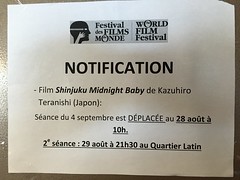
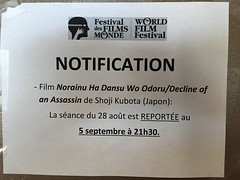
And the third movie… was cancelled due to some rescheduling! That’s quite annoying. I had made myself a (gruelling) schedule where I could see all Japanese movies, but with those changes it will be impossible. And at least one of the movie that I can’t watch is not even available in the Film Market screening room…
Anyway, I’ll try to post soon my comments on the two movies I’ve managed to see today, and you can still check my entry “Montreal World Film Festival 2015” for all the details on this year’s Japanese movies.
I also noticed in the Quartier Latin lobby a poster announcing the movie “Paul à Québec” for September 18th. Great!
Here our interest is mostly with the Japanese movies. At first, with the festival press releases and an article in the august edition of Coco Montreal, we determined that the festival would show at least fourteen Japanese movies. However, with the release of the schedule we astonishingly discovered that a record-breaking number of Japanese movies will be shown this year: seventeen (twenty-one if we count a Liberian movie with a Japanese director, a four-minute short and two documentaries)! See the films index for details. (updated 2015-08-21)
Be careful, the schedule of some movies has changed (updated 2015-08-28).
Coco Montreal have put a more detailed article (this time with english and french translation) on the festival’s Japanese movies in their September issue (available both in the issuu.com flash version and on their Facebook page). [updated 2015-09-01]
You can now read some comments about the Festival’s Japanese movies (in french) in the first part of the article by my esteemed colleague Claude R. Blouin on the blog Shomingeki. [updated 2015-09-03]
You will find, after the jump, a list of all those movies (plus a few useful links — of course, more details and links will be added as the information become available):
World Competition / Film en compétition
Gassoh (??): Japan, 2015, 87 mins; Dir.: Tatsuo Kobayashi; Scr.: Aya Watanabe (based on the manga by Hinako Sugiura); Phot.: Hitoshi Takaya; Music: Asa-Chang; Cast: Yuya Yagira (Kiwamu Akitsu), Koji Seto (Masanosuke Yoshimori), Amane Okayama (Teijiro Fukuhara), Joe Odagiri, Mugi Kadowaki, Minami Sakurai, Kai Inowaki, Yuko Takayama, Reiko Fujiwara, Daisuke Ryu, Rie Minemura, Mantaro Koichi, Lily.
The final resistance to the dismantling of the Togugawa Shogunate at the end of the Edo period and the futile struggles of three young men who participated in the Shougitai resistance.
Schedule: Thu 9/03 9:00 CI; Thu 9/03 21:30 CI.
First Feature Competition / Compétition de premières oeuvres
When their claim to have seen a phantom deer is debunked, three young siblings are denigrated. Now, 25 years later, their father dying, the wounds are still raw.
Sangoroh, a rakugo artist, has a drinking problem and is annoyed by his partner Manami’s pestering him about it. Can he get his life in order before it’s too late.
Tokita would rather be making movies than teaching about them in film school. But it pays the bills and there’s always Yui, the pretty school secretary. Then Ritsuko enters his life…
Schedule: Fri 8/28 10:00 QL10; Sat 8/29 19:00 QL10.
The Next Generation Patlabor — Tokyo War (The Next Generation ????? ? ???? / Patoreiba: Shuto Kessen / Lit. “Patlabor: Decisive battle over the capital”): Japan, 2015, 93 min.; Dir./Scr.: Mamoru Oshii; Phot.: Hiroshi Machida, Tetsuya Kudo; Art Dir.: Anri Jojo; Ed.: Yoshinori Ohta; Music: Kenji Kawai; Labor Design: Hideki Hashimoto, Katsuya Terada; Cast: Toshio Kakei (Keiji Gotoda), Erina Mano (Akira Izumino), Seiji Fukushi (Yuma Shiobara), Rina Ohta (Kasya), Shigeru Chiba (Shigeo Shiba), Kanna Mori (Rei Haihara), Kotaro Yoshida (Onodera), Reiko Takashima (Kei Takahata), Yoshinori Horimoto (Isamu Otawara), Shigekazu Tajiri (Hiromichi Yamazaki), Kohei Shiotsuka (Shinji Mikiya), Yoshikazu Fujiki (Yoshikatsu Buchiyama).
In a world where giant robots are built and used for labour, a special police force of robots is created to handle crimes relating to these machines: the Patrol Labor.
At home (??????): Japan, 2015, 110 min.; Dir.: Hiroshi Chono; Scr.: Teruo Abe (based on the novel by Takayoshi Honda); Music: Takatsugu Muramatsu; Phot.: Shinya Kimura; Ed.: Osamu Suzuki; Prod. Des.: Shin Nakayama; Cast: Yutaka Takenouchi (Thief), Yasuko Matsuyuki (Swindler), Kentaro Sakaguchi (Jun Moriyama), Yuina Kuroshima (Asuka Moriyama), Yuto Ikeda (Takashi Moriyama), Jun Kunimura, Itsuji Itao, Seiji Chihara.
A father, a mother, an elder son, a daughter and a younger son. A family of five. For all appearances, a perfectly normal, happy family. But none of them related.
Blowing in the wind of Vietnam (??????????? / Betonamu No Kaze Ni Fukarete): Japan/Vietnam, 2015, 116 min.; Dir.: Tat Binh & Kazuki Omori; Scr.: Kazuki Omori, Uichiro Kitazaki (based on a novel by Miyuki Komatsu); Phot.: Koichi Saito; Ed.: Naoki Kaneko; Music: Tetsuro Kashibuchi; Cast: Eiji Okuda, Akira Emoto, Kôji Kikkawa, Keiko Matsuzaka, Yôsuke Saitô, Reiko Kusamura, Yûya Takayama, Shigehiro Yamaguchi, Reina Fujie, Yoneko Matsukane, Tan Nhuong, Lan Huong, Tan Hanh.
When Misao returns to Japan from Vietnam for her father’s funeral, she sees that her mother is becoming forgetful, even a bit senile. Can a change of scenery help?
Schedule: Fri 8/28 9:30 QL12; Sat 8/29 21:30 QL12.
Decline of an assassin (??????????/ Norainu ha dansu wo odoru / lit. “Stray dogs are dancing”): Japan, 2015, 100 min.; Dir./Scr./Ed.: Kubota Shouji; Phot.: Hiromitu Nishimura; Music: Ipeei Yogo; Cast: Yoshimasa Kondo, Keisuke Kato, Shogo Suzuki, Hidetoshi Kubota, Yuri Yanagi, Kouta Kusano.
After four decades as the reliable hitman for a criminal gang, Kurosawa is now making mistakes. It may be time to retire. But how can he ever return to “normal” life?
Schedule: Fri 8/28 20:30 QL16; Sat 8/29 12:00 QL16; Sat 9/05 21:30 Ql11.
Back in his hometown after retirement, Takashi Arimura finds life depressing. On his wife’s suggestion he takes up painting. The world now looks very different.
Schedule: Sun 8/30 16:00 QL16; Mon 8/31 9:10 QL16.
Love can be deadly but when Haruka decided to make love with her boyfriend she never expected it to be literally true. A dark fantasy about life, sex and love.
When the son of a government minister wants to be in Japan’s first gay marriage – to one of her political supporters, no less – a mysterious lawyer offers to help.
Schedule: Fri 9/04 16:00 QL11; Sat 9/05 21:30 QL11; Fri 8/28 10:00 QL11; Sat 8/29 21:30 QL11.
Summer on the frontline (???? 15??? / Soman kokkyo 15 sai no natsu / Summer of 15 years old on the Soviet national border): Japan, 2015, 94 min.; Dir./Scr.: Tetsuya Matsushima (based on his own novel); Phot.: Kazuo Okuhara; Ed.: Seiichi Miyazawa; Music: Koji Ueno; Cast: Ryuuchiro Shibata, Anna Kijima, Min Tanaka, Isao Natsuyagi.
When the great earthquake of 2012 destroys his high school’s filmmaking equipment, Keisuke, 15, looks forward to a dull summer. He couldn’t be more mistaken.
A young drifter hoping to escape from his social dead end, breaks into a gangster’s locker in search of gold. What he finds is a hard drive with very dangerous information.
Schedule: Fri 9/04 20:00 QL13; Sat 9/05 10:00 QL13.
The Letters (????? / Popura no aki / lit. “Autumn poplar”): Japan, 2015, 98 min.; Dir./Scr./Ed.: Ken’ichi Ohmori (based on a novel by Kazumi Yumoto); Phot.: Masao Nakabori; Cast: Nene Ohtsuka, Tamao Nakamura, Miyu Honda.
Chiaki, 8, devastated by the death of beloved father, moves into an apartment whose landlady claims to be able to deliver letters to the dead.
Schedule: Fri 9/04 9:00 QL12; Sat 9/05 19:30 QL12.
Yoko the cherry blossom (Yoko Zakura) : Japan, 2015, 115 min.; Dir./Scr.: Gen Takahashi; Phot.: Phil Harder; Ed.: Yoshinori Ota; Music: Benjamin Be’doussac; Cast: Takashi Sasano, Koji Matoba, Maki Miyamoto, Yuki Kazamatsuri.
The true story of a Japanese teacher’s quest to create a hybrid cherry blossom, to fulfill a promise he made to his students before they were sent off to die in World War II.
Alone in Fukushima (????????? / Naoto hitorikkiri): Japan, 2015, 98 min., Dir./Scr./Phot./Ed.: Mayu Nakamura; Music: Saho Terao; Sound: Masashi Furuya.
Alone in Fukushima is a feature length documentary about Naoto Matsumura, a man who remained alone in a no-man’s land after the nuclear disaster. The film follows Naoto struggling to survive with the animals in a small town which Japan tries to erase from the map.
Schedule: Tue 9/01 16:00 QL14; Sat 9/05 16:00 QL2.
Behind “The Cove” (?????????? / `Za k?vu’ no uragawa): Japan, 2015, 110 min.; Dir./Scr./Phot./Ed.: Keiko Yagi.
Keiko Yagi never bothered to see the 2010 film THE COVE, thinking it just another exaggerated attack on Japan’s dolphin hunt. But she decided to see for herself.
Schedule: Fri 9/04 21:30 QL14; Sat 9/07 14:30 QL14.
Several Japanese movies won awards again this year:
TAG by Sion Sono received the Cheval Noir Award for Best Film
Tomoe Kanno (for LA LA LA AT ROCK BOTTOM) received the Cheval Noir Award for Best Screenplay
Subaru Shibutani (for LA LA LA AT ROCK BOTTOM) received the Cheval Noir Award for Best Actor
Reina Triendl (for TAG) received the Cheval Noir Award for Best Actress
Sion Sono’s TAG also received a Special Mention “for its creative, surprising, and monumental opening kill sequence”
MISS HOKUSAI by Keiichi Hara received no less than three awards: the Satoshi Kon Award for Best Animated Feature Film, the Prix Séquences, as well as the Best Animated Feature Audience Award (Gold Prize)
LOVE & PEACE by Sion Sono received the Best Asian Feature Audience Award (Gold Prize)
Surprisingly, Attacks on Titan, the latest sensation from Japan, didn’t win any prize.
The dates for next year festival (the 20th anniversary edition!) were also announced: The Fantasia International Film Festival will take place in Montreal from July 14 to August 2, 2016.
Now, the question is: will Udon includes in this edition the more recent Rose of Versailles “Episodes” ? Or will it be in an eventual third omnibus volume? I hope they thought of acquiring the rights for those stories as well…
At the same occasion, Udon announced the release of Moyoco Anno’s Sugar Sugar Rune also for the 2nd Quarter 2016 [ ANN ]
Studio Ghibli’s latest film, When Marnie Was There, earned over $500K in U.S. Theaters [ ANN ]
Nintendo President Satoru Iwata Passes Away [ ANN ]
Shigeru Mizuki’s manga Showa: A History of Japan (1939-1944 and 1944-1953) won the 2015 Will Eisner Comic Industry Award for Best U.S. Edition of International Material from Asia [ ANN ]
Mamoru Nagano’s manga Five Star Stories will receive its first new volume in nine years this august [ ANN, Forbes ]
Sunrise Announced at Anime Expo that it is working on a new Gundam TV series [ ANN ]
Tokyopop has announced at Anime Expo that it is planning to begin publishing manga again in 2016 [ ANN ]
Vertical announced at Anime Expo that it has licensed the publishing rights for, amongst others, the Attack on Titan: Lost Girls novel spinoff [ ANN ]
The live-action adaptation of Masamune Shirow’s Ghost in the Shell, starring Scarlett Johansson, is set to be released in march 2017 [ ICv2 ]
Luc Besson has announced that his next movie as producer and director will be Valerian and the City of a Thousand Planets, based on the comics by Pierre Christin & Jean-Claude Mézières, which should see a release in 2017 [ ICv2, themarysue.com]
WARNING: May contains trace of spoilers! People allergic to the discussion of any plot’s elements before seeing a movie are strongly advised to take the necessary precautions for their safety and should avoid reading further.
Early monday morning on June 15th, TCM aired a double-bill of Japanese movies as part of their foreign movie programme, TCM Imports (the previous week they had shown Rashomon and two weeks later, on sunday June 28th, they will show two Gozilla movies: Godzilla vs. Monster Zero (1970) and Godzilla, King of the Monsters! (1956)). I have already commented on the first movie, Zero Focus. The second movie, The castle of sand, is also a movie directed by Yoshitaro Nomura and based on a mystery novel by Seicho Matsumoto.
The Castle of Sand is a detailed police procedural movie where we follow the meticulous investigation of two detectives: Imanishi Eitaro, a 45-year-old veteran police officer and part-time poet, and Yoshimura Hiroshi, a younger and enthusiastic policeman from Shinagawa station. An old man has been found bludgeoned to death in the Kamata train yard in Tokyo and the only clues is that a waitress from a nearby bar said the victim spoke with a Tohoku accent, she saw him with a younger man and overheard them talk about “Kameda”. Is that a person’s name or place? Maybe it refers to Kameda Station in Akita Prefecture? They travel by train to this place but cannot find any more leads and their investigation stalls.
They get their first break when the adoptive son of the victim files a missing-person report and identifies him has Miki Kenichi, a retired grocer from Okayama Prefecture. But then how could he talk in Tohoku dialect? However, Imanishi discovers that the Izumo dialect is somehow similar to Tohoku’s and that there’s a place called Kamedake in that area too, so he goes to Shimane Prefecture to investigate. He learns that, before becoming a grocer, Kenichi worked a longtime as a policeman in Kamedake. Imanishi meets with Kirihara Kojuro, a local abacus maker who was a friend of Kenichi and he can start to investigate Kenichi’s life in search for a motive for his murder. Kenichi was a very good man and the only incident that stand out in his career in Kamedake is when he helps a beggar, Chiyokichi Motoura, suffering from Hansen’s disease (leprosy) who’s traveling all over Japan with his son Hideo. Chiyokichi is put in a sanatorium and Kenichi, who doesn’t have any children, would like to adopt Hideo, but the young boy is full of resentment and disappears.
The last time Miki Kenichi was seen by his family, he was leaving for a lengthy pilgrimage that culminated in Ise. He was supposed the come right back to Okayama, so why did he stop in Tokyo? He must have seen something or someone that made him change his plans. So, once again, Imanishi takes the train to investigate around the Ise shrine. In the meantime, young policeman Yoshimura Hiroshi is looking for the murderer’s shirt which was likely covered by blood in the attack and, since he wasn’t noticed by anyone in the aftermath, he must have somehow got rid of it. Someone had noticed a woman in a train throwing shredded paper or clothing through the window. Could have it been the shirt? Yoshimura locates her but when he tries to interrogate her, she escapes. In several occasions, the detectives cross path with a young up-and-coming composer-conductor named Waga EiRyo, who, they later learned, is the lover of Rieko (played by Yoko Shimada, of Shogun‘s fame), the woman from the train. The investigation then shift toward him and brings our detectives to Osaka. Who is he and what’s his connection with Miki Kenichi?
The Castle of Sand is a very good movie offering a captivating detective story. It is well written and masterfully intertwines at least three storylines (the investigation, Chiyokichi and Hideo’s story, Rieko and Wada’s story) that will somehow converge in the end. The movie is also beautifully shot. It is in many ways similar to Zero Focus, the other movie by director Yoshitaro Nomura (often called “Japan’s Hitchcock”) that we have recently seen. Again, Nomura makes us travel by train to a rural Japan that doesn’t exist anymore, but this time we see it in colour. He also offers us a much more impressive cast with the like of Tetsuro Tamba (Harakiri, Kwaidan, You Only Live Twice, Riki-Oh, The Twilight Samurai) or Ken Ogata (Vengeance Is Mine, The Ballad of Narayama, The Pillow Book, The Hidden Blade, Love and Honor), with cameo appearances of Kiyoshi Atsumi (of Tora-san‘s fame) and possibly Nobuko Miyamoto (wife and preferred actress of director Juzo Itami—but she’s not credited here…).
This is probably the best and most successful of Nomura’s movies. It not only offers an interesting police story full of drama and compassion, but also preserve on film the fascinating geographical and social landscapes of the ’60s and ’70s Japan, somewhat reminding us that nonconformity (expressed here by the father’s disease) always brought rejection and ostracism from Japanese society. My only complain is that the movie is way too long. Particularly the end, where Imanishi explains to his colleagues how the last pieces of the puzzle come together while, as we see a long flashback of the hardship of his childhood, Waga plays his latest composition, titled “Destiny”, to a packed concert hall. We have to endure the whole concerto for nearly fourty minutes! However, it is still a movie that I highly recommend.
You can find several trailers of the movie on Vimeo and on Youtube (in Japanese only):
Actually, you can even watch on Youtube the whole movie (again, in Japanese only):
“If you are cold, tea will warm you; if you are too heated, it will cool you; If you are depressed, it will cheer you; If you are excited, it will calm you.” ― William Ewart Gladstone









 Clodjee's Safe-House