The NHK World Japan documentary series Anime Manga Explosion latest episode is a special about “Sports Manga & Anime”. After an overview of the Japanese beloved genre that is sports manga and anime, exploring with anime critic Fujitsu Ryota how the portrayal of sports evolved over time, and how have creators refined their craft, the documentary focus on the “the production of the figure skating anime Medalist to find out how animators capture the subtle movements and atmosphere of the rink.” This episode aired on December 27, 2025 and is available as VOD until December 27, 2026.
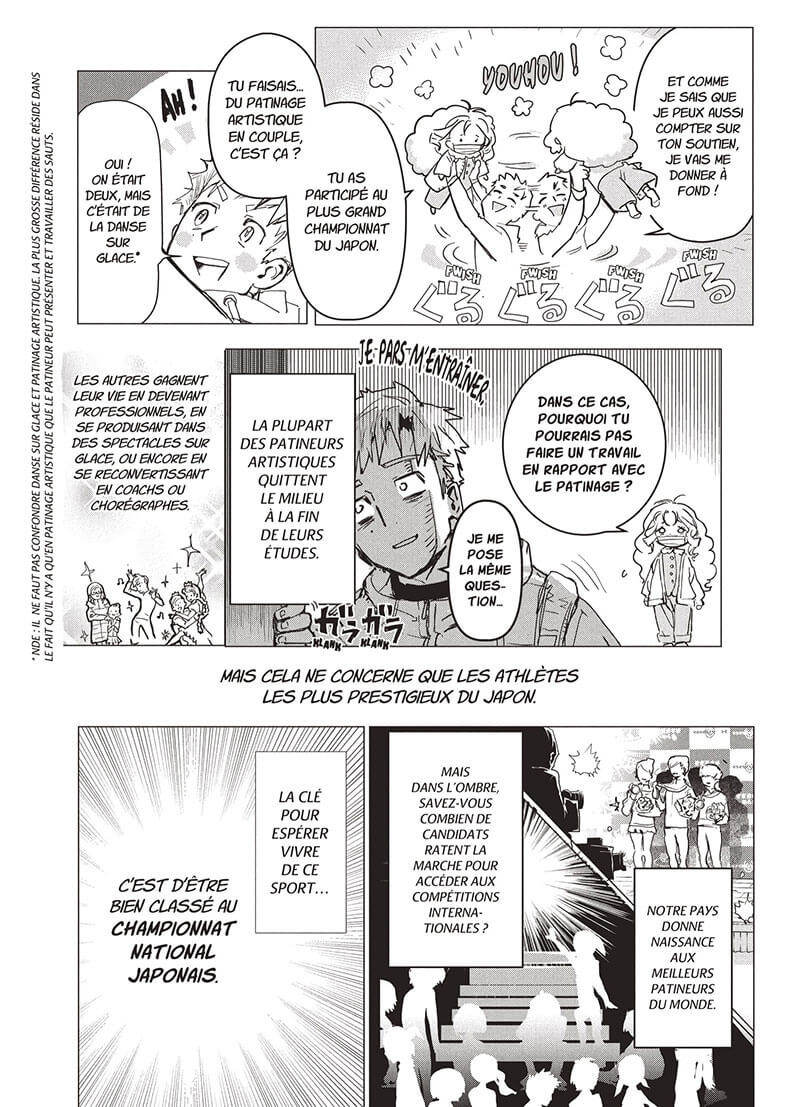
Medalistis a manga about figure skating. Created by Tsurumai Kada (つるまいかだ — the gender, age or identity of this artist has not been disclosed), it is serialized in Monthly Afternoon since May 2020 and has been compiled, so far, in thirteen tankōbon (volumes) at Kodansha. It has been translated in English and published by Kodansha USA (12 vol. so far) and in French by Nobi Nobi (Coll. Genki, 11 vol. so far). It has won the Next Manga Award in 2022,the Shogakukan Manga Award in 2023 and the Kodansha Manga Award in 2024. A novel adaptation by Jun Esaka is also being published by Kodansha KK Bunko since January 2025 (2 vol. so far).
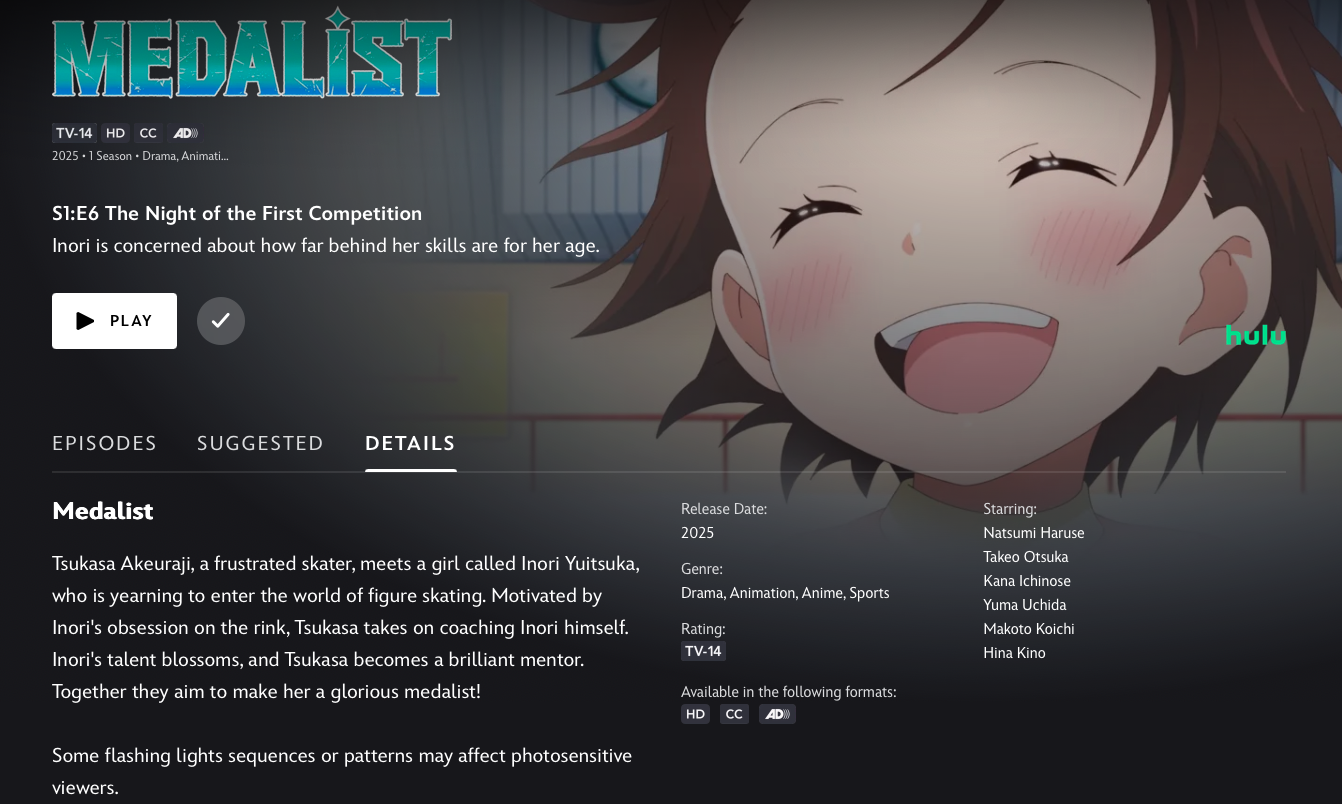
It is the story of fifth grade student Inori Yuitsuka who dreams to become a great figure skater, but since her sister injured herself in a competition, her mother doesn’t want her to even try. Then she meets Tsukasa Akeuraji, an athlete who has seen his skating dream crushed and is now considering becoming a coach. Together they will find the motivation to reach for Olympic Gold !
The story has been animated by ENGI studio into a 13-episode television series (one season so far), directed by Yasutaka Yamamoto, with screenplay by Jukki Hanada, character design by Chinatsu Kameyama and music by Yuki Hayashi. It was airing in Japan on TV Asahi and is currently streaming on Disney+ and Hulu.
It’s a story about perseverance. It’s funny, the style is rather cartoony, but the storytelling is quite average and the inking is very uneven, often too light, sometimes too heavy and always sketchy. All the characters are over the top psychos! No wonder kids now-a-day are having mental problems… The anime is very faithful to the manga.
Japanese library
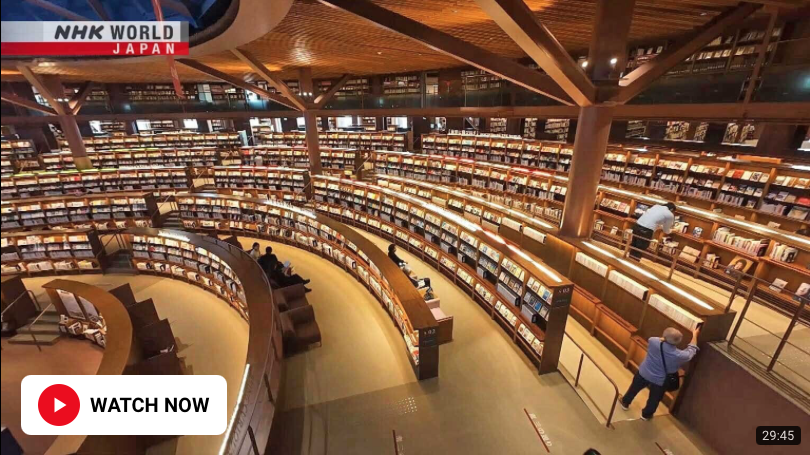
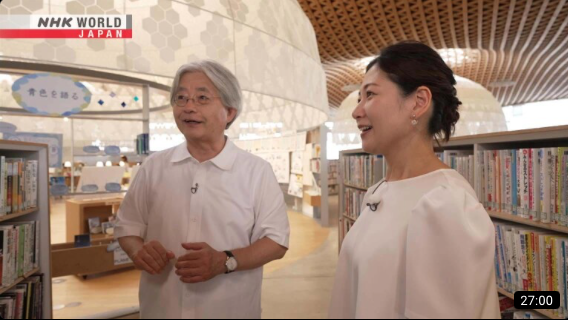
The documentary series Document 72 Hours offers an interesting report on a public library in Kanazawa. Titled “Beyond the Books at a Kanazawa Library” it talks about a library that “resembles a sublime theater and offers more than 1.1 million books. For three days, we asked people what books piqued their interest and how they spend their time here.” This episode was initially aired on March 3, 2025 (rebroadcast on December 28th) and is available as VOD until March 29, 2026. It is not directly related to anime or manga, but it’s about two of my main pole of interest: Japanese culture and libraries.
The documentary series “Anime Manga Explosion” offers a special on the manga and anime The Apothecary Diaries. It is a fantasy story based on a novel where, in a country inspired by the Tang dynasty’s China, a young girl trained as an apothecary is solving mysteries. The author (Hyūga natsu) and anime director (Naganuma Norihiro) talk about how the story and the anime were produced. This episode aired in May 24, 2025 and will be available as Video On Demand (VOD) until May 24, 2026.
Anime Sanctuaries
There was a documentary series named “Anime Sanctuaries” where the description said “Did you know that a lot of your favorite anime are based in real-life locations? Join us on a pilgrimage around Japan to the “Sanctuaries” that are the inspiration of some of the greatest anime!” Unfortunately, I missed it, there are no VOD available and no more air date. Sorry! Keep an eye and maybe they will broadcast it again.
The documentary series “Japanology Plus Mini“ offers an episode about Plastic Models: “Japan’s plastic models are popular worldwide. Shizuoka City leads the nation in plastic model shipments. We look at the city’s plastic model industry, from its history to the latest developments.” It was first aired on November 1 & 2, 2025 and will be available as VOD until November 1, 2026.
More Than Books
This is not about anime or manga, but it talks about a great interest of mine. The documentary series “Today’s Close-up” offers an episode about a new type of Japanese library. Titled “More Than Books: Libraries as Community Hubs” it is described as this: “So-called “lively libraries” that promote new concepts, such as allowing people to chat, eat and drink are gaining popularity, resulting in a sharp increase in users in an era of declining population. Some facilities use books and magazines to promote intergenerational exchanges and resolve local issues. In addition, some local governments have focused on their libraries’ ability to attract users by allowing people to use them for free as a key part of urban development. We visit a library in Gifu that has seen its visitor numbers increase tenfold. What is the potential for public spaces to evolve into places for everyone?” It was aired on November 6, 2025 and will be available as VOD until November 13, 2025.
The episode originally aired in Japan on March 24, 2025, but the English version just aired on September 12 and 13, 2025 and is now available to view as VOD (Video on Demand) until September 27, 2025.
Paper film: The curious origins of color Anime
“Much of the first animation came out of France in the early 20th century, but developed mainly in the United States with the rise of film. In Japan, black and white animation began in the nineteen tens, but colour didn’t become prominent until the nineteen sixties. Except for a brief little-known chapter. A U.S. researcher has rediscovered and successfully restored coloured anime created here in the nineteen-thirties. (…) In the 1930s, Japan produced animated movies on paper, not celluloid. A U.S. professor has been restoring existing films, which were known for their full color.”
Direct Talk interviews the stylist and costume designer Nakahara Sachiko who “translates the looks of popular Japanese anime and manga characters into costumes for live-action adaptations. She talks about making an impact on the global stage.” The show aired on July 22, 2025 and is now available as Video On Demand (VOD) until July 22, 2026.
History Uncovered: The Hiroshige Code
“Influential ukiyo-e artist Utagawa Hiroshige‘s “100 Famous Views of Edo“, a series of prints encoding his view of the changing face of Japan.”Art historian Toshinobu Yasumura, Professor Timon Screech, Hinohara Kenji and Manabu Oishi discuss, interpret and explain the messages hidden in Hiroshige’s art. This episode of “Time and Tide” aired on August 30, 2025 and is now available as Video On Demand (VOD) until August 29, 2026.
Another update on Manben: The latest episodes of the NHK World documentary series Manben: Behind the Scenes of Manga with Urasawa Naoki(which introduces us to mangaka like Shigeru Mizuki, Nishi Keiko, Chiba Tetsuya, or Iwamoto Nao) is about Morohoshi Daijiro, a master of mystery. We see him ink a draft of the stand-alone short story 俺が増える(“Ore ga Fueru” / lit. “I will increase”) for the ongoing anthology Daijiro Morohoshi Theater (Moroboshi daijirō gekijō serialized in Shogakukan’s Big Comic Zōkan-gō [Big Comic Special]and compiled in vol. 3 — of six tankōbon so far). The episode originally aired in Japan in November 2020 (available on Youtube), but the English version just aired on July 16, 2025 (at 09:10 PM) and July 17, 2025 (at 03:10 AM, 09:10 AM, and 03:10 PM) and should be soon available to view as VOD (Video on Demand).
Daijiro Morohoshi is a mangaka specializing in strange, horror, mystery or folklore stories. In 1970, he made his debut in COM magazine. In 1974, he was selected for the 7th Tezuka Award for the short story “Seibutsu Toshi” and he won the fourth Tezuka Osamu Cultural Prize in 2000 with Saiyū Yōenden. His works have not been very successful and he is not very well known in the West (his only works translated are BOX: Qu’y a-t-il dans la boite?published in French by Le Lézard Noir and Shiori et Shimikopartially (5 vol.) published in French by Doki Doki), but he received enormous recognition from his peers (he is known as the “manga artist of manga artist”) particularly for his detailed style. His majors works are Yōkai Hunter (1974), Mud Men [1975-82], Ankoku Shinwa [1976], Kōshi Ankokuden [1977-78]and Saiyū Yōenden [1983, ongoing].
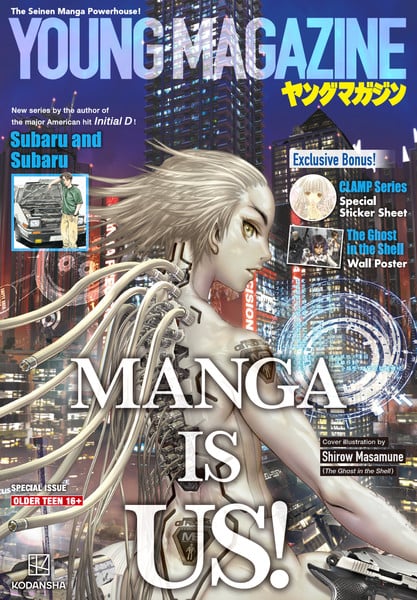
NHK World News reports that Kodanshaannounced that, to commemorate the magazine’s 45th anniversary, it is releasing a special English-language edition of Young Magazine, its popular magazine for young adults. According to NHK World Japan, “Young Magazine USA will have about 1,000 pages featuring 20 titles on themes including Sci-Fi and cyberpunk.” Kodansha will hand out the special edition at Anime NYC in August 21-24 and at Kinokuniyabookstores in the US from August 21 to November 10. It is unclear if this will be a one-shot edition or if more issues of the magazine are planned. According to ANN, “Readers will be able to vote for their favorites among 16 eligible titles, with the winners earning serialization on the K MANGA App.” [Sources: ANN • NHK World Japan]
The Professionals
Another interesting TV series on NHK WORLD Japan is “The Professionals“ about “exceptional people who are breaking new ground and making a difference in their area of expertise.” There are currently eight episodes available. Yesterday, I watched an interesting episode about Honda Tsuneyuki, a toy developer who designs capsule toys. He introduced capsule toys of unprecedented size: 7-centimetre ! In this documentary, we follow him as he is producing the capsule toy of a big Gundam head.
The latest episode of the NHK WORLD Japan documentary series “Anime & Manga Explosion !” is about anime and manga adapting mythological themes. The first part tells us about the anime adaptation of Masami Kurumada’s manga Saint Seiya directed by Morishita Kozo. The second part talks about a manga inspired by the Japanese folk tale of Momotaro (with a serious twist!): Tougen Anki by Yura Urushibara — which has just started airing on Nippon TV as an anime adaptation by Studio Hibari under the direction of Ato Nonaka. In this episode they mentioned Anime News Network !
The latest episodes of the NHK World documentary series Manben: Behind the Scenes of Manga with Urasawa Naoki(which introduces us to mangaka like Shigeru Mizuki, Nishi Keiko or Chiba Tetsuya) is about Iwamoto Nao, a popular shojo manga artist known for her rich worlds of fantasy, romance, and adventure. Over a four-day period, we see her work on pages for Seven Knights of the Marronnier Kingdom. The episode originally aired in Japan in October 2020, but the English version just aired on July 12, 2025 (at 09:10 PM) and July 13, 2025 (at 03:10 AM, 09:10 AM, and 03:10 PM) and should be soon available to view as VOD (Video on Demand).
Iwamoto Nao (岩本 ナオ) is a shōjomangaka who made her debut when she received the 10th Gekkan Flowers Comic Audition Golden Flower Award for her work “Sono Kanojo no Sonzai” which was subsequently published in the May 2004 issue of Monthly Flowers. She also received in 2009 the 55th Shogakukan Manga Awards in Shojo category for Machi de Uwasa no Tengu no Ko. She is mostly known for the latter as well as for Kin no Kuni Mizu no Kuni and Marronnier Oukoku no Shichinin no Kishi, but she has published more than half a dozen titles:
スケルトンインザクローゼット [Sukeruton in za Kuroozetto / Skeleton in the Closet] : a collection of 7 stories, serialized in Flowers, Shogakukan, 2005.
イエスタデイ、イエス ア デイ[Iesutadi Iesu a Di / Yesterday, Yes a Day] : serialized in Flowers, Shogakukan, 2006, 1 vol.
あめなしむらやくば さんぎょうか けん かんこうがかり [Amenashi-mura Yakuba Sangyou-ka ken Kankougakari ]: serialized in Rinka, 2007, 3 vol.
町でうわさの天狗の子 [Machi de Uwasa no Tengu no Ko / lit. “The Tengu Child Rumored in Town”] : serialized in Flowers, Shogakukan, 2007, 12 vol. Translated in French by Kazé as Spiritual Princess. [Nelligan]
ジャイキリ読んで〇〇してきました [Jaikiri Yonde Maru Maru Shite Kimashita / lit. “I Started Doing 〇〇 After Reading Giant Killing”] : an essay manga published in “Giant Killing extra”, Kodansha, 2010.
金の国水の国 [Kin no Kuni Mizu no Kuni / lit. “Gold Kingdom and Water Kingdom”] : serialized in Flowers, Shogakukan, 2014, 1 vol. It was adapted into an anime movie in 2023 and translated in English by Seven Seas. Also translated in French by Akata as Les noces de l’or et de l’eau.
七叶树王国的七名骑士[Marronnier Oukoku no Shichinin no Kishi / lit. “Seven famous swordsmen of the Seven Leaf Kingdom”] : serialized in Flowers, Shogakukan, 2016, 10 vol., ongoing series. Translated in French by Akata as Les 7 chevaliers du royaume des Marronniers.
岩本ナオ 古今東西しごと集 [Iwamoto Nao Kokon Touzai Shigoto-shuu / lit. “Nao Iwamoto: A collection of work from around the world, past and present”] : an anthology collecting 4 stories to celebrate her 15th year anniversary in the industry, Shogakukan, 2019.
The anime adaption of Scott Westerfeld‘s young adult novel series, Leviathan, is now available on Netflix. Produced by Studio Orange (Trigun Stampede, Beastars), it is set in an early twentieth century alternate steampunk past and tells the story of an Austrian fugitive prince and a Scottish airman in disguise who find themselves aboard the HMS Leviathan, a genetically engineered airship, fighting mechanized war machines in order to prevent a world war.
I have now watch half of the twelve episodes of the series and I must say that I am VERY impressed with this anime. It is quite faithful to the original book (of course, like all adaptation, there are a few shortcuts here and there, and some changes, but it is very respectful of the original) and the animation is of very high quality. It is somewhat reminiscent of Gundam (character designs) and Miyazaki (particularly the watercolour storyboard of the end credits by Christopher Ferreira & Alex Alice). It is an excellent work that I strongly recommend to all anime fans, particularly if you already know the novels or if you are interested in alternate history and steampunk.
One of the latest episodes of the NHK World documentary series Anime Manga Explosion is dedicated to the manga and anime Beastars. It first aired on NHK World on December 28, 2024, but was broadcast again this weekend. It is available as Video On Demand (VOD) until December 29, 2025.
Beastars is “a popular manga that uses a world of anthropomorphic animals to explore modern social issues. Through an exclusive interview with creator Itagaki Paru, learn how BEASTARS came to life and the passion behind it. Plus, take a behind-the-scenes look at the anime’s final season and the innovations that enhance its realism.”
Beastars is a shōnen manga by Paru Itagaki that was first serialized in Weekly Shōnen Champion from September 2016 to October 2020 before being compiled in 22 volumes by Akita Shoten. It was adapted into an anime by Studio Orange under the direction of Shin’ichi Matsumi and is airing on Fuji TV‘s +Ultra programming block since October 10, 2019. There are 36 episodes so far. It has been licensed on Netflix.
The latest episode of NHK World’s documentary series Anime Manga Explosion (see my article “Anime and manga on NHK World”) is dedicated to Patlabor. The show aired on NHK World Saturday 28 and Sunday 29th, but it should be available for viewing on demand (VOD) soon. [update 2024/09/30: it’s now available on VOD]
In Patlabor, Tokyo had been destroyed in a big earthquake and, in order to rebuild it, Japanese created heavy construction machines (more power suits than robots) called “Labors” to do the work. But what to do if someone steals a labor in order to rub a bank? The answer: you make the police drive their own labors instead of cars — and the Patrol Labors (Pat-Labor) were born. The show puts emphasis not on the mecha themselves but on the characters as it follows the daily life of the personnel of a police station (Section 2): the officers who are piloting the labors and the mechanics who are doing their maintenance, as well as their entourage.
However, today’s anime fans probably never heard of this excellent series. The best way to make them discover Patlabor, was to reboot the series (it’s a trend: we have recently seen announced the revival of Ghost in the Shell, Ranma 1/2 and even The Rose of Versailles). Therefore a new Patlabor series titled Patlabor EZY was announced in November 2016 as part of the 35th anniversary of the series. It would feature entirely new characters. Recently it was announced that it would be produced by J.C.Staff and would air in 2026. The series is directed by Yutaka Izubuchi (original mechanical designer), with a script by Kazunori Itō, character designs by Masami Yūki, mecha designs by Kanetake Ebikawa & Toshiaki Ihara, art designs by Masanori Kikuchi & Yuta Akiyama, animation direction by Takamitsu Satou, CG direction by Yoshinori Moriizumi, and music by Kenji Kawai. Akemi Takada is also contributing to the costume designs and Tarō Maki (Genco) is producing.
If you want to have an idea of what this new series looks like, you can watch the Patlabor Special of the Anime Manga Explosion documentary on NHK World. I just hope that, when this series is released, it will also be available in North America.
I really don’t know who wrote this. Thanks anyway. It is full of inaccuracies but that’s a beginning (what about a version in French?). Now I am really immortal !
I recently spent time answering questions for an online interview which gives me the inkling of eventually starting writing my memoirs…
It reminds me also that, as a retirement project (just 986 days left, by the way), I would like to become a Wikipedia contributor. I’ll probably have to first find a place to get some sort of training. However that would be an interesting occupation (one of the hundreds of projects that I want to do when I will finally have more time)…
One of the aspects of anime that I always found interesting is the music and the use of songs (but not just in opening and closing credits). It is something that we would not find in western animation of my childhood. The western animations were usually cheaply done and the scripts were quite simple. I am not sure when it started in Japan, but I have noticed it mostly in shows from the eighties, like Macross(1982), Mospeada (1983), Megazone 23 (particularly part II, 1986) or Bubblegum Crisis (1987-1991). The presence of music and lyrics in the shows was very sophisticated and was used to enhanced the emotion of the characters or emphasized the drama of a situation, like a battle scene. When it was well done it was really awe inspiring.
The concept was perpetuated through all the Macross sequels, but particularly with Macross Plus (1994-1995) and Macross 7 (manga: 1994-2001, anime: 1995, 1997-1998), and it was push even further with the creation of anime about music like Beck (manga: 1999-2008, anime: 2004-2005), Black Heaven (anime: 1999), Nana (manga: 2000-2009, anime: 2006-2007), Nodame Cantabile (manga: 2001-2010, anime: 2007-2010), La Corda d’Oro (manga: 2003-2011, anime: 2006-2007), or Carol & Tuesday (2019) — just to name a few.
Now it is an integral aspect of mostly all anime and much has been written about it (Crunchyroll, Google, My Anime List). We certainly talked a lot about Japanese music in Protoculture Addicts (particularly with the series of articles by James S Taylor titled “The Modern Japanese Music Database” which started in issue #57 — we used to have an index of old articles on the defunct magazine website and I intend to eventually make it available on a new website in a near future).
Today, while watching a documentary on NHK World (see my article “Anime and manga on NHK World”) part of the Anime Manga Explosion series, I learned about another increasingly popular genre of music anime: the Girl Band Anime that focuses on the life and tribulation of… girl bands. They talk about anime series like BanG Dream!(2017-2020) or BocchiThe Rock!(2022)whichfeatures authentic guitar rock scenes and where voice actors form real live bands.
In the last decades I’ve been mostly reading manga, but documentary like this makes me want to watch more anime…
Update (2024/06/02): Another documentary series is Anime Sanctuaries presenting real-life locations on which anime are based. One episode available in VOD covers Akihabara (location for Love Live!) and another one, airing June 4th, covers Kamiichi in Toyama (location for Wolf Children).
“Le premier guide des Châteaux de la Loire en Docu-BD pour parcourir et découvrir 25 lieux touristiques majeurs où la grande Histoire de France se mêle au patrimoine. Plans, repères, bonnes adresses, anecdotes étonnantes. Tout y est avec la force évocatrice de la BD et du documentaire !
Découvrir des châteaux, c’est parcourir leur histoire, remonter au temps des premières pierres, croiser les chemins de ceux qui les ont bâtis et habités, observer leurs transformations. C’est pénétrer dans les recoins les plus secrets. C’est découvrir leur lien avec des personnages historiques, mais aussi avec le peuple. En s’appuyant sur la force évocatrice de la bande dessinée, ce guide unique vous transporte au fil de la Loire, à la rencontre des majestueux châteaux qui la bordent. Les documentaires, quant à eux, fourmillent de trouvailles et d’anecdotes pour prolonger la balade…”
C’est un ouvrage très intéressant et instructif mais que j’ai trouvé tout de même plutôt décevant car je m’attendais à une véritable BD alors qu’il s’agit en fait d’un documentaire avec quelques BD anecdotiques. Les BD sur chacun des châteaux sont dessinées par des artistes différents ce qui fait que le styles varient beaucoup en genre et en qualité. À lire seulement si les châteaux et l’histoire de la Loire vous intéresse.
Guide des châteaux de la Loire en bandes dessinées, par Alexandrine Cortez et Julien Moca. Rouen: Éditions Petit à Petit, avril 2019. 160 pages, 15.5 x 23.5 cm, 19,90 € / $35.95 Can, ISBN 979-10-95670-87-2. Pour un lectorat jeune (7+).
Vous trouverez plus d’information sur les sites suivants:
However, I just discovered a fan website offering ALL the episodes of the series with English subtitles: www.naokiurasawa.com. The series has five seasons and about thirty episodes. Here is a list of all episodes (with links to view the documentaries):
It is the tradition for my Christmas vacations to read and watch lots of cartoons. Sometimes I read again the complete collection of Astérix or of Tintin. And, at this time of the year, there’s plenty of cartoon on TV. This year, since I am already reading plenty of manga, I decided to go in the documentary way. I’ve found and watched two interesting documentaries about famous cartoon artists (and I read a book of each for good mesure).
Who are you, Charlie Brown?
This documentary, narrated by Lupita Nyong’o, is covering three subjects. First, it brings us a new animated story where Charlie Brown agonize on the fact that he must write an essay about himself for school and he goes on a quest of self-discovery. Also, with the help of old interviews with Charles M Schulz (aka “Sparky”) and some of his close friends and family members we learn about who was the creator of Peanuts and about the genesis of the comics. Finally, fans, actors and other creators discuss the influence the comics had on them and on the global culture.
The documentary is interesting and also very entertaining, but also a little short and somewhat superficial. We see some early drawings of the Peanuts’ gang (a comic strip called Lil’ Folks) but it never mentions his other comic series, like Young Pillars (which I commented in 2015) or It’s Only a Game. It also doesn’t mention the fact that Schulz’ house was burned down during the Santa Rosa’s fire in October 2017. Fortunately, the nearby Charles M. Schulz Museum and Research Center, where the original illustrations are stored, was spared.Nevertheless, this documentary is a great way to celebrate the cultural icon that Charlie Brown is and introduce him to a new generation of comic readers.
Who are you, Charlie Brown? : USA, 2021, 54 min.; Dir.: Michael Bonfiglio; Scr.: Michael Bonfiglio & Marcella Steingart; Ed.: Tim K. Smith; Music: Jeff Morrow; Rated PG. It has received a score of 88% on Rotten Tomatoes (91% from the audience) and 7.2/10 on IMDb.
To learn more about this title you can consult the following web sites:
Of course, after viewing this documentary I was feeling like reading some old Charlie Brown comics. I chose a short one and got lost in nostalgia. When I was a kid, having outgrown the school library, I was making regular trips to one of the city’s libraries to borrow Peanuts’ compilations (the library was located on top of an old fire-station and it reeked of gaz and engine’ oil — for years after that the idea of a library was evoking in me a mix of awe and nauseous feelings!)
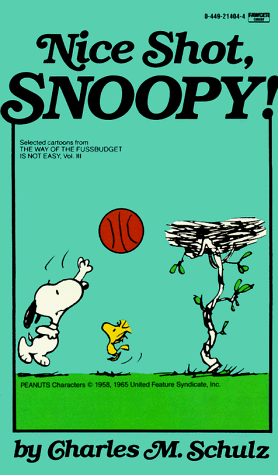
This book offers a selection of cartoons from the compilation The Way of the fussbudget is not easy, vol. III. Part of the Peanuts Coronet collection (#79), it was meant to provide a shorter and more affordable sampling of the Peanuts’ world. It present a single four-panel strip per page. The volume doesn’t have a particular thematic and I don’t know if the strips are in chronological order. It is simply a variety of stories involving all characters (Snoopy and Woodstock, Linus and Lucy, Peppermint Patty and Marcie, Schroeder, Pig-Pen, Spike, and, of course, Sally and Charlie Brown). It is a light reading that provides mindless vintage entertainment.
Page 24-25
Nice shot, Snoopy!, by Charles M Schulz. New York: Fawcett Crest (Ballantine Books/Random House), May 1988. 128 pages, 4.25 x 7 in., $US 2.95 / $C 3.95, ISBN 0-449-21404-4. For readership of all ages.
For more information you can check the following websites:
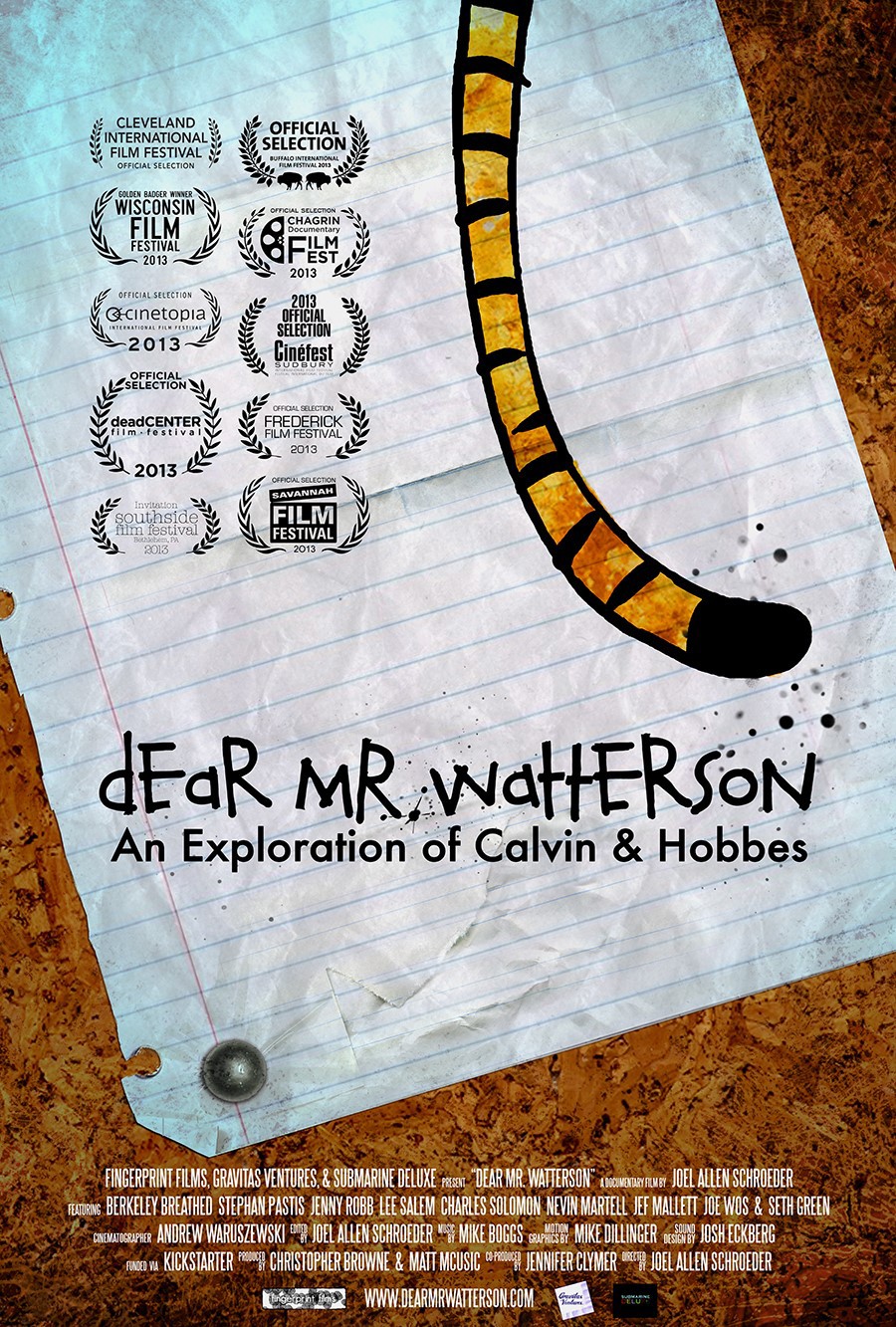
This is an older documentary but I just discovered it. It explores the phenomenon that is the comic strip Calvin and Hobbes, interview lots of people (fans, actor Seth Green, editor Lee Salem and other artists) who pay tribute to its popularity and talk about how it influenced them and the global culture. It also talks a little about its creator, Bill Watterson, who NEVER appears in the documentary (apparently he is a very shy and private person).
It is a very interesting documentary and it reminded me of all the reasons why Calvin and Hobbes was my favourite comic strip. Unfortunately, I was quite disappointed that I couldn’t learn more about its creator (although I can understand why someone who’s such a purist about his art would shy away fame and a fortune in licensing). However, the documentary also talk about the cartoon world in general and, if I couldn’t see Mr. Watterson, I could hear from many of the artists who created other strips that I like a lot too: Berkeley Breathed (Bloom County), Stephan Pastis (Pearls Before Swine), Jan Eliot (Stone Soup), Bill Amend (FoxTrot), Wiley Miller (Non Sequitur), Dan Piraro (Bizarro), etc. It was definitively worth watching.
Dear Mr. Watterson : USA, 2013, 89 min.; Dir.: Joel Allen Schroeder; Phot.: Andrew Waruszewski; Ed.: Joel Allen Schroeder; Music: Mike Boggs; Prod.: Chris Browne & Matt McUsic; Rated PG. It has received a score of 62% on Rotten Tomatoes (51% from the audience), 54% on Metacritic and 6.4/10 on IMDb.
To learn more about this title you can consult the following web sites:
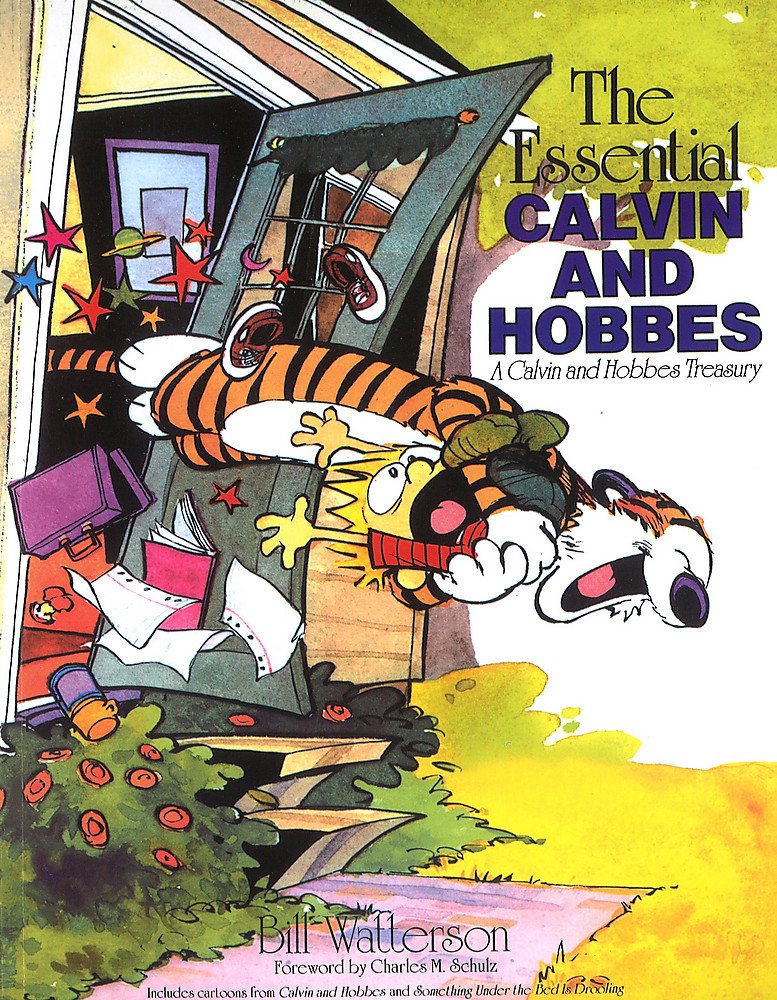
Again, watching this documentary made me want to read the comic again. I have a little less than a dozen compilations and I chose to read the one that I thought would be the most representative: The Essential Calvin and Hobbes, which includes all strips from the first two compilations (Calvin and Hobbes and Something Under the Bed Is Drooling). In this strip we enviously follow the (mis)adventures of an over-imaginative boy with his pet (stuffed?) tiger. It is superbly drawn in a simple, clean but descriptive style. The humour is brilliant. It is both entertaining and full of meaning. A must read.
Page 247
Page 225
Page 228
The Essential Calvin and Hobbes, by Bill Watterson. Kansas City: Andrews & McMeel (Universal Press Syndicate), March 1989. 256 pages, 8.5 x 10.7 in., $US $18.99 / $C 37.99, ISBN 0-8362-1805-1. For teenage readership (12+).
For more information you can check the following websites:
Apparently there are lots of stories on the internet about Bill Murray doing some crazy spontaneous things where he crashes a party or a wedding picture session, comes behind someone in a public toilet and puts his hands on the person eyes saying “No one will ever believe you”, or ends up doing the dishes in some kid’s apartment. He just shows up out of the blue, acts like he is just a normal guy (not a celebrity) but in a way that touches people’s life. Could those stories be true? That’s the question which Tommy Avallone asked himself and decided to make a documentary about it.
The Bill Murray Stories: Life Lessons Learned From a Mythical Man is a documentary that retells those stories and interviews the people who experienced them. It really seems that most stories — at least those told in the documentary — are true and there is pictorial or video evidences to prove it. Avallone then goes on asking himself: why? Why someone like Bill Murray would do such things? To goof around? As a publicity stunt? Not at all. It is just who Bill Murray is. It is part of an improv thing and part of a life philosophy (something like taoism or zen). He just like to live in the moment and make people happy.
Personally, I am just wondering what makes people wake up in the morning and decides to make a documentary about Bill Murray. You are in movie school and need to do one as an assignment? Or really want answers to those questions and decide to just films everything and try to make money out of it? Or you just have the “reporter” gene in your blood? I guess someone should make a documentary about that.
It’s not a very good documentary (it’s clumsy, particularly toward the end, and I dislike when someone makes a documentary about themselves looking for something) but I enjoyed it because I not only learned a lot about who is Bill Murray, but it was also quite entertaining (lots of funny anecdotes and movie excerpts). It reminds me of this book that I once saw in the library: The Tao of Bill Murray: Real-Life Stories of Joy, Enlightenment, and Party Crashing, by Gavin Edwards and R. Sikoryak, which was basically asking the same questions. [ Amazon / Goodreads / Library ]
Apparently, Bill Murray is quite an interesting person. But whether you are interested or not, whether you like documentaries or not, it doesn’t matter: if you just take the moment to watch this sixty-seven minutes movies you will certainly enjoy it. And maybe, maybe, you’ll take something out if it and wonder, like me, could I ever be that spontaneous and really live in the moment?
To learn more about this title you can consult the following web sites:
I just watched this CNN documentary about the life of judge Ruth Bader Ginsburg. It is really a historical crash course about the other side of the fight for civil rights: the legal aspect of the women’s lib movement in which RBG played an essential role. The film is composed of extracts of hearing and court proceedings as well as interviews with RBG, friends, family and some legal or political experts. We first learn how she became a lawyer in 1959 (Harvard and then Columbia) but couldn’t find employment because she was a woman. She taught law at Rutgers. Within the ACLU she co-founded in 1972 the Women’s Rights Project which oversaw hundreds of gender discrimination cases, RBG personally arguing six of them before the Supreme Court (winning five). It is incredible how such a small and frail woman could be so dedicated and determined to fight gender discrimination in any way necessary in order to slowly build up precedents and find justice.
In 1980, Jimmy Carter nominated her as judge on the U.S. Court of Appeals for D.C.. In 1993, Bill Clinton nominated her as an Associate Justice of the Supreme Court where she played an iconic role. With the retirement of Justice O’Connor in 2006, she became the only woman on the court, until the nomination of Justice Sotomayor in 2009. First considered a moderate, she shifted toward the Left to preserve the balance as the court became more conservative. She is known for her dissenting opinion. She could be the last line of defence against the civil rights roll back by the Trump administration. Strangely, the appeal of her work and personality — through an Internet meme named Notorious R.B.G., which was comparing her to rapper Notorious B.I.G. — has given her great pop culture fame.
This is a great documentary that is fun to watch, but also very informative. I’ve learned a lot about American history. It is also a nice introduction to another movie about RBG’s life, this time a fictionalized account of her early days, titled On the Basis of Sex and which was just released this Christmas. RBG was well received as it earned a 94% rating on Rotten Tomatoes and 7.6 on IMDb. Therefore, it is highly recommended. I recorded it when it aired on CNN in September, but it is now available on Dvd (from Amazon or your local library) and can also be streamed on iTunes or Amazon Prime.
To learn more about this title you can consult the following web sites:
Dans le cadre du Salon du livre de Montreal 2018, je voulais faire une série de mini (capsules) entrevues avec des auteurs (surtout de science-fiction) de chez nous. Malheureusement, l’ambiance sonore du salon n’était pas adéquate pour des entrevues, alors celles-ci ont été faite hors-site. Le principe de l’entrevue capsule est de s’en tenir à deux ou trois questions de base et que l’entrevue ne dure pas plus que trois à cinq minutes. Cela doit être compacte et bien se digérer!
Voici donc la première de ces entrevues capsules, réalisée avec Francine Pelletier. Pour en savoir plus sur cette auteure de science-fiction — à ne pas confondre avec la journaliste homonyme — et de polar (sous le pseudonyme de Catherine Sylvestre) vous pouvez consulter sa bio/bibliographie sur le site des Éditions Alire ou sur Wikipedia.
“Frederick Wiseman’s film, Ex Libris – The New York Public Library, goes behind the scenes of one of the greatest knowledge institutions in the world and reveals it as a place of welcome, cultural exchange and learning. With 92 branches throughout Manhattan, the Bronx and Staten Island, the library is a resource for all the inhabitants of this multifaceted and cosmopolitan city, and beyond.The New York Public Library exemplifies the deeply rooted American belief in the individual’s right to know and be informed. It is one of the most democratic institutions in America – everyone is welcome. The Library strives to inspire learning, advance knowledge and strengthen communities.”
Earlier this week I stumble upon this enormous documentary on PBS. If you are into books and libraries, you’ll just love this movie that gives us an extensive tour of the New York Library and demonstrates how dedicated and welcoming the staff of its 92 branches are, what are the challenges they face in order to keep up with the demands and needs of their patrons, and particularly how important libraries can be to foster the diffusion of culture & knowledge as well as artistic creativity. It’s certainly one of the best examples of what an ideal library should be (as I recently discussed).
It is amazing how our local libraries look insignificant and puny in comparison of the behemoth collection and the huge diversity of services offered by the New York Public Library… With 53 millions documents, it is the second largest public library in the U.S. (third largest in the world after the British Library and the Library of Congress). Surprisingly, despite its name, it is a private, non-profit library, but it’s using public/private partnership (and funding) to work in collaboration with local governments (city, state, federal) in providing a large array of services… It is quite interesting (and serendipitous) that, with our imminent provincial elections, a librarian and teacher at the U de M Library Science School has been very recently questioning the commitment of the government in regards of libraries. Will the government create a strategic plan for the development of libraries (like the PLA recently did) ? It is direly needed at a time when the usefulness of libraries (and even our society’s fundamental concepts of knowledge and truth) are being challenged(NYT, The Guardian) !
Of course, for such an enormous documentary, the reception has been rather mixed (with a critical response at 97%, but with only a 61% audience score, on Rotten Tomatoes) with reviews going from bad (Globe & Mail), to good (Variety) to excellent (The Guardian).
For me it was very interesting to watch and compare (seeing the similarities and differences) our library work here, in relatively small municipal library branches, to what’s done in NYC. However, even with the mastery of legendary documentarist Frederick Wiseman, I do think that 3h17 is really too long for any documentary to keep the attention of the viewers (at least in one sitting)! Many sequences are unnecessarily long. Also someone can get easily annoyed by Wiseman’s “no-comment” documentary style where he just show the scene as it happens without much editing or information (like not telling us who is talking!). In the end, despite those faults, this documentary is definitely worth watching for anyone (with spare time) who’s interested in the realm of books and libraries.
Ex Libris – The New York Public Library : USA, 2017, 197 mins; Dir./Ed./Sound/Prod.: Frederick Wiseman; Phot.: John Davey; Exec. Prod.: Karen Konicek; Cast: Ta-Nehisi Coates, Elvis Costello, Richard Dawkins and the very dedicated staff of all NYL branches. The DVD will be available soon from the producing company, PBS or Amazon (UK / FR). It can also be streamed online (legally?)…
“If you are cold, tea will warm you; if you are too heated, it will cool you; If you are depressed, it will cheer you; If you are excited, it will calm you.” ― William Ewart Gladstone