Jeudi nature en images [002.025.212]

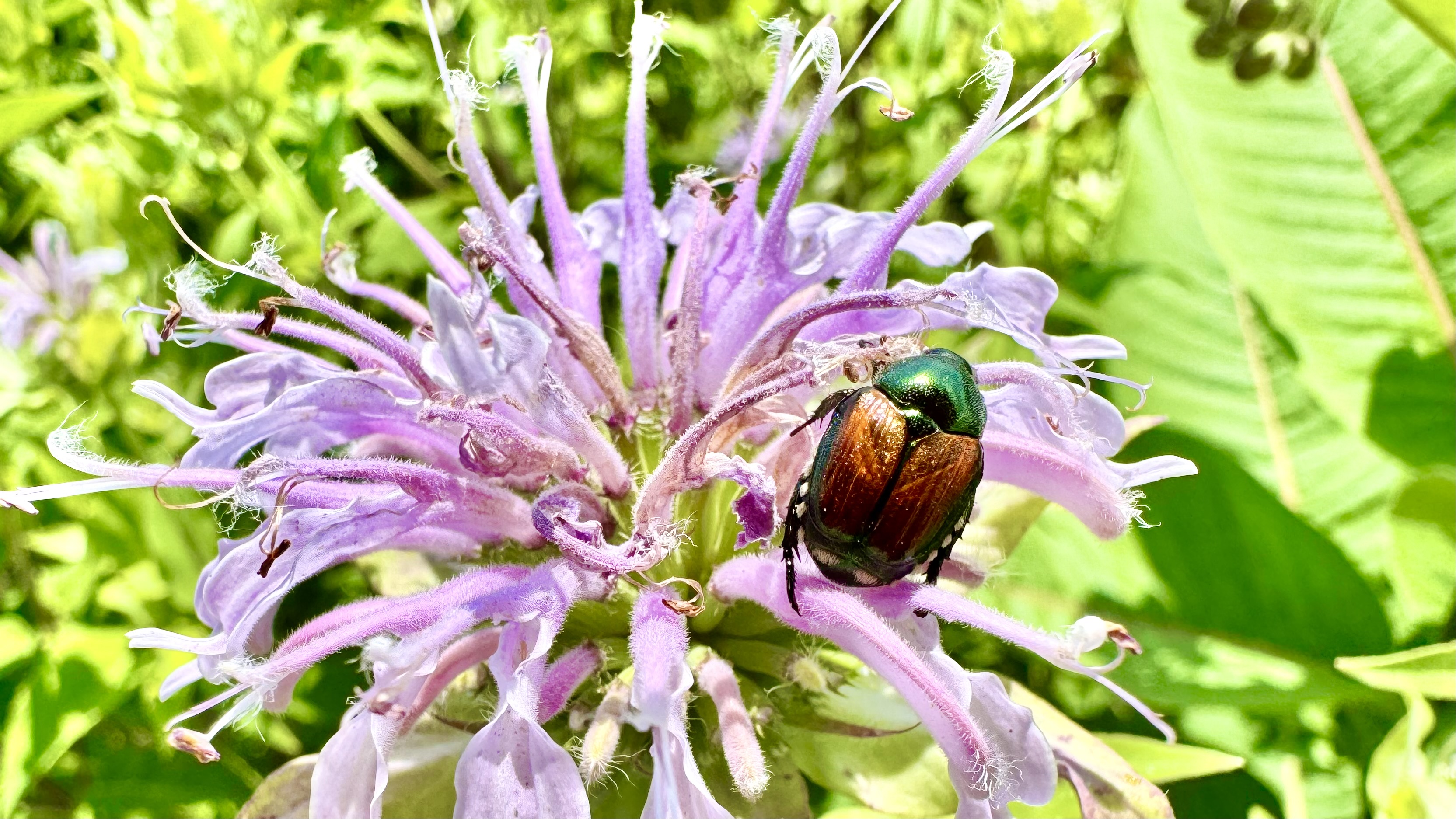
Daucus carota + Popillia japonica

[ iPhone 15 Pro, Parc Frédéric-Back, 2025/07/14 ]

Scarabée japonais / Japanese beetle / マメコガネ [Mame kogane]
Carotte sauvage / Queen Anne’s lace

Un autre photo de scarabée japonais. Ils sont très abondants cette année. C’est un très bel exemple de cette espèce appartenant à la prolifique famille des Scarabaeidae (scarabée / scarab beetles / コガネムシ [Kogane mushi]) qui sont d’ailleurs très appréciés au Japon.

[ Translate ]

Jeudi nature en images [002.025.198]

Amphion floridensis + Nepeta x faassenii

[ iPhone 15 Pro, Jardin botanique, 2025/06/21 ]

Sphinx de Nessus / Nessus sphinx

Népéta de Faassen / Fassen’s catnip / cultivar ’Junior Walker’

Un autre insecte que je n’avais jamais vu mais qui est pourtant, dit-on, assez commun. J’ai d’abord pensé que  c’était un oiseau-mouche, mais c’est en fait un hétérocère (“papillon de nuit”) diurne. C’est un insecte de l’ordre des Lépidoptères, de la famille des Sphingidés et du genre Amphion. Impressionant comme bébitte. Voir aussi: GoogleBugGuideiNaturalist.

Another insect I’d never seen before, but which is said to be quite common. I first thought it was a hummingbird, but it’s actually a diurnal moth. It’s an insect of the order Lepidoptera, family Sphingidae, and genus Amphion. Impressive as a critter. See also: GoogleBugGuideiNaturalist.

Jeudi nature en images [002.025.184]

Lucidota atra

[ iPhone 15 Pro, Domus, 2025/06/24 ]

Luciole sombre / Black firefly [Wikipedia / iNaturalist]

Je n’ai pas vu de lucioles depuis une cinquantaine d’années (quoi qu’une amie de ma femme dit en avoir vue récemment à Laval). J’ai donc été très surpris de découvrir sur ma porte de garage cette espèce de luciole diurne. La bioluminescence n’est pas vraiment présente chez l’adulte (parfois deux petits points sur les ailes vers l’arrière) et se retrouve principalement chez la larve.

[ Translate ]

Tasting Ancient Rome

My wife and I are big fans of everything that has to do with history and culture. While visiting a bookstore recently, she noticed a book titled Tasting History by Max Miller and Ann Volkwein [ AmazonGoodreadsGoogleNelliganWorldCat ]. It is a cookbook that recreates dishes from the past using historical recipes, adapting them for modern kitchen and putting them in their historical and cultural context. Knowing my interest for Roman history, she noted that it was containing several recipes from Ancient Rome and that Max Miller also had a website and a YouTube channel dedicated to this subject.

We quickly decided to take a look to his videos about Ancient Roman cuisine. It is very interesting, but heavily peppered with ads, sponsorship and products placements. It is quite popular (3.6 million subscribers) and offers a lot of material (443 videos so far), over forty of them about Ancient roman cooking (or other ancient recipes):


I have always been curious about the Food in ancient Rome and the Ancient Roman cuisine. If many ancient roman authors anecdotally talk about food and cooking (for example, Max Miller profusely cites Martial, Suetonius, Petronius, Plinus the Younger, Plinus the Elder, Columella, Galenus, Seneca, Athenaeus, etc., in his videos) very few books on cooking have come down to us. There is actually only one:

  • Apicius, De re coquinaria (On the Subject of Cooking) which seems to be a late compilation of recipes from various authors. It has not seen any recent publication or translation [besides Budé / Les Belles Lettres which is in French and not easily accessible], but it is available on the public domain [ Projet Gutenberg / Univ. of Chicago: Penelope ]. However, there is also a few books about or adapting Apicius:
    • Apicius, Barbara Flower & Elisabeth Rosenbaum. The Roman Cookery Book: A Critical Translation of the Art of Cooking, for Use in the Study and the Kitchen. An “adaptation” of Apicius published in 1958 and reprinted in 2012. [Amazon, Goodreads].
    • Apicius. Les dix livres de cuisine d’Apicius. Paris: Bonnel, 1933. [BANQ, Goodreads]
    • Marty-Dufaut, Josy. Mes meilleures recettes de l’Antiquité romaine : cuisiner avec Apicius. Bayeux : Heimdal, c2016. [BANQ, Goodreads]
    • Pedrazzini, Renzo. Saveurs et senteurs de la Rome antique : 80 recettes d’Apicius. [BANQ, Goodreads]

Three more books talk about the production of food while covering the subject of agriculture and provide a few recipes:

  • Cato, De agri cultura (On agriculture) is a treaty about farming. It is available in French in the famous Collection Budé of Les Belles Lettres and in English in various editions (including Loeb Classical Library). It is often published together with Varro’s Res rusticae [Project Gutenberg]. It is also available in the public domain [Univ. of Chicago].
  • Columella, De re rustica (On the rural issue) which is also a compilation of ancient texts, this time dedicated to agriculture and country life. It also has no recent publication (in French in Budé) but is partially available in the public domain [Univ. of Chicago]
  • Varro, Rerum rusticarum libri III (Rural Topics in three books) or De re rustica or Res rusticae (On Agriculture) where he describes the management of a large roman farm (latifundium). Again not widely available as a publication (in French in Budé), but it can be found in the public domain [Project Gutenberg / Univ. of Chicago]
    • Nisard, Désiré [Ed.]. Les agronomes latins : Caton, Varron, Columelle, Palladius. Paris : J. J. Dubochet et Compagnie, 1844. An old French translation regrouping all of the roman texts on agriculture. [BANQ, Goodreads]

Of course, lots of books about Ancient roman cooking have been written. Here are a few examples:

  • [Lily Heritage], The Cookbook from Ancient Rome: Classic Recipes Reimagined for Today [Amazon, Goodreads]
  • Blanc, Nicole & Nercessian, Anne. La cuisine romaine antique. [BANQ, Goodreads, Nelligan]
  • Chantal, Laure de [Ed.]. À la table des anciens : guide de cuisine antique. [BANQ, Goodreads]
  • Dalby, Andrew. The Classical cookbook [BANQ, Goodreads]
  • De Rubeis, Marco Gavio. Ancient Roman Cooking: Ingredients, Recipes, Sources [Goodreads, Amazon]
  • Faas, Patrick. Around the Roman Table: Food and Feasting in Ancient Rome [Amazon, BANQ, Goodreads]
  • Helton, Lauren M. A Culinary Journey Through Ancient Rome [Goodreads]
  • Husson, René & Galmiche, Philippe. Recettes romaines. [BANQ, Goodreads]
  • Quinot Muracciole, Martine. Rome côté cuisine. Paris: Les Belles Lettres, 2019. [Amazon, Goodreads]
  • Salomon, Jon. Ancient Roman Feasts and Recipes Adapted for Modern Cooking [Goodreads]
  • Tilloi-D’Ambrosi, Dimitri. Le régime romain : cuisine et santé dans la Rome antique. Paris : PUF, [2024]. [BANQ, Goodreads]
  • Wells, Laurene R. Ancient Roman Eats: Roman Style Cooking for Modern Cooks [Goodreads]

Enjoy !!!

Note: This could be considered the first part of the series of articles that I promised to write about Roman literature. More to come eventually… (I am working on it, but please note that there are still six hundred and ninety three days before my retirement !) [Updated: 2025/06/30, 2025/07/01]

[ Traduire ]

Image du chat-medi [002.025.172]

Nouveau venu dans la quartier

[ iPhone 15 Pro, hortus posterior, 2025/06/13 ]

Depuis quelques semaine notre cour arrière est régulièrement visitée par ce nouveau venu. Il/elle semble plutôt gêné et ne se laisse pas approcher. Ignorant s’il s’agit d’un mâle ou d’une femelle, je l’ai tout de même appelé “Contessa” à cause de la marque (mouche / grain de beauté) qu’il/elle a à gauche du museau. C’est un animal très enjoué qui cherche à attraper les oiseaux et souris qui fréquentent mon jardin. Je ne l’ai pas vu avec Félix alors j’ignore s’ils sont en termes amicaux ou si une rencontre les amènerait à l’affrontement… J’ignore également s’il a été abandonné ou si c’est un chat de maison qui passe beaucoup de temps dehors. Son pelage est propre et bien soigné, mais il n’a pas de collier. Un charmant nouveau voisin.

[ Translate ]