L’Humanité invisible (Liu Cixin 13)

HumaniteInvisible-Cixin13-cov“15 récits de l’écrivain de SF Liu Cixin adaptées en BD par des auteurs de tous pays ; 15 voyages quantiques à la croisée des dimensions scientifiques, géopolitiques et humanistes, qui imaginent les futurs possibles de l’humanité.”

“Depuis la confirmation d’un terrible flash d’énergie solaire, des dizaines de navettes spatiales avaient embarqué le maximum d’espèces terrestres, parties en quête d’un astre habitable. Notre unique et dernière solution pour perpétuer la vie. Et aujourd’hui, le Précurseur revenait enfin, seul survivant, après des années-lumière d’exploration. Dans quel état allait-il retrouver la Terre ?”  [Texte du site de l’éditeur]

“De retour sur Terre après des centaines d’années, Précurseur découvre avec effroi que le flash solaire s’est produit et a ravagé la planète. La vie n’y est désormais plus possible. Mais alors, quels sont ces messages vidéos ?” [Texte de la couverture arrière]

(Attention, lire l’avertissement de possible divulgacheurs)

J’ai déjà commenté la version anglaise des premiers volumes de cette série d’adaptation en BD des récits de l’excellent auteur de science-fiction chinois Liu Cixin: 1. Sea of Dreams, 2. The Wandering Earth, 3. The Village Teacher, ainsi que 4. YuanYuan’s Bubbles (publiés au USA dans la série “Liu Cixin Graphic Novels” de Talos Press). Pour des raisons pratiques (rapidité de publication et disponibilité) j’ai poursuivi ma lecture avec l’édition française qui est publiée (dans un ordre légèrement différent) chez Delcourt sous le titre “Les Futurs de Liu Cixin” et dont j’ai déjà commenté les tomes quatre (Nourrir l’Humanité), cinq (La perfection du cercle), six (Proies et Prédateurs), sept (L’Attraction de la foudre), huit (Brouillage intégral), neuf et dix (La Terre transpercée et L’Ère des anges) ainsi que le onze (Au-delà des montagnes) et le douze (Le calcul du papillon). Les titres se succèdent au rythme d’environ un par mois et il ne m’en reste plus que deux à lire: 14. L’Océan des rêves (août, déjà commenté en anglais) et 15. Les migrants du temps (septembre).
HumaniteInvisible-Cixin13-p024

Vol. 13, p. 24

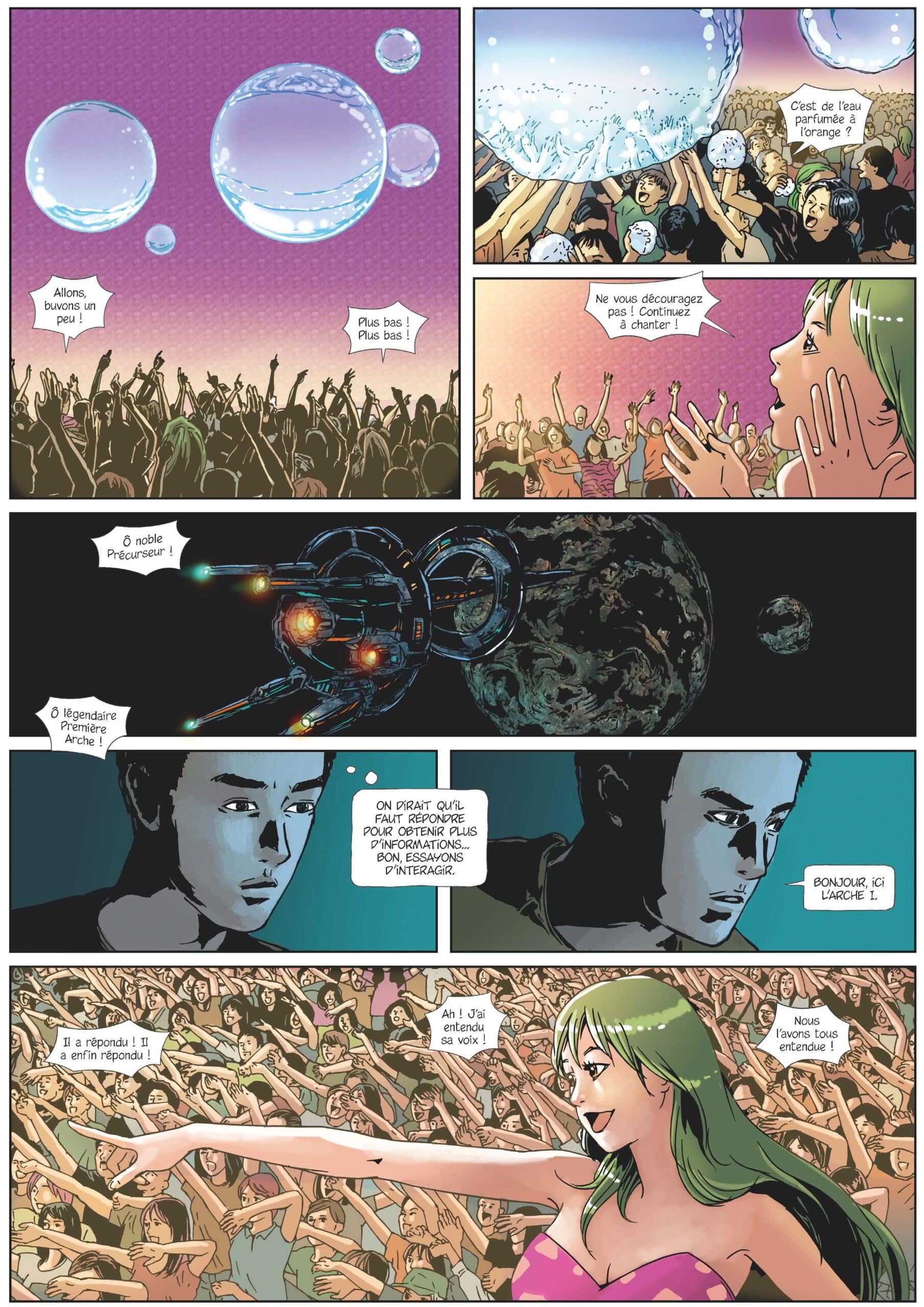
Cet album adapte la nouvelle 微纪元 (Wēi jìyuán / lit. “La micro époque”) publié en 2001 dans le mensuel chinois 科幻世界 (Kēhuàn shìjiè / lit. “le monde de la science-fiction” ou Science Fiction World). Suite à la découverte qu’un flash d’énergie solaire détruira la Terre, plusieurs vaisseaux d’exploration sont envoyé vers des exo-planètes pour vérifier si elles sont habitables. Seul survivant de ces expéditions, Précurseur revient bredouille sur Terre plusieurs millénaires plus tard (due à la relativité qui cause une dilatation temporelle) pour découvrir que le flash a bel et bien rendu la Terre inhabitable. Toutefois, il reçoit des messages vidéos de bienvenue ! L’Humanité a survécu en se miniaturisant et en vivant comme des microbes dans de minuscules cités souterraines. Son retour déclenchera une nouvelle ère de développement pour l’Humanité…

Dans un style graphique agréable similaire à celui des mangas japonais, Liu Wei fait une excellente adaptation d’un récit de hard-science qui est malheureusement ridiculement invraisemblable. C’est néanmoins une lecture agréable. À lire tout de même par curiosité.

L’Humanité invisible (Les Futurs de Liu Cixin, #13), par Liu Wei (Scénario d’après une nouvelle de Liu Cixin). Paris: Delcourt (Coll. Néopolis), juin 2023. 78 pages, 21.6 x 29.2 cm, 17.95 € / $36.95 Can, ISBN 978-2-413-03803-0. Pour un lectorat adolescent (12+). stars-2-5

Vous trouverez plus d’information sur les sites suivants:

[ AmazonGoodreadsGoogleNelliganWikipediaWorldCat ]

© 2021 FT Culture (Beijing) Co., Ltd. All rights reserved. © 2023 Éditions Delcourt pour la présente édition.


Silo #2-3

Shift (Silo #2)

Shift-cov“In 2007, the Center for Automation in Nanobiotech (CAN) outlined the hardware and software platforms that would one day allow robots smaller than human cells to make medical diagnoses, conduct repairs, and even self-propagate. The technology has an almost limitless capacity for good—but in the wrong hands, it could have an equally boundless capacity for evil.

In the same year, the CBS network re-aired a program about the effects of propranolol on sufferers of extreme trauma. A simple pill, it had been discovered, could wipe out the memory of any traumatic event.

At almost the same moment in humanity’s broad history, mankind discovered the means for bringing about its utter downfall, and the ability to forget it ever happened. With this godlike power at their fingertips, can humanity be trusted to create a new—and better—world? Or is it doomed to bring about its own destruction?” 

[Text from the publisher]

The Shift omnibus (Silo #2) by Hugh Howey. CreateSpace, January 2013. 603 pages. ISBN 9781481983556.

For more information you can check the following websites:

[ AmazonGoodreadsGoogleNelliganWikipediaWorldCat ]

Capsules

Dust (Silo #3)

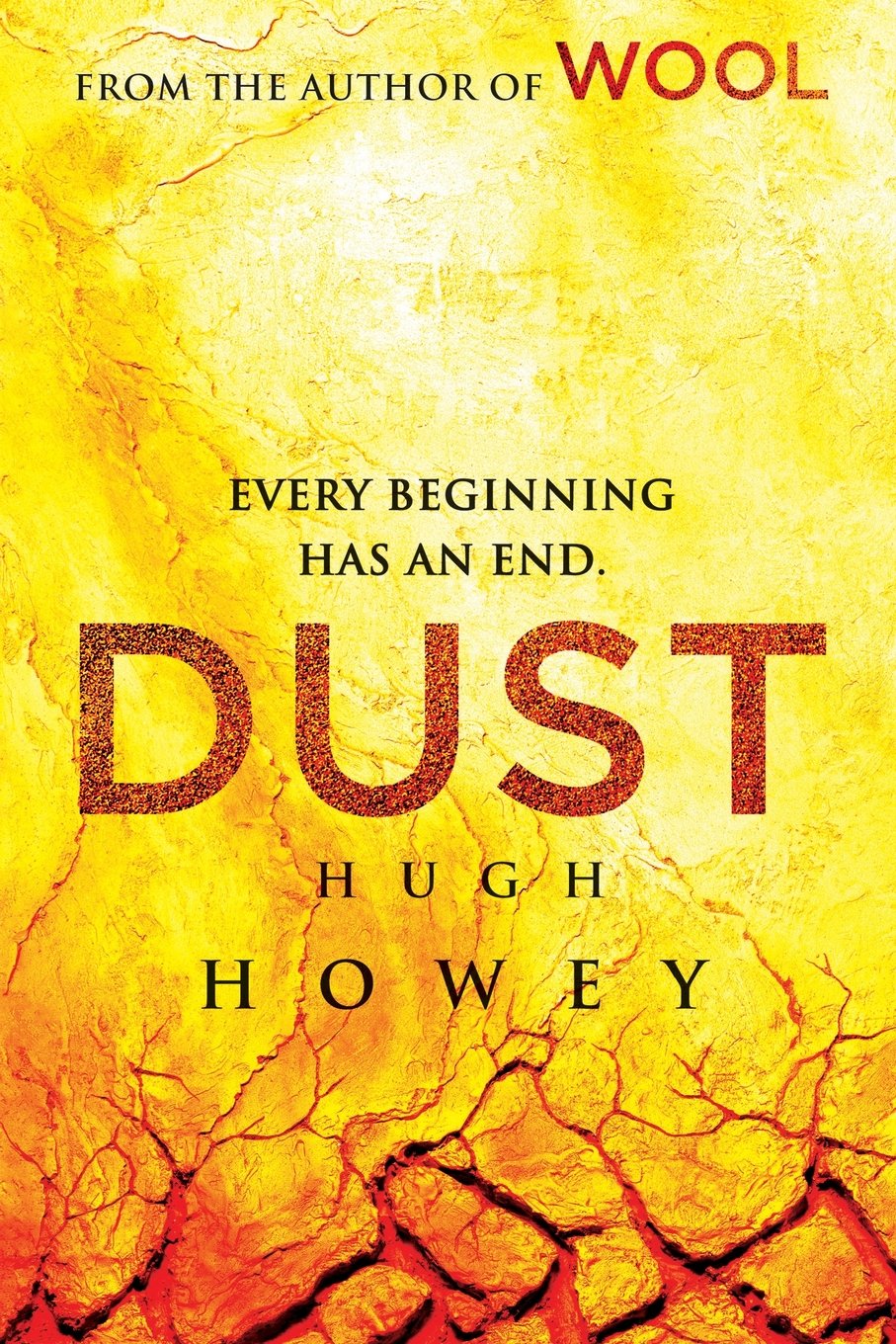
Dust-covWool introduced the world of the silo. Shift told the story of its creation. Dust will describe its downfall. In order for a new world to begin, the old one must fall.

Juliette, now mayor of Silo 18, doesn’t trust Silo 1, especially its leader, Donald. But in the world of the Silos, there is no black and white—everything is shades of gray. Donald may not be the monster Juliette thinks he is, and may in fact be key to humanity’s continued survival. But can they work together long enough to succeed?

In Dust, the final book in the New York Times best-selling Silo trilogy, the choices that Juliette and Donald make could lead to salvation . . . or to the death of everyone on the planet.”

[Text from the publisher; see also the backcover]

Dust (Silo #3) by Hugh Howey. Hugh Howey, c2013. 458 pages. ISBN 9781490904382.

For more information you can check the following websites:

[ AmazonGoodreadsGoogleNelliganWikipediaWorldCat ]

>> Please, read the warning for possible spoilers <<

If you’ve seen the first season of the Apple TV series Silo and you don’t want to know how the story ends STOP READING right now.

In Shift we follow the story of Donald who has just been elected to the U.S. senate. Because he has a background in architecture, he is asked by his mentor, the senator Thurman, to work on a special, secret project. They are building a site to burry nuclear waste near Atlanta and he is asked to design a shelter for the workers in case something goes wrong. It is like a skyscraper with hundreds of levels, but buried into the ground, like a huge silo. Unbeknown to him, Thurman is at the head of an ominous conspiracy. During the war against Iran, he has discovered that the Iranians were working on nanites (or molecular robots) that could target and kill a specific genetic group. To save his country against an eventual attack he decides to develop his own nanites in order to make a preemptive strike. The best way to be ready for an attack is to take the initiative. The silos (not just one but fifty of them, one for each U.S. states) are designed to be an ark to preserve the American culture for several centuries, until the world is habitable again. Thurman organizes the Democratic convention on the site of the silos and then launch an attack forcing each state delegation into its own silo. Silo 1 works differently than the other silos: all non essential personnel (women, children and civilian) have been put into a cryogenic sleep and an administrative crew take shifts to oversee the other forty-nine silos. The memory of everyone is wiped through the use of drugs. “Troy” stops taking his meds and eventually remembers that his name is Donald. His wife, Helen, who was mistakenly taken to another silo, is now long dead. He is not sure why, but he has the feeling that what they are doing is wrong…

The storytelling of this prequel is awkward and is often tedious. The story lacks of the excitements that made the first part a thriller. You are not sure  where it is going and your only reason to continue reading is because you are wondering where it intersects with Juliet story. stars-2-0

With Dust, we pick up again with the story of Juliet. She made it back to Silo 18 but she is determined to rescue her new-made friends from Silo 17. Below Mechanicals, she discovers a digging machine that she uses to excavate a tunnel toward Silo 17. Unfortunately, the digging and the coming of strangers in the silo disturb the order of things and the legitimacy of Juliet as mayor is contested. Lukas and Juliet struggle to maintain order. In Silo 1, Donald discovers the true intentions of Thurman but he is discovered and arrested. Thurman decides to put an end to Silo 18 which trigger a mass exodus toward silo 17, which Thurman doesn’t know is still functional but lacks the resources to sustain its new population of refugees. With the help of Charlotte, Donald’s sister, would Juliet be able to save the survivors of Silo 17 and 18 ?

This third book brings an interesting conclusion to the series. Like Wool, the first volume, it is a thriller that keeps you on the edge of your seat, flipping through the pages as fast as you can read to discover what will happen next. It is a good story that offers a warning against environmental disaster, warmongering, the misuse of science and extreme political ideals that can only lead to destruction. I feel it is a kind of allegory mirroring the political situation of the U.S. where each states live in its own “silo” competing against each other instead of working toward a common goal. The story isn’t as much entertaining as it is a source of reflexion, but you still enjoy it because you have become attached to the characters and care for their survival. I am wondering what the TV series will do with all this… stars-3-5

© 2013 Hugh Howey.

[ Traduire ]