Old Books (Part 3): Historia Augusta

Something funny happened on the way to the forum antiquarian book fair this weekend. Or, actually, at the antiquarian book fair. I found a book that I had been looking for for a long time and that I thought I would never find: a 17th-century Latin edition of the Historia Augusta.

For eight years, I worked on my Master and PhD thesis dedicated to the “Vita Veri” (a biography of the Roman Emperor Lucius Verus) which is part of the Historia Augusta (a compilation of biographies of Roman emperors from the 2nd and 3rd centuries probably written in the 4th century CE, supposedly by six authors: Aelius Spartianus, Vulcacius Gallicanus, Julius Capitolinus, Trebellius Pollio, Aelius Lampridius and Flavius Vopiscus). Therefore this book has a great sentimental value for me. It is only the first of two volumes, but that’s the one that counts for me since it’s the volume containing the “Vita Veri.”

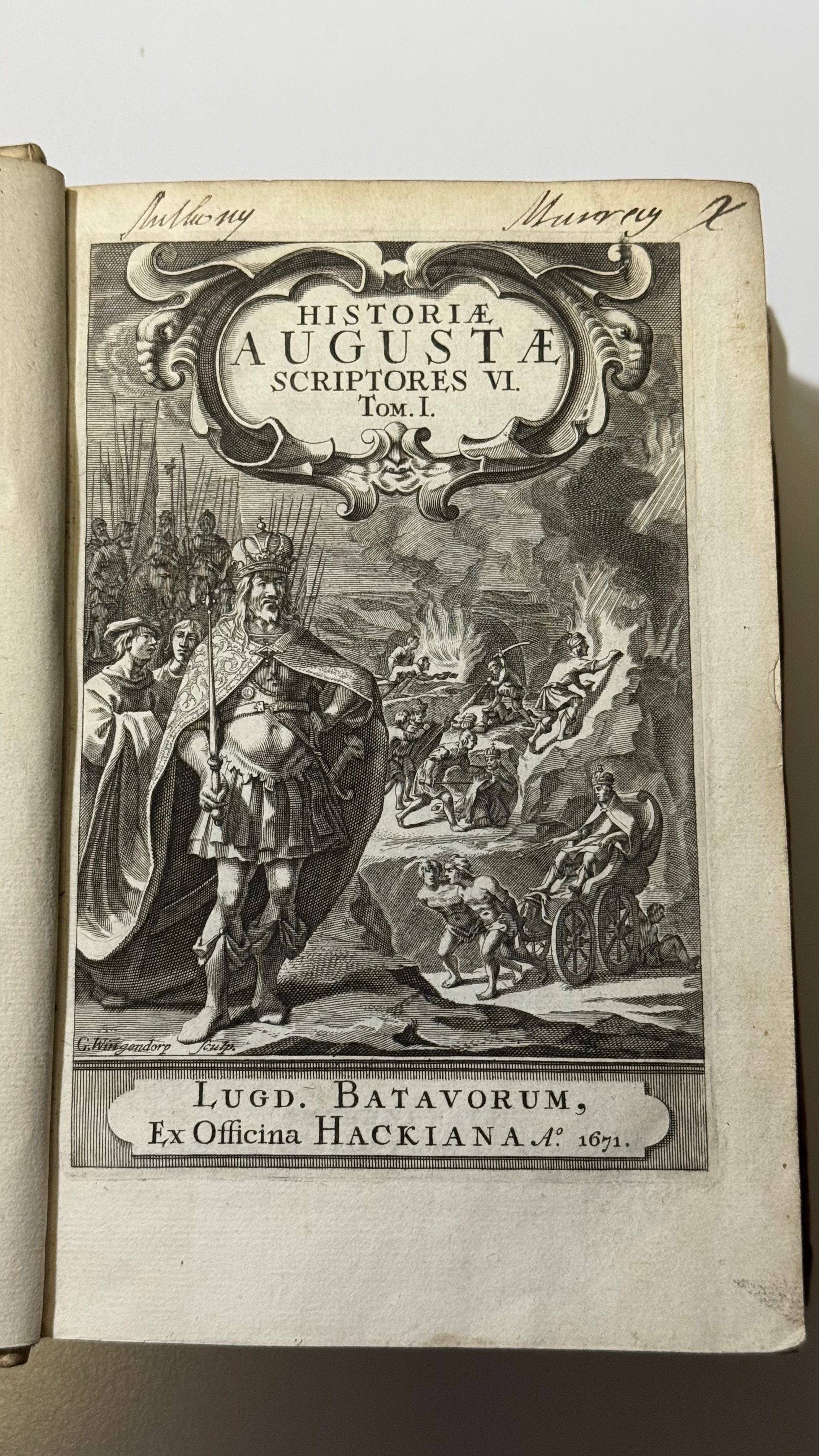
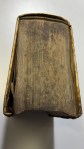
The book is a vellum-bound volume (of two), in small quarto (12.6 x 19.7 x 6.4 cm), with 1,144 pages (16 of introductions, 1049 of text and 79 of indexes). The title page offers this information:
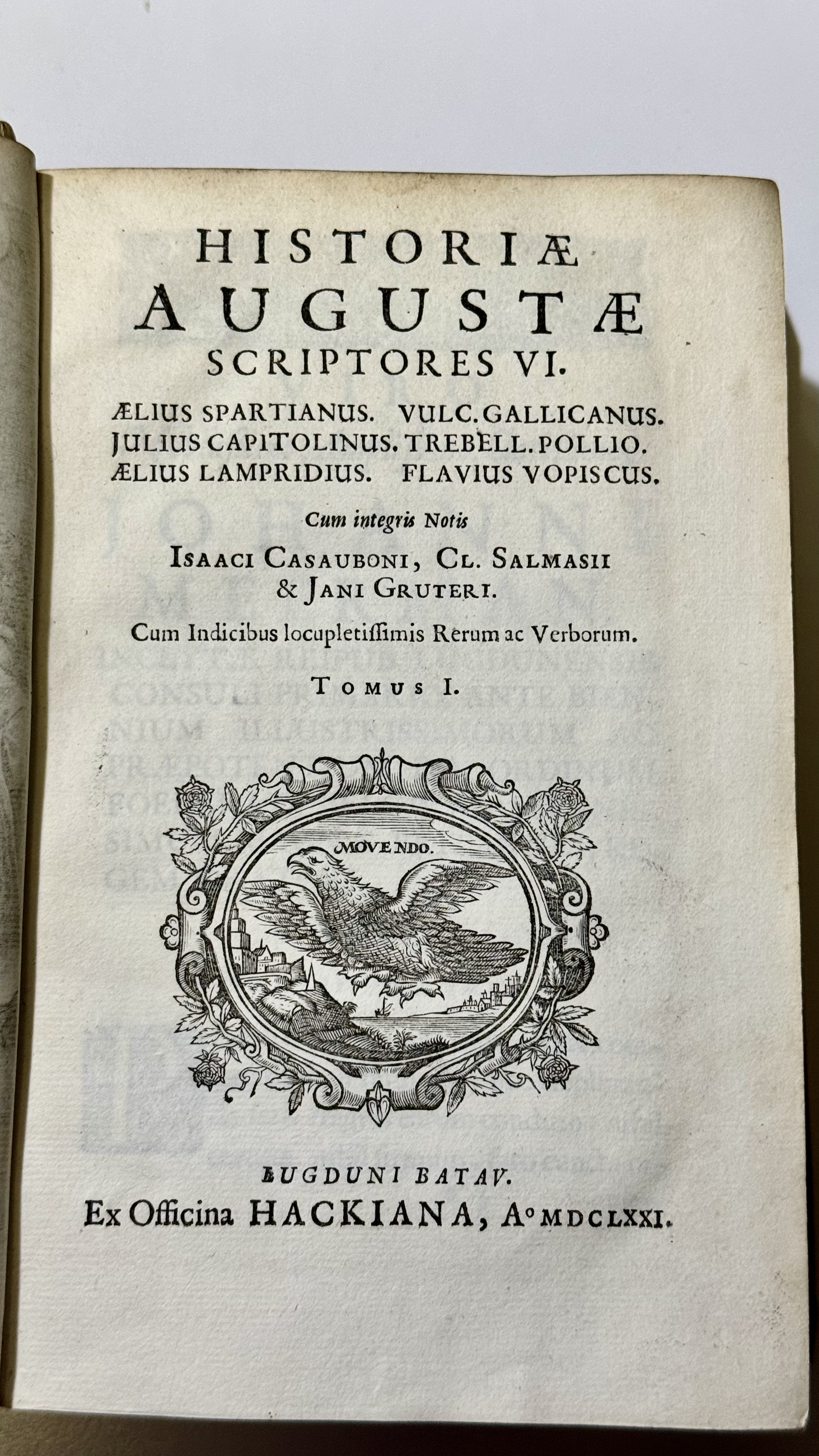
HISTORIAE AUGUSTAE
SCRIPTORES VI
.

AELIUS SPARTIANUS. VULC[acius] GALLICANUS.
JULIUS CAPITOLINUS. TREBELL[ius] POLLIO.
AELIUS LAMPRIDIUS. FLAVIUS VOPISCUS.
Cum Integris Notis
ISAACI CASAUBONI, CL[audi] SALMASII
& JANI GRUTERI.
Cum Indicibus locupletiffimis Rerum ac Verborum.

TOMUS I. [of 2]

LUGDUNI BATAV[orvm]. [Leiden, Netherlands]
Ex Officina HACKIANA [Johannes Hackius], A•MDCLXXI. [Anno 1671]

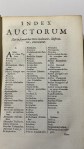
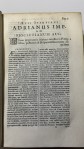
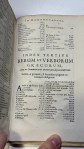
This first volume contains two introductions (one introduction by the publishers and a preface to the readers), an index of the authors cited, the biographies of Roman emperors from Hadrian to Severus Alexander (including erudite commentaries by Isaac Casaubon, Claude Saumaise and Jan Gruter), and concludes with three indexes (the first of “memorable things and words” from the text, the second of “memorable things and words” from the commentaries and the third of the “Greek things and words which occur in the commentary and is worthy of remembrance”).  It was published in Leiden (Netherland) by Johannes Hackius in 1671.

The book is in suspiciously good condition for the price (listed as $175 USD or $220 CDN, but the guy let me have it for $180). It also has a superb vellum binding and a beautiful engraved frontispiece. The seller listed the condition as “Very Good.” He describes it on his online catalogue as having “little staining to the binding. One page is lacking a portion to the right-side margin, not affecting text. There is very little foxing or staining throughout.” [That Guy With The Books]

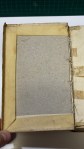
The book clearly had some restoration (which were not disclosed by the seller). If you look at the inside of the binding, you can see that it was reinforced with modern cardboard. The very small amount of foxing and staining made me doubt for a moment of the authenticity of the book (there are forgeries on the market), so I looked closely at the ink and texture of the paper. It all seems alright to me (but I’m not an expert) and the seller is a reputable one, therefore I should trust him, and concluded that the book should be genuine.

This is not one of my oldest books (in fact it is the most recent I have for the 16-17th century period) and I already have an in quarto. However, its very good condition and the fact that it’s about a subject that is quite dear to me, make it one of my most precious books (along with the works of Lucian of Samosata).

[ AbeBooksHathitrustThat Guy With The BooksWorldCat ]

On the subject of “old books” you can find more information in those articles:

[ Traduire ]

Antiquarian Book Fair 2025

Like every year, this week-end I went to visit the Antiquarian Book Fair (EventBrite, CLAQ, Le Devoir) hold at the Concordia University in September. I always hope to find something interesting, but I also dread to find something interesting because it will means that I will spend too much money.

To ensure that I greatly reduce the chances of spending money, I give myself very strict criteria for purchasing a book: I am looking only for 16th or 17th century editions of classical latin authors that are under two-hundred dollars !

I had a quick look around the room, and right at the beginning I found an interesting book: the Annals (Ab excessu divi Augusti Historiarum Libri) by Tacitus, in three volumes, for $250. Unfortunately, it was slightly over budget (but 3 volumes!) and only an 18th century edition with a veal on cardboard binding. Too recent for my taste.

After checking a little more than half of the tables, I hit the mother load. The table of Zubairul Islam, also known as That Guy With The Books. He always has interesting stuff, but usually quite expensive. I immediately noticed two latin in folio (I’ve always dreamed to have an in folio) that were, as expected, too expensive:

  • An illustrated compilation of the plays by Plautus (Ex emendationibus, adque commentariis Bernardi Saraceni, Ioannis Petri Vallae Plauti comoediae XX), 1511, in folio, Condition: Poor. $1,534.00 USD [That Guy With The Books]

He also had something quite rare: a load of books from Japan (and, of course, in Japanese). Most quite expensive, but some affordable (but, since I can’t read Japanese — and, even for Japanese people, the old script can be quite difficult to read — there was no use buying any however interesting they were). Although one was really interesting as it was some sort of encyclopedia explaining, with lots of illustrations, how to do stuff, but, even if it was in a bad shape, it was old and must have been quite expensive (so I didn’t even bothered to ask the price).

Then I saw something that really made me regret to have come to the book fair. A book that I have been looking for for years and that I thought I would probably never find: an old latin edition of the Historia Augusta ! That’s the book I was studying for my Master and my PhD ! I was so excited that my hands were shaking (or my sugar level was crashing, I am not sure which) ! It was the first of two volumes (emperors biographies from Hadrian to Severus Alexander) published in Leiden by Johannes Hackius in 1671. It was a small in quarto of over a thousand pages, in very good condition and with a superb vellum binding. It was listed at $220, so slightly over budget, but, seeing I was hesitating, the guy offered it to me at $180. I couldn’t refuse, so I took it right away ! (I will talk of this book more in details in a separate blog entry).

I reluctantly finished to go through the rest of the room, hoping I would not find anything else interesting. I didn’t. 

Why purchase an expensive book that I can’t even read ? For the simple joy of having in my hands a beautiful, precious object, a cultural artifact of human history. It’s like hanging on the wall an expensive painting or putting a trinket ornament on a bookshelf. Just for looking at it and thinking about all the people who have also hold it in their hands before me…

For information on previous Antiquarian book fairs you can check to following links: Antiquarian Book Fair / SLAM. You can also check the updated list of my old books collection

[ Traduire ]

Jeudi nature en images [002.025.268]

Plantes mystères apparues dans le jardin

[ iPhone 15 Pro, domus, 2025/07/14 & 09/02 ]

Une autre plante qui a mystérieusement commencé à pousser dans le jardin cette année. J’ai fini par l’identifier comme étant un chou-rave (Brassica oleracea var. gongylodes / Kohlrabi en anglais / コールラビ [毬茎甘藍 / korurabi] en japonais). Il en existe une quarantaine de variétés de différentes couleurs. La boule constitue un légume dont le goût rappelle celui du navet (toutefois, si l’on tarde à la cueillir, comme ici, la tige devient fibreuse). Il se cuisine cru, râpé en salade, ou cuit dans des potages, ragoût ou simplement sauté.

[ iPhone 15 Pro, domus, 2025/09/02, 17-18 ]

Différentes variétés de Cucurbitacées qui ont poussées d’elles-mêmes dans le jardin cette année et que nous ne pouvons pas identifier… Courge? Citrouille? Kabocha?

[ Translate ]

Images du mer-fleuri [002.025.267]

Canna indica

[ iPhone 15 Pro, domus, 2025/09/16-17 ]

Canna  / Indian shot / ダンドク (Dandoku)

Cette plante a mystérieusement commencé à pousser parmi nos fleurs. Graine portée par le vent ou un oiseau? Déjà présente dans la terre d’un pot qui a été acheté ou reçu en cadeau ? Qu’importe,  maintenant nous pouvons en profiter. • This plant has mysteriously begun to grow among our flowers. Was it a seed carried by the wind or a bird? Already present in the soil of a pot that was purchased or received as a gift? No matter, now we can enjoy it.

Jeudi nature en images [002.025.261]

Marmota Monax

[ iPhone 15 Pro, Parc Frédéric-Back, 2025-09-16 ]

Marmotte / Groundhog / ウッドチャック

Cette marmotte n’était vraiment pas gênée. J’ai pu l’approcher à près de deux pieds sans qu’elle ne fuie. C’est comme les pigeons sur mon balcon qui n’attendent plus que le chat ait fini de manger pour venir tenter de picorer dans son assiette! Soit qu’ils se sont habitués aux humains ou alors ils se foutent de nous, car ils savent que nos heures sont comptées sur cette planète! • This groundhog was really not bothered. I was able to approach it to within two feet without it running away. It’s like the pigeons on my balcony who no longer wait for the cat to finish eating to come and try to peck at its plate! Either they’ve gotten used to humans or they’re making fun of us, because they know our hours are numbered on this planet!

Images du mer-fleuri [002.025.260]

Diverses fleurs / Various flowers

[ iPhone 15 Pro, VSP, Août-Sept. 2025 ]

Helianthus annuus / Tournesol / Sunflower / ヒマワリ
Oenothera biennis / Onagre bisannuelle / Common evening-primrose / メマツヨイグサ
Cosmos bipinnatus / Cosmos / Garden cosmos / オオハルシャギク
Ipomoea purpurea / Volubilis / Common morning-glory
Symphyotrichum novae-angliae / Aster de N.-A. /  New England aster / ネバリノギク

À l’approche de l’automne, mon jardin (et tout le quartier) est encore plein de fleurs ! / As fall approaches, my garden (and the whole neighbourhood) is still full of flowers!

Anime & manga updates [002.025.256]

Anime & manga updates

Manben: Otomo

Urasawa Naoki & Otomo Katsuhiro

Another update on Manben: The latest episode of the NHK World documentary series Manben: Behind the Scenes of Manga with Urasawa Naoki (which introduces us to mangaka like Morohoshi Daijiro, Shigeru Mizuki, Nishi Keiko, Chiba Tetsuya, or Iwamoto Nao) is about Otomo Katsuhiro, the internationally renowned legend who created a masterpiece that shaped and revolutionized manga. Urasawa discuss his work with Otomo over the original pages of his manga Domu.

The episode originally aired in Japan on March 24, 2025, but the English version just aired on September 12 and 13, 2025 and is now available to view as VOD (Video on Demand) until September 27, 2025.

Paper film: The curious origins of color Anime

“Much of the first animation came out of France in the early 20th century, but developed mainly in the United States with the rise of film. In Japan, black and white animation began in the nineteen tens, but colour didn’t become prominent until the nineteen sixties. Except for a brief little-known chapter. A U.S. researcher has rediscovered and successfully restored coloured anime created here in the nineteen-thirties. (…) In the 1930s, Japan produced animated movies on paper, not celluloid. A U.S. professor has been restoring existing films, which were known for their full color.”

This news story aired on September 4th, 2025 and is now available as VOD. The 7-min. clip is also available on Youtube.

Adapting Anime Costumes for Live-Action

Direct Talk interviews the stylist and costume designer Nakahara Sachiko who “translates the looks of popular Japanese anime and manga characters into costumes for live-action adaptations. She talks about making an impact on the global stage.” The show aired on July 22, 2025 and is now available as Video On Demand (VOD) until July 22, 2026.

History Uncovered: The Hiroshige Code

“Influential ukiyo-e artist Utagawa Hiroshige‘s “100 Famous Views of Edo“, a series of prints encoding his view of the changing face of Japan.”  Art historian Toshinobu Yasumura, Professor Timon Screech, Hinohara Kenji and Manabu Oishi discuss, interpret and explain the messages hidden in Hiroshige’s art. This episode of “Time and Tide” aired on August 30, 2025 and is now available as Video On Demand (VOD) until August 29, 2026.

[ Traduire ]

Jeudi nature en images [002.025.254]

La récolte du jour / Crop of the day

[ iPhone 15 Pro, Domus, Été 2025 ]

Tout au long de l’été, notre jardin (arrière et le balcon avant) nous a donné une abondante et constante récolte surtout de tomates (pour assiette de crudités, salades, sauces et ragouts), fèves, raisins et pommes (ces deux derniers ensemble font une excellente confiture!). Sans compter les nombreuses fleurs pour colorer le jardin et enjoliver notre table… Et ce n’est pas encore terminé.

[ Translate ]

Jeudi nature en images [002.025.247]

Évolution du jardin – Été 2025

[ iPhone 15 Pro, Domus, Été 2025 ]

Un jardin est un espace en constante évolution qui peut passer en quelques mois (d’avril à août) de cour stérile à jungle chaotique. Si certains préfèrent les jardins bien ordonnés, celui-ci est un condensé de biodiversité conçu pour être non seulement agréable à l’oeil avec une variété florale parfois bien cachée (principalement, selon les saisons, tournesol, cosmos, gloire du matin [Volubilis], tagète, capucine, hosta, monarde, muguet, topinambour, aster, marguerite, camomille, rudbeckie, tulipe, jonquille, échinacée, souci, consoudre, etc.) mais aussi productif (cette année seulement framboises, raisins, pommes, tomates, tomates cerises, fèves, choux frisé, courges, basilic, menthe, shiso, roquette). Un jardin est vivant par ses végétaux, bien sûr, mais aussi par la riche faune qu’il abrite ou attire (au grand dam de certains voisins): de nombreux insectes (abeilles, bourdons, guêpes, coléoptères et lépidoptères), gastéropodes (limaces, escargots), oiseaux (moineaux, bruants, pigeons, cardinals, etc.) et même mammifères (chats, marmottes, écureuils, mouffettes, ratons, mulots, souris, rats, etc.). C’est un espace indispensable à la santé du corps et de l’esprit…

[ Translate ]

Images du mer-fleuri [002.025.246]

Althaea officinalis

[ iPhone 15 Pro, Parc Frédéric-Back, 2025/07/21 ]

Guimauve sauvage / Marshmallow
ウスベニタチアオイ [薄紅立葵 / Usu beni tachiaoi]

J’ai d’abord cru qu’il s’agissait d’une variété naine de rose trémière (Alcea rosea / hollyhock), mais la “Recherche Visuelle” de l’application Photos d’Apple m’a rapidement dirigée vers la bonne identification. Cette ressemblance n’est pas surprenante puisque les deux fleurs appartiennent au même ordre (Malvales) et à la même famille (Malvaceae) mais à deux genres différents: alcea (trémière) et Althea (guimauve). Cette proximité est d’ailleurs mise en évidence dans le nom japonais de la guimauve: trémière (tachiaoi) rouge (beni) claire (usu).

[ Translate ]