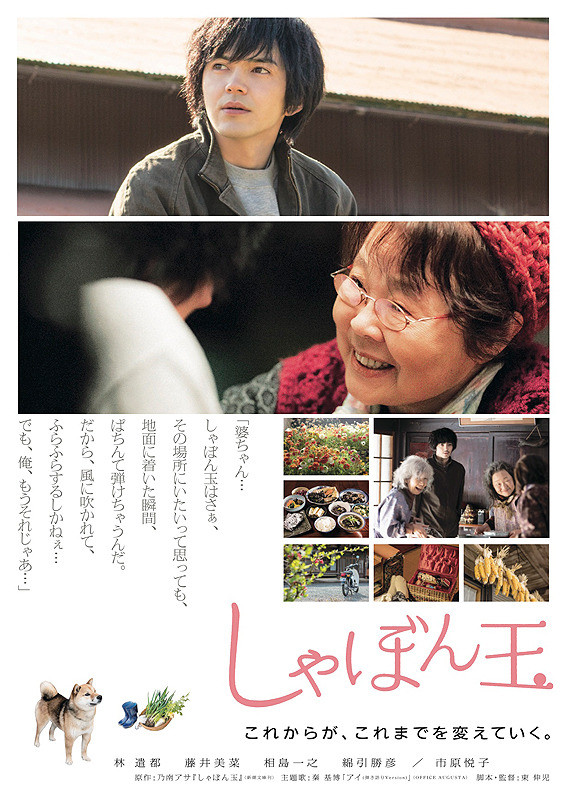
After committing robbery, Shoto’s flight from the cops takes him to the mountains of Miyazaki in southern Japan where he helps an injured elderly woman. This serendipitous encounter will softly coax him into changing and set him on the path to redemption. The Japanese countryside comes to life through beautiful cinematography in this simple and unhurried reflection on what it means to have a place where to belong.
A petty criminal (who was shaped by his environment or bad parenting) do something bad, escape to the countryside, feels guilty, meet with nice people, sees the error of his way and seeks redemption… I must say that Where I belong doesn’t feel very original as we’ve seen this type of movie often in Japanese cinema. However, it is still a nice feel-good movie. It offers a touching story, which is beautifully shot and with good acting. It’s an entertaining flick that offers a good time. Nothing more. The best part is probably that it is showcasing the nice landscapes of Miyazaki and giving us a glimpse at the Shiiba Heike Festival.
The 36th edition of the Japanese Film Festival will be held from Friday September 20th to Sunday September 22nd at the Cinémathèque québécoise (335 De Maisonneuve Blvd East, Montreal, QC). This annual event is presented by the Japan Foundation in collaboration with the Consulate General of Japan in Montreal. It offers four free Japanese movie screenings (in Japanese with English subtitles; Limited seating is available on a first-come, first-served basis; no reservations required).
Where I belong (しゃぼん玉 / Shabondama): Japan, 2016, 108 mins; Dir./Scr.: Shinji Azuma (based on a novel by Asa Nonami); Phot.: Wataru Miyamoto; Ed.: Shinya Tadano; Cast: Kazuyuki Aijima, Mina Fujii, Kento Hayashi.
After committing robbery, Shoto’s flight from the cops takes him to the mountains of Miyazaki in southern Japan where he helps an injured elderly woman. This serendipitous encounter will softly coax him into changing and set him on the path to redemption. The Japanese countryside comes to life through beautiful cinematography in this simple and unhurried reflection on what it means to have a place where to belong.
Friday September 20 at 6:30 p.m. / 18h30
The Night I Swam (泳ぎすぎた夜 / Oyogisugita yoru): Japan/France, 2017, 79 mins; Dir.: Kohei Igarashi / Damien Manivel; Phot.: Wataru Takahashi; Ed.: William Laboury; Music: Jérôme Petit; Cast: Takara Kogawa, Keiki Kogawa, Takashi Kogawa.
In the early hours of the morning in snowy northern Japan, a boy is woken up by the noise of his father leaving for work. Later, the boy deviates from the path to school and heads towards the fish market where his father works. This Japan-France coproduction has no dialogue, no narration, but instead captivates its audience with the power of images and everyday sounds, revealing in poetic silence the charming simplicity of a child’s world.
Saturday September 21 at 2:15 p.m. / 14h15
Drowning Love (溺れるナイフ / Oboreru naifu): Japan, 2016, 111 mins; Dir.: Yûki Yamato; Scr.: Yûki Yamato, Kishu Izuchi (based on the manga by George Asakura); Phot.: Takahide Shibanushi; Ed.: Kenichi Hirai; Cast: Nana Komatsu, Masaki Suda, Daiki Shigeoka, Mone Kamishiraishi, Nazuki Amano, Mickey Curtis, Masami Horiuchi.
Two of Japan’s rising stars take on the roles of a teenage fashion model from Tokyo and a successor to a family of Shinto priests, portraying together dreams of freedom and fragile teenage love, intense and tragic.
When a timid high school math whiz unwittingly unlocks a rogue AI program able to destroy the real world, calling on the bonds of family and human compassion might be the only way to counter this menacing mayhem. A timely 10th anniversary screening of this Mamoru Hosoda and Madhouse masterpiece which seamlessly blends the beauty of traditional Japan with Superflat colorful computer graphics.
Monday morning, the president of the Montreal World Film Festival, Serge Losique, has announced in a brief press release that “the festival will take a break this year to better prepare the 2020 edition”. The statement mentions Losique’s poor health as the reason for this year’s cancellation of the event. This comes to no one’s surprise as the festival had been declining severely in the last few years and it was plagued with financial troubles. Let’s hope that the festival will indeed use that time to recover and that the gap will not mean the death of this once-famed international event. They also said that more details on the 2020 edition will follow shortly.
I am disappointed because I was looking forward to have my yearly dose of Japanese cinema. However, it was to be expected. I should have made arrangements to free myself to attend the Fantasia festival instead…
The 23rd edition of the Fantasia International Film Festival, the top genre film festival in North America, will be held (mostly) at the Concordia Théâtre Hall from July 11 to August 1st 2019. The festival will open with Hideo Nakata latest movie, Sadako. It will also showcase over an hundred feature films & shorts in horror, sci-fi or fantasy genres and many filmmakers and actors will be attending to introduce their production — including Yamamoto Kiyoshi (Director of Brave Father Online – Our Story of Final Fantasy XIV), Yaguchi Shinobu & Kanekoa Ryon (director and producer of Dance with me), Makoto Tezuka (dir. of The Legend of the Stardust Brothers), Takahiro Umehara (dir. & writer for Moon in the hidden woods), Nao Yoshighai (retrospective), Oshiyama Kiyotaka (dir. of the short Shishigari) and Keita Amemiya (dir. of Garo and speaker of the Master Class on Wed July 31, 2019 7:00 PM at the York Amphitheatre). Tickets will be available at Concordia’s box office and online starting July 6th.
Movies from all over the world will be presented (including five from China, five from Hong Kong, twenty-four from South Korea and two from Taiwan), but here we are interested mostly in the forty-five production from Japan:
This year there’s lots of horror and lots of shorts, many anime and a few titles to watch closely (like Human Lost, The Relative worlds, Garo, Gintama 2, and The island of cats).
The 35th edition of the Montreal Japanese Film Festival will be held on Friday November 30th and Saturday December 1st at the Cinémathèque québécoise (web). There will be three Japanese films screened for free. The event is presented by the Japan Foundation (Toronto) and the Consulate General of Japan in Montreal. The films are in Japanese with English subtitles. Seating is limited and will be available on a first-come, first-served basis. No reservations is required but you’ll need to take a ticket at the box-office.
Close-Knit (彼らが本気で編むときは、/ Karera ga honki de amu toki wa / lit. “When they seriously knit”): Japan, drama, 2017, 127 mins; Dir.: Naoko Ogigami.
After being abandoned by her mother, 11-year-old Tomo is taken in by her uncle and his transgender girlfriend. Close-knit offers a heart-warming reflection on discrimination and ignorance and, more importantly, on the true meaning of family.
The young members of a competitive karuta (classic Japanese playing cards) team stand together against the odds and the emotional turmoil they face, seeking to capture and hold on to a treasured moment forever. Can they overcome their opponents?
La La La at Rock Bottom (味園ユニバース / Misono Yunibasu) : Japan, Drama, 2015, 103 min.; Dir.: Nobuhiro Yamashita.
Redemption is key in this humorous story about an amnesiac thug turned singer. A powerful and moving tale that reveals human complexity, baring charms and faults alike, and will make anyone want to believe in second chances. Added bonus: great musical moments!
The 47th edition of the Festival du Nouveau Cinema (FNC) will be held in various Montreal theatres (Cinema Impérial, du Musée, du Parc, Quartier Latin, Theatre Maisonneuve, Cinémathèque Québecoise, etc.) from October 3 to 14, 2018. In their own words, this festival is a gathering to “celebrate our shared passion for film, (…) for cinema of all types, from offbeat, one-of-a-kind niche works to crowd-pleasers to daringly innovative big events”.It is “resolutely forward-looking, has long been the unfailing advocate of new technologies“ making it “the best place around to preview the cinema of tomorrow”!
This year, it will offers over three-hundred movies including ten from Japan (click on the links for details & schedule):
There was no scuffle to get the credentials, no problem with the schedule or screenings and an excellent selection of titles.
Of course, it could be better. Apparently they brought back the Movie Market (and the press room?). I heard it was on the third floor of the Imperial, but couldn’t find how to get to it… In the past, they were always the practical places to access press information and to be able to screen video on our own schedule. However, what I really miss is the press conferences where we could have direct access to the film crew and cast of the movies in competition. Beside that, for me, the festival is already all I needs it to be.
As long as there’s good movies to watch, people should be happy. At least, as long as there’s Japanese movies, I’ll be happy. Although, come to think of it, the festival deserves a bigger audience. In the past, I used to see lots of people from the local Japanese community, but I saw very few of them this year. Most of the movie I’ve screened this year had barely an audience of a dozen people! Of course, there was absolutely no advertising this year and very little media coverage, so it certainly didn’t helped. And the last couple of years have had a fair share of scheduling and screening problems which might also have discouraged people from attending this year. If there is a festival next year (the same question come back every year lately), this really must be improved.
Another needed improvement, beside more advertising, would be more screens. The festival could use at least a couple more rooms of the Quartier Latin (if not the entire floor like in the good old years). However, for that to happen, the festival would need more budget. Not to put on lavish parties, but to make sure that all the movies can be screened at least a couple of times. Why not giving the festival a chance and give it again at least some subsidies?
The festival certainly has its share of detractors. People who don’t think it can improve or who want to see something else in its stead. Strangely, most of the criticism seems to come from the anglophone community (for example, the articles in The Gazette appears to be quite hostile). However, I don’t think that the majority of people in or around the local movie industry want the festival to continue in its downward spiral of death. But we don’t want a glamorous festival like Cannes or Toronto either (yeah, it’s nice to see Brad Pitt or the latest blockbuster with its load of stars, but what’s the use if that movie is gonna by in all theatres two weeks later?). Personally, I want a festival where I can see movies I couldn’t see anywhere else. Movies from all around the world. A festival that gives their chances to young or unknown directors, to small productions. A festival that doesn’t exclude stars, but that is not built around them. That’s what the festival was in the past and I think this formula can still works. There is no other festival like this one. And we can still mend its wounds. We must. Of course, every parties will need to water down its position a little. The government (local, provincial or federal) must look past previous disagreements and accept to provide a little help. And Losique needs to let go of his creation and prepare some sort of succession. Pass on the mantle while still remaining in the background to provide his knowledge and wisdom. If he doesn’t do that, the festival will surely die with him… We’ve seen a little improvement this year, so let’s hope it can continue in that direction…
All in all, this year, I’ve succeeded to watch five of the eight Japanese movies. I am pretty happy with this score. The selection included a great variety: a samurai movie, a docudrama-style movie, a comedy, a yakuza movie and a biopic — I wish I could have added to my score card the documentary, the action movie and the scary co-production!And almost all the titles I’ve seen were good movies — save one which was a disappointment. Beside this last entry, I was able to write seven articles (including five movie comments) about the festival (which represents more articles than La Presse, Le Devoir or The Gazette each wrote about the FFM !).
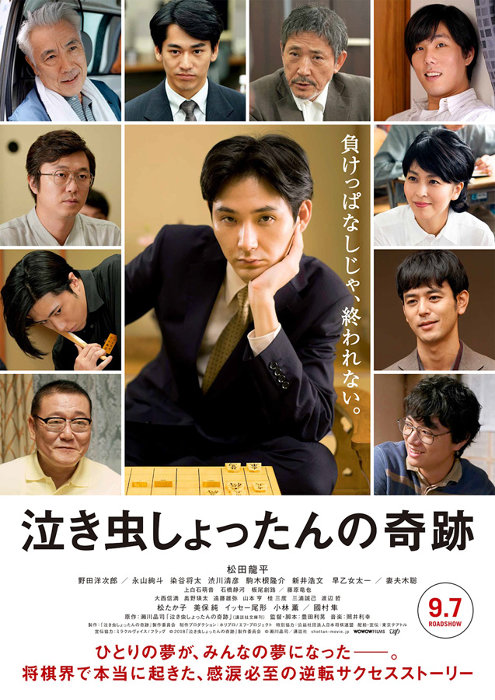
Based on the true story of Shoji “Crybaby” Segawa, a talented player of shogi, a Japanese variant of chess. After rising quickly in a shore-kai, an organization that supervises professional shogi status, Shoji fails to fulfill the ironclad requirement of reaching the 4th rank by age 26. With the encouragement of his friends, he sets out to achieve the impossible: to be the first amateur to become a shogi professional. (FFM)
WARNING: May contain traces of spoilers! People allergic to the discussion of any plot’s elements before seeing a movie are strongly advised to take the necessary precautions for their safety and should avoid reading further.
This is a great feel-good movie based on the autobiographical book about the incredible career of Shoji Segawa, a Shōgi player. Shōgi(将棋 / “The game of generals”) is a Japanese strategy board game very similar to chess (as you have a king, surrounded by his gold generals, his silver generals, rook and bishop, knights, lances and finally pawns pieces). We often see this type of “sport competition” story (where sport is often replaced by any possible type of occupation) in manga or anime (the best similar example is Hikaru no Go manga by Yumi Hotta & Takeshi Obata, which is about Go, but there are plenty of manga about shōgi likeMarch Comes in Like a Lion) but it is rare to see this type of story in a live-action movie.
The movie has a strong cast of stars, so it is not surprising that the acting is quite good (although I’ve notice poor performances in the case of some minor characters). The photography is good enough (it’s not always optimum, but I guess it’s due to the attempt to give the picture a look of the 70s or 80s). The storytelling is, however, excellent considering that it is not easy to make such a subject interesting and to keep the attention of the audience while showing two guys sweating over a board game! The upbeat music and some comedic devices are very helpful for that.
Shoji Segawa (nicknamed Shottan) is a shy, introverted boy who has been interested in playing shōgi since elementary school. Encouraged by his school teacher and his father (Jun Kunimura), he improves his skill playing against his neighbour Yuya. They both go to a shōgi dojo where they are tutored by the local master (Issey Ogata). He is known for sometime crying after a game (hence the other nickname of “crybaby”). Learning that you can become a paidprofessional player of shōgi, Shottan (Ryuhei Matsuda) decide to apply to the shore-kai (the Japan shōgi Association’s apprentice school) but he doesn’t give his all and fails to reach the 4-dan level by age 26. A good part of the movie is dedicated to showing him agonizing over his chance of success (despite being a little overconfident) and over his failures. He finds himself in his late 20s, with no high school diploma, no job and becomes depressed. He eventually finds a salaryman job, but keeps playing shōgi for pleasure. He becomes quite skilled as an amateur player and, eventually in his 30s, gets some fame as the amateur who keep beating professionals (a miracle record of 17 wins and 5 losses!). He then starts fighting for the JSA to give him a second chance at becoming professional…
Strangely, nowhere in the movie they talk about the rules or strategy of the shōgi game. I guess, if the movie is solely aimed at a domestic Japanese audience, they assume that everyone know them. Anyway, the knowledge of the game is totally irrelevant to the story. The movie is more about fighting for your dream, learning the discipline (not being too distracted) and to play for the right reasons (not to win but just for the pleasure of it). It is interesting to note that the director, Toshiaki Toyoda, attempted himself to become a professional player when he was younger.
All in all, The Miracle of Crybaby Shottan is an upbeat biopic that provide a very good entertainment. Well worth watching.
The Miracle of Crybaby Shottan (泣き虫しょったんの奇跡 / Nakimushi Shottan no Kiseki): Japan, 2018, 127 mins; Dir./Scr.: Toshiaki Toyoda (based on the autobiographical novel of Shoji Segawa); Phot.: Norimichi Kasamatsu, Kôji Naoi; Ed.: Masaki Murakami; Prod.: Ryo Otaki, Kyôichi Mori; Cast: Ryûhei Matsuda (Shoji), Yôjirô Noda (Yuya), Shota Sometani, Kento Nagayama, Satoshi Tsumabuki, Kiyohiko Shibukawa, Ryusuke Komakine, Hirofumi Arai, Takako Matsu, Issey Ogata, Kaoru Kobayashi, Jun Miho, Jun Kunimura.
Screened at the Cineplex Quartier Latin 13 (Thu. 8/30 at 21:30) as part of the “Focus on World Cinema” program of the 42nd Montreal World Film Festival. There was a little more than half-a-dozen people in the theatre.
Junpei, 21, is a lower-ranking yakuza. One day, his boss assigns him the mission to kill a high-ranking yakuza of a rival group. Junpei, who wants to be recognized by his clan, agrees. Junpei meets OL Kana and they spend the night together. He evokes with her the task that awaits her, and she is both worried and excited. She stays with him for three days until he carries out his mission. (FFM)
WARNING: May contain traces of spoilers! People allergic to the discussion of any plot’s elements before seeing a movie are strongly advised to take the necessary precautions for their safety and should avoid reading further.
This is a good movie for the younger crowd. It’s a yakuza movie with an existentialist tone. I don’t have anything bad to say on this movie: the photography is nice and clean, the acting is good, the storytelling fluid, the music is catchy and support well the story. However, I feel that there is something missing. It has all the looks of a feel-good movie and yet it ends badly for the main character (not surprising in a yakuza movie after all).
Junpei is a young wanna-be yakuza. He worships his aniki(“big brother”) and would do anything for him. However, he has a good nature, too good for him, as he likes to help people and has strong principles. In order to help a friend who has been wronged by a real-estate agency, he pays them a visit and play the tough yakuza. Unfortunately, the place is ran by a rival group. This initiative probably displeased his big boss because, not long after, he is asked to make a hit against a rival boss with little chance of survival. He is given money and told to enjoy himself for the three days before the scheduled hit.
A young woman working at the real-estate agency, Kana, noticed him and is impressed by his guts and looks. They hook up, make love — and fall in love. He goes back to his hometown to see his mother, they help a homeless man, etc. During all that time, Kana is tweeting (or using some equivalent app) their every moves, they every mood, and the tweetosphere is reacting, pondering weather killing people is bad (who still order hits on their competition, anyway?), how romantic they are, that they should forget the hit and elope, will Junpei survives the hit, etc. They plan to leave for a tropical island after it. Junpei goes ahead with the plan, because he is too loyal to avoid his responsibilities, even if he was told that his boss was using him to get promoted…
However, the boy Junpei is now a man. A good man who does the right thing (for a yakuza). He loves a woman. He takes his own decision. He has nothing to regret. In three days he has lived a whole life, more than many could boast for their entire existence. What is to live, but to live fully? And yet it feels sad. What a waste, some could say. But a yakuza’s story has an inescapable end. Is there a point to all of this?
I really enjoyed this philosophical yakuza movie. It’s both entertaining and food for thoughts, particularly for the younger generation who still have a life to live! It is well worth watching.
Screened at theCinema Imperial (Thu. 8/30 at 16:30) as part of the “World Great” (Out of Competition) program of the 42nd Montreal World Film Festival. There was a little more than a dozen people in the theatre (but I was told that there was about fifty people in the previous day’s screening).
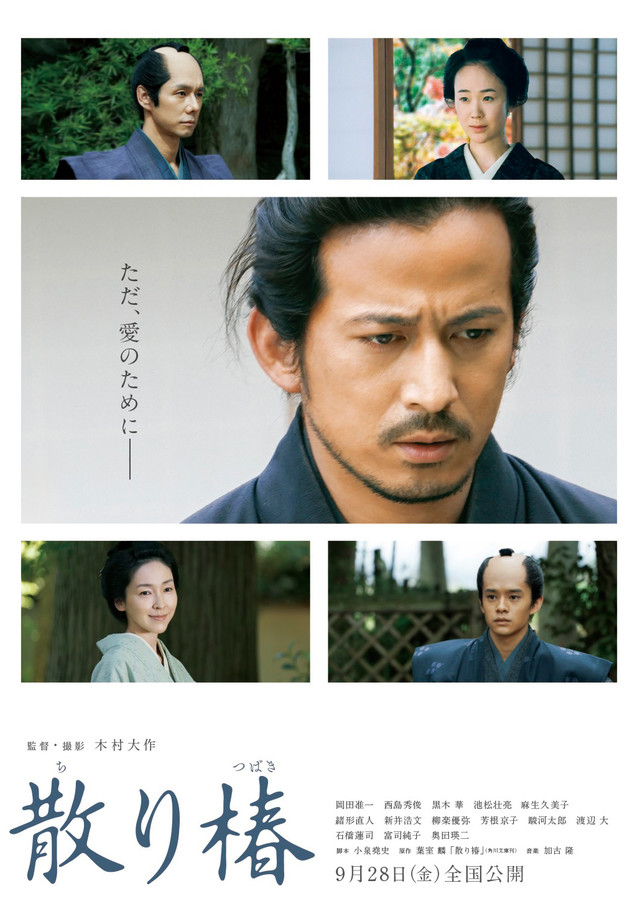
Shinbei is exiled from his clan for investigating its activities too closely. Eight years later, when Shinbei’s dying wife pleads with him to go to help his former best friend, Umeme, he returns to the clan. Infighting has produced turmoil within the clan, allowing Shinbei to discover the truth behind incidents involving his wife and his friend. Confronting Umeme, he understands the reason for his wife’s last wish. (FFM)
This is a very good movie. Its most noticeable aspect is that it offers an excellent photography (which is not surprising since director Kimura acted as his own photography director, a job he has hold many times for other directors like Kinji Fukasaku, Yasuo Furuhata, or Shin’ichirô Sawai). He made great use of the superb location in the Toyama Prefecture (anciently the Etchû province) showing as backdrop the fantastic landscape of the Hida mountains in the Northern Japanese Alps.
Another aspect that I quickly noticed was that the music was unfortunately very annoying. They used a soundtrack of classical music (which first accords sounded like The Godfather’s music by Nino Rota), playing it again and again recurrently. I think that, for a jidaigeki (samurai movie), a soundtrack of traditional Japanese music would have been better…
Shinbei (Jun’ichi Okada) is exiled from the clan after denouncing as corrupt a high-ranking officer of the clan — who is later mysteriously murdered leaving all the suspicion of culpability on Shinbei. Both Shinbei and his friend Uneme (Hidetoshi Nishijima) were courting Shino (Kumido Aso), but when Uneme’s family denies him the permission to wed Shino, she goes with Shinbei instead. The harsh condition of their exile put a toll on Shino’s health who eventually dies. She makes Shinbei promise to continue living, to go back to their village to observe the camellia falling in spring and to reconcile and help Uneme. When he tries to clear his name and find out the real assassin, he gets entangled in the complex politics of the clan…
Samurai’s Promise is a beautiful and interesting samurai movie. It has a smooth storytelling, although it is sometimes difficult (at the beginning) to understand who’s who and figure out all the plots and politics at play. The acting is good, and particularly the nice realistic combat scenes. It must not have been easy considering the fact that there was many fights in the rain or snow and that the dialogues were using an old form of Japanese.
Of course, we should expect nothing less from such a veteran director. During his sixty-year career, Daisaku Kimura worked on over fifty films and won many awards. He started his career as camera assistant on Akira Kurosawa’s Hidden Fortress(1958). Heworked five years with him (on movies like Yojimbo and Sanjuro) and he learned a lot during this time. Eventually, he cames to direct his own movies (Mt. Tsurugidake in 2009 and Climbing to Spring in 2014), mostly about mountain climbing. Samurai’s promise is his first jidaigeki and he made it as a tribute to Kurosawa. It is a beautiful and authentic movie, well worth watching. These days we don’t see much movies like this…
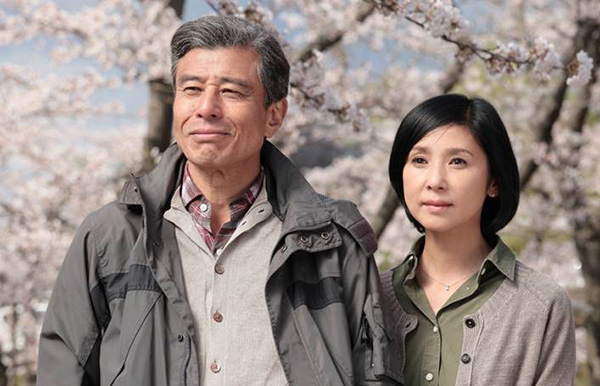
Sosuke Tashiro has a successful career in a large bank until he is transferred – or rather relegated – to a subsidiary until retirement. After decades of dedication to his work, he is lost and idle. He then decides to resume a professional activity, but realizes that the challenge is daunting. Over the course of two meetings, at the gym and at the adult education center, his life is on the move again. (FFM)
This is exactly the type of Japanese movie that I like the most: some sort of family drama that touches us (and often makes us cry) but which, in the end, makes us feel good and laugh. It is so perfectly enjoyable! And the seamless storytelling, the bright, well-framed and beautiful photography, as well as the nice soundtrack (particularly the beautiful song 「あなたはあなたのままでいい」 [Anatawa Anatano Mamadeii / “You can stay as you are”] by Miki Imai) really show the mark of an experienced filmmaker. Strangely, Hideo Nakata is mostly known for his horror movies (Ring, Chaos, Dark Water, Kaidan, etc.) so it is really surprising to see him direct for the first time a more traditional Japanese comedy! This is probably his way to tell us that he is not finished yet and that he can be a polyvalent creator. He does that brilliantly. Unfortunately, he didn’t arrive in time to present the movie and do the Q&A for the first screening at 11:30, and that was a great disappointment for me (I knew I should have gone to the 21:30 screening!). The quality of the production as well as Nakata’s fame makes of Life in Overtime a great contender for the competition. It is surely the best Japanese film I’ve seen at the festival so far this year.
Sosuke studied at the top university in Tokyo and finds himself on the path for an executive position at a large bank, but gets beaten by a rival and ends up finishing his career at a subsidiary branch. He already feels he’s a failure but, when he retires, he finds himself with no hobbies, no dreams, no job and no sympathy at home! What to do? He feels “Retirement is like a premature funeral (…) I don’t want my life to end like this!” It’s like the game is over but you continue to play in overtime in hope to finish on top (I like this idea)!
He tries to find a new purpose in order to make up for his failures. He looks for a new job but his impressive resume torpedoes his efforts. He considers going to graduate school to study literature, makes an attempt at a new romance or, after a chance meeting with the CEO of an IT company, try to start a new career but without any success. However, does it really matter as long as you have a life to enjoy?
Nakata succeeds in giving a realistic depiction of life struggles and relationships while tackling one of the hot topic of the decade: with its aging population, Japanese society has to deal with an ever increasing number of retirees. To keep them mentally and physically fit, it is important to make sure they feel their life is not finished yet and that they can make their experience or expertise valuable and useful to the society. It’s also a challenge on the domestic level as many couples, who never spent lots of time together because they were too busy working, find out that they don’t know much about what to do with each other! Retirement can surely be a shocking change but it is certainly not the end of your life (personally, I know very well that I’ll probably be even busier once I retired — in about 3192 days!). However, for some people, not knowing what to do or not feeling useful anymore can be an horrific experience and, in that aspect, maybe this is an horror movie after all…
Life in overtime, with its sadness and joy as well as its beautiful scenery, gives us plenty to ponder and an excellent movie experience. It is certainly a must see.
Kindergarten teacher, Chinatsu is always in a state of stress. And it is at this moment that a pupil of her class is murdered. Totally distraught, Chinatsu begins to sink into a world of illusion that she can not control. (FFM)
I don’t know what they have put in the water of that city but all the characters in this movie offer a whole catalog of mental illness: Chinatsu, a kindergarten teacher, cracks under the pressure brought by all those helicopter parents and develops schizophrenia; her acupuncture doctor, Yuichi, suffers from Capgras syndrome; Naoto, a salesman bullied by his seniors, has nomophobia; Akamatsu, the convenience store clerk, suffers from Asperger; Mitsuki, Haruka’s mother, suffer from Munchausen syndrome, etc. I guess it was the purpose of the director to show with this docudrama-style movie what it is to have such illness and how difficult it can be for the families.
It is a very dark movie and the end result is, unfortunately, barely average. The storytelling is awkward and not particularly skillful, the photography feels amateurish and the acting is so-so — although, the main actress is very charming and switching the actors who plays the two Yuichi toward the end of the movie in order to unexpectedly show the schizophrenia of Chinatsu is, I must say, quite brilliant. Also, the movie is really not well served by the poor translation (in the subtitles). When I noticed two typos in the very first sentence of the movie, I knew that this would spell trouble! (unless they made it on purpose to make us feel crazy!) If it was not already obvious with the production quality, the horrible translation really smelled of tiny budget…
Finally, to really give a last pathetic impression, the absence of a translator for the Q&A at the end of the presentation (due to the minimalistic ressources of the festival this year — what? they couldn’t even find a volunteer to take up the task?) left the poor director and main actress at the mercy of their basic English language skills and made for such a laughable exchange that you could only feel sorry for them.
However, undertaking such a difficult and serious subject requires some strength. I understand what the director was trying to achieve and I greatly appreciate his efforts (for that I give him extra points!). In a society that was repressed for so long, where you find a real epidemic of bullying (both at school and at the work place, including sexual harassment) and where an aging population is plagued by various forms of dementia, it is really not surprising to find that mental illness has become a great challenge in Japan today. Kudos to the director for trying to bring attention to this problem.
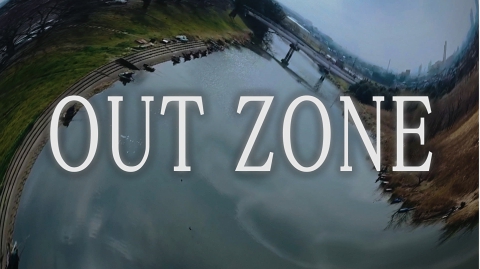
Zone Out / Regarder dans le vide (アウトゾーン / Out Zone): Japan, 2017, 115 mins; Dir.: Hiroshi Kanno; Scr.: Mari Takanashi; Phot.: Makoto Hayashi; Ed.: Aya Mitsuaka; Light.: Sousuke Yoshikado; Sound: Kazuyuki Tutiya; Mus.: Magumi Masui; Cast: Minami Matsunaka (Chinatsu), Masato Oki (Yuichi Akino), Kyoko Toyama (Kyoko), Gen Kuwayama (Naoto), Yusuke Ueda (Akamatsu), Yusuke Sugiyama (Yuichi Kagawa), Ben Hori (Hisashi Aoyama).
Screened at the Cinema Imperial (Sat. 8/25 at 16:30) as part of the “World Great” program (out of competition) of the 42nd Montreal World Film Festival.
This year the Festival des Films du Monde (FFM or MWFF, Montreal World Film Festival) strangely seems slightly more organized (at least for the accreditation) than the previous couples of years. They are probably getting used to extreme austerity and benefits from plenty of movie aficionado volunteers. Also, there’s more Japanese movies than last year (but still less than the usual dozen). Unfortunately, since there are only four screens (Cinéma Impérial and Quartier Latin 10, 12 & 13) to show ALL movies, they are shown only once (twice for the titles in competition) and mostly in the afternoon — which is not compatible with my own schedule, so I’ll probably end up viewing only half of the Japanese movies. Too bad, but that’s better than nothing!
However, I was happy that the title selected as opening film was one of the Japanese movies: Samurai’s Promise. No one from the cast or crew was present for the opening ceremony, although there was plenty of actors & actresses from other Japanese and Chinese movies (as well as local dignitaries) parading on the red carpet.
Red carpet photo gallery
Japanese cast
Japanese actress
Chinese actress
Serge Losique & Silvio Caiozzi
Cast for “Ghost Mask”
Line-up
Red carpet with Losique
Red carpet with Losique
Red carpet with Losique
The only speech was given by the president of the festival, Serge Losique. He seemed tired, but still defiant (although slightly apologetic):
“The festival is a great cathedral open to all. Our role was not to imitate whoever but to be ourselves, to be authentic. (…) Our role was also to helped small unknown countries, like Cape Verde or Sri Lanka [to promote their films]. All we want is for the public, and the journalists, to appreciate the films.”
He continues saying he doesn’t want the glamour of the other festivals but only to showcase the diversity of the world cinema. That’s why it is the “Festival des Films du Monde” [also a word-play in French meaning the festival of the people]. People are asking for stars, he says, but the stars here are the films. He also argues that the directors and actors who come to Montreal are stars in their own countries, and many more have been discovered here, at the festival, and are now stars! [I might add that I’ve seen plenty of great stars at the FFM over the years: Catherine Deneuve, Sofia Loren, Jackie Chan, Robert de Niro, Tony Curtis, Mamoru Oshii, etc.]
He also announces the new policy for the festival to chose as president of the jury a director that has previously won the Grand Prix of the Americas. Also the jury members will not necessarily be present at the festival but will screen the titles in competition via video link (although the president of the jury will always be present in Montreal). He introduces the members of this year’s jury (critic Élie Castiel, Pierre-Henri Deleau, an executive from China Film Group Corporation and another jury whose name will be revealed at the end of the festival) as well as its president, Silvio Caiozzi [Chilean director, winner of last year’s Grand Prix des Amériques], who also said a few words:
“From the beginning this festival always chose nothing but films of cinematographic excellence. Nowadays, I can feel that around the world somehow (…) [in the movie industry] the true quality of films is not looked upon, really. What they look upon is (…) what film has the big budget (…) or the politics (…) but not really the quality of the films. So, really, honestly, (…) in my opinion this is perhaps the only festival that still remains absolutely independant.”
Opening ceremony video
(I understand what Serge Losique is saying here. He is trying to explain and justify his position. The festival is his life-work, his baby, and he doesn’t want to relinquish its control. Indeed, if you accept public money you have to show transparency and do things the way the government wants them to be done… Unfortunately, if he doesn’t step down, pass the mantle to someone else soon (while maybe remaining on board as advisor), the festival will die with him…)
The theatre was not full, like we’ve seen for previous years, but considering the situation, it was full enough (maybe half?). Surprisingly, there was not that many people from the local Japanese community.
It was a short ceremony, a good movie (see my separate comment), the weather was nice, Radio-Canada / CBC was there to report on the event so, all in all, it was a good day for the festival.
The 42nd Montreal World Film Festival will be held from August 23rd to September 3rd 2018. So far there is only seven eight Japanese films listed in the line-up. We will add more details as they are available.
Of course, the festival has had financial troubles for sometime and run on a very minimal staff, so we shouldn’t expect a smooth operation. It will certainly not be better than last year. But the most important part of the festival is that there is movies to watch. This year it will be the nineteenth year that we are covering this movie festival and we hope that it will recover from this difficult period and prosper for many years to come.
Two Japanese movies won an award: Samurai’s Promise by Daisaku Kimura won for the Special Grand Prix of the Jury (Ex-aequo) and Hiroshi Tachi won the Best Actor award for his role in Life in overtime by Hideo Nakata.
The 22nd edition of the Fantasia International Film Festival will be held in Montreal from July 12th to August 2nd 2018. It specializes in animated and live-action genre cinema (fantasy, horror, action, science-fiction, etc.), but mostly horror and asian action movies. It will open with Daniel Roby’s “Dans la brume” (a Canada-France co-production). As usual, the festival will be offering “over 125 features and 220 shorts, featuring the premieres of more than 100 cutting-edge visions from across the world.”
The asian movies line-up (our main interest here) includes eight movies from China (six from Hong Kong), twenty-four from South-Korea, one from Vietnam and, of course, twenty-eight from Japan (including six anime). Here’s the list of Japanese movies:
Fireworks (2017, Akiyuki Shinbo & Noboyuki Takeuchi, 89 mins) adapted from the mid-’90s live-action TV series created by Shunji Iwai. [Vimeo, Wikipedia]
It is interesting to note that a large majority of those movies are manga or novel adaptations. I am particularly interested in seeing The Travelling Cat Chronicles and Tremble All You Want — unfortunately I don’t have time to attend the festival… Check the festival website for more details (description, cast & crew info, schedule, location, etc).
Comme a chaque année la « Japan Foundation » de Toronto et le Consulat Général du Japon à Montréal ont le plaisir d’offrir gratuitement des projections de films japonais. Veuillez noter que la bande originale japonaise est sous-titrée en anglais. Les places sont limitées et seront attribuées selon le principe « premier-arrivé, premier-servi », sans réservation préalable.
The 41st Montreal World Film Festival (FFM) is now over. This year was a slim pick for the Japanese cinema aficionado since there was only two Japanese movies (two others were co-productions with non-Japanese directors). Besides that, the festival went smoothly for me. However, the only question remaining above our heads is: will there be a festival next year? Of course Serge Losique wants to be reassuring and said that the FFM was here to stay. He even announced the dates for the next two years: August 23rd to September 3rd 2018 and August 22nd to September 2nd 2019 !!
One of the event that I would have liked to attend (but couldn’t by lack of time) was the press conference and Master Class held at L’Astral by Chinese Martial Art Filmmaker Xu Haofeng (The Hidden Sword) on Monday August 28th. It seems that it was one of the rares (if not the only one) press conference held at the FFM this year. I really miss those… (and the film market and the press room!)
The closing film of the festival was a surprise to be announced after the awards, just a few hours before its free screening. It was meant as a gift for the movie fans.
A press release announced the awards for the 48th Student Film Festival: for the Canadian competition it went to Land by Samiramis Kia (York University, Toronto) and for the International competition it went to Elene by Seven Kayhan (Koç University, Istanbul, Turkey).
Another press release announced the awards for the festival itself: the Grand Prix of the Americas (Best Film) went to And Suddenly the Dawn by Silvio Caiozzi (Chile) and the Special Grand Prix of the Jury went to Dear Etranger by Yukiko Mishima (Japan). Check the press release for the other awards.
To summarize, I’ve seen and commented on two Japanese movies:
Based on the novel from Kiyoshi Shigematsu, this is the story of Makoto Tanaka, a 40-years-old who has remarried. His wife is Nanae and they care for 2 daughters from Nanae’s prior marriage. Makoto tries to have an ordinary family but Nanae becomes pregnant and things are bound to change.
WARNING: May contains trace of spoilers! People allergic to the discussion of any plot’s elements before seeing a movie are strongly advised to take the necessary precautions for their safety and should avoid reading further.
Dear Étranger is an average Japanese family drama: it’s both funny and sad, offers excellent acting but is rather slow moving. It’s a touching story about Makoto, a man in his forties, who has remarried and must deal with the difficulties of a blended family. He has one pre-teen girl (Saori) from a previous marriage (with Yuka). His new wife, Sanae, has two daughters (Kaoru, a tweenager, and Eriko, a preschooler) from her own previous marriage (with Sawada, who used to beat her and the children). When she gets pregnant, the delicate balance of their couple is challenged. Of course, in such situation, the children are suffering the most (with emotional or psychological stress). Can they really call themselves a “family”? Can he call himself a “dad”? Can he succeeds to keep a good relationship with BOTH his tweenage daughters? Or is he just a “dear stranger” to them?
The movie tackle quite realistically many aspects of the modern Japanese society: divorce, one of its causes (domestic violence) and one of its increasingly frequent consequences, the stepfamily. Divorce in Japan is relatively similar to what it is in the West (although there is no joint custody). Still not as frequent as in the West, the Japanese divorce rate has been steadily increasing (up to one in three marriages, quadrupling the rate of the post-WW2 era — mostly among retiring-age couples) but it has recently started to decrease due to a corresponding diminution in marriages (men are too busy at work and don’t feel economically confident enough to seek marriage and have children). The Japanese society is evolving and it is not surprising that we also see an increase in the number of female movie directors, who are more likely to want to use sociological theme in their storytelling.
I cannot pass over in silence the superb inclined elevator that regularly appears in the film. The Nashion inclined elevator (ナシオン斜行エレベーター / Nashion shakō erebētā) is located in Higashiyamadai, Nishinomiya (Hyōgo prefecture) near Kobe and Osaka. Many scenes were shot in that area. It offers a beautiful scenery but might also symbolise the hardship of the main protagonist as he must step up to resolve his delicate situation.
Anyway, when you put together two interesting writer and script-writer, a skilled director (who already came to the FFM in 2014 with A Drop of the Grapevine) and a great cast of actors, you can only get a good movie. And, apparently, the Jury of the 2017 Montreal World Film Festival agreed with this, since they awarded Dear Étranger with the Special Grand Prix of the Jury (a kind of “second best” award).
Dear Etranger (幼な子われらに生まれ / Osanago Warera ni umare / lit. “Children born to us” or We’re having a Baby): Japan, 2017, 127 mins; Dir.: Yukiko Mishima; Scr.: Haruhiko Arai (based on a novel by Kiyoshi Shigematsu); Cast: Tadanobu Asano (Makoto Tanaka), Rena Tanaka (Nanae), Shinobu Terajima (Yuka), Raiju Kamata (Saori), Sara Minami (Kaoru), Miu Arai (Eriko), Kankurô Kudô (Sawada), Shingo Mizusawa, Narushi Ikeda.
Film screened at the Montreal World Film Festival on Friday September 1st 2017 (Cinema Imperial, 19:00 — the attendance was about an hundred people) as part of the “World Competition” segment. Shinji Sakoda, the international sales representative from Pony Canyon, was there to introduce the movie.
For more information you can visit the following websites:
Eight years have passed since the Akihabara massacre. A pop star whose mother was killed in the incident, a teenager who left her home of Akihabara, a delivery boy who turns his anger to the city. This is a story about the characters striving to grasp the string of hope within the darkness surrounding the city, the incident, and the people.
WARNING: May contains trace of spoilers! People allergic to the discussion of any plot’s elements before seeing a movie are strongly advised to take the necessary precautions for their safety and should avoid reading further.
In this movie we see Japan like we rarely see it in movies: people being poor, homeless, destitute, at their wits’ end. Japan is interiorizing everything, hiding the pain, the ugliness and sometimes the boil needs to burst. The Akihabara massacre wasn’t the cause of anything, it was a symptom. It also shows the ugly underside of Akihabara, the low level idols that are struggling, the delivery guys who deliver goods by feet because they lost their driving licenses in accidents, the almost-sex industry exploiting young girls, etc.
This docudrama is interesting because this director is willing to show us what others wouldn’t dare: the price Japan is paying for past economic crises and for a rigid society that must always preserve the appearance. Unfortunately, this young director is lacking the skills to express all this in a beautiful, well-organized manner. The result is a loud (it’s called noise isn’t it?), disjointed, awkward, disorganized movie. There are too many characters, scenes transition that comes without warning or coherence which makes the story quite difficult to follow. However, it is compelling and the actors’ play is excellent.
It is a hard movie that requires patience like most unpolished gems. In the end, it gets easier to understand as we get to know each character better. Noise has potential with such an interesting subject and its great acting, but it unfortunately doesn’t succeed to be artistically good enough. However, it is entertaining and well worth watching.
Film screened at the Montreal World Film Festival on August 25th, 2017 (Cinema du Parc 1, 20:15 — the attendance was around fifteen people out of a capacity of about two-hundred seats) as part of the “First Feature Competition” segment. There was no production team member to introduce the movie or do a Q&A.
For more information you can visit the following websites:
There are only four Japanese movies at the Montreal World Film Festival this year. You will find bellow all the details we could find on each of them:
World Competition / Film en compétition
Dear Etranger (?????????? / Osanago Warera ni umare / lit. “Children born to us”): Japan, 2017, 127 mins; Dir.: Yukiko Mishima; Scr.: Haruhiko Arai (based on a novel by Kiyoshi Shigematsu); Cast: Rena Tanaka, Tadanobu Asano, Miu Arai, Narushi Ikeda, Raiju Kamata, Kankurô Kudô, Sara Minami, Shingo Mizusawa, Shinobu Terajima.
Based on the novel from Kiyoshi Shigematsu, this is the story of Makoto Tanaka, a 40-years-old who has remarried. His wife is Nanae and they care for 2 daughters from Nanae’s prior marriage. Makoto tries to have an ordinary family but Nanae becomes pregnant and things are bound to change.
Eight years have passed since the Akihabara massacre. A pop star whose mother was killed in the incident, a teenager who left her home of Akihabara, a delivery boy who turns his anger to the city. This is a story about the characters striving to grasp the string of hope within the darkness surrounding the city, the incident, and the people.
Schedule : Cinema du Parc 3 — Fri 08/25 10:00 / Cinema du Parc 1 — Fri 08/25 20:15 / Cinema Dollar 1 — Sat 08/26 21:00.
Focus on World Cinema / Regards sur les Cinéma du Monde
Nightscape : S. Korea / Japan, 2017, 71 min.; Dir.: In-chun Oh.
Based on a true event. There was a new team chasing after a suspicious Taxi. It started with just a small suspicion. But… what happened to them that midnight?
Schedule : Cinema Dollar 2 — Sat 08/26 21:00 / Cinema du Parc 3 — Thu 08/31 12:00 / Cinema du Parc 3 — Mon 09/04 17:00.
No song to sing : Japan / United Kingdom, 2017, 24 min.; Dir./Phot.: Lukasz Gasiorowski; Scr.: Maiko Takeda; Ed.: Masahiro Hirakubo; Mus.: Ewen Bremner; Cast: Make Takeda, Takuji Suzuki, Shinjiro Takahashi, Nobuyuki Kobayashi, Kayo Takeda, Ryubun Sumori, Issei Yamashita, Kenichi Masuda.
Natsu, a professional femme fatale works for a typical Tokyo “Telephone Date Club”. She enjoys selling fantasies to lonely men, but as she becomes emotionally entangled in the web of her own deceptions, she finds herself unable to pay the price of her own merchandise.
Schedule : Cinema du Parc 3 — Sun 08/27 16:00 / Cinema du Parc 3 — Tue 08/29 16:15 / Cinema Dollar 2 — Sun 09/03 21:00.
The 41st edition of the Festival des Films du Monde is offering us this year only ninety-two movies and forty-two shorts from countries all over the world. It might be a reduced formula (no printed program, no press room, no film market) but, still, no other festival could offers such diversity.
The information has finally finished to trickle down and we now know the complete list of the movies to be screened and their schedule. Unfortunately, aficionado of Japanese cinema will feel a little short-changed this year as the lists includes only FOUR Japanese movies:
World Competition (18 movies, including one from Japan: Dear Etranger)
Day 1: I went to see my first movie tonight, Noise. The theatre was almost empty, but that’s to be expected for a Japanese movie on a Friday night. I have taken notes on the bus ride on my way back, and I’ll post my comments on the movie as soon as I can. However, I will not see much movies this year: the one in competition for sure (Dear Etranger), but I’ll see for the other two (a horror movie and a short ?). The first day went smoothly so, even with the minimalist organisation, the festival seems to be doing well (I guess that with the experience of last year’s disaster they were better prepared this time). I hope it will continue and get better in the future. This year is the eighteeth time I have been covering and reporting on the FFM and I wish I’ll reach the twentieth time…
Eight years have passed since the Akihabara massacre. A pop star whose mother was killed in the incident, a teenager who left her home to Akihabara, a delivery boy who turns his directionless anger to the city. This is a story about the characters striving to grasp the string of hope within the darkness surrounding the city, the incident, and the people.
The only Japanese movie in Competition will screen at the Imperial on Friday September 1st at 19:00 with English subtitles and on Sunday September 3rd at 11:00 with French subtitles.
DEAR ETRANGER (?????????? / Osanago Warera ni umare): Japan, 2017, 127 mins; Dir.: Yukiko Mishima; Scr.: Haruhiko Arai (based on a novel by Kiyoshi Shigematsu); Cast: Rena Tanaka, Tadanobu Asano, Miu Arai, Narushi Ikeda, Raiju Kamata, Kankurô Kudô, Sara Minami, Shingo Mizusawa, Shinobu Terajima.
Based on the novel from Kiyoshi Shigematsu, this is the story of Makoto Tanaka, a 40-years-old who has remarried. His wife is Nanae and they care for 2 daughters from Nanae’s prior marriage. Makoto tries to have an ordinary family but Nanae becomes pregnant and things are bound to change.
We are less than a week before the alleged beginning of the 41st edition of the Montreal World Film Festival on Thursday and there is still very little information available about it. Will it even take place?
My guess is that the festival will be even more chaotic than last year and scheduling information will trickle down day by day… But does it really matter as long as we can watch good international movies that we would probably not be able to see anywhere else?
Before the screening of the first movie, A Tale of Samurai Cooking, the attendees were treated with a few canapé and a degustation of sake. There was a presentation by the a staff member of the Japanese consulate in Montreal, followed by allocutions of the Cinémathèque general director, Marcel Jean, and the Consul General in Montreal, Hideaki KURAMITSU.
“Serving the Lord of Kaga not with the sword, but with the kitchen knife, the Funaki family has been known as “Kitchen Samurai” for generations. However, Yasunobu’s lack of culinary skills has placed the Funaki name in peril. To save her new family and its status as “Kitchen Samurai”, Haru decides to teach her new husband the refined art of Kaga cuisine from her point of view. Inspired by a true story.”
WARNING: May contains trace of spoilers! People allergic to the discussion of any plot’s elements before seeing a movie are strongly advised to take the necessary precautions for their safety and should avoid reading further.
This movie is based on a joseiyonkoma (4-panel comic strip aimed at an adult female readership) by Miri Masuda. This style of comic is very popular in Japan. S?-chan “follows the daily lives of women who deal with their anxieties regarding love and work”. It is published by Gentosha and “has sold over 280,000 copies” (up to March 2013). Four volumes have been released between April 2006 and November 2012 (the first volume came out in paperback in August 2009; a preview of the first six pages is available online — opposite: pp. 4-5). (Sources: ANN, Wikipedia Ja)
The movie adaptation, titled Sue, Mai & Sawa: Righting the Girl Ship, is a typical Japanese feel-good movie. However, despite the light tone, it seriously tackles the anxieties of Japanese single women. It tells the story of three women in their thirties who find themselves questioning their life situation and how they more or less succeed to find happiness.
Yoshiko Morimoto, nicknamed Sue-chan, is 34-year-old and works in a coffee shop where she can put to use her talent for cooking. She has feeling for the manager, but her hesitation prompts a younger, more aggressive colleague to secure his love before she can do anything. However, the owner ends up offering her the manager position. She’s insecure at first and makes mistake, but she slowly grows into the responsibility. She has good wisdom and is a great help to confort and give advise to her friends.
Maiko Okamura, nicknamed Mai-chan, is a 34-year-old office lady working in the sales department of an OA manufacturing company. She is stressed by the pressure at work and frustrated with the fact that her affair with a married man is going nowhere. When her dermatologist suggests that she should give up on some of her life’s problems, she decides to dump her boyfriend and registers with a marriage agency. One year later, she is married and pregnant. However, she worries that motherhood would change her, but finally learns to say goodbye to the woman she was and accepts whom she has become.
Sawako Hayashi, nicknamed Sawa-san, is a 39-year-old web designer. She helps her mother take care of the grandmother who’s bedridden and suffers from dementia. She worries that if she ever marry she would leave her mother to do the care-giving by herself. She meet by chance a former classmate and starts going out with him, but when he appears more concerned with having a descendance and requests a “fertility certificate”, she gets angry and dumps him. She comes to term with having to take care of her grandmother.
The movie feels a little like a sketch comedy in the beginning, but it quickly gets structured into a more uniform storytelling. It might have been intentional, in order to allude to the original 4-panel format which is, by definition, a series of short stories ending with a punch. Food is also a recurring theme in the movie (and a theme shared by all three movies screened at the festival this year) as the friends always gathered around a meal to discuss their problems. But since Ozu it seems that food and meals has been a frequent theme in Japanese movies.
All in all, Sue, Mai & Sawa is an interesting movie that provide some reflection about life and a good entertainment.
Sue, Mai & Sawa: Righting the Girl Ship (????????????????? / Sû chan Mai chan Sawako san). Japan, 2013, 106 min.; Dir.: Osamu Minorikawa; Scr.: Sachiko Tanaka (based on the 4-koma by Miri Masuda); Phot.: Gen Kobayashi; Prod.: Yoshitaka Takeda; Cast: Yôko Maki, Shinobu Terajima, Kou Shibasaki, Shota Sometani, Arata Iura, Hana Kino, Gin Pun Chou, Akiko Kazami, Megumi Sato, Mio Uema, Aoi Yoshikura, Ai Takabe.
A Tale of Samurai Cooking: A True Love Story (????? / Bushi no kondate). Japan, 2013, 121 min., drama, dir.: Yûzô Asahara, with Aya UETO, Kengo KÔRA, Kimiko YO, Toshiyuki NISHIDA. Read our comments on this movie.
Haru has an excellent sense of taste and unsurpassed skill in the kitchen, but her impetuous character leads to her husband asking for a divorce after only a year of marriage. One day, she is approached by Dennai Funaki, a samurai chef from Kaga, to marry his son and heir, Yasunobu.
Serving the Lord of Kaga not with the sword, but with the kitchen knife, the Funaki family has been known as “Kitchen Samurai” for generations. However, Yasunobu’s lack of culinary skills has placed the Funaki name in peril. To save her new family and its status as “Kitchen Samurai”, Haru decides to teach her new husband the refined art of Kaga cuisine from her point of view. Inspired by a true story. (Text from the Cinémathèque website)
Drops of Heaven (????? / Ten no shizuku Tatsumi: Yoshiko inochi no sûpu). Japan, 2012, 113 min., documentary, dir.: Atsunori Kawamura, with Yoshiko Tatsumi.
A cooking guru serves wisdom, one soup at a time. In this heartwarming documentary, discover 88-year-old culinary artist Yoshiko Tatsumi and her “Soup of Life”, a soothing dish she ingeniously created for her bed-ridden father. As seasonal crops grow in the beautiful and delicate landscapes of Japan, Yoshiko Tatsumi brings out the best of ingredients, cooking with care to nurture love and joy. (Text from the Cinémathèque website)
Sue, Mai & Sawa: Righting the Girl Ship (????????????????? / Sû chan Mai chan Sawako san). Japan, 2013, 106 min., drama, dir.: Osamu Minorikawa, with Yôko Maki, Shinobu Terajima, Ko Shibasaki. Read our comments on this movie.
A heartwarming drama based on Miri Masuda’s comic strip series, Sue, Mai & Sawa: Righting the Girl Ship offers a warm and tender depiction of the lives of three women, former colleagues whose friendship has endured over the course of 10 years. Now in their thirties, the three friends each harbor anxieties about their future, their professional paths, their love lives, and their family ties. (Text from the Cinémathèque website)
The 45th Festival du Nouveau Cinéma (FNC) will be held from 5 to 16 October and will offer 340 films (including 138 feature films and 170 short films) from 62 countries, document.write(“”); including 43 world premieres. That will include nine Japanese movies. For more information: nouveaucinema.ca.
“If you are cold, tea will warm you; if you are too heated, it will cool you; If you are depressed, it will cheer you; If you are excited, it will calm you.” ― William Ewart Gladstone
After committing robbery, Shoto’s flight from the cops takes him to the mountains of Miyazaki in southern Japan where he helps an injured elderly woman. This serendipitous encounter will softly coax him into changing and set him on the path to redemption. The Japanese countryside comes to life through beautiful cinematography in this simple and unhurried reflection on what it means to have a place where to belong.






















 Clodjee's Safe-House