Cette application offre une approche différente de la lecture de bande-dessinée. Chacune des cases défile sur l’écran comme un diaporama, avec une trame sonore originale (par Goran Vejvoda). Il n’y a pas de bulle mais à la place on a soit le texte qui apparait en sous-titres, ou une version racontée du texte (la narration est d’ailleurs faite par Enki Bilal lui-même!). On peut zoomer sur les détails des images. C’est assez intéressant, mais, si j’apprécie bien les formats électroniques, je dois avouer être tout de même un peu traditionnaliste dans ma lecture de BD (ou de comics) et j’aime bien avoir d’abord une vue d’ensemble de la planche et de pouvoir zoomer ensuite sur les cases et les textes (approche que l’on retrouve dans des applications de lecture comme Comics par ComiXology par exemple).
Petite démonstration:
C’est cool, non?
J’adore l’idée de lire en format électronique une bande-dessinée européenne, et une de Bilal encore plus. Toutefois, ce qui est domage c’est que l’on ait pas le controle sur la vitesse de défilement des cases (à moins de faire “pause” et d’avancer manuellement, mais les boutons de controles restent alors en filigrane, ce qui nuit beaucoup à la lecture). Mais ce qui m’embête énormément avec cette application c’est que lorsque la description me dit “cette application vous propose l’intégralité de la bande dessinée Julia & Roem,” je m’attend vraiment à avoir l’intégralité de la BD. Je me disais d’ailleurs que $5.99 c’était vraiment toute une aubaine (alors que la BD en soi est $32.95)! Après avoir acheté l’application, je me rend compte qu’elle ne contient que la première partie de l’histoire et qu’il me faudrait payer un autre $3.99 pour une deuxième partie et un autre $3.99 pour une troisième. Il y a combien de partie comme ça? Est-ce que ça se termine vraiment avec la troisième partie? C’est pratiquement une arnaque! Bon, la première partie est un peu plus chère parce qu’elle inclue l’application comme telle et les bonus (un entretien avec Bilal, de l’info sur la bande-originale, une biographie, une bibliographie et une filmographie de Bilal, ainsi que quelques liens internet). Et même à $13.97, c’est quand même moins chère qu’acheter la BD papier… Mais je m’attendais quand même à mieux de Casterman…
Je suis donc plutôt décu. Mon $5.99 m’a tout de même permis d’expérimenter avec le format, mais j’ai quand même préférer lire la BD papier. Je recommande cette application seulement s’il vous faut vraiment sauver de l’argent et si vous voulez expérimenter une façon “différente” de lire une BD. Sinon, il y a toujours les bibliothèques publiques!
Ma première impression a été que Julia & Roem offrait un style et une histoire plutôt similaire aux dernières oeuvres de Bilal. Mais je me suis vite rendu compte que cette nouvelle BD se déroulait dans le même univers qu’Animal’z. D’où la similitude. Mais Julia & Roem est une oeuvre indépendante qui ne nécessite pas la lecture du précédant opus. Cette fois-ci, Bilal nous présente une variation sur Roméo et Juliette (bien sûr: Roem est Roméo, Julia = Juliette, H.G. Lawrence = le frère Laurent, Merkt = Mercutio, Tybb = Tybalt et Kyle F. Parrish = Pâris) où il explore les thématiques des relations humaines et, surtout, de l’amour. Mais Roem et Julia sauront-ils échapper au destin que leur avait initialement attribué Shakespeare?
Julia & Roem présente une histoire plus sobre et plus accessible, ainsi qu’un style beaucoup plus sombre et flou que ses ouvrages précédents. Pourtant il utilise une technique (crayon de bois) et une palette de couleurs (noir, blanc, bleu et rouge) beaucoup plus simples. C’est très beau mais cela me donne l’impression de dessins inachevés. Dans l’ensemble, cette bande-dessinée nous offre une petite lecture rapide mais qui laisse un petit arrière goût d’insatisfaction. On aimerait toujours en voir plus… (surtout après avoir payé $32.95! Quoique vous pouvez aussi l’emprunter à votre bibliothèque de quartier) Mais c’est quand même du Bilal, alors c’est une lecture incontournable.
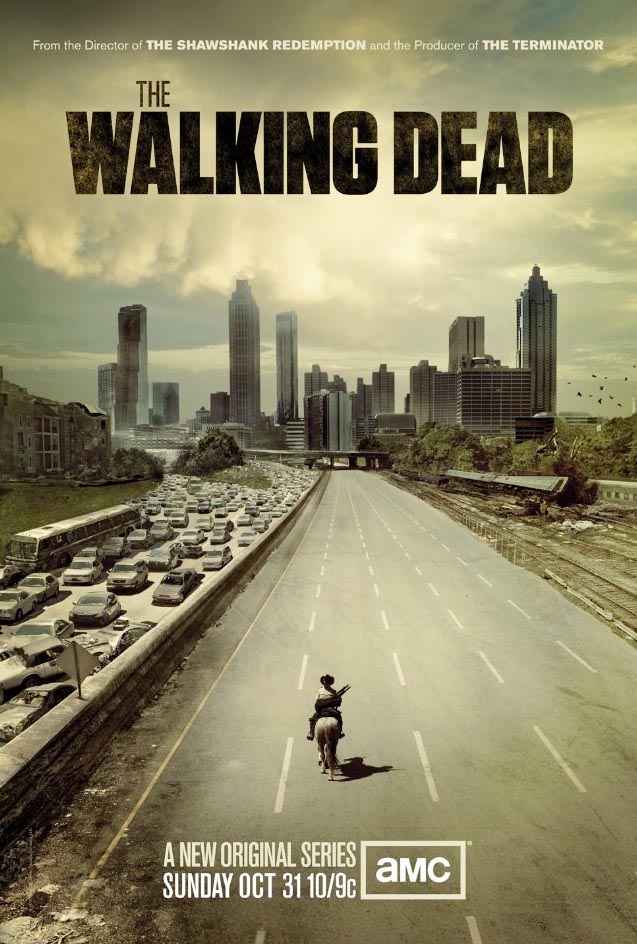
I don’t really know what made me want to watchThe Walking Dead TV series. I never was a big fan of horror and even less of zombies movies, finding them rather ridiculous and disgusting. Being amused by the idea of a feature-quality TV series about zombies, I guess I took notice of the web punditocracy announcing it as something worth watching and there was probably nothing else on TV that night… The fact is that, after watching the first episode, I was intrigued enough to follow the entire first season (six episodes).
I admit that I have always been a sucker for a good post-apocalyptic story (with or without zombies). What makes this TV series interesting is its excellent production quality, particularly the quite realistic CGI and make-up of the zombies. Despite the subject, it is not at all an horror story (unexpectedly I didn’t get a single nightmare after watching this, although I quickly realized that it was not a good idea to eat any meal while watching!) as it is rather about survival and how humans react and behave in extreme conditions. The writing is nothing exceptional but it is good enough to warrant excellent ratings, nomination for several awards and to be renewed for at least another thirteen-episode season.
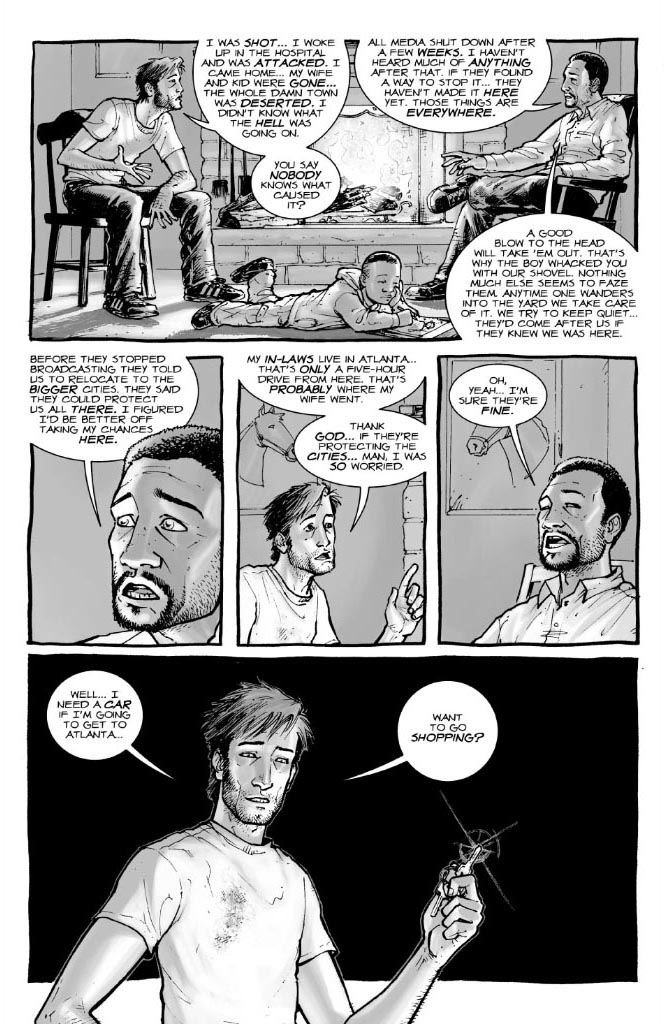
However, at some point, I discovered that the TV series was based on an american comic book and, as always, I wanted to compare the TV adaptation with the original story. Even if it was available in electronic format on iPhones & iPads (it even has its own app!) through comiXology (the first issue is available for free), I must admit that I read the french edition instead since it was the only version available at my local library (all for free!). The Walking Dead is published by Image Comics as a monthly b&w comics. It is written by Robert Kirkman and illustrated by Tony Moore (issue #1-6) and Charlie Adlard (since issue #7). Started in 2003, it includes so far 79 issues compiled in 13 trade paperback volumes (containing 6 issues each), 6 hardcover volumes (containing 12 issues each), 3 Omnibus editions (containing 24 issues each) and one compendium edition (containing 48 issues). The french edition (12 volumes so far) is the equivalent of the trade paperbacks. In 2010 it has received the Eisner Award for best continuing series.
Vol. 1, page 17
On the website, the story is described as follow: “An epidemic of apocalyptic proportions has swept the globe, causing the dead to rise and feed on the living. In a matter of months, society has crumbled: There is no government, no grocery stores, no mail delivery, no cable TV. Rick Grimes finds himself one of the few survivors in this terrifying future. A couple months ago he was a small town cop who had never fired a shot and only ever saw one dead body. Separated from his family, he must now sort through all the death and confusion to try and find his wife and son. In a world ruled by the dead, we are forced to finally begin living.”
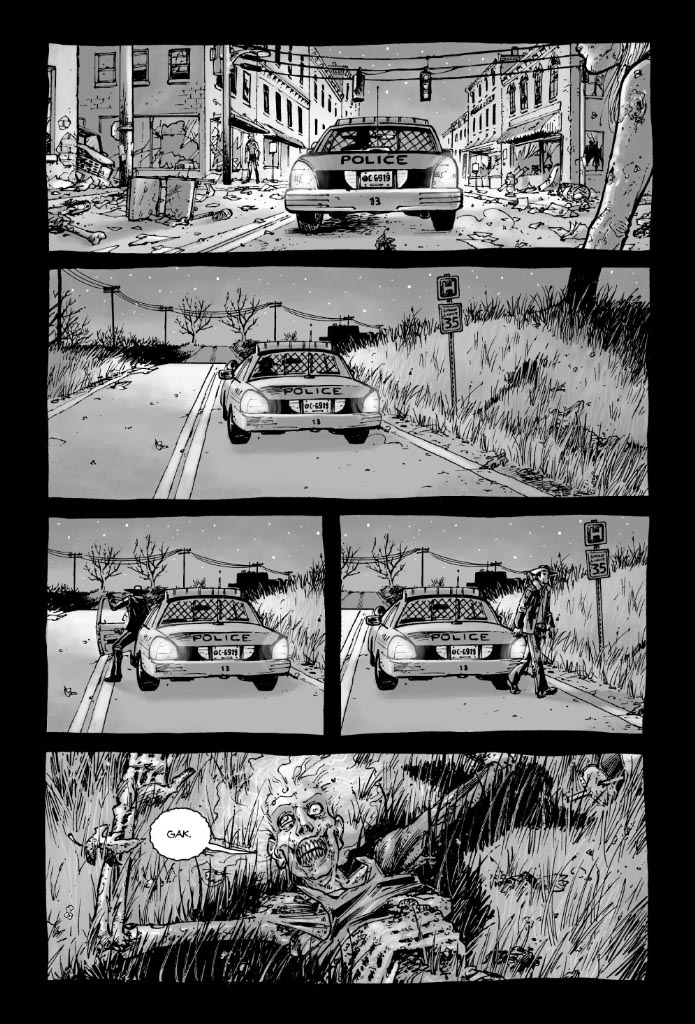
Vol. 1, page 24
The black and white art is very precise, neet and enjoyable. Action scenes are always clear and easy to understand. Strangely, because it’s in black and white, it feels much less gory than the TV series. Nevertheless the story is quite violent and people die by the handful in every volume (and that’s not counting the enormous amount of zombies that get sliced down). However what sets the story apart and makes it interesting is not this violence (although I am sure many read the comics for that reason), but the human side of the storytelling: the characters’ will of survival, their relationships, the depth of their emotions, particularly their fear, angst and even madness. So far I’ve read eleven of the trade paperbacks and I can’t wait to read more. It is really well written.
After going through the original story, I am quite surprised to find how pale the TV series is in comparison with the comics. The latter has a much stronger storytelling and is much more innovative. Actually, they don’t have much in common beside the original concept, the name of the characters and the events set in the first volume of the comics. At the end of the first volume, one of the main character dies and from there, so far, the story is completely different than what I’ve seen in the TV series. It might be easier (as in less challenging to the mind) to simply sit in a couch and watch a TV series, but the comic book is much more interesting and enjoyable. If you don’t mind too much the zombies and like post-cataclysmic survival stories, I strongly recommand the Walking Dead comics.
Toutefois, je ne peux m’empêcher de penser que, malgré l’importante oeuvre qu’elle a laissé derrière elle, la vie de Sagan est une vie perdue, gaspillée. Elle l’a vécut à fond, un peu à l’image de la Cécile de Bonjour Tristesse, aimant passionément tant hommes que femmes, se perdant dans des dépenses folles, l’alcool et la drogue. Comme beaucoup d’artiste bohème (Piaf par example), elle a finit sa vie pratiquement seule, ruinée et malade. Quelle tristesse…
SAGAN. France, 2008, 117 min.; Dir.: Diane Kurys; Scr.: Diane Kurys, Claire Lemaréchal, Martine Moriconi; Phot.: Michel Abramowicz; Ed.: Sylvie Gadmer; Art Dir.: Maxime Rebière; Set Decor.: Alexandra Lassen; Cost. Des.: Nathalie du Roscoat; Music: Armand Amar; Cast: Sylvie Testud (Francoise Quoirez dite Sagan), Pierre Palmade (Jacques Chazot), Jeanne Balibar (Peggy Roche), Arielle Dombasle (Astrid), Lionel Abelanski (Bernard Frank), Guillaume Gallienne (Jacques Quoirez), Denis Podalydès (Guy Schoeller), Margot Abascal (Florence Malraux), Samuel Labarthe (René Julliard). Rated PG / 14+. Site officiel: sagan-lefilm.com.
Mais je ne me suis pas arrêté là et j’ai décidé de poursuivre l’expérience “Sagan” (car j’aime découvrir les choses d’une façon thématique) avec le visionnement de l’adaptation cinématographique de Bonjour Tristesse, son oeuvre la plus connue. Le film en soi est très bon, comme peuvent l’être la plupart des films de cette époque, mais malheureuse-ment, comme je n’avais pas encore lu le roman au moment du visionnement, je ne pouvais pas le comparer au récit original. Et c’est peut être tant mieux car je préfère toujours juger un film sur ses propres mérites.
Vivant avec un père séducteur, Cécile mène un vie morne malgré qu’elle soit pleine de mondanités et de flirts. Elle serait sans doute heureuse si ce n’était du souvenir douloureux, remplis de tristesse et de remors, d’un été idyllique passé avec son père sur la Côte d’Azur et qui se termina dans le drame. Tout le préambule du film est en noir et blanc mais passe rapidement à la couleur lorsqu’un flashback nous amène dans les souvenirs de Cécile. C’est une très belle histoire, racontée avec brio et une technique visuelle d’une exceptionelle qualité. Au delà d’un bon récit, ce drame psychologique nous offre une intéressante réflection sur la moralité et la maturité. A voir absolument. Malheureusement, il semble que ce film soit assez difficile à trouver: il ne semble plus disponible qu’en usagé et la bibliothèque ne l’a qu’en format VHS. Il est toutefois disponible sur Amazon.com video on demand et le iTunes Store mais ce serait sans doute un titre mûr pour une sortie en format Blu-Ray.
Bonjour Tristesse. USA, 1958, 94 min.; Dir.: Otto Preminger; Scr.: Arthur Laurents (d’après le roman de Francoise Sagan); Phot.: George Perinal; Ed.: Helga Cranston; Art Dir.: Ray Simm; Set Decor.: Roger Furse; Cost. Des.: Hope Bryce, May Walding; Music: Georges Auric; Cast: Deborah Kerr (Anne Larson), David Niven (Raymond), Jean Seberg (Cecile), Mylène Demongeot (Elsa), Goeffrey Horne (Philippe), Juliette Gréco (herself). Rated NR (Suggéré pour 14+).
Extrait du film sur YouTube:
Après avoir vu un film aussi charmant j’étais encore plus curieux d’en lire le récit original. Chanceux que je suis, j’ai trouvé parmi les trésors de mon sous-sol une édition toute jaunie de Bonjour Tristesse (Julliard, 1957; la couverture nous précise que la réimpression a déjà atteint le 700e mille). A cette époque les romans français avaient des couvertures vraiment ennuyantes, par contre j’aime bien l’illustration de couverture de cette édition anglaise (ci-contre) qui représente bien l’esprit du livre. Celui-ci est bien sûr disponible en bibliothèques en de multiple éditions françaises.
La couverture arrière nous dit: “Un homme de quarante ans, charmant, léger, aux aventures faciles et nombreuses, et sa fille de dix-sept ans, Cécile, forment un couple inséparable de camarades. Ils vivent dans la plus grande liberté, une amoralité parfaite, une insouciance totale, jusqu’au jour où, plus dangereuse que toutes les habituelles « passantes », une femme survient… Belle, envoûtante, un peu mystérieuse, Anne, qui fut la meilleure amie de la mère de Cécile, va vouloir enchaîner l’homme volage et préserver la jeune fille d’une dépravation certaine. Devant cette menace, Cécile, avec un machiavélisme à la fois innocent et pervers, provoque la rupture, la catastrophe… Le danger est écarté, mais un nouveau visage hantera désormais l’adolescente : celui de la tristesse. Écrit par une jeune fille de dix-huit ans, ce roman, poétique et ensorcelant, révèle un talent exceptionel.”
L’ouvrage débute ainsi: “Sur ce sentiment inconnu dont l’ennui, la douceur m’obsèdent, j’hésite à apposer le nom, le beau nom grave de tristesse.” Contraitement au film, le récit original est plutôt linéaire et n’a pas de véritable flashback — quoique la narration se fait au passé. À part cela, il n’y a guère de différences: Cécile a dix-sept ans (et non dix-huit), son jeune amant se nomme plutôt Cyril (au lieu de Philippe) et leur relation est plus poussée (évidemment un film américain des années ’50 ne pouvait pas montrer de sexualité). C’est assez bien écrit (quoique je trouve que le style de Sagan manque un peu de fluidité) et se prête bien à la narration que l’on retrouve dans le film. C’est charmant et c’est court (cent-quatre-vingt-huit pages). La grande popularité de ce roman ne tient pas tant à sa qualité littéraire, qui n’a absolument rien d’exceptionelle, mais plutôt au jeune âge de l’auteur et au sujet qui, pour l’époque, était choquant. Le Vatican avait d’ailleurs condamné l’ouvrage dont les personnages ignoraient complètement la moralité, et, sans le mettre à l’index, tentait d’en dissuader la lecture “comme un poison qui doit être éloigné des lèvres de la jeunesse.” Cela n’en demeure pas moins un ouvrage important de la littérature française.
Created and co-produced by Neil Jordan (The Crying Game), who also wrote and directed the first two episodes, and Michael Hirst (The Tudors), who wrote episode three to ten, the series will air sometimes in 2011 on Showcase in the USA and on Bravo!, as well as on CTV, in Canada. Two episodes will also be directed by Jeremy Podeswa (Six Feet Under, The Pacific) and the series’ production design will be by François Seguin (Jesus of Montreal, The Barbarian Invasions). A co-production by Canada, Hungary and Ireland, the series offers a solid cast: Jeremy Irons will play Rodrigo Borgia (aka Pope Alexander VI after 1492), with François Arnaud (J’ai tué ma mère) starring as Cesare, David Oakes (William Hamleigh in The Pillars of the Earth) as Juan, Holliday Grainger as Lucrezia, Joanne Whalley as the mother, Derek Jacobi as Cardinal Orsini, and Colm Feore as Rodrigo’s arch nemesis Cardinal Giuliano Della Rovere. It is quite promising!
Simply titled “Sherlock”, the series is a piece of very clever writing. The first episode, titled “Study in Pink”, is probably the best. It is obviously based on the original story “A study in scarlet”. The character of Watson is introduced in a manner that is superbly similar to the original: he is a recently discharged soldier back from a tour in Afghanistan where he injured his leg (although Sherlock diagnosed his limping as psychosomatic). In the original, Sherlock also deducts lots of information on Watson family background by looking at his pocket watch. Here, he does the same by looking at his cellphone! In the first episode the parallel between the clever adaptation and the original story is more easily drawn. In the subsequent episodes (titled “The Blind Banker” and “The Great Game”, respectively inspired by “The dancing men” and “The Bruce-Partington plans” amongst others) the story is increasingly complex and the parallel less obvious. Unfortunately, this complexity and the fast pace of the storytelling make the series a little too hard to follow for the people who prefer more simple and quiet stories. It really gets worse with the third episode, as if they wanted to cram too many elements in the 90-minute broadcast show.
Despite the fact that Holmes uses the latest of technology to solve crimes, the modern adaptation is, in many aspects, more respectful of the spirit of the character than Guy Ritchie’s recent movie. It is exactly the same type of adventures as written by Doyle, but played in fast forward for the attention-deficit plagued video-game generation. In his crazy way, Sherlock (played by Benedict Cumberbatch) almost feels and speaks like The Doctor in “Doctor Who” (no wonder there considering Moffat’s involvement). There’s quite some good acting in that part. And, having watched the entire Granada Television series, I can certainly say the adaptation is brilliant in its every details: Watson writing a blog, Holmes using nicotine patches instead of smoking and shooting heroin, etc.
My main disappointment was that only three episodes were broadcasted on the BBC in late July and August 2010 (they are due to air on PBS in the USA from October 24th 2010). There will be a new series in Fall next years, but unfortunately it will be again only three 90-minute episodes.
Another disappointment is that Moriarty is way too present in the story. I guess the general public perception of Holmes stories is probably at fault here: since Moriarty is Holmes archenemy, people imagine he must occupy a large place in the original stories whereas he appears only in a few episodes. Interestingly, the modern adaptation ends in a way quite similar as in the first Sherlock Holmes book: rather than letting his enemy go, Sherlock doesn’t hesitate to die with him. In the original story, he jumps (or falls) into a waterfall with Moriarty. In the modern version, it is suggested that he will blow a bomb to kill Moriarty as well as himself (and Watson). Will he really die? We’ll see in the second season, I guess.
A clever and intellectually challenging tv drama. It is quite promising. I can’t wait for more. It is already available on DVD in the UK and the North American release will be in November. It would also be a good occasion to read (or re-read or read about) the original stories.
Vous pouvez visionner la conférence de presse présentant la programmation 2010 du FFM dans sa quasi-totalité sur Vimeo.
Losique sur le cinema Japonais from clodjee; on Vimeo.
At the press conference unveiling the Montreal World Film Festival 2010 programming, which was held on August 10th, Serge Losique, the director of the festival, made some comments on the Japanese cinema. It is not the first time that he express such a particular interest for this cinema (although a few years ago he did it while the festival was presenting a special “focus” on the Japanese cinema) which seems to demonstrate that he is quite fond of it.
He laments that Japanese cinema is unfortunately not very present nor known in North America, and that it is up to the journalists to introduce it to movie goers and make them appreciate it. He recalls that Japan gave us many great directors and that, following several decades of lean times, Japanese cinema is coming back with great strengths. He points out that it has always had an important place at the Montreal World Film Festival because Japanese producers see the festival as a stepping stone toward the international market.
You can watch the MWFF 2010 programming press conference in almost its entirety on Vimeo.
There are two TV series that I’ve recently discovered and that I strongly recommend for various reasons:
Moyashimon Live-Action Drama
The story is based on the Moyashimon manga (first adapted into an anime in 2007: see ANN, Wikipedia and we had a nice article about it in PA #96) in which we follow the young Tadayasu as he enters an Agricultural University. Of course, he finds himself in all sorts of situations because of the special ability that allows him to see and communicate with micro-organisms like fungi and bacteria. I heard about the live-action drama adaptation several months ago, but I was surpised to discover yesterday that it was already available in North America through the Korean drama streaming site DramaFever.com (so far five episodes can be streamed for free) and FUNimation’s YouTube channel (also five episodes available so far; click here to see episode 1). It is both funny and very educational as it is relatively faithful to the original story (the choice of the cast is amazingly close to the original character designs).
Ken Follet’s The Pillars of the Earth
A friend recently recommended me Ken Follet’s book The Pillars of the Earth. I downloaded it to my iPad from Apple’s iBookstore ($6.99) and started reading it. It is a complex and dark historical saga set around a medieval stonemason named Tom Builder who dreams of building a cathedral (for more details see the Wikipedia entries on the novel & TV series, the IMDb entry as well as Ken Follet’s website). Then, by chance, I discovered that it had just been adapted into a Germano-Canadian 8-hour TV series showing on both Starz and The Movie Network. I’ve seen three of the eight episodes so far (a fourth is airing tonight) and I think it is a compelling historical epic well worth watching. Of course, as for all adaptations, it is not entirely faithful to the novel, but, despite the relatively somber subject, it’s a good piece of entertainment with great actors. I’ve seen a really bad review in The Washington Post, but USA Today give quite a positive impression, as well as talking about the show production and even about an “amplified edition” apps available for Apple’s iPad, iPhone and iPod Touch! If you like historical drama, it is certainly worth checking out.
This afternoon, document.write(“”); while watching a documentary on French TV, I discovered an intriguing Japanese rock band (aren’t they all?) which is singing the virtues of eating fish! After a little research I even found a Wall Street Journal article talking about them.
“Captain” Tsurizao Morita, a former tuna fisherman, works in his fish shop by day and become the leader of the rock-band Gyoko (meaning fishing port) at night to promote the fish industry and convince his fellow Japanese countrymen & women to eat more fish. All their songs are about fish. During concerts he wield a big fisherman’s knife, slicing real fish that they serve afterward to the public.
An old article on Detour Japan gives us more details on the band native of Urayasu in the Tokyo Bay. The band has its own website and has released several CDs, two of them available on Apple’s iTunes store (one self-titled album, Gyoko, offering twelve songs for only $1.99 US and the other, Fish & Peace, available for $11.88 US). They even have videoclips on YouTube! Here’s their song “Maguro” (Tuna):
Notes on the music for Fantasia’s METROPOLIS event by Gabriel Thibaudeau:
“For the last 22 years I have been resident pianist and composer for the Cinematheque québécoise. METROPOLIS is one of the first films I played to. Writing a new score for this film represents, for me, a long cherished dream. The film’s modern feel and visual treatment lends itself well to experimentation and is a pure joy to create sound for!
How to express musically the class struggle and dialectic that are the foundations of this work? By utilizing not one, but two chamber orchestras! Quite simply, at stage left the orchestra represents the elitist spirit of the city through a string quintet and keyboard. At stage right a brass quintet with organ will form the second orchestra, symbol of the strength of the workers in the subterranean city. The percussion section in the center will form a link between the two worlds/ensembles.
For this two and a half hour performance, specially commissioned by the Fantasia Festival, the majority of movements will be precisely written and perfectly synchronized with the images on screen. However, certain passages will be more free, created live through “Soundpainting”, a technique of improvising from coded gestures used by the conductor.”
– Gabriel Thibaudeau
A LIFETIME ACHIEVEMENT AWARD FOR KEN RUSSELL
Fantasia will present Britain’s celebrated enfant terrible, the director of such one-of-a-kind classics as ALTERED STATES, TOMMY, CRIMES OF PASSION, WOMEN IN LOVE, LISZTOMANIA, GOTHIC, SALOME’S LAST DANCE, MAHLER and LAIR OF THE WHITE WORM, with a lifetime achievement award in celebration of his astoundingly unique and bravely provocative visions. On the night of his ceremony, we will screen a rare 35mm print of his explosive and still-controversial 1971 masterpiece THE DEVILS. This notoriously powerful film, which remains unavailable on DVD anywhere in the world, stars Oliver Reed and Vanessa Redgrave, and featuring art direction by Derek Jarman. Russell will be in town for a week and our special “Devils’ Night” award presentation will kick off a massive retrospective of his filmography split across Cinematheque Quebecoise and Cinema Du Parc.
DUAL LIFETIME ACHIEVEMENT AWARDS FOR ANIMATION DUO DON BLUTH & GARY GOLDMAN
Along with the homage to filmmaker Ken Russell, the Fantasia Film Festival is proud to give a lifetime achievement award to Don Bluth and Gary Goldman, the creative duo behind such animated modern classics as THE SECRET OF NIMH, AN AMERICAN TAIL and ALL DOGS GO TO HEAVEN. Bluth and Goldman share a unique story in animation cinema. Beginning their groundbreaking work with Disney, they created their own independent studio in 1973, which lead to numerous collaborations with Steven Spielberg and George Lucas, a detour in the video game world with the DRAGON’S LAIR series and a dozen imaginative feature films. To celebrate this event, the Fantasia Film Festival will screen the prehistoric tale THE LAND BEFORE TIME, the unforgettable classic that lives in the imagination of a generation of cinephiles. Our audience will also have a chance to meet the filmmakers during a special panel on animation.
THE INTERNATIONAL PREMIERE OF STUART GORDON & JEFFREY COMBS’ CRITICALLY ACCLAIMED EDGAR ALLAN POE STAGE PLAY
Award-winning filmmaker Stuart Gordon, beloved for such films as RE-ANIMATOR, FROM BEYOND and STUCK will be returning to Fantasia (after gracing us with the Canadian premiere of EDMOND in 2006) with his staple star Jeffrey Combs to stage their acclaimed one-man play NEVERMORE: AN EVENING WITH EDGAR ALLAN POE, which features Combs in a breathtaking performance as the legendary author. It should be noted that Gordon was a celebrated theatre director for many years before turning to cinema. Among his many impressive credits, the future filmmaker founded Chicago’s Organic Theater in the ’70s and was the first to stage a play by David Mamet, who he continues to collaborate with every now and then. A spellbinding recreation of the public recitals that Poe regularly performed in the years before his death, based on reviews and reports of his actual appearances, NEVERMORE premiered in Los Angeles in July 2009 and was originally slated to run for four weeks. Critical raves and mass audience draws saw the run extended to nearly six months. Combs’ performance is so captivating and mercurial that many critics have championed him as “the definitive Poe,” a claim that we can fully agree with! 2010 also happens to be the 25th anniversary of RE-ANIMATOR, and in celebration of this, Fantasia will be screening an uncut 35mm print of the cult classic, hosted by Gordon and Combs.
MORE – MUCH MORE – TO COME
The above is but an early tease-taste of what Fantasia has lined up for Montrealers this summer, released to tide you over until we announce our full line-up of over 100 feature films in mid-June. Don’t hesitate to get in touch if you’ve got any questions or requests. Enquiries can be sent to press@fantasiafestival.com .
“Thomas, la cinquantaine, père de famille, arrive par hasard dans la ville de son enfance. Alors qu’il se recueille sur la tombe de sa mère, il est pris d’un malaise. Quand il se réveille, son corps semble différent et le nom de sa mère n’est plus gravé sur la pierre tombale… Revenu quarante ans en arrière dans son corps d’adolescent, il décide alors de rentrer ‘chez lui’ pour comprendre ce qui a poussé son père à les abandonner cette année-là et tenter d’empêcher cette mystérieuse disparition. Mais peut-on modifier son passé en le revivant ?” [Texte de présentation sur le site du distributeur]
Quartier lointain, dont le titre allemand est Vertraute Fremde (Familiar Strangers), est une co-production belge (Entre Chien et Loup), française (Archipel 35), luxembourgeoise (Samsa Film) et allemande (Pallas Film). Le film de 98 minutes, distribué par Wild Bunch Distribution, met en vedette Léo Legrand (Thomas enfant), Pascal Greggory (Thomas adulte), Jonathan Zaccaï (le père), Alexandra Maria Lara (la mère), Laura Moisson (Corinne), Pierre-Louis Bellet (Rousseau) et Laura Martin (Sylvie). Ayant déjà eut une avant-première à Cannes en 2009, il sortira d’abord en Allemagne le 20 mai (étrange pour ce qui est, techniquement, un film français) et en France en septembre.
Si l’on se fit à la bande-annonce, le film (dont la production avait été annoncé depuis près de quatre ans) est vraiment proche de l’histoire et de la “mise-en-scène” originale (mis à part la transposition du lieu et quelques détails). C’est certainement à voir.
“If you are cold, tea will warm you; if you are too heated, it will cool you; If you are depressed, it will cheer you; If you are excited, it will calm you.” ― William Ewart Gladstone







 Clodjee's Safe-House