Le Guide du Mauvais Père (4)

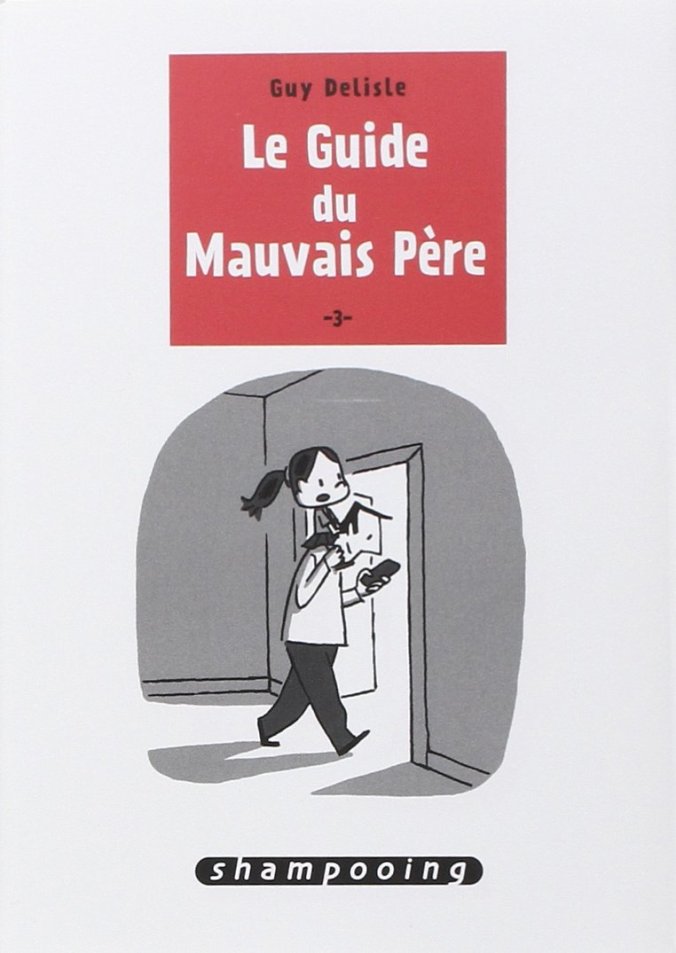
Guide_du_mauvais_pere_4-covToujours aussi parentalement incorrect, Guy Delisle retrouve son rôle préféré : meilleur (mauvais) papa du monde ! Sa recette : une bonne dose de mauvaise foi, des colères importunes, un tas de gamineries et surtout BEAUCOUP d’humour !

Défier son fils aux jeux vidéo quand il travaille, oublier sa fille dans un magasin et lui faire croire le contraire, parler à ses enfants de sa vie merveilleuse d’étudiant… quand ils n’existaient pas… Guy Delisle, un mauvais père ? Non, un auteur de bande dessinée qui sait puiser l’imagination là où elle se trouve, avec un sens aigu de l’observation et une bonne dose d’autodérision.

[ Texte du site de l’éditeur; voir aussi la couverture arrière ]
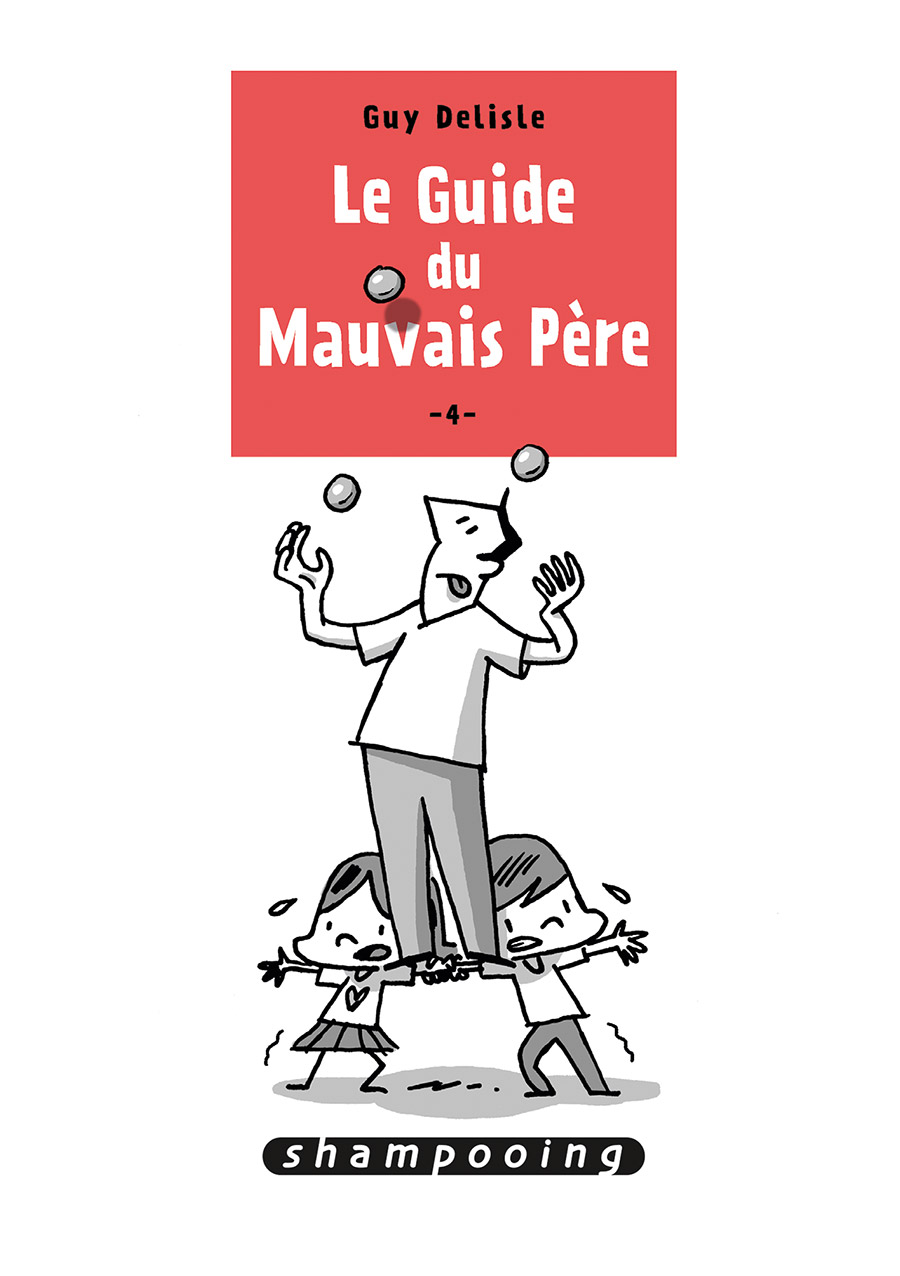
Guy Delisle nous fait encore rigoler avec son alter-égo qui représente le summum du mauvais parent: distrait, égocentrique et enfantin. Il s’agit de quatorze petites histoires d’en moyenne un douzaine de pages chacune (entre dix et dix-huit pages): Coup de blues, La dent III, La signature, Au magasin, Compétition, Sortie scolaire, Le jeu, Une histoire, Les invités, Savoir résister, Le test, Un petit film, Le placard, Tunnel of life.

Somme toute c’est quand même très similaire aux trois premier volumes. Je suppose qu’il y a une limite à étirer la sauce avec toujours le même genre d’histoires inspirées de son quotidien. C’est pourquoi ce quatrième volume sera sans doute le dernier. Dans la dernière histoire, Tunnel of Life, le père s’amuse bien avec les enfants dans un parc d’attraction mais se rend compte soudainement que ceux-ci ont grandit (Alice a maintenant 11 ans et Louis 14 ans) et n’ont plus autant le goût du jeu…

À travers cette série (et la plupart de son oeuvre) Delisle réussit le tour de force de raconter des histoires complexe et riches en émotions de façon très succincte et avec un trait de crayon très simple. C’est un livre amusant (et terrifiant à la fois) mais, avec en moyenne deux dessins par page, cela se lit plutôt vite. C’est tout de même une bonne lecture, légère, pour le transport en commun ou la salle d’attente.

Le Guide du Mauvais Père 4, par Guy Delisle. Paris, Éditions Delcourt (Coll. Shampooing), juin 2018. 18 x 13 x 1.75 cm, 192 pg., 9,95 € / $15.95 Can. ISBN: 978-2-413-00280-2. Recommandé pour public adolescent (12+). stars-3-0

Pour plus d’information vous pouvez consulter les sites suivants:

[ AmazonBiblioGoodreadsGoogleWikipediaWorldCat ]

Voir aussi mes commentaires sur les trois premiers volumes:

Le Guide du Mauvais Père © Éditions Delcourt, 2018.

[ Translate ]

Capsules

Mystery solved!

I used my sherlockian power again! This time not to identify, locate and defeat a sunflower thief, but rather to identify a mystery flower. Last year we came upon this strange flower in the park and we were unable find out which genus or species it belong to and I was quite flustered by that.

Last year’s pictures

[ iPhone 8+, Parc Frédéric-Back, 2017-10-22 ]

This year’s pictures

[ iPhone 8+, Parc Frédéric-Back, 2018-09-29 ]

Last year, the plant we found was more developed and mature. This year, it is a little earlier in the fall, so it is at a younger stage of its development. However, it is clearly the same plant, with several stages of flower on top of each other, tubular flowers (undeveloped this year) and long lance-like reddish leaves.

Today, thanks to the Reader’s Digest A-Z Encyclopedia of Garden Plants (I tried before with various other books like Daigle’s Les fleurs Sauvages du Québec or Parent’s Fleurs des champs du Québec et des Maritimes, without success), I was able to find enough clues to establish that the mystery plant that eluded identification for nearly a year was… the Monarda Punctata, also known as the spotted beebalm or horsemint.

It is from the family of the Lamiaceae (to which many herbs like mint belong) and it seems that at least one of its sub-species (Monarda punctata var. villicaulis  / Monarde ponctuée à tige velue) is  pretty rare in Quebec (see also this study, in French). There are several variety of Monarda in Quebec (like the Monarda fistulosa / wild bergamot or the Monarda didyma / Crimson beebalm) but, after comparing plenty of pictures, I am pretty sure that my mystery plant is one of the two varieties (var. punctata or var. villicaulis) of the Monarda punctata.

Mystery solved!

[ Traduire ]

A walk in the park in late September

Today was the time to relax. In the morning, I read a pile of couple of weeks-old newspapers (mostly The Gazette) while listening to smooth jazz on the internet. Then, in early afternoon, I went for a walk in the park with my lovely wife. It was a beautiful day of late September!

The deep blue sky was dotted by luminous clouds. There was still plenty of colours in the field and a great variety of flowers: a few Sweet William, many Asters and Sunflowers, Thistle and Chicory, those tall Dandelions like in spring, some Mint and plenty others that I couldn’t put a name on. It was full of life as grasshoppers and crickets were jumping all over in front of our steps, bees and bumblebees buzzing in the air, as well as blue and orange butterflies dancing around in the wind. We also saw a dead rat, a murder of crows and even a flight of Canadian geese flying high toward warmer skies in the south. A great day — even if we could smell in the air that rain would come later…

I took many pictures. Unfortunately no camera could render the richness of details that the human eye can capture. And the memory is fleeting. We have no choice but to rely of those imperfect pieces of frozen time to remind ourselves of this moment: the blue sky, the green grass and yellow flowers…

[ iPhone 8+, Parc Frédéric-Back, 2018/09/29 ]

About reading

Each time I see a new book I am taken by the deep desire to read it. However, if I try, I find out that I often don’t have the energy or the attention span to do so anymore. Why reading has gotten so hard? Is it because of age? The fact that I have less energy now? Or that having such a large field of interests makes me too busy (or being too spread out) and I have difficulty adding more activity to my schedule? So many books, so little time!

Reading is extremely rewarding but it is also very time consuming. So, I guess I am losing patience after a while, taking the lazy path of watching TV instead. Also, if I am reading, I am not writing about books. And if I am writing about some books, I can’t read other books. I really have to work that out and find the strength and patience to keep reading. There is so much wealth and experience and pleasure in each story! How can I be so weak that I find myself passing on this?

As I often say, I cannot wait to retire and have more time to read. I don’t understand how people can have a job, kids or pets, go out, travel, go run a marathon or train and still have time to read books (without burning out, of course) ! My house (and the world!) is filled with marvellous books waiting for me to appreciate, discover and love them! Well, there’s only 3158 days left before I am liberated from my obligation to work productively for society. Maybe sooner if I manage my stuff well (or if I am lucky). I just need to be a little more patient. And maybe read a book to spend the time…

[ Traduire ]

Souvenirs d’Emanon

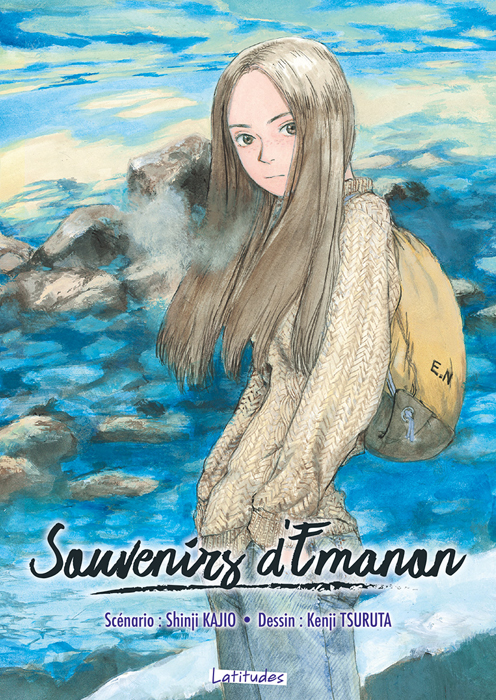
Souvenirs_Emanon-cov“1967, dans le sud du Japon. Loin des événements qui agitent le monde, un étudiant prend le chemin du retour après un voyage d’errance. Une longue nuit en ferry s’annonce. Alors qu’il cherche à oublier une énième déception amoureuse en se plongeant dans ses romans de SF, une intrigante jeune femme s’installe à ses côtés.

 Fumant cigarette sur cigarette, elle a pour unique bagage un sac à dos marqué des initiales “E. N.” Son nom ? Emanon, ou “no name” lu à l’envers… Elle aussi voyage seule et sans but apparent. D’abord peu bavarde, les yeux dans le vague, elle se rapproche du jeune homme, car il lui rappelle un ancien amour… datant de plusieurs siècles !

 Au fil de la conversation, elle lui dévoile son secret : sous ses airs d’étudiante, elle cache une âme vieille de trois milliards d’années ! Ses souvenirs remontent au plus profond des âges, avant même l’apparition de l’humanité. Son récit dépasse toutes les histoires de SF. Cette nuit en compagnie d’Emanon va bouleverser à jamais la vision du monde du jeune voyageur…

 Emanon est un des personnages les plus fascinants de la science-fiction contemporaine japonaise. Le dessinateur Kenji Tsuruta, tombé amoureux du concept imaginé par l’écrivain Shinji Kajio, donne un visage aussi vivant que mélancolique à cette incarnation féminine du passé, du présent et du futur de l’humanité. Que l’on croie ou non à son histoire, impossible d’oublier Emanon. Et elle non plus ne vous oubliera jamais…”

[Texte du site de l’éditeur; voir aussi la couverture arrière]

Souvenirs d’Emanon (おもいでエマノン / Omoide Emanon) est un manga seinen qui a été prépublié dans le magazine Comic Ryu et compilé en volumes chez Tokuma Shoten à partir de 2008. La série comporte trois autre manga publié en 2012, 2013 et 2018. Le premier volume à été traduit en français chez Ki-oon (dans leur collection grand format, Latitudes) en janvier 2018 et la version française du deuxième volume, Errances d’Emanon (ISBN : 979-10-327-0315-1), y est déjà disponible en Europe depuis le début septembre 2018. L’histoire est basée sur une série de romans de science-fiction par Shinji KAJIO (aussi publiés par Tokuma Shoten), débutée avec une nouvelle en 1983, qui met en scène le personnage de “Emanon”, une mystérieuse jeune femme dont la mémoire remonte au début de la vie sur Terre, il y a trois millions d’année (et dont le nom, en anglais, signifie “no name” [sans nom] épelé à l’envers).

Le dessin de Kenji Tsuruta (Spirit of Wonder, Forget-me-Not) est plutôt classique et est à la fois clair, précis et détaillé. Le récit de Shinji Kajio, quant à lui, est plutôt simple (l’histoire se déroule principalement durant l’après-midi et la soirée du 24 février 1967) et est essentiellement narratif (sans vraiment d’action). 

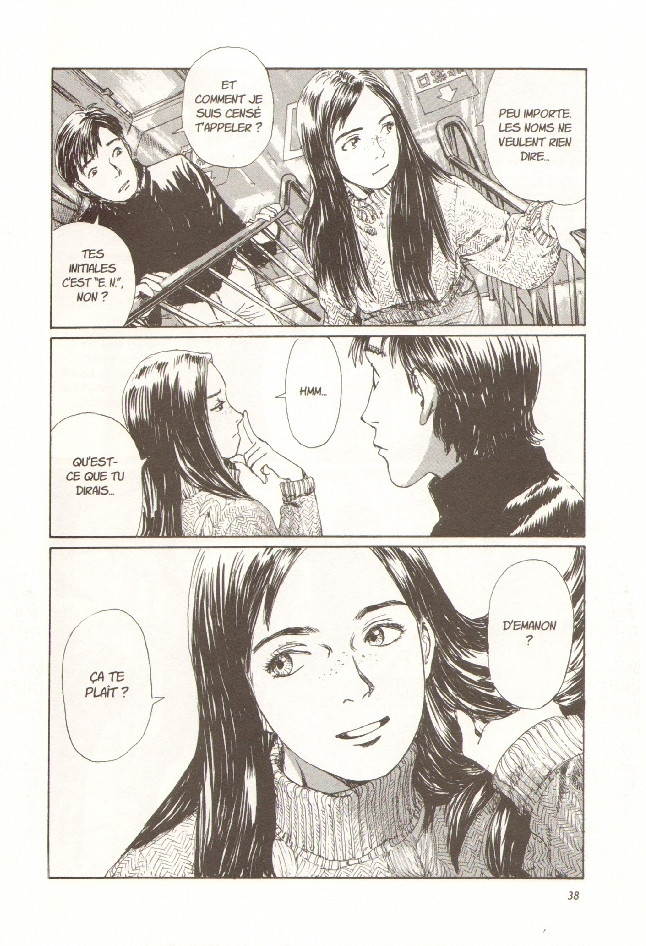
Souvenirs_Emanon-p038Un jeune étudiant bohème rentre chez lui après un voyage et, durant le périple de dix-sept heure du traversier qui l’amène sur l’île de Kyushu, il fait le rencontre d’une jeune fille mystérieuse. Elle dit s’appeler “Emanon” et, voyant qu’il est grand amateur de science-fiction, elle lui confesse qu’elle a l’étrange pouvoir de se souvenir des vies des tous les individus de sa ligne ancestrale directe depuis l’apparition du premier organisme unicellulaire! Toute cette mémoire lui pèse lourd et elle se demande pourquoi elle a ce pouvoir et dans quel but? Autour de quelques bières, à la cantine du traversier, ils discutent et spéculent sur les implications d’un tel pouvoir. Puis elle rit et avoue lui avoir raconté une histoire pour savoir ce qu’il en pensait, puisqu’il est fervent de SF. Ils discutent toute la soirée et, au matin, lorsque le traversier accoste au port, elle a disparu. Il la cherche partout mais en vain. Treize ans plus tard, il l’aperçoit sur le quai d’une gare accompagnée d’une enfant. Il l’approche mais elle ne se souvient pas de lui. Toutefois, la fillette lui dit: “C’est moi, Emanon. C’est gentil de te souvenir de moi!” Le pouvoir ne peut résider que dans un seul individu par génération, et lorsqu’un enfant nait, le parent oubli tout des vies précédentes! Il la revoit encore plus tard, alors qu’il est un vieillard…

Souvenirs d’Emanon nous offre donc une intriguante histoire agréablement illustrée par Tsuruta. Un bon moment de lecture que je recommande sans hésitation.

Souvenirs d’Emanon, par Shinji KAJIO (scénario) et Kenji TSURUTA (dessin). Paris: Ki-oon (Coll. Latitudes), janvier 2018. 180 pages, 17 x 24 cm, 15,00 € / $28.95 Can. ISBN 979-10-327-0226-0. Pour un lectorat adolescent (14 ans et plus). Un trailer et un extrait de 28 pages sont disponibles sur le site de l’éditeurstars-3-0

Pour en savoir plus vous pouvez consulter les sites suivants:

[ AmazonBiblioGoodreadsGoogleWorldCat ]

OMOIDE EMANON © Shinji Kajio, Kenji Tsuruta / TOKUMA SHOTEN PUBLISHING CO., LTD

[ Translate ]

Souvenirs Emanon-Logo

Mary and the Witch’s Flower

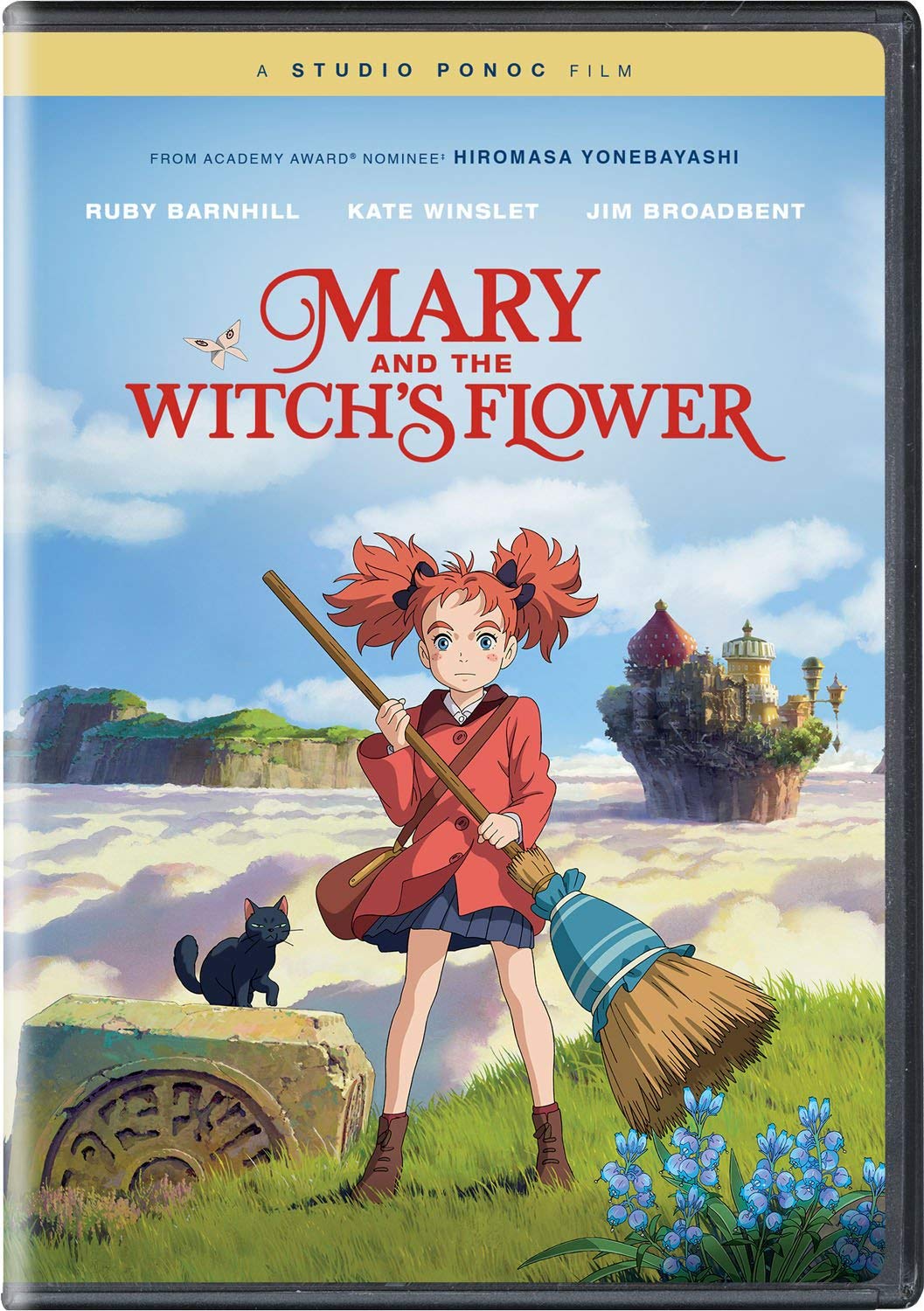
Mary_and_the_Witchs_Flower-covThis smooth and beautiful animation was produced by the Studio Ponoc, staffed with people who worked at the famous Studio Ghibli. The movie is directed by Hiromasa Yonebayashi (who was a key animator at Studio Ghibli and director of The Secret World of Arrietty [2010] and When Marnie Was There [2014]), with a screenplay by Hiromasa Yonebayashi & Riko Sakaguchi and character designs by Akihiko Yamashita. It is based on Mary Stewart‘s 1971 children’s novel The Little Broomstick (although it is never mentioned in the staff interview included with the Dvd).

Mary and The Witch’s Flower (メアリと魔女の花 / Meari to Majo no Hana) offers a good storytelling and quite a cute story but it doesn’t really look original at all. It rather feels like it is a mishmash of every Ghibli designs: the witch part is vaguely reminiscent of Kiki’s Delivery Service, the witch school in the sky reminds me a little of Laputa: Castle in the Sky, a herd of animal fleeing seems similar to a scene in Princess Mononoke, a costume design evokes Nausicaä of the Valley of the Wind, the girl being away from home with some distant family members is similar to When Marnie was There, etc. This could be explained by the fact that most animators learned their skills while working at Ghibli. However, the influences are not limited to this source: Doctor Dee’s design makes me think of Dragonball’s Master Roshi and even Harry Potter makes a cameo appearance in one of the school classroom! I guess it was all intended as hommage or humour.

If I found this a little odd, I was not really annoyed by it. The movie is good entertainment (critical rating of 87% on Rotten Tomatoes) and, if you don’t feel the same depth as in Ghibli’s productions,  I was still quite glad that another major studio (even if this is their first real movie) would continue to produce traditional full length anime. Indeed, with the closing of Studio Ghibli after Hayao Miyazaki’s retirement, I really hope that Studio Ponoc will become its rightful heir… So, all in all, it is definitely worth watching. It is available on Netflix and on Dvd. stars-3-0

[ AmazonBiblioGoogleIMdBWikipediaYoutube ]

[ Traduire ]

Capsules

Ex-Libris: The New York Public Library

Ex-libris-dvd“Frederick Wiseman’s film, Ex Libris – The New York Public Library, goes behind the scenes of one of the greatest knowledge institutions in the world and reveals it as a place of welcome, cultural exchange and learning. With 92 branches throughout Manhattan, the Bronx and Staten Island, the library is a resource for all the inhabitants of this multifaceted and cosmopolitan city, and beyond. The New York Public Library exemplifies the deeply rooted American belief in the individual’s right to know and be informed. It is one of the most democratic institutions in America – everyone is welcome. The Library strives to inspire learning, advance knowledge and strengthen communities.”

Earlier this week I stumble upon this enormous documentary on PBS. If you are into books and libraries, you’ll just love this movie that gives us an extensive tour of the New York Library and demonstrates how dedicated and welcoming the staff of its 92 branches are, what are the challenges they face in order to keep up with the demands and needs of their patrons, and particularly how important libraries can be to foster the diffusion of culture & knowledge as well as artistic creativity. It’s certainly one of the best examples of what an ideal library should be (as I recently discussed).

It is amazing how our local libraries look insignificant and puny in comparison of the behemoth collection and the huge diversity of services offered by the New York Public Library… With 53 millions documents, it is the second largest public library in the U.S. (third largest in the world after the British Library and the Library of Congress). Surprisingly, despite its name, it is a private, non-profit library, but it’s using public/private partnership (and funding) to work in collaboration with local governments (city, state, federal) in providing a large array of services… It is quite interesting (and serendipitous) that, with our imminent provincial elections, a librarian and teacher at the U de M Library Science School has been very recently questioning the commitment of the government in regards of libraries. Will the government create a strategic plan for the development of libraries (like the PLA recently did) ? It is direly needed at a time when the usefulness of libraries (and even our society’s fundamental concepts of knowledge and truth) are being challenged  (NYT, The Guardian) !

Of course, for such an enormous documentary, the reception has been rather mixed (with a critical response at 97%, but with only a 61% audience score, on Rotten Tomatoes) with reviews going from bad (Globe & Mail), to good (Variety) to excellent (The Guardian).

For me it was very interesting to watch and compare (seeing the similarities and differences) our library work here, in relatively small municipal library branches, to what’s done in NYC. However, even with the mastery of legendary documentarist Frederick Wiseman, I do think that 3h17 is really too long for any documentary to keep the attention of the viewers (at least in one sitting)! Many sequences are unnecessarily long. Also someone can get easily annoyed by Wiseman’s “no-comment” documentary style where he just show the scene as it happens without much editing or information (like not telling us who is talking!). In the end, despite those faults, this documentary is definitely worth watching for anyone (with spare time) who’s interested in the realm of books and libraries.

Ex Libris – The New York Public Library : USA, 2017, 197 mins; Dir./Ed./Sound/Prod.: Frederick Wiseman; Phot.: John Davey; Exec. Prod.: Karen Konicek; Cast: Ta-Nehisi Coates, Elvis Costello, Richard Dawkins and the very dedicated staff of all NYL branches. The DVD will be available soon from the producing company, PBS or Amazon (UK / FR). It can also be streamed online (legally?)… stars-3-0

[ IMDbOfficialPBSWikipediaYoutube ]

[ Traduire ]

Capsules

Un dimanche au musée

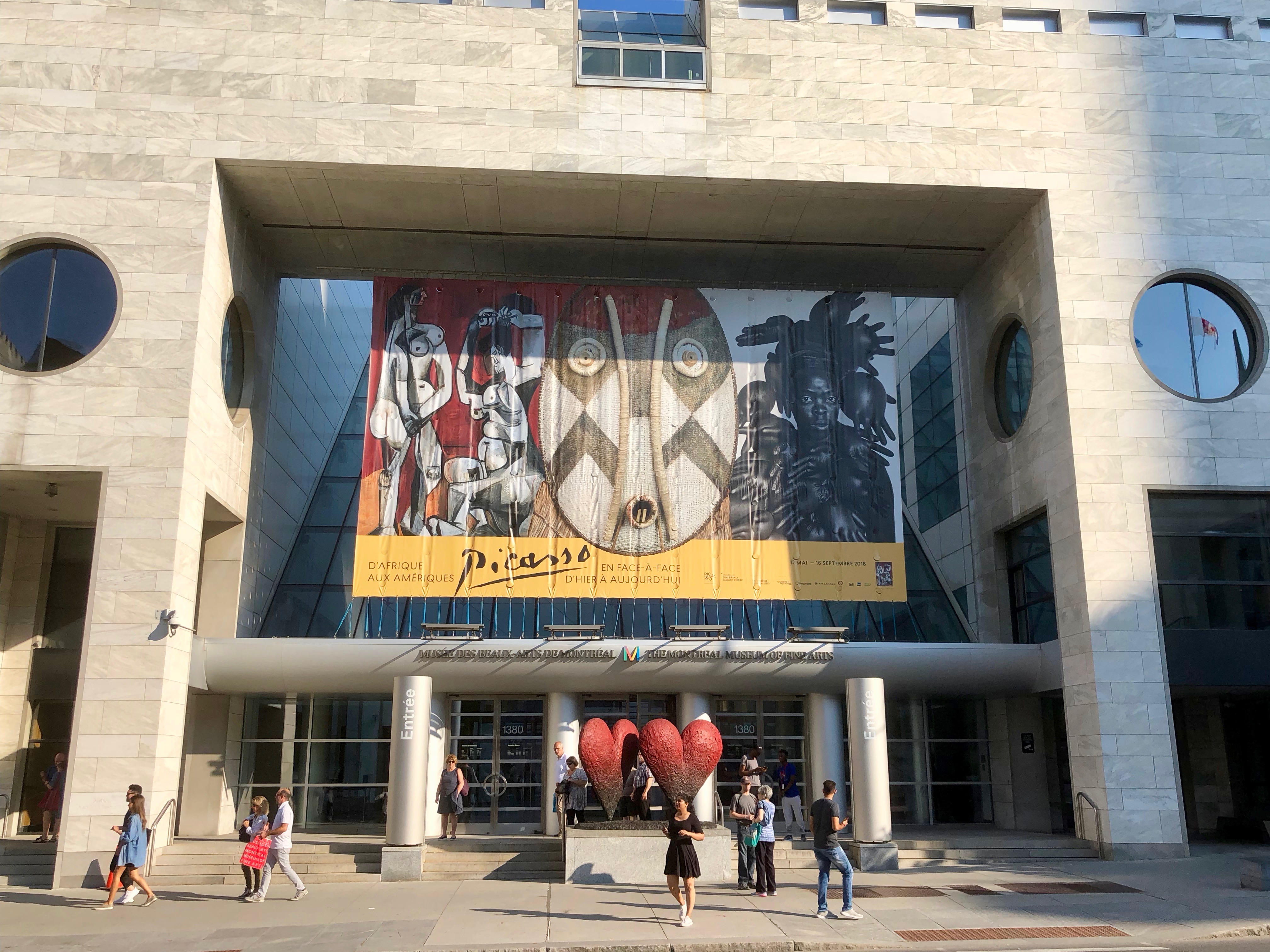
IMG_3412J’ai encore visité une exposition au Musée des beaux-Arts de Montréal in-extremis: en effet, l’exposition D’Afrique aux Amériques : Picasso en face-à-face, d’hier à aujourd’hui se terminait aujourd’hui. Comme toujours, cela en valait la peine (malgré la foule).

Je n’ai jamais beaucoup aimé Picasso (et l’art abstrait en général) mais, comme il se situe aux limites du figuratif et que j’ai toujours été fasciné par la vision du monde qu’il exprime dans son art, il m’intéresse tout de même. J’ai toujours interprété son oeuvre avec l’entendement que, la photographie ayant rendu le besoin de représenter la réalité caduque, les artistes modernes ont délaissé le figuratif pour l’impressionisme, d’abord, puis pour l’expressionnisme et même carrément l’abstrait (cubisme, surréalisme, etc.). On déforme la réalité pour exprimer et inspirer des sentiments. Picasso a commencé à peindre durant une période troublée du XXe siècle, alors ce n’est pas surprenant qu’il exprime des sentiments perturbés, dérangés ou dérangeants. Je me suis toujours demandé comment il pouvait réussir à déformer la réalité d’une telle façon ou s’il voyait vraiment le monde comme cela. Quoiqu’il en soit, j’ai toujours trouvé son art plutôt laid. Mais bon, comme je dis souvent à mon épouse, pas besoin d’aimer ça pour l’apprécier! Pour apprendre, il faut aller au-delà de ses goûts et de sa zone de confort.

Toutefois, ce n’est vraiment qu’en visitant cette exposition, qui met en parallèle des oeuvres de Picasso et de l’art Africain (dans ses très multiples déclinaisons), que j’ai finalement compris son inspiration. À cette époque-là, les artistes tribaux africains tentaient de représenter les esprits de la nature, le divin, la terreur de leur démons. Et c’est dans ces formes là que Picasso a trouvé sa muse.

Étrangement, l’art africain m’a aussi toujours fasciné. J’y trouve quelques chose de surréel, et, là où l’artiste tentait de représenter le surnaturel (esprit, démon), j’y vois une vision d’outre-monde, tantôt lovecraftienne, tantôt l’expression d’une science-fiction accidentelle (extra-terrestre, créature “star trekienne” ou “alienesque”, robot, arme klingonne, etc.). 

Et c’est sous le prisme de ces deux considérations que j’ai visité, et apprécié, cette exposition…

[ Translate ]

Continuez la lecture après le saut de page >>

Continue reading

About [not] reading

GreatAmericanReadI just watched The Great American Read on PBS, a show that searches for the “100 best-loved books and explores the many ways in which these novels affect, reflect and connect us all”. People are invited to vote for their favourite book in the list. It made me want to read more and wonder why I read so little.

I used to read a lot. As far as I can remember I often read books (novels, comics, books about space, about lost civilizations, about extra-terrestrials; all sort of books). My parents always encouraged us to read. I was spending long nights reading (and sometimes writing), particularly in the summer, when I didn’t have school the next day. I remember going to the public library (first, the one in the basement of our elementary school, and then the city library on top of the fire station). In my last year of high school, I remembered reading over a hundred books, mostly cheap science-fiction novels (space opera that freed my imagination and made me feel that everything was possible). Why did I stop reading so much? 

I was still reading a lot in college and in university (undergrad and grad school). That’s when I started reading also in English (first with L. Niven’s The Ringworld Engineers and Tolkien’s The Lord of the Rings). Ironically, it’s only when I got busier with my publishing company that I seriously reduced my reading habit. Working hard (even at the library) takes much of my energy. Now I barely read twenty to fifty books a year, and it is mostly manga or comics. I guess I got lazy and life doesn’t leave me enough free time to read. I cannot read in the bus/subway anymore, I’m too tired. I read sometime on the weekends and more often than not before going to sleep. Mostly, I watch too much TV. It’s much easier to watch the movie version than read the novel; but it’s also an unfortunately diluted experience. A book is so much more than a movie. You can create your own visual of the story while the movie provide it for you…

On that Great American Read list, I’ve read only a dozen books: 1984 (G. Orwell), And Then There Were None (A. Christie), The Da Vinci Code (D. Brown), Dune (F. Herbert), Foundation (I. Asimov), A Game Of Thrones (G. R.R. Martin), The Grapes of Wrath (J. Steinbeck), Jurassic Park (M. Crichton), The Pillars of the Earth (K. Follett), The Hitch-Hiker’s Guide to the Galaxy (D. Adams), The Little Prince (A. De Saint-Exupery) and The Lord of the Rings (J.R.R. Tolkien). There are many that I think I might have read, at least partially, or maybe I just saw the movie… I am not sure… But there are many, many more I just wish I had read. I will. I still have time. 

I just can’t wait to retire and I have the entire day to myself, with a nice cup of tea and a book!

I wish my entire life was only about books. Wait! It is: I work in a library and I write a blog (partially) about reading! Gosh! I should dedicated even more time to books…

Unfortunately, I cannot vote for the Great American Read. First, I am not American. Second, I haven’t read enough books in that list. And finally, I would have really a hard time deciding which book is my favourite… Each one has its own value and it’s difficult to compare one to another. They all had an impact on my life, because they all transmitted to me a valuable experience one way or another. But I have such a bad memory for those things… Maybe Dune, La nuit des temps (R. Barjavel), Neuromancer (W. Gibson), or Lord of the Rings ? I don’t know… Anyhow, you can follow my readings on Goodreads

And you, what are your favourite books?

[ Traduire ]

Dimanche à la ferme

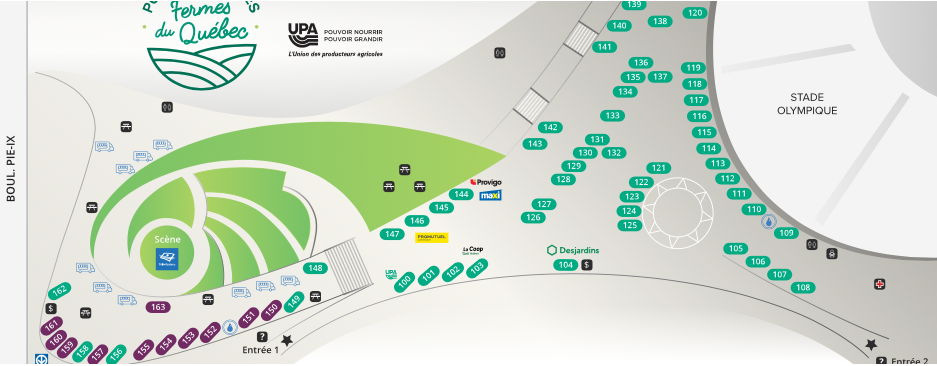
FarmerFair2018-logoNous avons décidé de passer notre dimanche aux Portes Ouvertes sur les Fermes du Québec qui se déroulaient (entre autre) au Parc Olympique de Montréal. Nous avions déjà visité cet événement l’an dernier et, comme nous avions bien apprécié, nous avons décidé de récidiver cette année. C’est l’occasion pour les différents producteurs agricoles de la province de présenter et de promouvoir leur production au public. On peut donc y découvrir les différentes variétés de vaches qui sont élevées au Québec (Holstein, Ayrshire, Jersey, Suisse Brune, Canadienne, Limousin) ou les différentes variétés de grains qui y sont cultivés (Maïs, Soya, Orge, Blé, Canola, Avoine). Il y avait même une petite ferme avec une grande variété d’animaux que les enfants pouvaient caresser (chèvres, âne, Alpaga, etc.). C’était fort amusant… (quoique c’était exactement la même chose que l’an dernier!)

FarmerFair2018-map

J’y ai découvert quelques nouveaux produits intéressants comme la bière bio artisanale Boldwin, l’huile de Caméline, les produits de la cidrerie Lacroix, la boutique de produits de laine Merlaine, etc.

Album photos:

[ Translate ]

FarmerFair2018-banner

FFM 2018: Wrap-up

FFM2018-banner2

It has been a good festival this year.

There was no scuffle to get the credentials, no problem with the schedule or screenings and an excellent selection of titles. 

Of course, it could be better. Apparently they brought back the Movie Market (and the press room?). I heard it was on the third floor of the Imperial, but couldn’t find how to get to it… In the past, they were always the practical places to access press information and to be able to screen video on our own schedule. However, what I really miss is the press conferences where we could have direct access to the film crew and cast of the movies in competition. Beside that, for me, the festival is already all I needs it to be.

As long as there’s good movies to watch, people should be happy. At least, as long as there’s Japanese movies, I’ll be happy. Although, come to think of it, the festival deserves a bigger audience. In the past, I used to see lots of people from the local Japanese community, but I saw very few of them this year. Most of the movie I’ve screened this year had barely an audience of a dozen people! Of course, there was absolutely no advertising this year and very little media coverage, so it certainly didn’t helped. And the last couple of years have had a fair share of scheduling and screening problems which might also have discouraged people from attending this year. If there is a festival next year (the same question come back every year lately), this really must be improved.

Another needed improvement, beside more advertising, would be more screens. The festival could use at least a couple more rooms of the Quartier Latin (if not the entire floor like in the good old years). However, for that to happen, the festival would need more budget. Not to put on lavish parties, but to make sure that all the movies can be screened at least a couple of times. Why not giving the festival a chance and give it again at least some subsidies?

The festival certainly has its share of detractors. People who don’t think it can improve or who want to see something else in its stead. Strangely, most of the criticism seems to come from the anglophone community (for example, the articles in The Gazette appears to be quite hostile). However, I don’t think that the majority of people in or around the local movie industry want the festival to continue in its downward spiral of death. But we don’t want a glamorous festival like Cannes or Toronto either (yeah, it’s nice to see Brad Pitt or the latest blockbuster with its load of stars, but what’s the use if that movie is gonna by in all theatres two weeks later?). Personally, I want a festival where I can see movies I couldn’t see anywhere else. Movies from all around the world. A festival that gives their chances to young or unknown directors, to small productions. A festival that doesn’t exclude stars, but that is not built around them. That’s what the festival was in the past and I think this formula can still works. There is no other festival like this one. And we can still mend its wounds. We must. Of course, every parties will need to water down its position a little. The government (local, provincial or federal) must look past previous disagreements and accept to provide a little help. And Losique needs to let go of his creation and prepare some sort of succession. Pass on the mantle while still remaining in the background to provide his knowledge and wisdom. If he doesn’t do that, the festival will surely die with him… We’ve seen a little improvement this year, so let’s hope it can continue in that direction…

All in all, this year, I’ve succeeded to watch five of the eight Japanese movies. I am pretty happy with this score. The selection included a great variety: a samurai movie, a docudrama-style movie, a comedy, a yakuza movie and a biopic — I wish I could have added to my score card the documentary, the action movie and the scary co-production!  And almost all the titles I’ve seen were good movies — save one which was a disappointment. Beside this last entry, I was able to write seven articles (including five movie comments) about the festival (which represents more articles than La Presse, Le Devoir or The Gazette each wrote about the FFM !).

Please read our other articles on the festival:

Your can also check the review of the Japanese movies at the FFM by Claude R. Blouin (in French: “FFM 2018: Cinq témoins japonais de la condition humaine” on Shomingeki.org)

[ Traduire ]

The festival’s awards:

Continue reading

Ready Player One

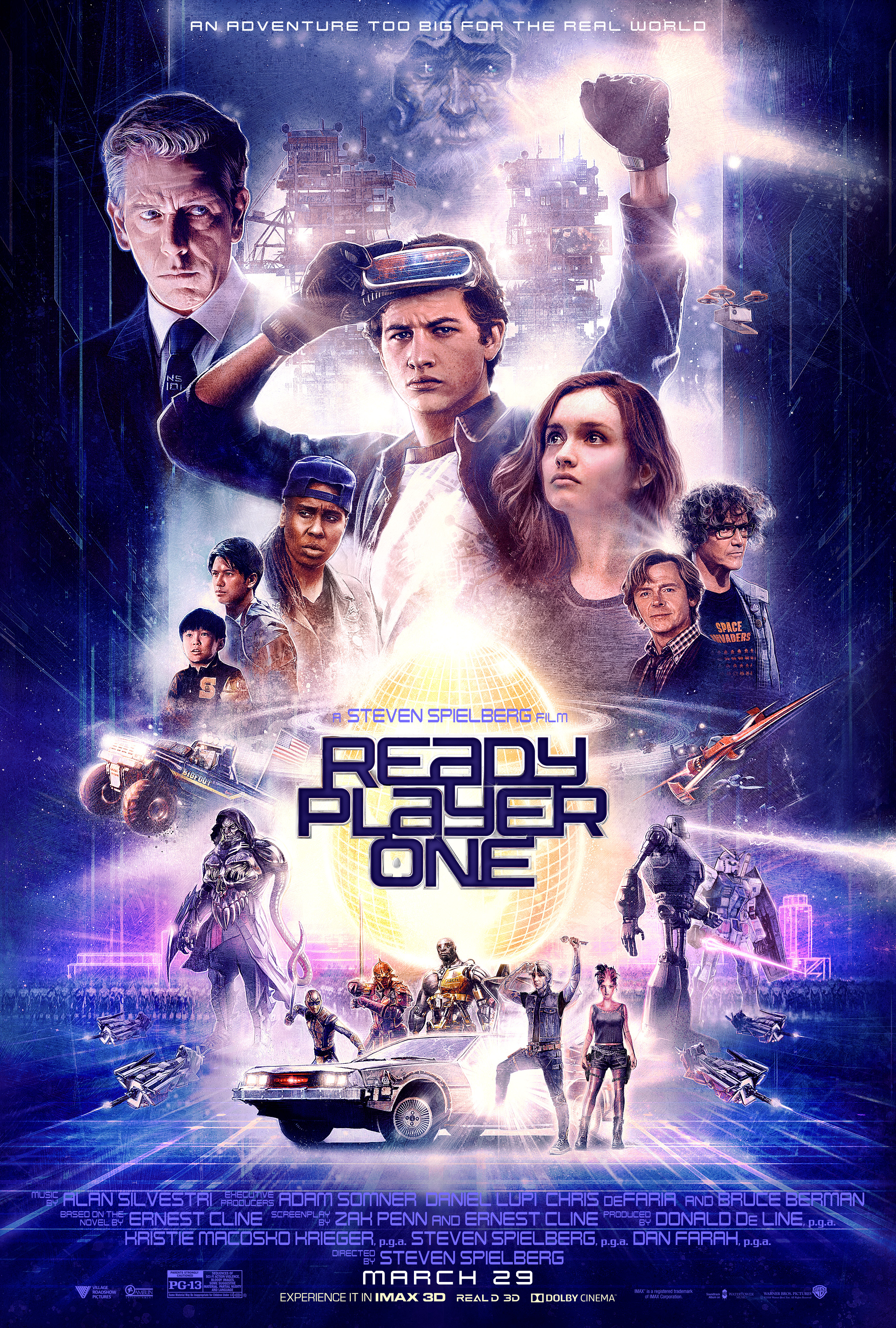
ReadyPlayerOneIn a dystopian future (Is it? It realistically could be just our future or it could be a “trumpian” future), the reality is too tough to take and people are looking to forget their troubles. What was originally created as a virtual reality game become the perfect source of escapism for the people. In virtual reality they can be whoever or whatever they want! It is based on the novel by Ernest Cline. 

This is a typical fantasy story where the hero (with a group of companions) must find an artifact to save the world from an evil overlord (or a nefarious corporation plotting to control the world). The only difference is that, this time, the artifact is a legendary Easter Egg in a virtual reality video game. It is also a quest to find the heir to the Halliday’s fortune and ownership of the entire virtual world, known as OASIS (Ontologically Anthropocentric Sensory Immersive Simulation). The movie improves on the book by providing a great visual: the part inside the virtual reality (60% of the movie) was created with motion capture CGI. It is certainly not very original, but it’s brilliantly written and well orchestrated.

For me, what makes the movie interesting is that it’s a treasure trove of popular culture references (mostly related to movies and video games) from the 80s (including a few anime like Akira, Dragon Ball, Godzilla, or Gundam !) that plays on the nostalgia of a long gone era. In that aspect, it can particularly appeal to two different audiences: those who grew up in that era (the Millenials or Generation Y) or those who grew up hearing stories from their parents and have a glorified impression of the era (the Generation Z or iGen, Centennials). It is so rich in references that you could see the movie a dozen time and still discover new ones! 

The movie was well received (with a Rotten Tomatoes critical score of 72% and a slightly better audience score of 78%) and did well at the box office (bringing back in revenue three time its budget of $175 millions). Unfortunately, even if it’s directed by Spielberg, it has the usual flaws of most teenage action movies: it offers an heroic but superficial story (and characters) where the exploding action (full of car races, fights and magic!), a shared cultural trivia, visual overload and an expedited storyline replace the depth and richness that usually make truly excellent movies. However, it remains a great and funny movie that celebrate geek culture. It is entertainment at its best. I enjoyed it immensely and, if you are in the right demographic, you will certainly too. stars-3-5

[ AmazonBiblioGoogleIMDbWikipediaYoutube ]

[ Traduire ]

Capsules

The Miracle of Crybaby Shottan

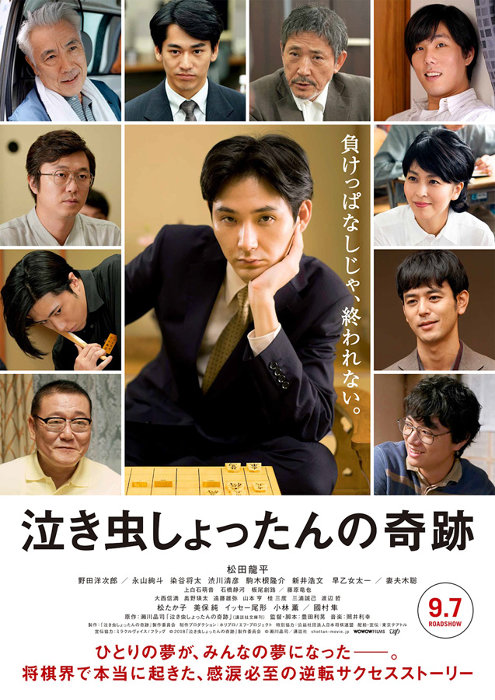
Nakimushi_Shottan_no_Kiseki-PosterBased on the true story of Shoji “Crybaby” Segawa, a talented player of shogi, a Japanese variant of chess. After rising quickly in a shore-kai, an organization that supervises professional shogi status, Shoji fails to fulfill the ironclad requirement of reaching the 4th rank by age 26. With the encouragement of his friends, he sets out to achieve the impossible: to be the first amateur to become a shogi professional. (FFM)

WARNING: May contain traces of spoilers! People allergic to the discussion of any plot’s elements before seeing a movie are strongly advised to take the necessary precautions for their safety and should avoid reading further.

This is a great feel-good movie based on the autobiographical book about the incredible career of Shoji Segawa, a Shōgi player. Shōgi  (将棋 / “The game of generals”) is a Japanese strategy board game very similar to chess (as you have a king, surrounded by his gold generals, his silver generals, rook and bishop, knights, lances and finally pawns pieces). We often see this type of “sport competition” story (where sport is often replaced by any possible type of occupation) in manga or anime (the best similar example is Hikaru no Go manga by Yumi Hotta & Takeshi Obata, which is about Go, but there are plenty of manga about shōgi like March Comes in Like a Lion) but it is rare to see this type of story in a live-action movie.

The movie has a strong cast of stars, so it is not surprising that the acting is quite good (although I’ve notice poor performances in the case of some minor characters). The photography is good enough (it’s not always optimum, but I guess it’s due to the attempt to give the picture a look of the 70s or 80s). The storytelling is, however, excellent considering that it is not easy to make such a subject interesting and to keep the attention of the audience while showing two guys sweating over a board game! The upbeat music and some comedic devices are very helpful for that.

Shoji Segawa (nicknamed Shottan) is a shy, introverted boy who has been interested in playing shōgi since elementary school. Encouraged by his school teacher and his father (Jun Kunimura), he improves his skill playing against his neighbour Yuya. They both go to a shōgi dojo where they are tutored by the local master (Issey Ogata). He is known for sometime crying after a game (hence the other nickname of “crybaby”). Learning that you can become a paid professional player of shōgi, Shottan (Ryuhei Matsuda) decide to apply to the shore-kai (the Japan shōgi Association’s apprentice school) but he doesn’t give his all and fails to reach the 4-dan level by age 26. A good part of the movie is dedicated to showing him agonizing over his chance of success (despite being a little overconfident) and over his failures. He finds himself in his late 20s, with no high school diploma, no job and becomes depressed. He eventually finds a salaryman job, but keeps playing shōgi for pleasure. He becomes quite skilled as an amateur player and, eventually in his 30s, gets some fame as the amateur who keep beating professionals (a miracle record of 17 wins and 5 losses!). He then starts fighting for the JSA to give him a second chance at becoming professional…

Strangely, nowhere in the movie they talk about the rules or strategy of the shōgi game. I guess, if the movie is solely aimed at a domestic Japanese audience, they assume that everyone know them. Anyway, the knowledge of the game is totally irrelevant to the story. The movie is more about fighting for your dream, learning the discipline (not being too distracted) and to play for the right reasons (not to win but just for the pleasure of it). It is interesting to note that the director, Toshiaki Toyoda, attempted himself to become a professional player when he was younger.

All in all, The Miracle of Crybaby Shottan is an upbeat biopic that provide a very good entertainment. Well worth watching.

The Miracle of Crybaby Shottan (泣き虫しょったんの奇跡 / Nakimushi Shottan no Kiseki): Japan, 2018, 127 mins; Dir./Scr.: Toshiaki Toyoda (based on the autobiographical novel of Shoji Segawa); Phot.: Norimichi Kasamatsu, Kôji Naoi; Ed.: Masaki Murakami; Prod.: Ryo Otaki, Kyôichi Mori; Cast: Ryûhei Matsuda (Shoji), Yôjirô Noda (Yuya), Shota Sometani, Kento Nagayama, Satoshi Tsumabuki, Kiyohiko Shibukawa, Ryusuke Komakine, Hirofumi Arai, Takako Matsu, Issey Ogata, Kaoru Kobayashi, Jun Miho, Jun Kunimura.

Screened at the Cineplex Quartier Latin 13 (Thu. 8/30 at 21:30) as part of the “Focus on World Cinema” program of the 42nd Montreal World Film Festival. There was a little more than half-a-dozen people in the theatre. stars-3-5

[ AsianWiki / IMDb /  Official  / Youtube ]

[ Traduire ]