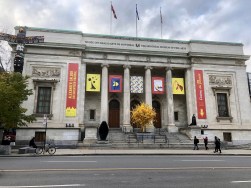
 On October 16th, after a lengthy trek in the Mount Royal Park to admire the autumn foliage, we went to the Museum of Fine Arts to have a look at a small exhibition about books of hours. Titled “Resplendent Illuminations” the exhibit displays Books of Hours from the medieval and Renaissance eras (13th to the 16th Century) but the interesting part is that they are all from Quebec (seven private and public collections). The exhibit, born from in-depth academic research, offers more than 50 artifacts (leaves, complete manuscripts, prints) and is held at the MMFA (pavillon Jean-Noël Desmarais – niveau S2) from September 5, 2018 to January 6, 2019.
Created for the Christian faithfuls (not for men of the cloth but for lay people), Books of Hours offered a collection of calendar of holy and religious feasts as well as passages from the gospels and prayers. They were used for devotion but also to learn reading. What’s characterize them however is that they were personalized with family information (births and weddings) and illuminated with miniature paintings (illuminations) illustrating the life of Christ, the saints or the Virgin Mary. Very minute and beautiful art.
It is really amazing that the faithfuls of New France would bring such beautiful manuscripts with them (or order them abroad) to express their devotion and that those books ended up being so well preserved. Unfortunately, to satisfy the thirst of modern collectors, such beautiful manuscripts were often cut open and sold by the pages (to maximize profits). That’s why many of the artifacts displayed are simple folio. I am quite surprised to see that most Books of Hours are so small, usually in duodecimo book format (each folio has been folded four times to make twelve leaves or twenty-four pages). A detail that I didn’t know: some books of hours were produced AFTER the invention of the printing press (c1450)… The exhibit display seven of those, where wood- and metal cuts replaced illuminations.
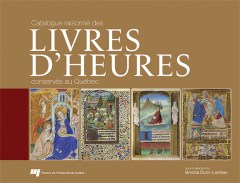 The catalog of this magnificent exhibit (and more) has been published (in French): Catalogue raisonné des livres d’Heures conservés au Québec, edited by Brenda Dunn-Lardeau. Québec, Presses de l’Université du Québec, 2018. 468 pages. $48 (softcover)/$55 (hardcover), ISBN 978-2-7605-4975-3. [ Amazon / BAnQ / Biblio / WorldCat ]
It is a small exhibit (only two rooms) but it is quite enlightening and well-worth seeing for all (ancient) books lovers. You really should take the time to go see it.
Here are some pictures that I took as a memento:
First room

Hours of Philippe de Montholon, c1460, Hainaut/Dijon, Archives of the Jesuits in Canada. Adoration of the Magi.

Masmines et Bouthillier Hours, c1500, Ghent, Archives of the Jesuits in Canada. Heraldic crest of two Flemish families with illustration of the crucifixion.

Bordures décorées du nom des possesseurs, c1475-1480, Lyon, McGill University Library. Personnalised with the names of the owner, here to commemorate a wedding.

Calendrier du mois d’octobre, c1475-1480, Lyon, McGill University Library. Calendrier donnant les fêtes des saints et les fêtes liturgiques, illustré des signes du zodiaque ou des travaux relatifs à chaque mois. Le recto est ici illustré d’une scène de semence (au verso on retrouve un scorpion).

Folio d’un livre d’Heures à l’usage de Paris (présenté sur l’écran d’une tablette), c1430-1435, Paris. Musée des Beaux-arts de Montréal. L’Annonciation.

Horae for the use of Rome, 1515, Paris, Séminaire de Saint-Sulpice (Montréal). In-quarto format. Engraving: arrest of Christ.

Hours for the use of Toul, c1500-1510, 1547, 1560, Paris, Musée de l’Amérique Francophone (Québec). Hybrid book resulting from the assemblage of different editions with a manuscript leaf in latin detached and inserted in the book of hours.

Seven miniatures from a breviary (displayed on the screen of a tablet), c1470, Rouen, McGill University Library. Illustration of the psalter: “a corpse in a cemetery above which takes place a fight between Saint Michael and the Devil for the soul of the dead man. Meanwhile, a hermit monk is praying, with a prayer book open on his knees” (Office of the Dead).

Heures de Notre dame, a l’usage de Rome, selon la reformation de notre S. Pere Pape Pie V, 1583, Paris, Musée de l’Amérique Francophone (Québec). Printed music sheet.

Hore intemperate Virginias Dei génitrices Marie for the use of Rome, 1516, Paris, McGill University Library. Printed on vellum, illustration of King David in prayers and the coronation of King David.
Second room

La Flagellation et début de Tierce, c1425-1450, Bruges, McGill University Library. Folios d’un livre d’Heures manuscrit en latin à l’usage de Rome.

L’Adoration des Mages, c1500, Rouen, McGill University Library. Folio d’un livre d’Heures manuscrit en latin à l’usage de Rouen.

Suffrages à Sainte Barbe, c1475-1485, Paris, McGill University Library. Folio d’un livre d’Heures manuscrit en latin.

La Déposition du Christ, c1375, Vénétie, Musée des Beaux-arts de Montréal. Folio d’un livre d’Heures manuscrit en latin.

L’Adoration des Mages, c1225-1270, Paris, Musée des Beaux-arts de Montréal. Folio manuscrit d’un psautier, d’un livre d’Heures ou d’un bréviaire.

L’Arrestation du Christ et le Baiser de Judas, c1235-1250, Augsbourg, McGill University Library. Folio d’un psautier manuscrit.

Bréviaire (extraits), c1300, Bruges?, McGill University Library. Folio d’un bréviaire manuscrit en latin.

La Visitation, c1430-1440, Bayeux, McGill University Library. Folio d’un livre d’Heures manuscrit en latin à l’usage de Bayeux. Scène de la Visitation de Marie à sa cousine Élisabeth.

Psaume 110, c1480, Pays-Bas, McGill University Library. Folio d’un psautier-bréviaire manuscrit en latin à l’usage des Brigittines (abbaye de Mariënwater). “Une décoration exubérante caractérise les manuscrits, telle cette bordure en rinceaux à l’or bruni sur fond réservé et semé de pointillés d’or. Ces rinceaux sont peuplés de motifs végétaux (boutons d’aubépine, feuillage, fraises, grappes de raisin), d’un cerf couché dans la partie inférieure, ainsi que d’un renard avec une cape rouge dans la bordure de droite. Des marques textuelles indiquent que ce livre était destiné à un public féminin.”
More pictures are available on my Flickr album. View the legends for all pictures after the jump…
[ Traduire ]
Continue reading →
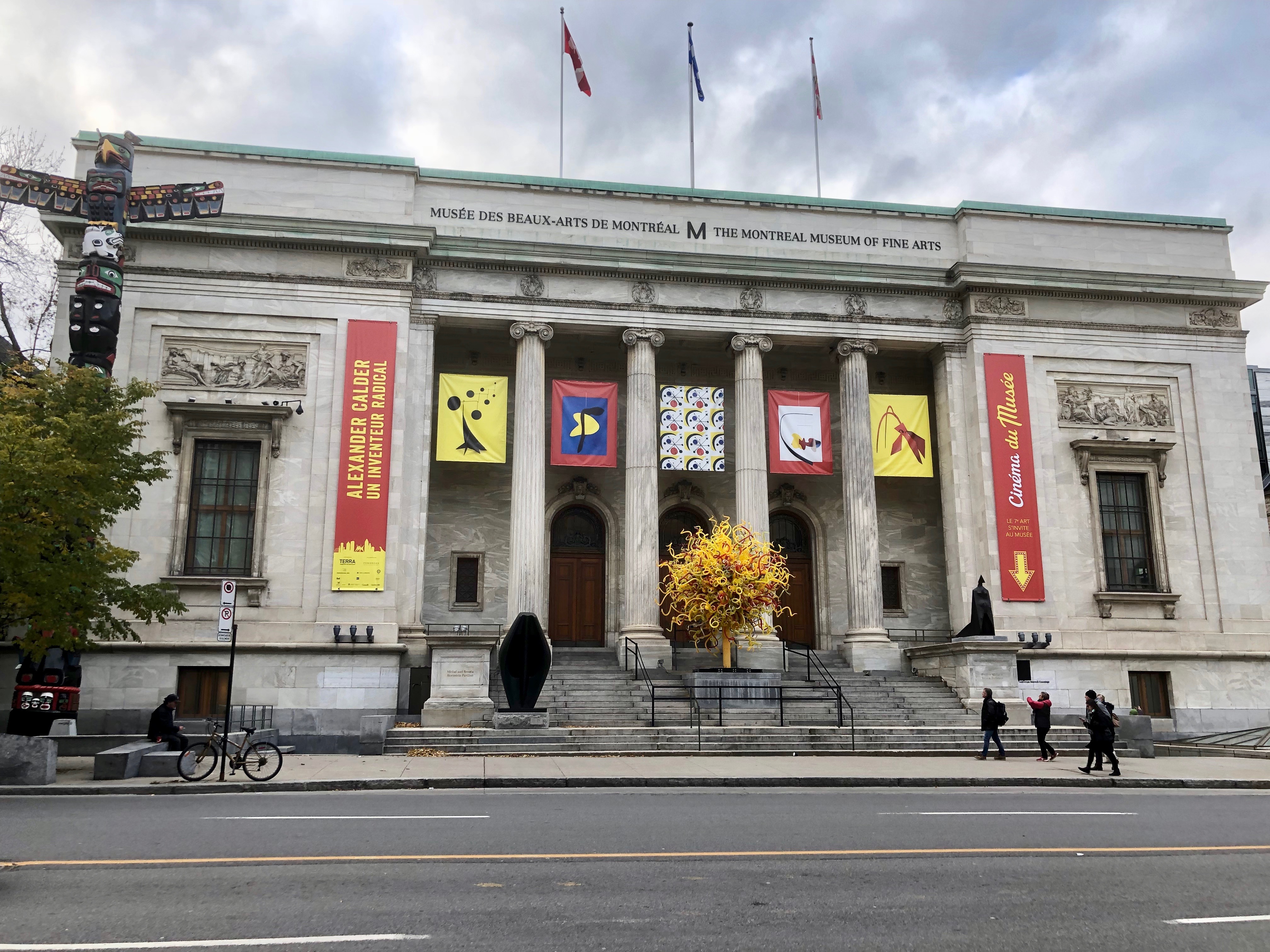 On October 16th, after a lengthy trek in the Mount Royal Park to admire the autumn foliage, we went to the Museum of Fine Arts to have a look at a small exhibition about books of hours. Titled “Resplendent Illuminations” the exhibit displays Books of Hours from the medieval and Renaissance eras (13th to the 16th Century) but the interesting part is that they are all from Quebec (seven private and public collections). The exhibit, born from in-depth academic research, offers more than 50 artifacts (leaves, complete manuscripts, prints) and is held at the MMFA (pavillon Jean-Noël Desmarais – niveau S2) from September 5, 2018 to January 6, 2019.
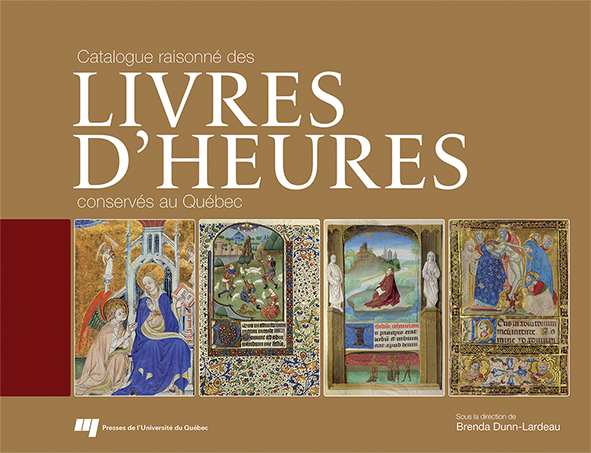 The catalog of this magnificent exhibit (and more) has been published (in French): Catalogue raisonné des livres d’Heures conservés au Québec, edited by Brenda Dunn-Lardeau. Québec, Presses de l’Université du Québec, 2018. 468 pages. $48 (softcover)/$55 (hardcover), ISBN 978-2-7605-4975-3. [ Amazon / BAnQ / Biblio / WorldCat ]


 Clodjee's Safe-House