Détour

DetourLes week-ends se déroulent rarement comme prévu. Je planifiais de faire de menus travaux, de la comptabilité, de lire et commenter des mangas (surtout Isabella Bird et Moriarty) et je me retrouve finalement à lire (relire?) des vieilles BDs de Moebius, à regarder des animés sur Netflix (Gundam Unicorn !) et à rechercher une nouvelle adaptation animée d’un vieux manga shōjo des années ’70 par nulle autre que Waki Yamato (Haikara-san ga tōru) et dont je parlerai sans doute amplement dans un futur proche…

Encore un coup de nostalgie. Cela faisait un bout de temps que j’avais pas regardé d’animés… C’est bon. Ça fait du bien. Et sur Netflix, qui plus est (quoiqu’on y retrouve rien de bien nouveau puisque Gundam Unicorn date déjà de 2010). Et ce n’est pas fini puisque Netflix a annoncé plusieurs titres d’animés à venir (dont Evangelion en juin, Saint Seiya plus tard dans l’été et Ghost In The Shell Stand Alone Complex en 2020 !!!). Ce n’est vraiment plus de la culture populaire (geeky stuff) mais cela commence à faire partie de la culture courante (mainstream)…

[ Translate ]

Avengers: Infinity War

Avengers_InfinityWarThis is a very depressing movie mostly about sacrifice and loss. The sophisticated and over-the-top special effects are not enough to make you really appreciate this over compartmented story which is a literal who’s who of the Marvel Cinematic Universe as they pit almost EVERY Marvel superheroes against Thanos in order to try saving the universe. It is just too much (too much non-stop action, too many character killed). And it is also “To be continued” ! ;(

Of course, it was greatly appreciate by the Marvel Universe fans (score of 8.5 on IMDb and critic/viewer ratings of 85% / 91% on Rotten Tomatoes), but for me it wasn’t enough to prevent me from feeling bored (beside the occasional “what? Those characters are part of the same universe” or “oh no, they didn’t dare going there” or “you means, he’s dead, dead?”)—although I almost sympathized with the supervilains who has a very gordian way of solving the universe’s problem (who knew? Earth is not the only place with an overpopulation of idiots!). It might have helped to have watched some of the one shot movies (like Spider-Man: Homecoming,  Ant-Man or Doctor Strange) as well as some of the TV series. Now, they will really need new characters (oh, yeah, that’s probably why they dug out Ant-Man, Black Panther and Captain Marvel !). However, I am curious to see how the heroes will manage to find their way out of this dire situation… Which we will know, of course, with Avengers: Endgame coming out next month !

It is an entertaining movie, the kind you watch with friends, beer and chips, or that you distractingly watch while fiddling with your phone. stars-2-5

To learn more about this title you can consult the following web sites:

[ AmazonBiblioGoogleIMDbNetflixOfficialWikipedia ]

[ Traduire ]

Capsules

“Natural History” quest – a sequel

NHa-000_IMG_4392

My mystery book

My quest to identify a mystery book simply titled “Natural History” continues…

Today I went to the National Library (BAnQ) to renew my membership and request an Inter-Library Loan (PEB)  for Bernard BARR’s book about William Milner. Hopefully this time it will work and the fee won’t be too expensive. While I was there I had a look at their impressive manga collection and borrowed a volume of The Walking Dead comics (I am a book geek in various spectrum!)…

I have decided not to request an Inter-Library Loan (PEB) for Richard COPE’s book (the most likely candidate for the identity of the mystery book) but to directly go the University of Montreal library to check the copy they have and compare it to my book. After all, I am already downtown, so why not take the time now to resolve this question. It can be found at the media division (médiathèque) of the Library of Letters and Humanities (Bibliothèque des Lettres et sciences humaines – BLSH). Actually, they don’t have a copy of the book itself but a copy on microfiches.

Unfortunately, despite the fact that the online catalog indicated an “on shelf” status, the entire Landmark Microfiche collection had been boxed as the media section is about to be moved. I was a little pissed but convinced the clerk to at least open a few boxes to see if he couldn’t find the microform set that I needed. He was clearly unwilling to help and said “You know, we’re closing in an hour and half!”. But I just needed ten minutes… It would be easy if they had been boxed alphabetically: since the author is “COPE” it would be in the first boxes. He reluctantly opened the first five boxes and indeed it was there (in box four)! I sat at one of the microform reader and had a look. Unfortunately, this machine was not equipped to make copies, so I simply took pictures with my iPhone (which I had to put together later at home, converting them from negative to positive). I took my time, but after fifteen minutes I was done. However, I could finally confirm the identity of my book!

First, I’ve been able to see the pages that were missing from my book (although nothing in the binding let us suspect that something is missing—or maybe the binding was changed at some point in the past?), mostly the title page, the introductory remarks (indicating that the original publishing date is 1840) and the index of subjects:

For me the most important aspect was to be able to see the title page:

NATURAL HISTORY;

OR,
A DESCRIPTION OF THE EARTH AND OF ANIMATED NATURE,
COMPILED FROM THE WORKS OF
BUFFON, GOLDSMITH, CUVIER, SHAW, VAILLANT, HUMBOLT, AUDUBON. &c., &c.

A NEW EDITION, IMPROVED AND ENLARGED

BY RICHARD COPE, LL.D., F.A.S.,
Author of the Pulpit Synopsis, Religious Anecdotes, Domestic Altar, &c., &c., &c.

“Creation teems with life,
From the gay flies that people the sunbeam,
To the huge whale whose home is in the deep,
And the wise elephant that shades him in the forest.”
MONTGOMERY

WITH FOUR HUNDRED & TWENTY-FIVE ENGRAVINGS
OF BIRDS, BEASTS, FISHES, REPTILES, &c.

HALIFAX:
PRINTED AND PUBLISHED BY WILLIAM MILNER,
CHEAPSIDE.
MDCCCXLVI. [1846]

If we compare a few pages, we can see that it is the same book (my copy (a) on the left and the Université de Montréal microfiche copy (b) on the right):

After comparison it is evident that the layout and the type are exactly the same. Beside the missing pages, the only differences are (possibly) the cover (my cover is a simple cloth on board, with raised bands and the title hot-stamped in gold on the spine while the microfiche copy is illustrated—although it is not clear if this is really a cover illustration or an inside cover page) and (definitely) the line of text at the very bottom of the last page of my book (“WILLIAM MILNER, PRINTER, CHEAPSIDE, HALIFAX.”) is completely missing for the microfiche copy. My conclusion is that it is indeed the same book, although a different edition (either a cheaper one or a different year of publication — but, save for the last page, it is clearly the same printing plates). 

Now that I have identified for sure the book as Natural History by Richard COPE, I only have to wait for the Bernard BARR’s book to see if I can learn more details about the publisher,  William Milner, and maybe also about the various editions of COPE’s Natural History. So, it is still to be continued…

[ Traduire ]

A Gentleman’s Murder

522362267When the newest member of Eric Peterkin’s London club is found stabbed to death, Eric throws himself into a quest for the truth: missing nurses, morphine addiction, shell shock. The Great War is over, but the memories remain…” (From the publisher’s website)

The year is 1924. The cobblestoned streets of St. James ring with jazz as Britain races forward into an age of peace and prosperity. London’s back alleys, however, are filled with broken soldiers and still enshadowed by the lingering horrors of the Great War. 

Only a few years removed from the trenches of Flanders himself, Lieutenant Eric Peterkin has just been granted membership in the most prestigious soldiers-only club in London: The Britannia. But when a gentleman’s wager ends with a member stabbed to death, the victim’s last words echo in the Lieutenant’s head: that he would “soon right a great wrong from the past.” 

Eric is certain that one of his fellow members is the murderer: but who? Captain Mortimer Wolfe, the soldier’s soldier thrice escaped from German custody? Second Lieutenant Oliver Saxon, the brilliant codebreaker? Or Captain Edward Aldershott, the steely club president whose Savile Row suits hide a frightening collision of mustard gas scars? 

Eric’s investigation will draw him far from the marbled halls of the Britannia, to the shadowy remains of a dilapidated war hospital and the heroin dens of Limehouse. And as the facade of gentlemenhood cracks, Eric faces a Matryoshka doll of murder, vice, and secrets pointing not only to the officers of his own club but the very investigator assigned by Scotland Yard.” (From the book flap)

In the roaring twenties, in the heart of the British Empire, a member of the Britannia Club is murdered. Eric Peterkin, a young half-Chinese man who usually spend his time reading submissions for a London publisher, cannot resist the urge to solve this mystery (with the occasional help of his sister Penny and his friend Avery). However, in order to discover who killed Benson—a man he barely knew—he will have to solve a cold case as well as a third murder. Amongst the prominent members of the club, who has done it? Aldershott, the club president? Bradshaw, the club secretary? Norris? Parker? Saxon? Wolfe? They all had possible motive and opportunity. Everything seems rooted in Flanders and in the manor turned into a makeshift hospital where some of them recovered or worked during the war…

A Gentleman’s Murder is  murder mystery novel inspired by the Golden Age of Detective Fiction. It follows all the rules of the genre (the Knox’s “Decalogue”) save for rule no. 5 (“no Chinaman must figure in the story”). It is set in the world of the military and retired officers’ club. The story particularly address the question of PTSD (or, as it was called then, “shell shock”) and, to a lesser extend, “the soldier’s disease” (aka morphine addiction).  As the author says in the book (p. 322) “Some scars weren’t visible. And some deaths weren’t physical.” The novel also talks about racial bias, as the character, who is half-English and half-Chinese, often struggle to be taken seriously because he doesn’t look like a gentleman. The author has probably drawn from his personal experience as he made his military service in Singapore (a city-state with the dual British and Chinese heritage) and is himself of Chinese origin.

The author seems to favour the post-WWI era because it is a beautiful era and doesn’t involved the complex methodology that investigators have to deal with in modern times (like DNA)—the mystery must remains in the reach of the amateur sleuth. As the author write in his postface, the 20s was a delicious time to write about because it was an exciting age of transition: you still have in place all the Victorian manners and mores but also all the innovation brought by the modern world (like telephone, radio, cars, electricity, etc.).

The story, which includes several unforeseeable twists, is very well written. The characters are detailed and quite believable. It seems that lots of efforts were put in describing all the setting with rigour (although most of the locations are fictional). Crime novel (particularly if set in the 20s) is a prolific genre and it’s hard to have such story not feel a little cliché. The only other caveat I can see is that the story offers so many characters and the protagonist takes so much time to imagine each possible permutation of culpability and action for EACH of those numerous suspects that, after a while, it gets a little tiring and confusing. It is almost impossible for the reader to guess who the murderer is — but, in this case, it is probably better that the dénouement come with a surprise.

A Gentleman’s Murder is a good novel. It is agreeable to read and, like all good murder mystery, you go through each new chapter with anticipation, reading faster and faster as the climax approaches. I recommend it warmly particularly because it is written by a local author. Christopher Huang, although born in Singapore, now lives in Montreal.

The publisher, Inkshares, is also of interest. It is a reader-driven publisher, which means that their books and authors are selected not by editors but by readers—through contests, pre-orders (as a form of crowdfunding you need 750 pre-orders to get published) and how much interest an online draft of the story is getting (i.e. follows, shares, and reads). Authors will receive 35% of net receipts (gross revenue minus the cost of production and distribution) in exchange of a full publishing service (editing, design, printing, marketing, as well as both direct and wholesale distribution). That seems a fair deal. It is an improvement on the self-publishing type publisher, where a publisher will “assist” an author in publishing his/her book. A good example of this type of publisher is the indie ebooks distributor Smashwords (one of my friends is using this service). Would-be writers have more and more options to publish their work.

A Gentleman’s Murder, by Christopher Huang. Oakland: Inkshares, July 2018. 348 pages. US$ 15.99 / C$ 19.99. ISBN 978-1-94264-595-5. For young adult readership (16+). stars-3-0

To learn more about this title you can consult the following web sites:

[ AmazonBiblioGoodreadsGoogleInksharesWorldCat ]

© 2018 Christopher Huang

[ Traduire ]

A Natural History Investigation Update

Here’s a quick follow up on my research to identify one of my old books…

My first attempt to get Bernard BARR’s book about William Milner failed because the Montreal libraries have a policy not to get an Inter-Library Loan (PEB) if it will incur a fee for the borrower. Actually, I wouldn’t have minded but I’ll check if the National Library (BAnQ) has a similar policy. The last resort would be to travel to NYC where the NYPL has a copy… Or I could get a copy through Google books or Amazon… Although, it doesn’t seem available… We’ll see…

In the meantime, I dug deeper into WorldCat and found possible candidates for my book.

The first candidate could be: Georges Louis Leclerc BUFFON, comte de. Natural History (containing a full and accurate description of the animated beings in nature : illustrated with upwards of three hundred engravings of birds, beasts, fishes, reptiles, insects, etc.). Milner & Co., [188-?], 224 pages. Interesting description of the binding (red cloth over boards stamped with black ink, gilt title on top board, gilt spine ornaments) but it’s too recent and there’s not enough pages to be my book…

The second candidate looks more interesting: Richard COPE & Thomas BEWICK, Natural History (or a description of the earth and of animated nature, compiled from the works of Buffon, Goldsmith, Cuvier, Shaw, Vaillant, Humboldt, Audubon, &c.). Milner & Co., [1860]. It was first published in 1840 and has 730 pages, its size is 23 cm and includes 425 engravings [by or after T. Bewick]. I could compare my book with it since the Université de Montreal has a copy (but is it available to the public? And it doesn’t say which specific library…). There’s another edition of 1846 (but the size is 27 cm) again with a copy at the UdeM. Among the numerous editions (many seems to be microform copies) of the same book, the oldest seems to date from 1842. One specifically says “by William Milner, Cheapside, 1846” (with also a copy at the UdeM!). Too bad there are no pictures. 

The Cheapside 1846 edition seems the best option, so I’ll first see if I can get it through Inter-Library Loan (despite the age of the book). If not, I’ll go to the UdeM to investigate further… 

To be continued

[ Traduire ]

Doodling girls

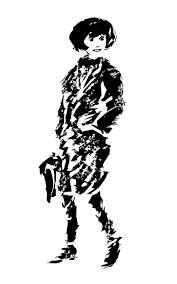
DoodlingGirls-covGhislain Barbe is best known for designing the visual aspects of several science fiction franchises such as Heavy Gear, Jovian Chronicles and Tribe 8. He also created the visuals for the characters of PBS’s cartoon TV series Sagwa, the Chinese Siamese Cat and worked as Art Director in the videogame industry. Doodling Girls 2017 is a collection of girls illustrations taken from his 2016 and 2017 Sketchbooks. (From the publisher’s website)

All these doodles were made for the fun of it (i.e. no commercial purposes) between January 1st of 2016 and December 31st of 2017. Some might have been inspired by pictures seen here and there, other are pure products of the need to fill a piece of paper. (Book’s introduction)

The reason I find difficult to read books written by people I know is that I am always afraid that I might not like them and have to make negative comments… I really want to talk about this book, but unfortunately I found it quite disappointing. So, I guess it will be a case of “Qui bene amat bene castigat”…

Above all, I must say that Ghislain Barbe is without contest one of the best artist I have ever known. He is incredibly fast and extremely creative. His art is usually quite great. I particularly like his character designs (although he can do great mechanical designs too). I still remember this young man, both shy and quite volubile, from Quebec City knocking on our office door with his portfolio under the arm. We were impressed right away by his work and I have always had great respect for him. After doing cover and illustration works for Ianus Publication/Protoculture and, later, Dream Pod 9 (Alternate Reality Cyberpunk, Heavy Gear, Jovian Chronicles, Tribe 8), he worked at CinéGroupe as character designer (on animation like Sagwa the Chinese Siamese Cat, Lion of Oz, Pig City), and then as concept artist as well as art director for Behaviour Interactive (on videogames like Carmen Sandiego and the Secret of the Stolen Drums, Disney’s Planes or Warhammer 40,000: Eternal Crusade MMO). He also illustrated Annie Bacon’s series “Le gardien des soirs de bridge published by Les Éditions Druide. His talent is well recognized.

DoodlingGirls-3The Doodling Girls’ illustrations themselves are quite good even if they are simple sketches. Barbe made those morning doodles every day to keep is drawing hand and his creativity sharp (and probably also to keep his sanity through the vicissitudes and trials of life — a widower rising three teenage girls might certainly have its challenges). I understand that perfectly since that’s what I am trying to do with this blog, trying to write a few hundreds words each day to keep my mind sharp and my sanity. Here, this book gathers some of those doodles that all share one thematic: girls — in all styles or situations, from the silly to the macabre. It is an interesting concept to make use of those doodles, and gather them in an impromptu portfolio. He probably got tired of working on other’s people books and wanted to do one just for himself (and his girls) — for the fun of it ! So, he self-published it (under the name Clay Book Press) using Lulu.com. Hopefully more books will follow, like Doodling Girls 2018-19, Doodling Creatures (as he draws more than girls), or simply Morning Doodles, or even Meeting Doodles (as I know he was also doodling in production meetings!)…

DoodlingGirls-5If the artist is great and the concept is interesting and the drawings themselves are good, then what’s the problem? The disappointment lies in the annoyingly sloppy execution of the concept — although none of this is really the fault of the artist. First, the book offers very little introduction (less than fifty words!) and there are no page numbers, titles, descriptions, production dates or commentaries for the illustrations. This book definitely lacks text. Second, I am sorry to report that my copy has a defect in the printing of the cover (the cover is badly cut: the spine titles are actually on the cover itself and there’s a white bands on the left side of the back cover where we can see crop marks!). Very bad quality control! That printer should be hanged: defective copies should never make it to distribution!! Please choose your printer wisely! Third, the book was printed in the USA, purchased via Amazon.ca and shipped by Book Depository in the U.K. ! That’s the worse example of a wasteful distribution chain I’ve ever seen. Please choose your mean of distribution even more wisely! Finally, that kind of book would usually sell for $15 to $30… $53.76 [although it depends on the seller: from US$ 31.72 on AbeBooks and US$33.22 on Barnes & Noble to C$ 44.17 on Amazon.ca] is a little too much (particularly for artwork that are already available for free on the internet: Behance, Facebook, Pinterest, Tumblr, etc.)! That’s what happens when there are too many intermediaries, each taking their share (Lulu.com, the printer, the seller, the distributor, the shipping cost, etc.). All inclusive “publishers” like Lulu.com are not always the perfect solution, unfortunately (but, I’ll admit, they are convenient). In a way, I don’t really mind because I wanted to encourage the artist in his endeavour no matter the price. Otherwise, it’s really too expensive! Sorry, Ghis! I am sure you could have done better!

All in all, despite its shortcomings, it IS a nice book. It is an artbook, so it’s not something you will really “read”, but it makes for a pleasing coffee table or bedside book. So, don’t hesitate to purchase this book to encourage the artist. However, if you want to see his best works, it’s probably better to buy one of his other books (like a Heavy Gear Rulebook for example)! 


Doodling Girls, by Ghislain Barbe. Montreal: Clay Book Press (Lulu.com), December 2018. 160 pages, 15 x 23 x 1.7 cm, US$ 33.22 / C$ 44.17, ISBN 978-0-359-20459-5. For readership of all age. (See back cover). stars-3-0

For more information you can check the following websites:

[ AmazonGoodreadsGoogleIMDbWikipediaWorldCat ]

© 2018 by Ghislain Barbe.

[ Traduire ]

Un parc toujours glacé

Constatant que les rues et les trottoirs étaient largement libre de glace, j’ai décidé d’aller prendre ma marche de santé sans mettre mes crampons. Quelle Erreur! Le Parc Frédéric-Back est lui toujours glacé sur la majorité de ses sentiers (et ceux qui sont libre de glace sont évidemment plutôt boueux)…

J’ai pris le sentier polyvalent par le parc Champdoré, comme à mon habitude, et dans ce secteur c’est toujours une patinoire qui nécessiterait un épandage généreux d’abrasifs. C’est le cas jusqu’après la côte, passé l’entrée Legendre, et après cela c’est fondue. Toutefois, n’ayant pas été déneigé de tout l’hiver, l’accès Émile-Journault vers l’intérieur du parc est encore enneigé et glacé. Par contre, comme la neige a fondue un peu et est durcie, cette entrée est maintenant accessible sans trop d’acrobaties. À partir de là, le sentier qui fait le tour de la butte du “boisé” est en grande partie dégagé.

Je suis donc très déçu que le Parc Frédéric-Back, qui devrait normalement être accessible en toute saison tant aux piétons, coureurs et cyclistes, qu’aux skieurs et raquetteurs, n’a reçu que très peu d’entretien cet hiver, le rendant pratiquement inaccessible aux randonneurs qui n’ont pas de crampons et le laissant au plaisir exclusif des skieurs et raquetteurs. Cela n’a d’ailleurs rien à voir avec la quantité de neige ou de pluie reçue cet hiver et tout à voir avec la quasi absence de déneigement et d’épandage d’abrasifs dans le parc. Le parc était beaucoup mieux entretenu durant l’administration précédente. Comme la mairesse de VSP m’a informé que le “parc se trouve dans notre arrondissement cependant la gestion ne nous reviens pas” et qu’il “fait partie du réseau des grands parcs et donc c’est la ville centre qui le gère,” je vais donc dorénavant adresser mes doléances à la ville centre (Ville de Montréal, Valérie PlanteParc Frédéric Back) qui malheureusement réponds pas mal moins souvent (jusqu’à maintenant je n’ai jamais eut de réponses) aux commentaires que les arrondissements…

Voir mes autres commentaires sur l’état glacé des sentiers du Parc Frédéric-Back avec mes billets Coeur de glaceN’ice park, et Stat’ice report.

Aussi, suite à cette malencontreuse chute sur le sentier polyvalent du parc (où j’ai  déchiré mon pantalon), j’ai décidé de faire une réclamation à la ville (pour le remplacement de mon pantalon et l’achat de crampons!). J’ai reçu une confirmation écrite (dans un language un peu intimidant!) et par téléphone. On me demande si j’ai reçu des dommages physiques. Je réponds que si c’était le cas je l’aurais mentionné dans ma réclamation. “À part le pantalon déchiré et une petit ecchymose, non, il n’y a pas eut de dommage physique”. Sur ce on me répond (je paraphrase), “une ecchymose? Ben là, à cause de ce dommage à votre personne il va y avoir un délais d’un mois avant que l’on puisse poursuivre la réclamation” ! Maudite ville à marde!

[ Translate ]

Je suis un chat

Je-suis-un-chat“Le célèbre roman de Sôseki devient un manga. Célèbre et désopilant. Vue par l’œil ironique d’un chat doté de remarquables talents d’observation et d’analyse, voici la vie d’un professeur d’anglais et de son entourage au début du vingtième siècle, lorsque le Japon est secoué par l’essor des valeurs mercantiles venues d’Occident.

Le professeur Kushami, double de l’auteur, sa famille, ses visiteurs, l’étudiant amoureux, le tireur de pousse-pousse, le riche industriel, la maîtresse de koto, sans oublier les chats, l’univers fantaisiste et débridé du roman est parfaitement restitué, avec toute sa richesse et sa profondeur.”

(D’après le site de l’éditeur; voir aussi la couverture arrière)

Je suis un chat (吾輩は猫である / Wagahai wa, neko de aru / lit. “Moi qui suis un chat”) est l’adaptation en manga d’un classique de la littérature japonaise par le romancier Sôseki. Le roman avait d’abord été publié en feuilletons dans la revue littéraire Hototogisu entre 1905 et 1906. 

9782809711905_pgKushami est professeur de littérature anglaise à l’ère Meiji et tout un monde orbite autour de lui: ses étudiants (Meitei, Kangetsu), ses amis, sa famille, ses voisins. Le témoin de cette vie quotidienne est un chat sans nom, qui prends ici la place d’un narrateur omniscient. Il s’agit d’un récit satirique, qui parodie la classe moyenne japonaise ayant adopté tant bien que mal les coutumes de l’occident et qui se prends des airs arrogants. Une bonne partie de l’intrigue se déroule autour des spéculations sur le possible marriage de Kangetsu avec Tomiko, la fille des Kaneda — un riche marchand. Malheureusement, l’histoire finit mal pour le chat…

Le récit est très amusant et assez proche de l’oeuvre originale. Par contre, le style graphique est plutôt décevant: il est très simple (épuré, voir primitif) mais il fait tout de même le travail et illustre bien le récit. C’est une excellente façon de faire connaître cet oeuvre de Natsume Sōseki — dont le personnage est un peu l’alter ego de Sōseki qui était lui aussi professeur de littérature anglaise.

Je suis un chat, par Cobato Tirol (Traduction par Patrick Honnoré). Arles: Éditions Philippe Picquier, août 2016. 208 pages, 14,50€ / C$ 26.95, ISBN-13 : 978-2-8097-1190-5. Pour lectorat de tout âge. stars-3-0

Pour en savoir plus vous pouvez consulter les sites suivants:

[ AmazonBiblioGoodreadsGoogleWikipediaWorldCat ]

© Tirol Cobato / Home She, 2010. © Éditions Philippe Picquier 2016 pour la traduction française.

A noter que l’on retrouve d’autre mangas aux Éditions Philippe Picquier:

Miss Hokusai Tome 1, par SUGIURA Hinako.
Dix Nuits Dix Rêves, par KONDÔ Yôko (D’après le roman de Sôseki).
La porte,  par INOUE Daisuke (d’après le roman de Sôseki).

[ Translate ]

Capsules

Latest acquisition

A couple of years ago I’ve talked about my collection of ancient books. Well, I just made a new acquisition. I never thought I would find more interesting (but affordable) books to add to this collection…

This week-end I went to the Westmount Book Fair at the Green Center in Westmount. I’ve been hearing about this bi-annual antiquarian book fairs for a while and always wanted to have a look but was always too busy. When I saw another one advertised on facebook, I thought now was the time. Although I was rather apprehensive that I would find a very interesting (and expensive) book.

The Westmount Book Fair was organized by Wilfrid M. de Freitas, who is himself a bookseller. It was the 27th edition of what is advertised as “the smallest ancient books fair in Canada, where booksellers from Quebec and Canada will help you discover a wide selection of books, brochures, maps, printed matter and small papers”. It was indeed a small venue with a little more than a dozen stands.

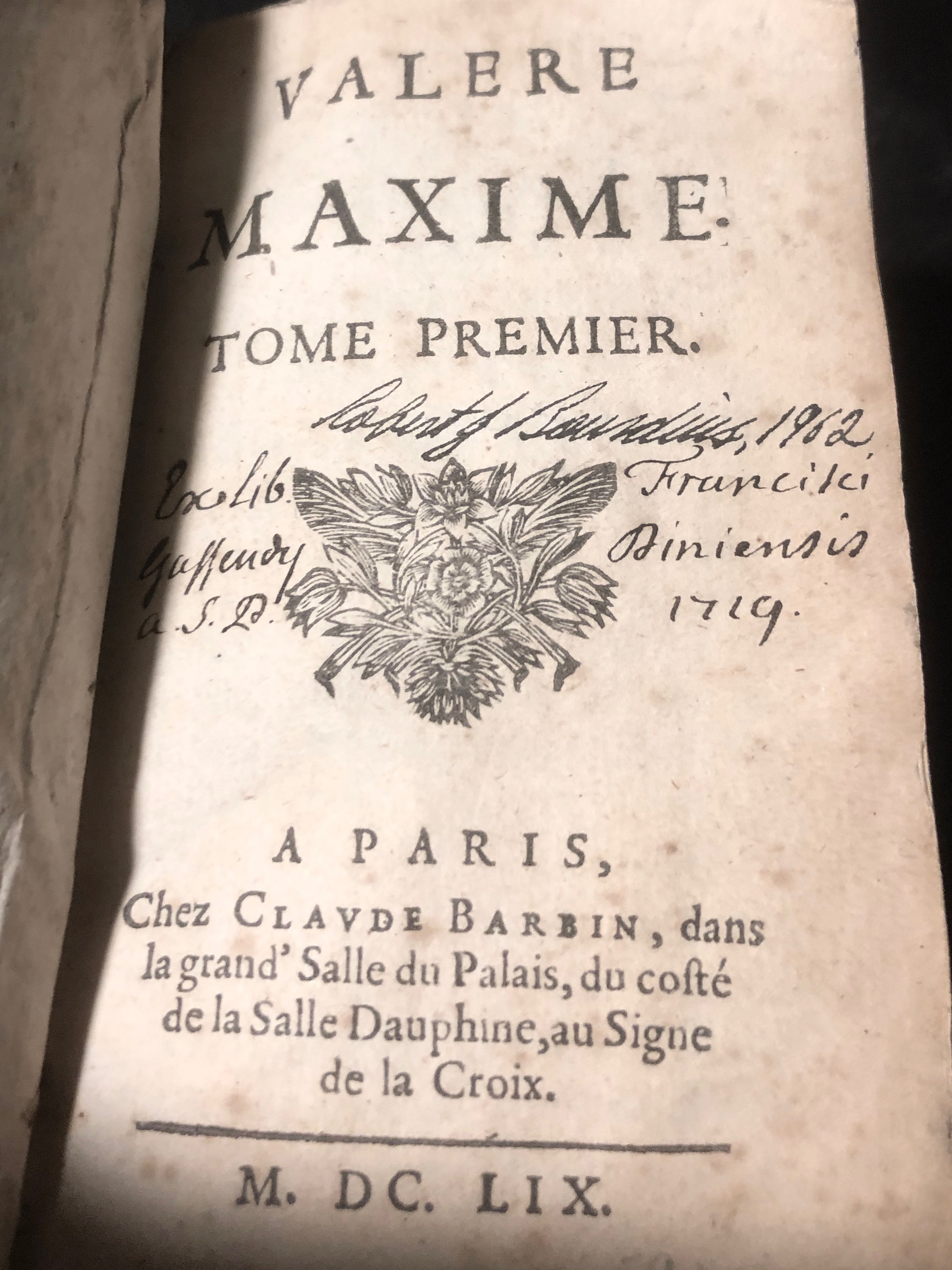
I took a quick look and identified all the books the would interest me and fit into my unfortunately small budget: the Caesar commentaries (in French, 1763, $125), the work of Tacitus (2 vols in latin, 1772, $350), and the work of Valerius Maximus (1659, $275). More affordable but out of my subjects of interest for this type of books (ancient authors, 16th to 18th century editions) there was also a Short French Dictionary (in English, 1701, only $100). There was also a big format velum book (about 25 cm hight and 8 cm thick) from the 17th century about mythology (a mere $5000 !), the works of Bossuet in a big volume ($4500), a few sheets from German old books (incunable?) or a large format book (in-folio) about the myth of the wandering jew illustrated by Gustave Doré for which I didn’t even dare looking for the price tag. Out of interest and price range, I also noticed the first annual compilation of the bande-dessinée magazine Pilote ($500-$700). It gave me a few interesting books to choose from. After, deliberating over the interest (age, condition of the binding, subject) and the price, I finally chose the Valerius Maximus. It was the only 17th century edition in my list, in relatively good condition and at an affordable price. It was sold by Mr. de Freitas and he even gave me a small discount.
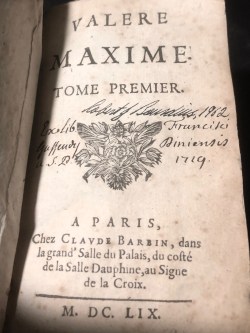
IMG_4317VALERE MAXIME, A PARIS, CLAVDE BARBIN, dans la grand’ Salle du Palais, du cofté de la Salle Dauphine, au Signe de la Croix. M.DC.LIX. [1659]”

The title of the book (which doesn’t appear on the first page) is “Factotum ac dictorum memorabilium libri IX” [nine books of memorable deeds and sayings]. The binding (pork skin?) includes two volumes (it’s 4.5 cm thick), in the sextodecimo format (in-16, in this case 8 x 12.75 cm) . According to the note from Mr. de Freitas, it’s the second edition in French, translated by Jean Claveret. It is a collections of a thousand historical anecdotes, many lifted from earlier Roman writers, re-drafted by Valerius Maximus as moral and social models. It was written during the reign of Tiberius (around around CE 30 or 31). It is quite interesting…

The Collection (or my cabinet of curiosities)


The next book fair, organized by the Confrérie de la Libraries Ancienne du Québec, will be the 36th Antiquarian Book Fair held at the Concordia University (Pavillon McConnell, 1400 bout Maisonneuve O.) Saturday September 28th (from 12:00 to 18:00) and Sunday September 29th (from 11:00 to 17:00).

IMG_4304While having my nose in old books, I decided to do some more research on one of my (very interesting) books on which I have little information. It’s an octavo volume (15 x 24 x 5 cm) titled Natural History. It has a cardboard cover, covered with brown cloth and thin leather. It doesn’t have a title page and the only publisher information appear on the very last page: “WILLIAM MILNER, PRINTER, CHEAPSIDE, HALIFAX.” I first thought it was printed in the maritime provinces in mid-19th century (I think my father purchased it in Gaspésie in the 60s, for $35). It has 730 pages and is in average condition (yellowed pages and several stains, little tears in the cloth of the cover).

It seems inspired by Pliny’s Naturalis Historiae, but it is not its translation as it has a different content organization and covers more modern subjects: Part I : Of the Universe, Part II-XXII: Animals (mostly mammals), Part XXIII: Unclassified Animals, Part XXIV-XXX: Birds; then A History of the Fishes in General (including cetaceous, crustaceous, frogs, lizards, serpents, turtles, and insects !) Part I-XII.

With a closer examination and more research, I discovered new information about this book. First, it seems that the printer is NOT from Nova Scotia but rather from England. Cheapside is a street in Halifax, West Yorkshire, England. William Milner (1803-1850) is a printer who was known for publishing lots of cheap books (selling for sixpence (2 pence) and a shilling (5 pence)). He apprenticed as a printer, but started publishing his own books, first with local printers and then setting up his own press in the 1830s (or in 1844). After his death, his stepsons took over the business under the name Milner & Sowerby. Therefore, my books must have been published between the 1830s and 1850. I will try to find more about this publisher. There is a book that seems to list some of his production, so I will probably start there. To be continued…

[ Traduire ]

Deserved end

I am exasperated by human behaviours. Most animals will never shit where they eat and will never hurt others unless in self-defence, self-preservation or to eat. While humans, lately, don’t care about anyone but themselves and will go out of their way to hurt others simply by pleasure, by revenge or even for no reasons at all. It is a mean, selfish creature that is slowly killing everything on this planet just because it wants stuff. Frankly, why fight against our own destructive nature and try to save ourselves? Or why try to even give our worthless selves a peaceful end? Why not go all the way toward a well deserved end?

I wish I was a recluse, away from all this stupidity. But I am not, so I always do my best not to hurt anyone and to help when I can. To give the other cheek. And it hurts to see all the others not giving back the same respect. People act selfishly, stupidly, against their own interest because they don’t make the effort to understand, to learn, to follow logic. I am exasperated and I am afraid. Afraid that I will eventually become like them, a beast. I am already becoming grumpy and resentful. If it is indeed our true nature to be not an animal but a beast, maybe it is also for me a deserved end…

[ Traduire ]

Star Trek Discovery

StarTrekDiscoverySeason2First, I must say that Discovery is definitely one of the best Star Trek TV series I have seen in a long time. If we don’t count the animated series and the movies, it is the sixth Star Trek series (after Star Trek The Original Series (1966-69), The Next Generation (1987–94), Deep Space Nine (1993–99), Voyager (1995–2001), and Enterprise (2001–2005)). After The Original, none of these series were really satisfactory (in imagination, plot and action) until Discovery.

For the first time, with Discovery, the main character of a series is NOT the captain of the USS Entreprise. The series focus on Michael Burnham (played by Sonequa Martin-Green [The Walking Dead]) who is the First Officer of the USS Shenzhou in the beginning before becoming Science Specialist on the USS Discovery. Born in 2226, she is a xenoanthropologist raised on Vulcan by her adoptive parents, Vulcan ambassador Sarek (James Frain) and his human wife Amanda (Mia Kirshner). She is therefore Spock‘s foster sister! Her biological parents were killed during a Klingon raid on Doctari Alpha.

The first season, set a decade before the Original series, focuses on the FederationKlingon war. During a rare encounter of the Shenzhou with the Klingons, Burnham uses her knowledge of Klingon and Vulcan strategy to try preventing the war but act against her captain’s orders. She fails and Georgiou is killed in the ensuing battle. Burnham is sentenced to life in prison for mutiny, but during a prison transfer her shuttle is damaged and she is rescued by the USS Discovery, commanded by Captain Gabriel Lorca (Jason Isaacs), where she is given a temporary position of Science Officer. The Discovery uses an experimental spore drive which, after sabotage, brings them to a parallel universe where Captain Georgiou is the Empress of the Terran Empire! After multiple trials and betrayals, the crew succeeds to end the war.

In season two (which is not over yet, as three more episodes remain to air), the captain of the USS Enterprise, Christopher Pike, takes emergency command of the Discovery from interim-captain Saru (Doug Jones) in order to investigate a series of mysterious signals. Spock (Ethan Peck), who appears to have suffered a mental breakdown, has had foreknowledge of those signals, which seem linked to the apparition of a mysterious Red Angel. They must find Spock before Section 31 to try to unravel the mystery…

The latest episode (“If Memory Serves”, 8th episode of the 2nd season and 23rd episode of the series, which aired on March 7th) was particularly impressive. It starts with “Previously on Star Trek” and then shows scenes from the pilot episode of the Original series (“The Cage”, produced in 1964-65 was never aired but later partly used in episodes 11 & 12, “The Menagerie”). In the original pilot, the captain of the Entreprise was not Kirk but Pike and Spock is the only crew-member who remained in the series. In Discovery, Spock brings Burnham to Talos IV so the Talosian can read his mind and show crucial information to Burnham, therefore both healing him and their relationship. That episode was quite something.

It has been relatively well received (with a rating of 7.4 on IMDb, an overall Rotten Tomatoes critic rating of 82% [but an audience score of 48%, are they mad? !!!] and the same 82% for season 2 [this time with an audience score of 29%! Unbelievable !!!]. In my point of view, it is a series that is well worth watching, even if you know nothing of Star Trek. It is simply very good science fiction. And a third season has already been commissioned. stars-3-5

Apparently, more live-action series are planned including one with Captain Jean-Luc Picard (Patrick Stewart) and one with Captain Philippa Georgiou (Michelle Yeoh) focusing on the activities of Section 31. 

To learn more about this title you can consult the following web sites:

[ CBSGoogleIMDbOfficialSpaceWikipediaYoutube ]

[ Traduire ]

Capsules

On the frontier

9782505069812_cg“Avec ses histoires « tranches de vie », qui vous feront voyager de la douce innocence de l’enfance aux désillusions de la vieillesse avec des personnages hauts en couleur, ce titre émouvant se doit de finir entre vos mains. Un recueil d’histoires courtes poignantes, remplies d’émotions et de poésie.”

On the frontier (辺境で 伊図透作品集 / Henkyo de – izu toru sakuhin-shu / lit. “At the frontier: Izu Toru Work Collection”) est un recueil rassemblant huit courtes premières oeuvres de Tôru Izu pré-publié entre 2007 et 2015 dans différents magazines. Il a été publié en 2016 chez Enterbrain (éditeur de Comic Beam). C’est le cinquième manga de Tôru Izu à être publié au Japon (après Mitsubachi no Kiss [ミツバチのキス / lit. “Kiss of the Killer Bee”, Futabasha, 2 vol., 2008], Onsa no Hibiki [おんさのひびき / lit. “Echo of the ancient time”, Futabasha, 3 vol., 2009], Ace [エイス, Kodansha, 3 vol., 2012], et Juuza no Uruna [銃座のウルナ / lit. “Urna of the gun turret”, Enterbrain, 6 vol. +, 2015]) mais le premier à être traduit en français.

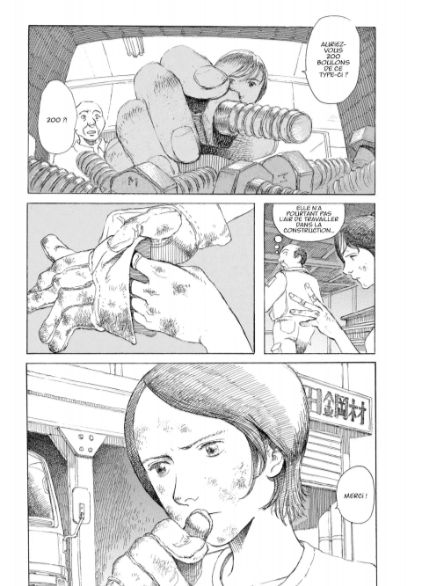
Screen Shot 2019-02-24 at 19.39.22Dans “Steel Blue” (Steel Blue, 30 pages), une jeune étudiante en arts graphique, Kako Amakasu, choisie de faire une sculpture comme projet de fin d’étude au lieu d’un dessin comme ses collègues. Elle prends comme matériaux un rail de chemin de fer et des boulons qu’elle soude ensemble. Malgré les difficultés et son inexpérience avec la technique, elle est assez satisfaite du résultat même s’il laisse les professeurs un peu perplexes. Pré-publié chez Futabasha dans le magazine Manga Action (Avril 2008). Lauréat du 5e prix de Manga Action récompensant les débutants. C’est mon histoire favorite du lot. stars-4-0


Dans “Lace tes chaussures!” (靴ひもを結べ!/ Kutsu himo o musube!, 30 pages), on retrouve une Kanako Amakasu plus jeune (en dernière année de secondaire, juste avant d’entrer au collège) qui s’inquiète de sa carrière et du fait qu’être une femme est limitatif. Elle trouve les garçon idiots. Pourtant, elle se lie d’amitié avec Eto et Sakai qui aiment jouer à chat perché sur les hauteurs. Elle admire leur insouciance mais les incite tout de même à penser à leur avenir… Cette histoire a été pré-publié dans Manga Action (Septembre 2008) et constitue la première apparition (sous des noms différents) des personnages de sa série Onsa no Hibiki. stars-3-0

Dans “Lace tes chaussures! Épisode hivernal” (靴ひもを結べ!・冬 / Kutsu himo o musube! Fuyu, 24 pages), Kô Mizuura (qui que n’a que quatre orteilles aux pieds) vit à l’orphelinat “La maison de Hibikigaoka” avec Satomi, Daisuke, et Takashi. Il a un petit boulot de distributeur de journaux mais n’aime pas le faire en hiver car il a froid au pieds. Il est amateur de chaussures et admire les bottes d’une serveuse de café mais ne croit pas pouvoir se les payer. Pré-publié dans Gekkan Comic Beam (septembre 2015). stars-3-0

Dans “On the frontier” (辺境で / Henkyō de, 42 pages), des hommes travaillent dure à la construction d’un chemin de fer dans un pays désertique mais froid qui n’est pas nommé (possiblement en Amérique du Sud?). Il s’agit d’une dictature où la guérilla fait rage. Les accidents de construction ne sont pas rares et souvent ils sont mortels. Un jeune se joint à l’équipe. C’est en fait un journaliste incognito mais il est découvert et exécuté… Toutefois, le contre-maître voit à le venger. Pré-publié dans Big Comic Spirits Casual (mai 2007) et lauréat du 59e prix Shinjin Komikku Taishô de Shōgakukan (débutant, catégorie seinen). J’aime bien. stars-3-5

Dans “”Laisse-moi” (ほっとけ / Hottoke, 16 pages), Mako s’inquiète pour Junki qui est dehors tard le soir à jouer seul car ses parents travaillent et ne sont jamais là. Elle s’inquiète aussi pour Eto que personne n’a vue depuis plusieurs jours. Elle trouve une excuse pour passer voir Junki, pensant qu’il s’ennui mais il s’amuse dans son imaginaire… Dans “Cerisier” (さくら / Sakura, 11 pages), des policiers visionnent une video où un jeune garçon se fait battre par un sadique. S’agit-il d’Eto? Dans “La pierre d’Union Soviétique” (ソ連の石 / Soren no ishi, 27 pages), Mako croise Eto dans le train. Il est plus sale et défraîchi qu’à l’habitude. Ils parlent de leur avenir. Eto lui remet une pierre qu’il dit avoir trouvé en Union Soviétique où il serait allé plusieurs fois comme passager clandestin. Il veut voyager autour du monde et découvrir les merveilles qui se font à l’étranger. Elle boude car elle ne veut pas qu’il reparte sans lui dire à elle et à Junki. Ces trois récits ont été publié à compte d’auteur (doujinshi?) dans le recueil Récits qui ont débordé puis sombré (あふれてしずんだお話たち / Afurete shizunda ohanashi-tachi, publié en décembre 2014 chez l’éditeur クリーク・アンド・リバー社 / Kurīku Ando ribā-sha / lit. “Ruisseau et rivière”). Le second est pratiquement incompréhensible et le plus intéressant du lot est le troisième. stars-2-5

Dans “Sans titre” (No Title, 40 pages), un gamin qui aime se balader sur les trains clandestinement et dit vouloir faire le tour du monde sans payer (Eto?) passe du temps avec les cheminots. Le vieux Duka lui montre les rudiment du métier. Mais celui est mis à la retraite et met fin à ses jours. Le jeune continue à se tenir avec le cheminots et McLintock s’occupe de lui un peu. C’est une histoire que Izu a créée avant de devenir mangaka. stars-3-0

Le style graphique de Tôru Izu, qui me semble influencé par celui de Leiji Matsumoto, est assez uniforme tout au long du volume. Par contre, les différentes histoires courtes sont de qualité et d’intérêt assez variable. Dans l’ensemble, le récit manque parfois de fluidité à un point où, dans certaine occasions, on se demande un peu ce qui se passe dans l’histoire. On the frontier demeure une bonne lecture et j’aimerais bien voir la traduction d’autres titres de cet auteur (comme Onsa no Hibiki, dont plusieurs histoires de ce livre semblent être la genèse, ou Juuza no Uruna qui a déjà été traduit en espagnol). La collection “Made In” de Kana semble offrir de nombreux auteurs peu connus mais intéressants et qui méritent probablement un coup d’oeil…

On the frontier : Recueil d’histoires courtes, par Tôru Izu (traduction par Pascale Simon). Bruxelles: Kana (Coll. Made In), mars 2018. 240 p., 14.8 x 21.0 cm, 15,00 € / $C 26.95. ISBN 978-2-5050-6981-2. Manga seinen pour public jeune adulte (14+). Un extrait est disponible sur le site de l’éditeur. Aussi disponible en format électronique sur iTunes. (Voir couverture arrière) stars-3-0

Pour en savoir plus vous pouvez consulter les sites suivants:

[ AmazonBiblioGoodreadsGoogleWorldCat ]

© 2016 IZU Toru. All rights reserved. Édition française © Kana (Dargaud-Lombard s.a.) 2018.

[ Translate ]

Victoria S03

VictoriaS03What first interested me into this series was the fact that Jenna Coleman (one of the best Doctor Who companions) had the starring role. But, of course, it was also a very good British historical TV drama, so that was plenty of reasons to follow it. 

In season 3, Queen Victoria and Prince Albert are now older (close to their 30s) and have already six children. This time the story is less political (although it covers the machinations of the foreign secretary, Lord Palmerston, and the monarchy being threaten by anarchists, the revolutionary wind from France or the Chartists) and is more centred around the family. The couple struggles as they become disenchanted with each other, bringing the various type of emotions that any couple would experienced with time, but having their differences being fanned by the plotting of Victoria’s estranged sister, Feodora. Albert exhaust himself trying to find his own place (with pet projects like being the Chancellor of Cambridge or organizing the Great Exhibition). They try to give the unruly Bertie (the future king Edward VII) a proper education.

When it comes to the personal life of monarchs I am not sure if this story is truly historical — it is probably mostly dramatized — but it is quite interesting. It was well received (rating of 8.2 on IMDb as well as an average tomatometer of 84% for the whole series and an audience score of 81% for Season 3 on Rotten Tomatoes) and is well worth watching. stars-3-5

To learn more about this title you can consult the following web sites:

[ GoogleIMDbPBSWikipediaYoutube ]

[ Traduire ]

Capsules

Stat’ice report

Pour suivre l’état des choses dans le parc…

Suite à mes commentaires sur l’état glacé des trottoirs du quartier VSP et des sentiers du Parc Frédéric-Back (voir mes billets Coeur de glace et N’ice park), je constate — une semaine plus tard — que, si il y a encore un effort pour déglacer les trottoirs, il n’y a par contre aucune amélioration du côté des sentiers du parc. Ce sont toujours de véritables patinoires, inaccessible à quiconque n’a pas de bons crampons aux pieds.

Pourtant, alors que je prenais ma marche de santé journalière, j’ai croisé une épandeuse qui sortait du parc Champdoré. Elle a laissé l’entrée du parc avec une quantité généreuse d’abrasif. Je me disais que c’était bon signe. Mais non! L’épandeuse n’est pas passé par les sentiers du Parc Frédéric-Back car il n’y avait pas la moindre trace d’abrasif sur la côte du sentier qui prend naissance près de l’édicule du parc Champdoré. Il n’y avais pas plus d’abrasif ailleurs jusqu’à l’entrée Émile-Journault (qui était elle aussi encore une patinoire et l’accès à l’intérieur du parc n’était toujours pas déneigé) ou même jusqu’à l’escalier de l’entrée du Pélican. Les sentiers polyvalents de ce parc devaient être accessible en toutes saisons aux promeneurs et ce n’est pas le cas! On ne peut pas s’y aventurer sans crampons! Je me suis fait dire que, plus tôt cette semaine, la situation était assez similaire dans le Parc Jarry. Cette administration municipale se fout vraiment de la gueules des citoyens! 

Je suis bien déçu… Vivement le printemps et l’été que l’on puisse à nouveau profiter de la nature que nous offre le parc. D’ailleurs la ville n’est-elle pas censé ouvrir une nouvelle section du parc en 2019?

[ Translate ]

Vérité évidente en soi?

Une expérience récente m’a fait me questionner sur le racisme et la controverse du “racisme inversé.” Un collègue (d’origine haïtienne) me faisait remarquer que si un blanc dit “il y a trop de noirs ici” ce serait définitivement du racisme. Par contre, lorsqu’un noir dit “il y a trop de blancs ici” (ou similairement “il n’y a pas assez de noirs ici”) ce n’est pas considéré comme du racisme. Pourtant, me disait-il, c’est exactement la même situation (en miroir) et c’est donc dans les faits aussi du racisme. Ou plutôt, c’est ce que bien des gens considère comme du “racisme inversé.” Pourtant, on fait tout un plat en décriant ce concept, en affirmant fortement que le “racisme inversé” n’existe pas, que c’est un mythe.

J’ai beaucoup de difficulté à comprendre cette controverse car j’ai moi-même souvent eut l’impression de subir ce racisme inversé. Pour moi, quand on me fait sentir mal simplement parce que je suis blanc ou que l’on me traite de raciste — moi qui pourtant fait toujours beaucoup d’efforts pour traiter les gens équitablement (cela arrive surtout quand je critique ou fait un reproche à une personne qui passe devant moi dans une ligne d’attente ou qui ne respecte pas un règlement; C’est sans doute un mécanisme de défense quand ils sont pris en défaut, de tout de suite sortir la carte du racisme même si elle n’est pas justifiée). Je ne peux certainement pas comprendre toute l’horreur de subir le racisme (quoi que je vois et ressens ce que mon épouse expérimente parfois) mais je crois pouvoir en comprendre la frustration — ce n’est certes pas amusant de constamment subir l’oppression juste à cause de la couleur de sa peau (alors que pourtant on ne fait jamais de discrimination parce que les gens sont blonds ou roux ou qu’ils ont les yeux bleus ou de gros nez). 

Cela ne devrait pas exister et c’est exaspérant et enrageant de le subir. Ce n’est toutefois pas une raison de passer ses frustrations sur les autres qui eux ne vous ont jamais rien fait. Je comprend que l’oppressé puisse développer de la haine pour l’oppresseur mais si il projète cette haine avec violence (verbale ou physique) contre lui (ou toute autre personne qui lui ressemble sans nécessairement ÊTRE un oppresseur lui-même) cela en fait un acte tout aussi répréhensible, et l’oppressé sombre aussi bas dans l’abîme moral que l’oppresseur. Cela ne fait que renforcer le mépris ou la haine de l’oppresseur, ou de la faire naître chez celui qui, jusqu’alors, n’avait aucune raison de la ressentir. C’est ainsi que se perpétue la haine dans un cycle éternel et que le feu du racisme couve toujours quelques part. Il faut l’éteindre, l’éradiquer à tout jamais. Car, au bout du compte, il n’y aura toujours qu’une seule race d’hommes sur terre: la race humaine.

L’argument contre le “racisme inversé” est que c’est la défense des blancs pour justifier leur racisme. Ce serait l’invention du mouvement alt-right, des suprémacistes blancs et des opposants à la discrimination positive. Il n’en demeure pas moins que le “racisme inversé” est un fait — mais est-il aussi grave que le racisme? Le problème tient en fait à la définition que chacun donne au “racisme inversé” et même au racisme. Peut être que le gens ne parlent pas de la même chose… Si il n’y a pas de concensus (un example est la différence de définition du “racisme inversé” entre les pages française et anglaise de Wikipedia!), on s’entend généralement à définir le racisme comme étant une oppression et exploitation perpétrée par une race dominante contre un groupe minoritaire (par exemple l’esclavage). Les minorités raciales ou ethniques n’ayant pas le pouvoir économique et/ou politique de nuire aux intérêts de la majorité blanche, il ne peut donc pas y avoir de “racisme inversé”. Dans ce cas-ci, il serait donc plus juste de parler de préjudice racial ou de discrimination inversée. Ou alors si une personne a de la haine envers une autre personne parce qu’elle est différente, c’est de la xénophobie. Au delà de tout cet excès de “political correctness”, je crois que c’est jouer avec les mots. Dans l’esprit du commun des mortels, si tu haït l’autre parce qu’il est d’une race différente, c’est du racisme peu importe la race ou le statut sociale.

Sidebar: Qui a oppressé qui en premier?… On en revient à un paradoxe du type de l’oeuf et de la poule qui me rappel beaucoup mon propre questionnement sur l’origine de la souveraineté au Québec: le canadien-anglais hait-il le québécois parce qu’il est souverainiste? Ou le québécois hait-il l’anglais parce qu’il est oppressé? Et est-il souverainiste parce qu’il hait l’anglais qui lui tape dessus parce qu’il est souverainiste? Allez donc savoir où tout cela a commencé! Probablement parce que le québécois hait l’anglais qui l’a conquit et, après une tentative échouée de génocide culturel (lisez le rapport Durham), il l’a oppressé en le gardant longtemps peu éduqué et pauvre. L’anglais hait le québécois qui persiste à être différent (catholique et francophone) et rebel. Mon père, qui a beaucoup voyagé dans l’ouest canadien dans les années ’50 et ’60, a été témoin de cette haine des anglais (voitures avec des plaques d’immatriculation du Québec prisent pour cibles, travailleur québécois tabassés, etc.) et c’est ce qui l’a rendu souverainiste. Ce n’est sans doute pas par hasard que Vallières nous a appelé les “nègres” blancs d’Amérique… Enfin, je m’égare.

Je comprend parfaitement que ce serait une fausse équivalence de prendre la “discrimination” faite envers les blancs par les noirs et de la comparer avec tout l’historique du racisme que ceux-ci ont subi (particulièrement dans le cas des noirs américains et du lourd passé de l’esclavage). De la même manière, la “discrimination” qui m’est faite lorsque l’on me traite de raciste (et la tentative d’intimidation que cela représente) n’est AUCUNEMENT comparable à l’échelle de l’humiliation, de la frustration  et de l’oppression ressenti par la personne de couleurs qui subie le racisme. Toutefois, de mon point de vue, ce que je ressent est de l’oppression aussi — juste à plus petite échelle — et qui ne devrait pas être rendue triviale juste parce que je suis blanc. C’est un peu la faute des média qui ont perpétué le mythe du noir violent et criminel — d’où la réaction immanquable de la vieille dame qui resserre sa sacoche contre elle quand un jeune noir entre dans la pièce ou monte dans l’autobus. Un mythe qui est exploité tant d’un côté comme de l’autre pour générer la peur et un malaise sociale… Et bien sûr, indépendamment de son appartenance ethnique, c’est d’abord le caractère et l’éducation d’un individu qui le fait agir de façon stupide, irréfléchie ou inconsidérée.

Je trouve quand même au peu insignifiant tout ce pointage de doigts, ce “il a commencé en premier” et ce “il me hait plus que je le hait”. Cela en est presque enfantin. Le racisme, peu importe qui le commet, est un acte condamnable. En bout du compte, toute le monde devrait être respectueux envers l’autre — peu importe la couleur de sa peau ou sa culture d’origine. Point.

Note: Le titre de ce billet, “Self evident truth?”, fait référence à la Déclaration d’indépendance Américaine qui proclame “Nous soutenons que ces vérités vont de soi, que tous les hommes sont créés égaux.” C’est beau l’idéalisme…

(Mise à jour: 2019/03/10)

[ Translate ]

Apprendre

Il y a des gens qui parlent constamment de ce qu’ils savent — ou pensent savoir. Ils en font l’inventaire et en sont fier. Mais ils portent peu d’attention aux opinions variées des autres. En fait, pour apprendre il faut simplement écouter, être à l’affut de ce que l’on ne sait probablement pas. Il n’y a jamais de fin à ce que l’on peut apprendre. Aucune connaissance n’est insignifiante. Pour connaître le monde, il faut juste s’ouvrir à lui…

[ Translate ]