The story so far
In the beginning of the COVID-19 pandemic I wanted to avoid crowds in public transport. My workplace was a little far to walk so I decided to go to work on a bicycle. However, I found it a little hard on my body. Then I remembered that a few year back I heard about electric bicycles but they were a little expensive just to buy one without a good reason. And now I had found a very good reason so in spring 2020 I started to shop around. After carefully considering several options, I purchased an Écolo Lithium (by Green Power HQ) in July 2020 and customized it with a few accessories.
Despite a few mechanical problems (a flat and falling pedals) I was very satisfied with my Écolo. It looked great and offered a smooth, confortable ride. However, with time, several factors made me start to consider changing it. First, it is very heavy (80 kg) which makes it very difficult to maneuver without the motor. It is nearly impossible to carry it up a flight of stairs, it cannot be put into the back of a car in case of mechanical trouble and, if the battery dies, the pedals are nearly useless to keep it moving. Second, it looks like a scooter (despite having pedals and no platform to rest the feet) and, since scooters are forbidden on bike paths and in parks, I was afraid to get into troubles. Third, the shop where I bought the Ecolo and where I was going for repair and maintenance, moved to the East of Montreal making it a little too far to reach by bike and I couldn’t find any other good repair shops (even Dyad — which recently changed its name for Jusst — was reluctant to repair bikes others than their own). Those three reasons made me start to consider purchasing a more flexible alternative.
In March 2022, after careful considerations, I chose the RadExpand 5 from Rad Power Bikes and had it assembled by Velofix. After a little delay, it was finally delivered at the end of May 2022. I have now been riding it for a little more than a year (and 1800 km), so it is time for me to introduce it to you and comment on the experience.
The specs

The RadExpand 5 has all the best features one would like to have in an electric bicycle for a very affordable price (I paid $1600 last year but it now sells at $2150 !). I paid an extra $250 to have it assembled by Velofix. This model is basically an upgrade of the RadMini (hence the five in the name) but without the fork suspension (however this model includes fenders and a rear rack).

Frame assembled
It has a sturdy but quite light aluminium Step-Thru frame which weights only 28.3 kg (compare to 80 kg for the Ecolo !). It is 173 cm long. The seat can be adjusted between 61 cm and 79 cm high. The handlebar can be adjusted between 114 and 123 cm high. It can carry a 125 kg payload. It looks great but the handlebar reach (41 cm) is a little far and uncomfortable in long rides. The center of gravity of the bike is also quite high (compare to the low center of gravity of the Ecolo) which I found a little unsettling at first (but I got used to it).

Wheel

Tire
The wheels are set with Aluminum alloy rims, 12-gauge stainless steel spokes and 20″ x 4.0″ CST BFT tires (with inner tubes) which have an all-purpose tread, puncture-resistant liner and reflective strip. They should be inflated at 30 psi (200 Kpa or 2.0 bar). Unfortunately, they are not as “puncture-resistant” as they say since in one year I already had two flats !

Motor

Half-grip twist throttle
The motor is a 500W brushless rear-mounted geared hub with 5:1 planetary gear reduction (that’s the Canadian version; the American motor has 750W). The maximum speed is limited to 32 km/h (although I’ve been told that the controller can be reprogrammed to allow faster speed). It offers four levels of pedal assist from none to full assist (which can also be obtain by turning the half-grip twist throttle in a motocycle fashion which makes this bike a Class 2 — Throttle on Demand type). The use of the twist throttle override the pedal assist which is convenient when a quick acceleration is needed.
-

-
Battery in position
-
-
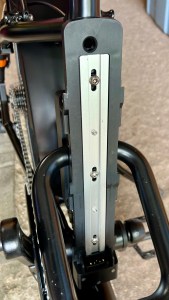
Battery rack
-

-
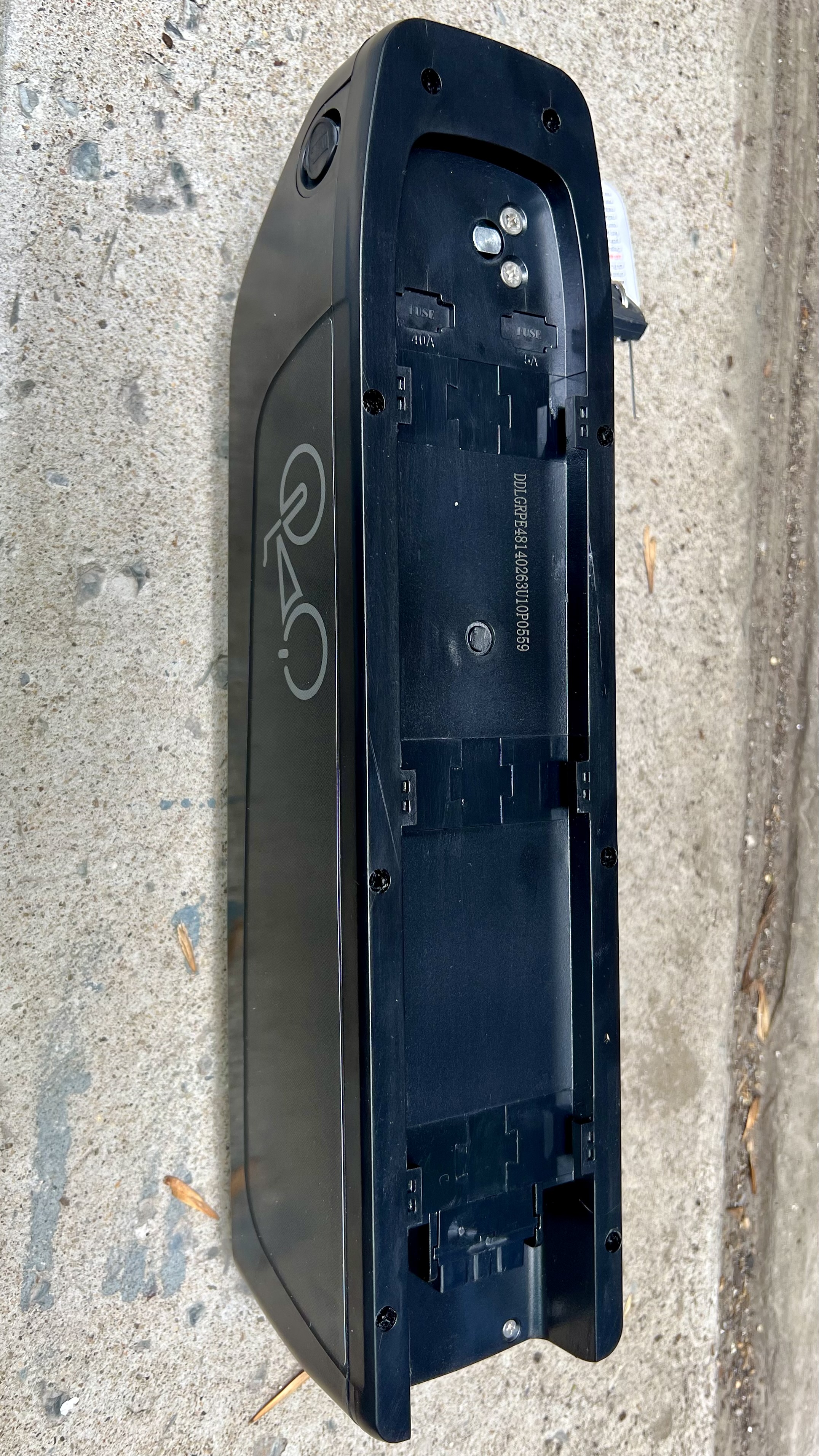
Battery
-

-
Charger
-
-
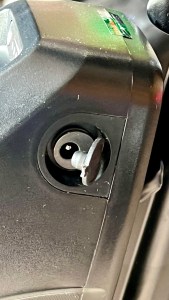
Charging port
-

-
“Ignition”
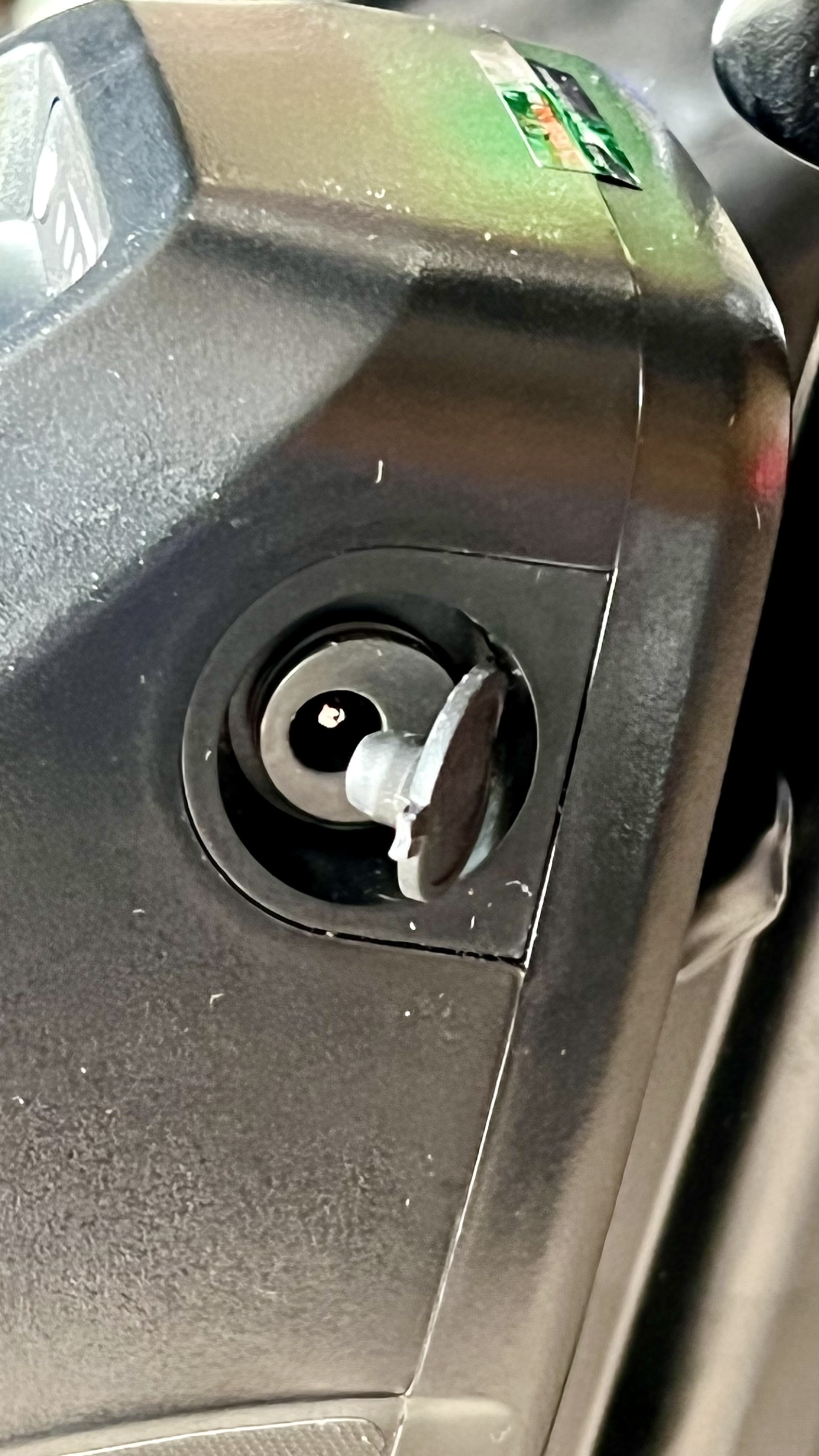
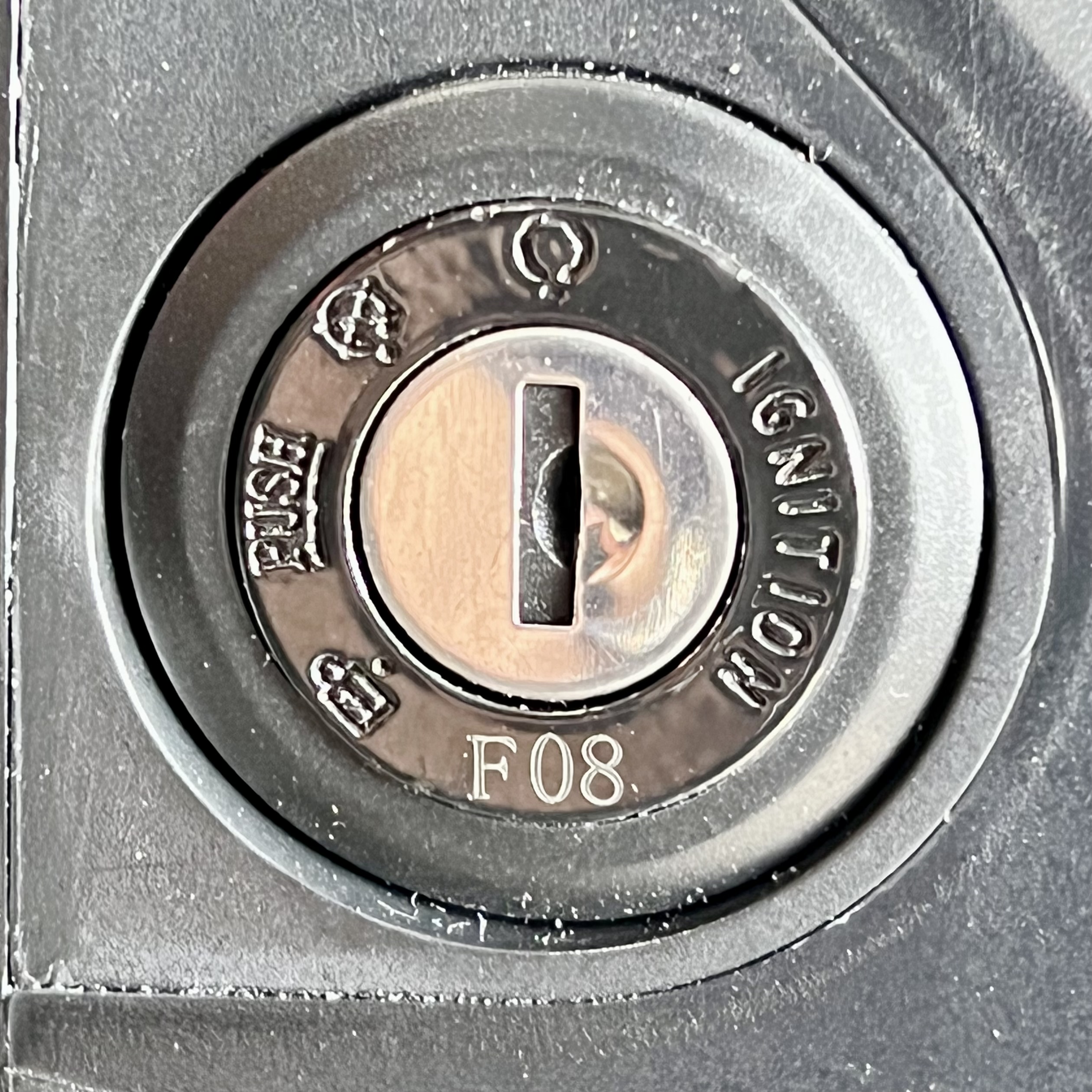
The battery is a 672 Wh Lithium-Ion (3500mAH, 48 v, 14 ah). The 48V / 2 Amp smart charger can operates on 100V-240V AC power outlets and provide a full charge within seven hours. It gives the bike a range of 40 to 72 km per charge (depending on the payload, the riding conditions and the level of assist that is used). From my experience (payload of 100 kg, city roads and park paths with no steep hills, level 3 or 4 assist) I can safely say that it’s rather around 30 to 50 km per charge. The battery is turned on by an “ignition” key (located on the right side, opposite to the charging port) with three positions: power on, power off and unlocked from frame (to remove the battery).

Original display

Replacement LCD display

USB port
The original LED display (left) was offering very little information (power and light on/off as well as battery and assist levels), therefor it is the first accessory that I have upgraded. The replacement display (middle) offers a LCD screen with additional information including Speedometer, Odometer, Trip Odometer, Average Speed, Max Speed, Mode (Eco, Std, Power, Speed — related to the four levels of pedal assist) and Wattage (i.e. 0w with pedal assist 0, 65w with pedal assist 1, 350w with level 3 and 500w with level 4). The battery capacity display is made of five bars (1 flashing: empty, 1: nearly empty, 2: 25%, 3: 50%, 4: 75% and 5: fully charged). It comes with a 3-button Remote and includes a USB plug underneath (to charge a cellphone). There is a little light indicator that appears when the front and tail lights are turned on (by pushing the Arrow Up and Mode buttons simultaneously) and the screen is backlit. That’s even more informations than the Ecolo was displaying!

Chainring

Derailleur

Thumb shifter
The drivetrain is composed of a 170 mm crank set, a 48-tooth steel chainring with a dual-sided plastic guard, a 124 links chain, a 7-Speed MicroShift RD-M26 derailleur (protected with a steel guard) with 14 to 32 tooth freewheel controlled by a Shimano thumb shifter (located on the right side of the handlebar). Since I always ride using higher assist levels and often use the twist throttle, I don’t really need to switch speed often and tend to leave the derailleur in speed 6 or 7. It could be useful though to lower the gear speed if I encounter a steep hill.

Front brake

Rear brake

Flick bell
The front and rear brakes have Tektro Aries mechanical disc with 180mm rotors. The calipers have semi-metallic compound pads that are mechanically operated by pulling four-finger levers located on the handlebar (on the right side for the rear brake and on the left side for the front brake — that’s reverse of what I have on the Ecolo! Those brakes have smaller disks but they are enclosed in a case and therefor less affected by weather conditions). It is not as effective as hydraulic disc brakes but it is still pretty good, cheaper and easier to adjust and maintain. I have noticed that the brakes tend to become loose after a while and need to be adjusted every couple of weeks. On the perks side, the brakes levers have motor inhibitors (a switch that cut off the motor) and pulling them also activate the rear brake light. As a bonus, the left lever has a small flick bell built-in. It is not as good as the electric klaxon of the Ecolo but at least it’s loud enough to signal your presence to cars and pedestrians on the road.

Tail light

Headlight
The RadExpand has a tail light that activate when you turn on the night light and glow brighter when you use the brakes. The back fender has also a reflector (the two small round red light I have added for moonless nights). The LED headlight seems a little small but it 50 LUX focused beam provide enough lighting. There is also a reflector in the front. However, if you want, you can replace the standard headlight with a premium LED Halo headlight which is brighter (500 lumens), offers better visibility from all angles and is rugged. It is expansive for a light ($60) but I am considering it.

Pedal

Kick stand

Fender

Rear rack
Contrary to the Ecolo, the RadExpand has plastic pedals that doesn’t fold — probably a cost-cutting mesure but it can be easily remedied by purchasing sturdier pedals online. I’ll wait until those wear down before replacing them with better ones. Other included accessories (that are not available on all Rad Power Bikes, so having them on the RadExpand is quite a bonus) are a rear side-mounted kickstand with adjustable lean angle, full coverage (110mm width) plastic front and rear fenders and an integrated rear rack with a 27 kg carrying capacity. The latter made me pretty happy since the Ecolo dearly lacks a rear rack.

Frame locking mechanism

Frame stand

Stem riser latch

Folded !
The most convenient and amazing characteristic of the RadExpand is that it can be folded. The frame locking mechanism is located on the right side, just forwards of the pedals. To open it you unlatch the locking lever, pull the quick-release lever out toward the back of the bike and unhook the back of the locking lever. You can then turn the front part of the bike to the left to fold the bike in two until both wheels are side by side. The bike now rests on the frame stand (located under the cranks). You can secure the frame with a velcro strap. Next, to fold the stem riser (shaft of the handlebar), you press forward the button to release the latch down, then move forward the latch bolt to allow the stem riser to fold down and rest against the bike frame. Folded, the size of the bike is reduced to a mere 71 x 61 x 104 cm (and still weight only 28 kg). You can more easily lift and carry it or you can tilt it onto the front wheel in order to roll it carefully. This option is practical for storage or for transportation, as it can more easily be put into the back of a car to go to a repair shop or a more distant biking trails.
The accessories

Mirror & Phone holder

Bottle holder

Comfortable seat

Collapsable milk case
The Ecolo has a lot of accessories that make it a safe and comfortable ride. Unfortunately, the RadExpand doesn’t have many of them. So I tried to customize the bike as much as possible to make it as safe and comfortable as the Ecolo. As I already mentioned, the first accessory that I added was the replacement LCD display ($130) mostly to have an odometer, speedometer and wattage information. The second most important upgrade was adding a rearview mirror ($30). The Ecolo has two but adding just one on the left side was enough to improve safety. I also installed a QuadLock iPhone holder ($95; for using the GPS), a water bottle holder ($25), a more comfortable seat ($30; unfortunately nothing will beat the comfort of the Ecolo’s saddle), and installed a basket on the rear rack. Instead of a full milk case (the only one I had was pink!) I’ve put a collapsible one that I found at Walmart ($15).

Signal light

Signal light

Tool kit & pump

Rad fat tire wheel lock
I have also added turn signal lights that fit at the end of the handles but they are quite disappointing: expansive ($75), not very visible and difficult to turn on and off (by pushing a button on the top of the lights) — nothing like the integrated signal lights of the Ecolo. I have purchased a 529 Shield Garage Bicycle Registration Kit ($15, an anti-theft deterrent), a Tire Patch Repair Kit ($15), some Dry chain lubricant ($25, it smells like banana!), some Loctite Threadlocker ($15, to make sure that screws stayed screwed) and, if the RadExpand comes with a rather complete assembly / repair kit, I’ve decided to add to it a Cordless Tire Pump ($65). More recently I have also installed the Rad Fat Tire Wheel Lock ($90) for an increased security. The total cost of those upgrades: a whooping $625 ! However, security and comfort really has no price…
The maintenance

Taking tube out

Applying patch

Puncture 2

Puncture 3

Velofix

Tannus Armour
The maintenance of the bike is rather easy so I do most of it myself. It is really just to make sure that no bolt or wire connection is loose, that the bike is clean, the tires inflated, the brakes adjusted and the mechanical parts (like the chain and derailleur) are lubricated. For the more complicated stuff, like the assembly of the bike and the yearly check-up, I have called on the expertise of Velofix. They are a little expensive but they come to you in their workshop van, they are very friendly and really know what they are doing, so it is well worth it.
The only “mechanical” problems I have experienced were tire punctures. The first one was with the Ecolo (it was caused by a small shard of glass). I had to have the bike towed to the repair shop and it costed me a bundle. The second one was caused by some sort of industrial staple and, to save money, I decided to take care of it myself. Removing the rear wheel, taking out the tube and gluing a patch was relatively simple. Reinstalling the wheel and threading the chain on the derailleur was a little more complicated (luckily I took pictures of the derailleur before doing the job). It took me nearly two hours but it was 30ºC that day, so I sweat a lot !!!
However, Montreal’s bike paths are really dirty. After a third flat (caused again by a very small shard of glass), I’ve decided to have Velofix install the Tannus Armour Bundle inside my tires. Hopefully it will do the trick and protect against tire puncture in the future. Rad Power are describing the RadExpand tires as having “puncture-resistant liner” but that’s definitely not true if a 3 mm shard of glass can puncture the tube ! It was again a very expensive ordeal ($185 for the Tannus Armour plus $35 for the installation). I chose to have Velofix performed at the same time an annual check-up ($170, plus the brake pads needed replacement for another $30). So, (with taxes) it costed another $475. Hopefully it will give me some peace of mind and there will be no more trouble for a while.
The experience
 The RadExpand lack of suspension (unlike the Ecolo) make the ride bumpy and a little hard on the butt. The Ecolo runs much more smoothly (mostly because it is lower, has a suspension, excellent brakes and a more confortable seat). However, the RadExpand might give a rougher ride and its brakes might needs constant adjustments but it seems much more powerful (both have 500 w motor but the Ecolo is quite heavier…).
It took a while to get used to it but now I really like it. It gets me where I need to be and allows me to make some exercise at the same time. It is comfortable enough and more flexible than the Ecolo so I can go where-ever I want knowing I won’t get stuck in case of trouble and therefor I feel safe. For now, I use it mostly to go back and forth to work (a 15 km ride) and to run some errands to the library, the pharmacy, etc. Hopefully, I’ll eventually take the time to go for longer, sightseeing rides. I am very satisfied with my RadExpand and I strongly recommend it to anyone who is considering buying an electric bike. 
Now, I guess I am ready to get rid of the Ecolo. I could sell it for half the price I paid for it (I would accept a $1000). It would make room in the garage…Although I still like it and it can still be useful when there’s a problem with the RadExpand (like a flat) so I can still have a ride to go to work… We’ll see.
Additional note: On various Facebook groups many people have complained about the after sale service of Rad Power Bikes. I must say that it has not been my experience. I suppose it is a medium size company with limited resources and that’s probably why they are VERY slow to answer enquiries (and sometimes to deliver orders). For more informations and to seek advices from fellow bike owners I recommend checking the various Rad Power Bikes Facebook groups like Rad Power Bikes Québec, RadExpand Owners Group or Rad Power Bikes Canada. It is also worth mentioning that there is a store in Coaticook, Vélo Tric, that rent and sell Rad Power Bikes and they might also do repair and maintenance (although they are not officially recognized by Rad Power which may cause problem with the warranty).
Next step: a tricycle ?
When you are a kid your first ride is a tricycle. And when you get old and realize your coordination is not as good as it was, your last ride is a tricycle. So I am starting to look into acquiring one. I am not ready to stop riding the RadExpand just yet (I’m only in my sixties) but maybe my wife or my sister could use it first…
I don’t want a three-wheel or four-wheel mobility scooter because, like any scooter (or the Ecolo), it’s cumbersome and lacks flexibility. I would like a simple tricycle that just happened to be electric. I found a local company, E.T. Ride (located south shore of Montreal), that is producing several models of tricycles: they have a Classic model ($1500), an Hybrid model ($2000) and an All-Terrain (fat-bike, $2700). That’s interesting…
However, I recently discovered that Rad Power Bike is also producing an electric tricycle, the RadTrike. It is practical (as it can carry a good amount of cargo), comfortable, stable, safe and, above all, it looks really cool but it is rather expensive ($2,499 US). Unfortunately, it is available only on their U.S. website (although they do seem to ship to Canada). Definitely something to consider for the future.
No matter how old you are, there’s always a ride for you!
Update (2024/03/24):
Il have recently acquired a few more accessories to make the ride more confortable.
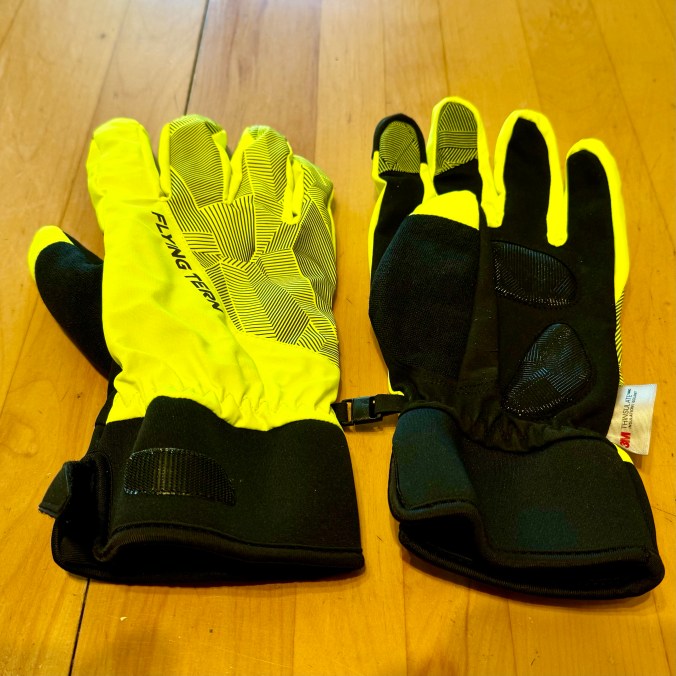
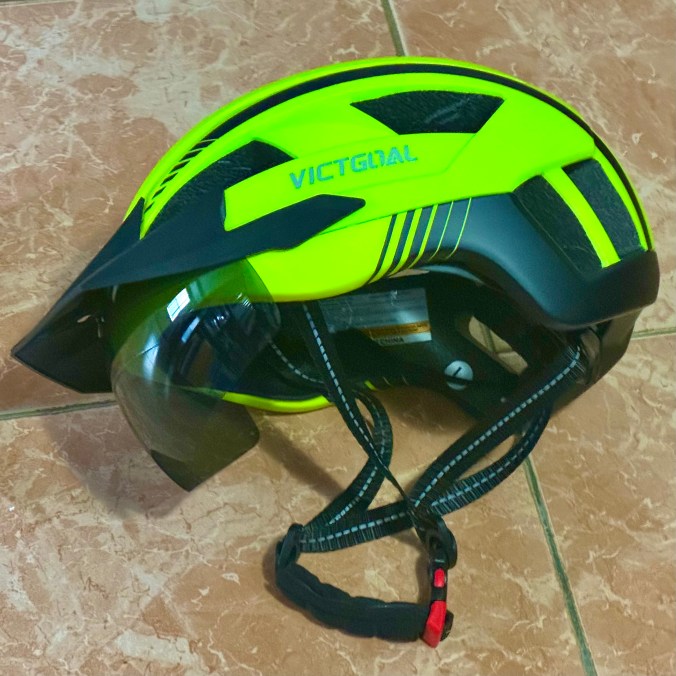
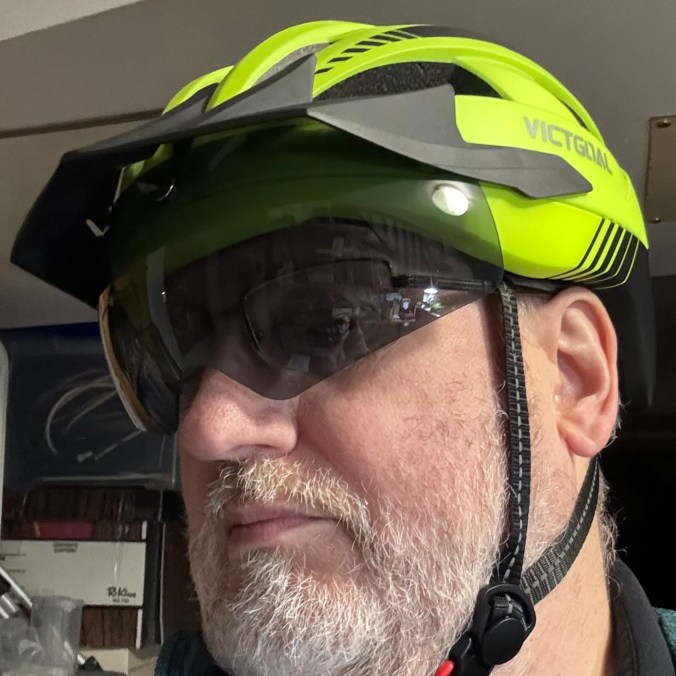
First, I purchased a new pair of gloves ($16) to keep my hands warmer in the late fall and early spring. Also a new helmet ($57) that is lighter, more suitable for a bicycle and with a visor that protect my eyes from the sun or the cold wind.
Second, I have decided to change the collapsible milk box with the new RadPower Hardshell Locking Box ($200) that allows me to leave all my stuff (pump, tools, raincoat, lock, etc.) securely on the bike. I had to install the extender rack in order to clear the seat (if not it was nearly impossible to open the box) but it was easy and straightforward to do. I have also added on the box some yellow fluorescent reflective tape ($16) to increase the visibility of the bike. I am quite satisfied with final result:

The next purchase I’ll consider is the Rad Trailer ($300 US, which is available only on the American website). That would be quite useful to go shopping. I’ve seen that someone had made a custom sidecar — which would be cool to ride with my wife but I don’t think it would be legal here and that sidecar was made to carry a dog not a wife (and it’s quite expensive).
Update (2024/10/14):
The government is making it difficult for those ridding electric scooters with the publication of the “ministerial decree 2024-15”. I wrote a commentary about this ministerial decree.
Another accessory that I will be considering purchasing soon (next biking season?) is the new Safe Shield™ Advanced External Battery ($799). It is a 14.4-15Ah / 680-720 Wh lithium battery that offers increased security due to its thermal-resistant technology and a slightly longer range (about 7% more). After two years and half with the RadExpand, the battery seems to have lost some of its capacity. It rather annoying because it’s an expensive purchase (it’s half the price of the bike !) but it would it would give a renewed energy to the bike and some peace of mind to me.
Another notable news is the fact that there’s two bike stores in Montreal that are officially recognized by RadPower as repair shop: Campus CycloChrome on Duluth East and Repair and Run on Saint-Denis. I went to the latter in early September to have the break pads replaced ($100 + tx) and I was quite satisfied with the job (considering it was replaced on the spot without an appointment). It’s good to have more choices than just VeloFix for maintenance and repair.
[Tag:
eBike ] [
Traduire ]










![Bourgeon de pommier [2023/04/09] / Apple Tree bud](https://i0.wp.com/clodjee-blog.com/wp-content/uploads/2023/04/img_3739.jpeg?ssl=1 "IMG_3739")
![Crocus [2023/04/01]](https://i0.wp.com/clodjee-blog.com/wp-content/uploads/2023/04/img_3718.jpeg?ssl=1 "IMG_3718")
![Tussilages [2023/04/09] / Tussilago](https://i0.wp.com/clodjee-blog.com/wp-content/uploads/2023/04/img_3750.jpeg?ssl=1 "IMG_3750")
![Jonquille [2023/04/21] / Daffodyl](https://i0.wp.com/clodjee-blog.com/wp-content/uploads/2023/04/img_3777.jpeg?ssl=1 "IMG_3777")


 Clodjee's Safe-House